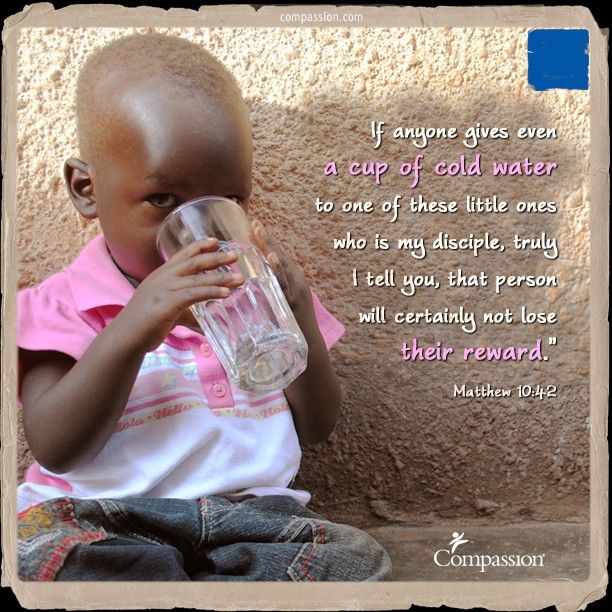
Praise the Lord Saints!! Praise the Lord!! How are you doing today? Fine, I hope. I would like to say that Matthew 10:42 says: If anyone gives even a cup of cold water to one of these little ones who is my disciple, truly I tell you, that person will certainly not lose their reward. This Bible verse talks about compassion. I am saying this because, it is the truth! Matthew 10:42 means that we all supposed to help those who are not able to help themselves.
For example, if I see someone who is homeless, and begging for money, I usually buy them some food to eat. In some cases, I would give that person a one-dollar bill. I have helped many people who were in need. Like they say, the Lord helps those who help others.
Next, humility comes into play here because one hand helps another. What is the definition of the word compassion? Compassion is to recognize the suffering of others and then act to help. Compassion embodies a tangible expression of love for those who are suffering. Compassion alludes to kindness and sympathy, but there is something deeper, something even more profoundly powerful, in its meaning. … They speak of a God who has compassion for Israel. They tell of a Savior who suffers for the world, and they ask us to live and act compassionately.
Also, when it comes to helping another person, there are times when you will not get paid or a favor in return. God has been helping me in this area because I used to be a type of person who would receive help from others without returning a favor. Right Now, my heart is in the right place because I am able to ask someone for assistance, and then return a favor. God has really changed my heart for the better. I am a very compassionate person. I have a lot of common sense. I am very intelligent, calm, kind, bold, brave, and honest. I am a very open person.
Moreover, I want everyone to know that God has changed me for the rest of my life. This is simply because, I used to use other people myself. I used to spend all of my money on female harlots. I have spent a considerable amount of money on females from 6/24/1986 to July 3, 2010.
One thing that I can say about myself is that I used to pay all of my rent and utilities inside of my apartments. Afterwards, I used to walk the streets all night long. I used to look at females as if they were sex objects. I am very happy that God has changed my entire heart for the better. I am a whole lot responsible right now. I have to give credit to my mother, grandmothers, aunts, and uncles for taking me to church all of the time. My family members and friends helped me to change my attitude.
What It Looks Like to Have the “Faith of a Mustard Seed”
Bethany Verrett202124 Mar
When looking at the cornerstones of the Christian life, some tenets include prayer and worship, but the key one is faith. Putting our trust in God, that He will take care of the future, provide for needs, and provide for salvation. Jesus spoke about the power of faith several times in His teachings and used multiple metaphors to explain what faith is and how important it is.null
One of the most powerful is that faith can be like a mustard seed. Jesus said to those struggling with belief, “Because of the littleness of your faith; for truly I say to you, if you have faith the size of a mustard seed, you will say to this mountain, ‘Move from here to there,’ and it will move; and nothing will be impossible to you” (Matthew 17:20b).
God wants to work with His people, but will not force them to become instruments of His will like puppets; instead He works through them based on their faith, challenging believers to a deeper relationship with Him.
What Is the Context of This Verse?
The mustard seed comparison appears several times in the Gospels, usually as a metaphor for the Kingdom of God. In this instance in Matthew 17, however, the Lord uses it to discuss faith with his disciples.
A man had a son possessed by a demon that gave the child seizures, forcing him to often fall into water and fire. Jesus’ disciples tried and failed to exorcise the demon, but He succeeded with one rebuke. When the disciples asked why they failed, Jesus uses the mustard seed analogy to explain: “Because of your little faith. For truly I say to you, if you have faith like a grain of mustard seed … nothing will be impossible for you” (Matthew 17:20). Jesus wanted to highlight that it does not take much faith for God to work in a person, but the disciples needed to believe.
It can be inferred they were trying to exorcise the demon because the father asked, and because they saw Jesus do it, but lacked the faith in God to actually expel it. This trait in believers is not just true of the disciples back then, but through the centuries. It is easy to believe that Jesus could do great things, but difficult to believe He can use us to do even small things.null
The mustard seed would have been a common enough plant in that culture; they would be able to picture it without reference. Classified as an evergreen, the Salvadora perisica can grow to twenty feet wide and tall. They can thrive in environments typically hostile to plants. Their seeds are very small, but they grow large.
The mustard seed in Jesus’ example symbolizes the potential in faith. When a believer begins their journey, they have just begun to learn about how much God loves them, how much He wants to do for them, and all that He has for them. God wants to work with these believers to bring others to Himself, and to build His kingdom; “Truly, truly, I say to you, whoever believes in me will also do the works that I do; and greater works than these will he do, because I am going to the Father” (John 14:12). By following God’s plan, Christians will do great things for Him, even with the small faith they have at the beginning of their walk.
Of course, the truth about a seed is that it does not remain a seed. It eventually germinates, where the seedling breaks out of the shell, and grows into a full-sized plant. Mustard trees are huge, despite the size of their seeds. Faith cannot remain static or the same in order to have a deeper relationship with the Lord. The things people will do for God, and their courage they do it with, is correlated with the amount of faith present. If someone has faith that God saved their sins, but that God cannot heal an illness, they have a smaller amount of faith than someone who does. The courage to share faith in dangerous settings, or to be martyred for it takes a lot of faith. James even wrote, “faith without works is dead” (James 2:26b). Faith must grow, and be tested, and be acted upon with good deeds and evangelism. https://f578172ae48a75c18d62ed324b46e98e.safeframe.googlesyndication.com/safeframe/1-0-38/html/container.html
Does It Matter How Much or Little Faith We Have?
If Jesus is saying faith as small as a mustard seed is all it takes, then is that all that’s needed? Can one have just a little faith?
Putting one’s faith in Jesus Christ is an important step. In the same chapter where Jesus tells the parable of the mustard seed, the people in his hometown reject Him, and lacked faith. The Bible says, “And [Jesus] did not do many mighty works there, because of their unbelief” (Matthew 13:58). It was not just in Nazareth where Jesus would not work great miracles because of a lack of faith. He declared, “Woe to you, Chorazin! Woe to you, Bethsaida! For if the mighty works one in you had been done in Tyre and Sidon, they would have repented long ago in sackcloth and ashes” (Matthew 11:21).
In Mark 8:22-26, an account of Jesus healing a blind man in Bethsaida recounts that Jesus took the blind man out of the town before He healed him, and ordered the man, “Do not even enter the village” (Mark 8:26b). The people of Nazareth, Chorazin, and Bethsaida had so little faith that nothing Jesus could have done would have led them to repent. There are still people like that today.
The level of faith one has can also impact how God can bless individual Christians. In the Book of James, the writer stated, “You desire and do not have, so you murder. You cover and cannot obtain, so you fight and quarrel. You do not have because you do not ask” (James 4:2). Believers in James’ time were fighting amongst one another because they lacked, but they did not have the faith to go to God and ask. This statement does not mean that one can have anything, or that ‘name it and claim it’ philosophy is true, but that it is important to rely on God, and ask Him for the things needed.https://f578172ae48a75c18d62ed324b46e98e.safeframe.googlesyndication.com/safeframe/1-0-38/html/container.html
Without faith, the Christian life is inhibited, and lacking the fullness that God wants to bestow upon those who love Him.
The importance of faith is as crucial today as it was when Christ walked the earth 2,000 years ago. Jesus gave a commission to His followers as He ascended into Heaven, a command to follow until He returns, “Go therefore and make disciples of all nations, baptizing them in the name of the Father and of the Son and of the Holy Spirit, teaching them to observe all that I have commanded you. And behold, I am with you always, to the end of the age” (Matthew 28:19-20).
Once the seed of faith has been planted in someone’s heart and they are saved, the next steps of faith are to learn more about this new relationship, and obey this commission.
Faith can be difficult, which is why it seems that in some moments in life it can be easy to have great faith, but at others, almost none. When pursuing a relationship with God, growing that faith regularly can empower the believer to know their Savior better, and obey Him fully.
Sources
Balfour, John Hutton. The Plants of the BibleTrees and Shrubs. London: T. Nelson and Sons, 1857.
Frost, John. Remarks on the Mustard Tree Mentioned in the New Testament. London: Henry Fisher, Son, and Co., 1827.
Wilmington, H.L. Wilmington’s Guide to the Bible. Wheaton: Tyndale House Publishers, 1981.
Wright, Tom. Small Faith, Great God. e-book, 2012. null
Bethany Verrett is a freelance writer and editor. She maintains a faith and lifestyle blog graceandgrowing.com, where she muses about the Lord, life, culture, and ministry.
This article is part of our larger resource library of popular Bible verse phrases and quotes. We want to provide easy to read articles that answer your questions about the meaning, origin, and history of specific verses within Scripture’s context. It is our hope that these will help you better understand the meaning and purpose of God’s Word in relation to your life today.
Have you ever wondered why we call Good Friday “Good”? After all, the date commemorates the brutal torture and execution of our Lord and Savior. Why would anyone call that good?null
As one of the most important—and difficult to stomach—holidays in the Christian calendar, Good Friday reminds us about our desperate need for a Savior, and the incredible outpouring of his love and obedience, to even death on a cross (Philippians 2:8).
In this article, we’ll analyze the nature and history of Good Friday, talk about why we call this holiday good, and when Good Friday will take place this year.
Get your FREE Holy Week Guide here. Have encouragement delivered straight to your inbox!
What Is the Meaning of Good Friday?
For those not familiar with Good Friday, this day remembers when more than 2000 years ago Jesus Christ died for the sins of the world. The events kicked off at the beginning of Holy Week when Jesus rode into Jerusalem. Mid-week, Judas Iscariot, one of Jesus’ followers, agreed to betray him to the temple leaders. Jesus had been making, in the eyes of the religious leaders, uncomfortable claims about being God (John 8:48-59). They saw this as blasphemy and wanted to put him to death for it.
After Jesus shared a Last Supper with his disciples, he prays in the Garden of Gethsemane (Matthew 26:36-56). There, Judas leads a mob to arrest Jesus. Jesus stands trial late in the night—certainly not the proper legal practice. False witnesses can’t seem to get their story straight (Luke 22). Nevertheless, Jesus is tortured and presented to the Jewish people. They call for his death (Luke 23:21).
Jesus is sentenced to die via crucifixion, a Roman punishment reserved for criminals (most often, insurrectionists). He is nailed to the cross on Golgotha, where those who travel via the road nearby jeer at him (Luke 23). Jesus cries out seven times, and then he gives up his spirit. He perishes.null
After a stab wound from a Roman soldier (John 19:32-34) confirms his death, Jesus is taken down from the cross. And Joseph of Arimathea has Jesus’ body prepared for a tomb (Matthew 27:57).
The meaning of Good Friday marks the death of our Lord Jesus Christ. Though he lived a perfect, unblemished life, he dies for the sins of mankind. So that, through his Resurrection on Easter Sunday, that we may have a way of salvation through him (John 3:16).
All four Gospel accounts contain entire chapters dedicated to Christ’s trial, crucifixion, burial, and resurrection. We don’t have enough time to dive into every verse and passage. However, I will include a portion of each Gospel account below.
Matthew 27:11-14: “Now Jesus was standing before Pilate, the Roman governor. “Are you the king of the Jews?” the governor asked him. Jesus replied,“You have said it.” But when the leading priests and the elders made their accusations against him, Jesus remained silent.“Don’t you hear all these charges they are bringing against you?” Pilate demanded.But Jesus made no response to any of the charges, much to the governor’s surprise.”
Mark 15:6-15: “Now it was the custom at the festival to release a prisoner whom the people requested.A man called Barabbas was in prison with the insurrectionists who had committed murder in the uprising.The crowd came up and asked Pilate to do for them what he usually did.“Do you want me to release to you the king of the Jews?”asked Pilate, knowing it was out of self-interest that the chief priests had handed Jesus over to him.But the chief priests stirred up the crowd to have Pilate release Barabbasinstead.“What shall I do, then, with the one you call the king of the Jews?” Pilate asked them.“Crucify him!” they shouted.“Why? What crime has he committed?” asked Pilate.But they shouted all the louder, “Crucify him!”Wanting to satisfy the crowd, Pilate released Barabbas to them. He had Jesus flogged,and handed him over to be crucified.”null
Luke 23:32-38: “Two other men, both criminals, were also led out with him to be executed. When they came to the place called the Skull, they crucified him there, along with the criminals—one on his right, the other on his left. Jesus said, “Father, forgive them, for they do not know what they are doing.” And they divided up his clothes by casting lots. The people stood watching, and the rulers even sneered at him. They said, “He saved others; let him save himself if he is God’s Messiah, the Chosen One.”The soldiers also came up and mocked him. They offered him wine vinegar and said, “If you are the king of the Jews, save yourself.”There was a written notice above him, which read: THIS IS THE KING OF THE JEWS”
John 19:28-30: “Later, knowing that everything had now been finished, and so that Scripture would be fulfilled, Jesus said, “I am thirsty.” A jar of wine vinegar was there, so they soaked a sponge in it, put the sponge on a stalk of the hyssop plant, and lifted it to Jesus’ lips. When he had received the drink, Jesus said, “It is finished.” With that, he bowed his head and gave up his spirit.”
Why Is Good Friday Called “Good”?
These are incredibly difficult passages to read, let alone to have been alive to witness these events. So why would we call Good Friday “good” when Jesus experienced such horrible pain and agony?
According to Christianity.com, some Christians do call Good Friday “Sorrowful Friday” as a somber reminder of the events. But what about the rest of the church?null
We call Good Friday good for a number of reasons. First, we remember that Good Friday did not end on that Friday. We had Resurrection Sunday a few days later to look forward to. It is good in the sense that we anticipate what would come to pass days later.
Secondly, we call Good Friday good because we cannot have the Good News of the Gospel without the bad news of sin first. Good Friday helps us to realize the gravity of our sinful nature and how much we need a Savior. People don’t need good news unless they’ve endured something bad before.
When Is Good Friday This Year?
Good Friday always occurs right before Easter Sunday, but the specific day of Good Friday shifts each year. For 2021, Good Friday occurs on April 2, 2021. We’ve included the upcoming dates for the next few years as well.
April 15, 2022
April 7, 2023
March 29, 2024
April 18, 2025
April 3, 2026
A Prayer for Good Friday
Jesus, I stand amazed at what you had done for me on that Good Friday. That you, Lord of all Creation, would live a perfect life and pay the ultimate penalty for my sins. I cannot thank you enough and want to submit myself to you and your will every day. Thank you that Good Friday didn’t end on that Friday, but that we had the glorious Good News of that Resurrection Sunday. Amen.
Hope Bolinger is an editor at Salem, literary agent at C.Y.L.E., and a graduate of Taylor University’s professional writing program. More than 1,000 of her works have been featured in various publications ranging from Writer’s Digest to Keys for Kids. She has worked for various publishing companies, magazines, newspapers, and literary agencies and has edited the work of authors such as Jerry B. Jenkins and Michelle Medlock Adams. Her modern-day Daniel trilogy released its first two installments with IlluminateYA, and the final one, Vision, releases in August of 2021. She is also the co-author of the Dear Hero duology, which was published by INtense Publications. And her inspirational adult romance Picture Imperfect releases in October of 2021. Find out more about her at her website.
◄ What Does Lamentations 3:24 Mean? ► “The LORD is my portion,” says my soul, “Therefore I have hope in Him.”
Lamentations 3:24(NASB)
Verse Thoughts It must have been devastating for the prophet Jeremiah to witness the fall of Jerusalem, the enslavement of his people, and the destruction of the holy Temple of God. He knew that the reason for this painful period in Israel’s problematic history, was due to the gross sin and spiritual adultery of God’s chosen people.
Here, we witness Jeremiah mourning for both the downfall of the city of Jerusalem and the shocking sinfulness of the nation. In his book of deep lamentation, he pens five distinct dirges that rehearse the reason for Israel’s calamity. But we also discover him offering reproof, instruction, direction in righteousness, and hope for the future to those that survived the city’s devastating destruction.
And so we discover that the weight of his sorrow and the traumatic grief that hung so heavily on the heart of this weeping prophet, was interspersed with echoes of hope and whispers of God’s amazing love and grace.
Over many centuries of their history, the Lord had proved Himself to be faithful to the erring children of Israel. Jeremiah had witnessed God’s long-suffering mercy, but also understood that God is both righteous and just… and must therefore, punish evil. And so, in the midst of all the trauma and pain, Jeremiah is able to declare, “the LORD is my portion.. therefore, I have hope in Him.”
From the inner depths of his very being, Jeremiah was able to proclaim that Jehovah was his Heritage. God was his Portion, and the Lord was his Helper. And so, despite the terrible circumstances through which he was going, Jeremiah chose to place his hope and his trust in God. He decided to wait expectantly for Him to direct and govern his future – and that of the faithful remnant of Israel.
Despite the inner turmoil that grieved his soul and the outer destruction he witnessed with his own eyes, this man was able to stand firm on his hope in God – knowing that His mercies are new every morning, for the Lord is a faithful God and true to His Word – and the same holds true today.
As we see the systematic destruction of sound doctrine in Christianity today, as apostate teachers and false prophets infiltrate the churches of Christendom and seek to destroy the very foundation of our faith… and as we watch the shocking inhumanity of man towards his fellows, and the unbelievable corruption that floods the corridors of government – our hearts also grieve.. as we witness this painful period in our own problematic history.
But like Jeremiah, we know in Whom we have believed and are persuaded that He is able to keep us and all that we have committed to Him. No matter what we may be called upon to suffer in this transitory life, we KNOW that God is faithful and will not suffer us to be tempted above that which we are able to bear, but will make a way of escape so that we may be able to bear it.
God is indeed faithful to His Word which cannot be broken… and so with the grieving Jeremiah, we too can trace the rainbow through the rain and proclaim, “The Lord is my portion – therefore I have hope in Him.”
My Prayer Heavenly Father, there are times when it seems that I am alone as I face life’s difficulties, mourn over the spiritual decline that is overtaking the Church today, and grieve to see the shocking evil that is saturating the world. Thank You Lord that I am not alone, but am one of a remnant of believers who desires to do Your will. Thank You that Your mercies are new every morning and that You are building up Your church to Your praise and glory. In Jesus’ name I pray, AMEN.
◄ Previous: Lamentations 3:23 Next: Lamentations 3:25 ► Choose a Verse from Lamentations 3 123456789101112131415161718192021222324252627282930313233343536373839404142434445464748495051525354555657585960616263646566
Acts 9:1
Hebrews 3:4
Psalm 125:1
Romans 2:14 Follow us
Lamentations 3:24 Further Study Lamentations 3:24 in the Parallel Bible Lamentations 3:24 in the Thematic Bible Lamentations 3:24 Cross References Lamentations 3:24 Treasury of Scripture Knowing Lamentations 3:24 Sermons Lamentations 3:24 Prayers Lamentations 3:24 Images Choose Chapter Subscribe to the Verse of the day
I’m hoping you’re reading this because you’re wondering too why life sometimes brings us to our knees, or flat on our faces. Maybe you’re curious if this is the only way to “reach” God. Or doubtful as to whether a certain protocol of kneeling, standing, or sitting (or any ritual) is God’s desire.null
I wanted to dig into the question, “why do we kneel in prayer?” because I don’t know.
Rather, I seek.
And most of all, I want to encourage readers that Jesus didn’t come exclusively for the upper echelon who knew all the steps and rules. He’s looking for us to long for his love and grace. He’s finding those who might not be “doing it right” but are precious in his sight, anyway.
“For the Son of Man came to seek and to save the lost” (Luke 19:10).
I come to this topic with the belief that God doesn’t even require knees to be in relationship with us. That said, kneeling is still a beautiful choice, as it can stir us toward his presence.
I won’t make a case for kneeling as a prerequisite for redemption, but let’s explore why it’s wonderful, whether it’s required, and interesting places kneeling is mentioned in the Bible.
Why Do We Kneel in Prayer?
Author Brooke Cooney suggests that kneeling in prayer is an act of humility, reflecting obedience to what is best for us. Kneeling isn’t the easiest action. It takes effort and requires a surrendering of our selves. In a way, it releases our limited strength into a more receptive pose, one that seeks to stand on God’s strength, not our own.
Cooney suggests that if we stand on our own merit, we succumb to a brokenness of spirit. And yes, feeling broken will often drive us to our knees in prayer. But the confession when we’re willing to kneel in prayer is, “you alone, God, are able.”
Always standing tall, if we’re thinking it’s all about looking strong, surrenders us captive to our brokenness. It can serve a façade rather than help us seek God.null
Not only does kneeling to pray elicit a physical sense of humbling, it also communicates a reverence for the One to whom we pray. It demonstrates need, and a choice to be halted and healed.
Then Paul continues: “For this reason I kneel before the Father” (Ephesians 3:14).
This is just before Paul’s famous exposé on being so rooted and established that you actually grasp the width, length, height, and depth of Christ’s love. It’s a blown-away, knocked-off-my-feet action. It’s one way to show that when you speak with God you are in the presence of incomparable, immeasurable divinity.
God won’t turn away if you don’t kneel, but we have the freedom and the confidence to approach him this way.
Hannah prayed standing in 1 Samuel 1:26and the Lord answered her. Even Job was standing while crying in prayer (Job 30:20). In Psalm 4:4 and Psalm 63:6, people pray while lying in bed.
And in a compelling example of going prostrate to pray, Jesus falls face down before the Father in the Garden of Gethsemane:
“Going a little farther, he fell to the ground and prayed that if possible the hour might pass from him” (Mark 14:35).
We’re invited to pray continually (1 Thes. 5:17) to stay connected with God’s power. There’s no exclusive prayer-position commanded. null
What Does the Bible Say about Kneeling to God?
Whether or not you kneel in your prayer time these days, or find yourself wondering if your prayers are ever heard, it’s comforting to know that the Bible assures us: one day every knee shall bow. This truth repeats in the Old and New Testaments, like a thread pulling us forward in hope.
This idea of kneeling or bowing down is carried through God’s love story because when promises this awesome prove true, it can knock our feet out from under us—in the best possible way.
His revelation that the entirety of all creation will be bowing down means that there won’t be any need for our false props of self-righteous earning, or performing our way into his gift of grace and eternal life. It will be okay to ‘lose it’ and fall down on our knees in joy and honor of the One who brought us through.
He is the Lord. There is no other.
God warns us not to worship, bow down, or kneel in reverence to other gods or false idols. In the end, he will reveal his authority over them all.null
“You shall not bow down to their gods nor serve them, nor do as they do, but you shall utterly overthrow them and break their pillars in pieces” (Exodus 23:24).
The purpose of sending his Son and the mercy he offers, is to free us from bondage to idols, distractions, sins, or choices that deceive or endanger us. Choosing to pray in the name of Jesus as the way, truth, and life stays in step with a beautiful plan:
“So that at the name of Jesus every knee should bow, in heaven and on earth and under the earth…” (Philippians 2:10).
In an iBelieve.com article, author Meg Bucher shares 20 verses that encourage an attitude of the heart toward praying. Praying, as our lifeline to God, doesn’t require kneeling. But oftentimes kneeling can adjust the heart.
And remember, when you can’t find the words, you can pray God’s word to him, or rely on the Holy Spirit to intercede for you. In fact, our prayers can be raw, casual, and the only words we can cobble together.
Author Betsy DeCruz offers comfort that you don’t have to pray just right for God to listen. God hears every prayer, fancy or not. Sometimes we can only pray, “God help me,” or “Be with me.”
Kneeling to pray is a way of speaking to yourself first, that you want to submit in obedience to the only authority that is good. But praying is the goal. Approaching the gift of prayer as our tether to God’s guidance in our lives.
You don’t have to prepare or posture. Just pray.
The Bible makes it evident that prayer is a two-way relationship with God. Sometimes we’re utterly destitute, wordless even, or overcome. Other times we may stand in the presence of our King.null
To pray, you can kneel, stand, lie prostrate, jump for joy. You can pray in any position at any time. The point is to position your heart. Whether on your knees or not.
But because kneeling can serve to portray surrender, it’s a lovely way to remind ourselves that God is available when we surrender our hearts in prayer.
“This is the confidence we have in approaching God; that if we ask anything according to his will, he hears us” (1 John 5:14).
◄ What Does 2 Corinthians 10:4 Mean? ► for the weapons of our warfare are not of the flesh, but divinely powerful for the destruction of fortresses.
2 Corinthians 10:4(NASB)
Verse Thoughts Our adversary, the devil, roams about like a roaring lion seeking whom he may devour, and there was much evidence of the enemy’s meddlesome wiles in the lives of many of the Corinthian Christians – for he seemed to have infiltrated every area of their everyday lives and spiritual walks.
They had abused the gifts of the Spirit for personal promotion. They engaged in divisive arguments and petty quarrels. They backslid into spiritual infancy and engaged in the carnal ways of the world. They condoned ungodly practices in their midst… and even overlooked the gross, sexual sin of one of their members. Members in this church fellowship had forgotten that their bodies were a temple of the living God.
Paul had to chastise these Christians for their inappropriate behaviour and lack of spiritual growth, and his admonishment of their carnality can be traced throughout his first epistle to the Corinthians. But in this second letter, we discover that these believers had repented of their worldly ways which enabled Paul to give some important spiritual teaching that would help their spiritual understanding and influence their spiritual growth, “the weapons of our warfare are not of the flesh,” Paul explained. Our weapons not material weapons but are spiritual weapons. “The weapons of Christian warfare are divinely powerful for the destruction of fortresses.”
Paul explained that in this Church age, we do not use conventional weapons of war – we do not use carnal weapons because we are in a spiritual battle and require spiritual weapons. We have weapons that are far greater than the steel sword or the mighty cannon. We do not use armoured tanks or missile warheads. We have the truth of God’s Word which can bring down any philosophical argument or worldly wisdom.
We should not be tempted to use the same, human tactics to fight against satanic deceit or the world’s manipulative practices. We are to use the spiritual weapons that God has proved for all his children. We have the belt of truth, the breastplate of righteousness, and the glorious gospel of peace to counter the attacks of the enemy. We have the shield of faith, the helmet of salvation, and the sword of the Spirit to ward off all evil advances – and we have the wonderful weapon of prayer – praying ALWAYS with all prayer and supplication – in the spirit, to rout the enemy’s attacks.
We are to clothe ourselves in Christ, for through Him we have the ability to cast down men’s high-minded murmuring against God… to lay waste the imagination of man, and put to naught everything that exalts itself against the knowledge of the truth. In Christ, we have the sufficient grace and spiritual strength to bring down high-minded babblings that have been raised up against the knowledge of the truth – as we take every thought captive to the obedience of Christ.
But what are these weapons of the enemy that we are equipped to demolish? What are the strongholds that our spiritual weapons can destroy through Christ Jesus our Lord? Well, they are worldly words and foolish, intellectual augments of sinful man. They are personal influence, tortuous philosophies, stylistic verbiage, deceptive schemes, and the long-winded opinions of men with their impressive credentials and dismissive policies – that seek to annihilate the truth of the gospel of God. BUT the weapons of our warfare are not carnal and fleshly, but mighty through God to the pulling down of such arguments and strongholds.
The weapons of our divinely inspired, spiritual warfare… is the proclamation of the Word of God, together with a submissive heart and a bended knee. Our power does not come from our own clever conversation or witty words, but is evidenced in the man or woman who lives in full dependence upon God… and relies on Him for His sufficient strength and godly wisdom – to guide them through life towards their spiritual home.
May we be ready to counter all the foolish thoughts and false perceptions of fallen man who seeks to contradict the truth of the knowledge of the gospel of God. May we be ready to give an answer to every high-sounding argument that exalts itself against our heavenly King, for the hope we have in Christ – for He can break down every satanic stronghold and reclaim the spiritual high-ground with the truth of the gospel of Jesus Christ the righteous.
My Prayer Heavenly Father, there are many that seek to demolish the truth of the glorious gospel of Christ through scornful sarcasm and ill-imagined philosophies. Thank You that in Christ, we have the Word of God and the power of prayer to demolish any long-winded, ungodly opinions of men with their impressive credentials and dismissive policies. May the words of my mouth and the thoughts of my heart reflect the truth of Your Word. May I depend on You to bring down all the strongholds and arguments that are fired against me that seek to discredit the truth of the glorious gospel of God. This I ask in Jesus’ name, AMEN.
◄ Previous: 2 Corinthians 10:1 Next: 2-Corinthians 10:5 ► Choose a Verse from 2 Corinthians 10 123456789101112131415161718
Psalm 118:28
Romans 3:22
James 3:10
Psalm 45:2 Follow us
2 Corinthians 10:4 Further Study 2 Corinthians 10:4 in the Parallel Bible 2 Corinthians 10:4 in the Thematic Bible 2 Corinthians 10:4 Cross References 2 Corinthians 10:4 Treasury of Scripture Knowing 2 Corinthians 10:4 Sermons 2 Corinthians 10:4 Prayers 2 Corinthians 10:4 Images 2 Corinthians 10:4 Devotionals Choose Chapter Subscribe to the Verse of the day
One of the great hurts in the world is the plague, a great manifestation of how the whole earth is broken by sin. Disease, famine, or swarms of pests are all problems that cycle through from time to time, but when they reap abnormally high levels of destruction, they cement their place in local or sometimes global history as a plague. People suffer, and it seems pointless.
The Bible is not silent on the topic of plagues; in fact, it seems replete with them. Some of the most memorable moments in the history recorded in the Bible are plagues. Throughout the Old Testament, plagues reflect a people’s standing with God, though after the death and resurrection of Christ, they become reminders of how fallen the world is, and that He will be coming again.
Plagues can be seen and understood through two lenses, the noun and the verb. When defining the noun, the dictionary says, “a contagious disease that spreads rapidly and kills many people, an unusually large number of insects or animals infesting a place and causing damage; a thing causing trouble or irritation” and the verb’s definition is, “cause continual trouble or distress to; pester or harass (someone) continually.” When looking for plagues in the Bible then, it can be a disease, a swarm of pests like insects, or anything which causes continual distress or harm to a person or people group.
The first place people think of in the Bible when considering plagues is the ten plagues of Egypt. Moses, acting as a prophet, called on the Pharaoh of Egypt to let the Hebrew people go to the wilderness to worship their God, and he refused. God sent ten plagues, one for every time Pharaoh refused.
The ten plagues were:
1. The Nile River turned to blood
2. Frogs left the river and swarmed the land
3. Lice or gnats
4. Flies
5. Disease upon the livestock
6. Boils
7. Hail and fire
8. Locusts
9. Three days of darkness
10. Death of every firstborn
These plagues are indicative of the plagues that would reappear in the Bible. They are pests and disease, as well as supernatural catastrophic events. They followed the pattern of how they happen as well. A person or people group sinned against God, a prophet came to warn them of the consequences of their behavior, if they do not repent, the plague comes.
Examples of plagues other than the ones in Egypt include:
– The prophet Amos prophesied a plague of locusts to destroy the crops (Amos 7)
– There were three years of famine after King Saul violated an ancient covenant of Israel with their neighbors the Gibeonites (1 Samuel and Joshua 9)
– There were seven years of famine during the days of Elisha the prophet to punish the people for their sins (2 Kings 8)
– God sent famine and wild beasts against Israel during the days of Ezekiel the prophet, as well as illness and war (Ezekiel 5)
In the Old Testament particularly, the plagues were a way for God’s wrath to exact justice for sin. Often the plagues that fell upon Israel were because they turned away from God and began worshipping idols. This pattern occurred regularly over the course of the history of Israel.
One period that serves as a good example is after the reign of King Solomon, who married hundreds of foreign brides who did not want to give up their false gods. Many of the kings after Solomon allowed idol worship, leading to the plagues. God sometimes dealt with Gentiles in this way. Jonah was sent to Ninevah to call them to repent, or God would wipe them out – possibly by a plague – but they repented. The more supernatural plagues, like the hail and fire on Egypt or the destruction of Sodom and Gammorah in a similar fashion, served this purpose.
Of course, not every plague was an act of God. Sometimes they were the byproduct of natural systems. Tornados, hurricanes, famines, and infestations of pests happened all over the globe during Biblical times because the world is broken due to sin. “For we know that the whole creation has been groaning together in the pains of childbirth until now. And not only the creation, but we ourselves, who have the firstfruits of the Spirit, groan inwardly as we wait eagerly for the adoption as sons, the redemption of our bodies” (Romans 8:22-23).
Unless specified, most plagues in both the Biblical days and today, such as the one that happened in Egypt during the days of Joseph, were the result of sin, rather than the wrath of God.
Photo credit: Unsplash/Jude Becknull
Are Current Plagues a Result of God’s Wrath?
It can be easy to point to the Old Testament, especially the plagues of Egypt in Exodus, and read into modern plagues. Is this country experiencing famine because of their sin? Has this disease taken away so many because God has turned His back on us? However, there is little evidence in the Bible to suggest that all plagues after the Resurrection play the same role as they did before.
In the Old Testament, plagues usually follow a pattern. A people group does something that offends God, a prophet warns them, they do not repent, and the plague happens. For centuries God had not sent a prophet to Israel before the birth of John the Baptist, and today He does not use prophets the way He did because He no longer acts out His justice and wrath; those are tempered after the death of Christ until the Tribulation. “Then I saw another sign in heaven, great and amazing, seven angels with seven plagues, which are the last for with them the wrath of God is finished” (Revelation 15:1).
Until the Tribulation, plagues will still happen, but as portents of the wrath to come. Jesus spoke of this in the Olivet Discourse, as recorded at the end of Matthew, “And you will hear of wars and rumors of wars. See that you are not alarmed, for this must take place, but the end is not yet. For nation will rise against nation, and kingdom against kingdom, and there will be famines and earthquakes in various places. All these are but the beginning of the birth pains” (Matthew 24:6-9). The wrath of God is temporarily stayed while people are given time to turn to Jesus for grace and forgiveness. In the meantime, war and plague will remind the world of its sin, and to turn to the Lord.
Is God Still Loving in the Midst of Plagues, Pandemics, and Disasters?
When confronted with the devastation after a disaster, it can be difficult to reconcile the idea of a loving God with the suffering. God seems far away and invisible, and the pain and hurt is visible and tangible. One of the hardest lessons to learn in life is that there is a lot of pain that does not make sense on this side of eternity, but God is still good, and loves humanity.
There are many verses that remind people that the Lord is good, steadfast, loving, and merciful. One verse in Psalms says, “Oh, taste and see that the Lord is good! Blessed is the man who takes refuge in him!” (Psalm 34:8). Because God granted people free will, and did not just end the world when sin entered it, there will be plagues and other disasters – the birth pains.
However, He wants to be there to comfort and love those who are hurting. The third person of the Trinity is even called the Comforter. While there is suffering in this world, God wants to show His love by comforting and strengthening people.
One day there will be no more suffering, no more crying, no more death, and no more plagues for those who love the Lord. In Heaven, there will be perfect peace, an eternity in the presence of God. In this world, plagues will continue to leave havoc and pain, though they are no longer a specific indication of God’s wrath. When they happen, calling out to God and taking refuge in His love gives the strength to bear the pain. Seek the Lord in the hard times, because one day, there will be joy forever.
Sources
Dictionary.com
Schnittjer, Gary Edward. The Torah Story. Grand Rapids: Zondervan, 2006.
Wilmington, H.L. Wilmington’s Guide to the Bible. Wheaton: Tyndale House Publishers, 1981.
Bethany Verrett is a freelance writer and editor. She maintains a faith and lifestyle blog graceandgrowing.com, where she muses about the Lord, life, culture, and ministry.
People should feel comfortable in church. They should feel valued and included, but sometimes people feel overlooked. And the very groups created for community might serve as painful reminders of another place people feel invisible.
When Jesus walked the earth, He ministered to everyone; not one person was overlooked. Whether we’re talking about the woman with the issue of blood, the lame, the poor, or even those with leprosy, it is certain that nobody was invisible to Jesus.
As Christ-Followers, we are to look around. If we prayerfully reach out in whatever circles we find ourselves, maybe no one will be overlooked. So who are the people who might feel forgotten?
Here are the ten most overlooked people in your church.
◄ What Does Psalm 40:1 Mean? ► I waited patiently for the LORD; And He inclined to me and heard my cry.
Psalm 40:1(NASB)
Verse Thoughts This beautiful Psalm of David is a joyful proclamation to Israel of what the Lord has provided for him personally. It is a great reminder of all that God has done for the nation of Israel historically and it announces ALL that God means to us collectively.
It is a wonderful example of the way that God carries out His plans and purposes in each of our lives. He does this in His own way and in His preferred time. He does this in order to develop our faith in His Word and to enlarge our trust in His never-failing goodness and grace.
For multiplied centuries, we have discovered the unfolding of God’s unchanging character, His gracious plan of redemption, and His faithfulness to His chosen people, Israel. God has promised in His Word to be an ever-present help in times of trouble and to work all circumstances of life together for the good of those that love Him with all their heart, fit in with His plan, and do not lean on their own understanding.
We have His promised assurance that His help will come at the right time. He does not provide His help too soon, for this would not allow the necessary time to build up our faith in Him or deepen our trust in His never-failing Word. However, we are also assured that His help will never be too slow, so that we start to lose heart or become discouraged.
But this is not only a Psalm that has helped countless generations of men and women to develop their trust in the Lord and increase their faith in His Word. It is a Messianic Psalm that, from beginning to end, casts a shadow on the passion of our Saviour, Jesus Christ.
The first few verses make various references to Christ’s glorious Resurrection while the later verses make mention of the sacrificial offering of Himself on our account… which God will not despise.
For nine hours, Christ hung on the Cross as the unique sacrifice for the sin of the whole world. Three of those bitter hours were shrouded in a deep darkness that covered the entire earth. Earlier He had prayed, “if it is possible… take away this cup from Me. Nevertheless, not My will but Thine be done.” Christ had no option but to drain the cup of suffering to its very dregs, for only the shed blood of the sinless Son of God – our perfect Kinsman-Redeemer – could pay the enormous price for the sin of the whole world.
It was during those three bitter hours on the Cross that God’s only begotten Son took the brutal punishment for the sin of the whole world upon His own shoulders. The Father turned His face away from Him and the indwelling Holy Spirit departed as He was made sin – for US. And, as this Messianic Psalm discloses… Jesus waited patiently for the Lord.. and God inclined His ear, and He heard His prayer, “Father forgive them for they know not what they do – Father, into Your hands I commend My spirit.” And Jesus died – according to the Scriptures. He was buried – according to the Scriptures, and He was raised on the third day – according to the Scriptures.
The Lord Jesus waited patiently on the Cross for His Father to hear and answer His prayer once the ransom price for sin had been paid in full. He waited patiently, together with the dying thief. “Today, You will be with me in paradise,” was the precious promise Christ made to this repentant sinner who hung on a cross alongside our Saviour.
And when the price for sin had been fully paid He cried, “it is finished,” and, “gave up the ghost.” For three days and three nights, Christ’s body lay cold in the grave while His soul remained in the bowels of the earth.
And His soul waited patiently for three days in the depths of the earth for His prayer to be answered according to God’s perfect will.
Yes, this beautiful Psalm explains that Jesus waited patiently for the LORD, “I waited patiently for the LORD; and He inclined to Me and heard My cry. He brought me up out of the pit of destruction, out of the miry clay, And He set My feet upon a rock making My footsteps firm. He put a new song in My mouth, a song of praise to our God. Many will see and fear. Many will trust in the Lord.” Then we read, “Behold, I come – in the scroll of the book – it is written of me. I delight to do Your will, O my God; Your Law is within my heart.”
May we who have been saved by grace through faith in Christ, follow in the footsteps of our Saviour and wait patiently for the Lord, knowing that His plans and purposes are perfect… and that in due time He will incline His ear to our cry and graciously provide all we need, according to His riches in glory.
My Prayer Heavenly Father, thank You for Your precious promises to me and to all men, and thank You for Christ my Kinsman-Redeemer. Thank You for His perfect example of patience. Thank You for His long-suffering as He hung on the Cross and slept in the tomb, waiting for the Resurrection of His body. Thank You that having been forgiven of my sins, I too have no fear of death and hell. Give me patience to endure to the end, to Your praise and glory. This I pray in Jesus’ name, AMEN.
◄ Previous: Psalm 37:24 Next: Psalm 40:2 ►
Choose a Verse from Psalm 40 1234567891011121314151617
Luke 1:7
Jude 1:8
Luke 6:31
Hebrews 12:11 Follow us
Psalm 40:1 Further Study Psalm 40:1 in the Parallel Bible Psalm 40:1 in the Thematic Bible Psalm 40:1 Cross References Psalm 40:1 Treasury of Scripture Knowing Psalm 40:1 Prayers Psalm 40:1 Images Choose Chapter Subscribe to the Verse of the day
Today’s Devotionals
Make Room For The Lord Jesus
Revelation 4:8
Luke 24:29
Calvary And Pentecost
Am I Carnally Minded?
Unconditional Acceptance – Grace Thru Faith- study [11]

















 9. People Without ChildrenAnother group of people who sometimes get overlooked are those who have no children. There just doesn’t seem to be a place for these dear people. The majority of people who are married have children, so when those who don’t are placed in these groups, you can imagine how it must feel when the subject of kids keeps coming up.The church is a diverse group of people, but the common bond is Jesus. Some people, however, make other factors into dividing lines.Photo Credit: ©GettyImages/moodboard
 10. People Who Live Different LifestylesPeople who live different lifestyles are often overlooked. Once again, our focus should be on what unifies us instead of what divides us.Even if we don’t have a lot in common with those who live different lifestyles, we can ask God to show us how we can make a valuable connection with them.Jesus came and died for the world — even those He knew would reject Him. It makes sense to include others. And when we are afraid, God will give us the courage we need to do the job He would have us do.Photo Credit: ©GettyImages/RawpixelAnne Peterson is a poet, speaker, and a published author of
  Site Title