I need Help From God and You!

Please keep praying for me because I need  and your help.   I want you to please pray to God The Father and Jesus Christ The Son, so that we will have a Father and son relationship.   Please ask God for forgiveness and allow God to literally help me to become a mature adult again.   I am in need of Pastoral and as well as your mentorship.   I didn’t have my own biological father in my life.   Remove that God and Jesus Christ comes first in my life right now.   I believe in the Lord Jesus Christ for the remission of sins.   God is my Heavenly and Earthly Father.   Please guide me in the same way that God will guide you by His Righteous Right Hand!  Please allow God to help you to help me get back on track.   God Loves You and So Do I!  I really mean it!  May God Be with you Sir  I didn’t get the job because I have a criminal record and I am out on a $2,500 dollar cash bond.  I consider you as a mentor and a good friend to me. I will help you with money as soon as I acquire it.   However I should not have to pay for advice when God gives it freely to those who ask Him.  I will consult with you as a Therapist and a Blogger right now.   My Psychiatrist gave me some bad advice yesterday.   I have to consider you as my Therapist and a Psychiatrist as well as my friend.   I will admit that I have been complaisant and lazy at times.  Please be there for me as a Sponsor as well.   I am suffering from Schizoid Affective Disorder which is a mental illness.   I have been Court Ordered to take medicine for the rest of my life.   Perhaps, you can tell the Judge that you have been working with me.  This means that God will be talking to you in the same way He talks to me every single day of the week.   It is The Holy Spirit that is guiding me through my life right now.   Please pray for me about all of this to God The Father and Jesus Christ The Son
Romans 10:13 says that Whosoever shall call on the Name of the Lord Shall be saved.  Out of the mouth is confession and Jesus Christ provides SALVATION ASSURANCE and Truth!

Please pray for me

Do you think I am very intelligent and smart?  Do you think that I am highly educated and bright ?  I don’t have any problems with self esteem, but I have a problem trying to obtain a good paying job in Dayton Ohio.  My job interview went well.  I need to get a license in Social Work again.   Please pray that I am able to receive a job working anywhere right now.   I know that I am very emotionally charged and impulsive at times.   I am not used to being broke fine right now.   I am barely making ends meet.  I really think that I am not able to get a job because I have a criminal record.   I am not accustomed to drama and being financially messed up.    I really need your help with everything because my life is unmanageable.   My life has been unmanageable for 30 years now.   I am telling you the truth about myself and my current situation.   I am very intelligent and smart.   I am capable of working with my hands.  I am a person who is academically gifted.  I just need Pastoral Counseling and a job working anywhere right now.   I will admit that I went to jail for Assault and Battery because the neighbor was inside of my apartment.   In Addition,  this person sells drugs.  I know that I didn’t have any business fighting with anyone.   The eviction was justification of my personal behavior.   It was justified by Law Enforcement and the Greater Dayton Premier Management Housing Authority.  I am a person who learns by seeing,  hearing,  and with my hands.   I am very sorry for getting into trouble with the law.  I really need a lot of resources and support.   I literally understand right and wrong.   I am talented and highly skilled when it comes to playing musical instruments.  All that I need is a second chance.   I only want Jesus Christ to please come to earth and literally save me and billions of people who are financially strapped and depleted right now.   Frankly,  all that I have is today!  I only want someone to please give me a chance to really prove to everyone that I can become a successful person in life.  I am physically,  emotionally,  mentally,  and psychologically messed up right now.  I am a hard working person.   I am a person who doesn’t give up.   I guess I am very happy to realize that God is with me.   I am inside of His Hands ✋️.  Will someone please give me a second chance at life?  I will admit that I am frustrated because I don’t have any money.   I only want someone to please pray for me and my entire family members and friends in Dayton, Ohio and Charlotte North Carolina!  I also have relatives in other places nationwide.   I want to be happy and healthy again.  I am financially messed up!  I owe $28,000 dollars in student loans and other debts right now.   Thank you for keeping it real with me.   Thank you for praying for me and my entire family members and friends in the United States.   Please allow me to become a mature adult again.   All that I am asking for is a second chance as well as another place to live with my relatives again.   My family members need jobs and another place to live inside of a decent neighborhood.   Crime is a very serious problem here in Dayton, Ohio this County.   

Ebook and Story

https://s3.amazonaws.com/jfm-web-images/ebook/FaithOverFearDevo.pdf

Good Evening & God Bless You!  I want all of you to please keep me in your prayers and thoughts because I have been suffering from seizures, for 43 years now,  and diabetes for 10 years now.  I also would like for you to please keep me and my entire family members and friends in your prayers and thoughts.   My family members and I are trying to keep the peace with each other right now.   On this particular day, I graduated from Paul Laurence Dunbar High School in Dayton Ohio.   This is my 39th year Anniversary.   I hope that everyone is having a nice day. Please pray that I am able to get a job because the President of the United States has signed an Executive Order indicating that people who receive monthly pensions will have their wages garnished starting after Labor Day of this year.  I also want to say that I have been suffering from Schizoid Affective Disorder for 28 years now.   As of Tuesday July 15, 2025, I will be suffering from Schizoid Affective Disorder,  which is a mental illness for 28 years now.   On Father’s Day of this year, I moved to Charlotte, North Carolina 28 years ago this Sunday.  I owe a total of $28, 000 dollars in student loan debt as well as my medical bills,  and other debts.  I really need a job and a place to live because my rent is a total of $1,000 dollars in rent.  My rent increased due to a technicality.  I do have one question, can a Landlord increase your rent by writing a handwritten note?  Please pray for me because I need a good paying job, and a decent place to live rather than staying with my relatives right now; due to an eviction on Tuesday January 21, 2025 at 2:00PM.  I really need a job really bad.  I love all of you very much.   Love Your Neighbor as Yourself!  Love The Lord God with all of your heart and all of your mind, and with all of your strength.   Please allow God to bless me with a Job immaturity before I would end up suffering dearly.  I feel defeated and depleted right now.

PLEASE PRAY FOR ME AND MY ENTIRE FAMILY MEMBERS AND FRIENDS 🙏 🧡

Good Morning and God Bless You!  I want all of you to please keep me in your prayers and thoughts because I have been suffering from seizures, for 43 years now,  and diabetes for 10 years now.  I also would like for you to please keep me and my entire family members and friends in your prayers and thoughts.   My family members and I are trying to keep the peace with each other right now.   On this particular day, I graduated from Paul Laurence Dunbar High School in Dayton Ohio.   This is my 39th year Anniversary.   I hope that everyone is having a nice day. Please pray that I am able to get a job because the President of the United States has signed an Executive Order indicating that people who receive monthly pensions will have their wages garnished starting after Labor Day of this year.  I also want to say that I have been suffering from Schizoid Affective Disorder for 28 years now.   As of Tuesday July 15, 2025, I will be suffering from Schizoid Affective Disorder,  which is a mental illness for 28 years now.   On Father’s Day of this year, I moved to Charlotte, North Carolina 28 years ago this Sunday.  I owe a total of $28, 000 dollars in student loan debt as well as my medical bills,  and other debts.  I really need a job and a place to live because my rent is a total of $1,000 dollars in rent.  My rent increased due to a technicality.  I do have one question, can a Landlord increase your rent by writing a handwritten note?  Please pray for me because I need a good paying job, and a decent place to live rather than staying with my relatives right now; due to an eviction on Tuesday January 21, 2025 at 2:00PM.  I really need a job really bad.  I love all of you very much.   Love Your Neighbor as Yourself!  Love The Lord God with all of your heart and all of your mind, and with all of your strength.   Please allow God to bless me with a Job immaturity before I would end up suffering dearly.  I feel defeated and depleted right now.

United Nation

Skip to main contentToggle navigation

Welcome to the United Nations

logo

Shaping our future togetherToggle navigation


Inequality – Bridging the Divide

Today, wherever people live, they don’t have to look far to confront inequalities. Inequality in its various forms is an issue that will define our time. Confronting inequalities has moved to the forefront of many global policy debates as a consensus has emerged that all should enjoy equal access to opportunity. ‘Leave no one behind’ serves as the rallying cry of the 2030 Agenda for Sustainable Development.

Overall, since the 1990s total global inequality (inequality across all individuals in the world) declined for the first time since the 1820s. Reinforcing this trend, we have mostly seen income inequality between countries decline. Yet income inequality within countries has risen, this is the form of inequality people feel on a daily basis. 

Inequalities are not only driven and measured by income, but are determined by other factors – gender, age, origin, ethnicity, disability, sexual orientation, class, and religion. These factors determine inequalities of opportunity which continue to persist, within and between countries. In some parts of the world, these divides are becoming more pronounced. Meanwhile, gaps in newer areas, such as access to online and mobile technologies, are emerging. The result is a complex mix of internal and external challenges that will continue to grow over the next twenty-five years.

Income inequality between countries has improved

For the most part we have seen income inequality between countries improve in the last 25 years, meaning average incomes in developing countries are increasing at a faster rate. This can be accredited to strong economic growth in China and other emerging economies in Asia. However, the gap between countries is still considerable. For example, the average income of people living in North America is 16 times higher than that of people in sub-Saharan Africa.

Income inequality within countries is getting worse

Income inequality between countries has improved, yet income inequality within countries has become worse. Today, 71 percent of the world’s population live in countries where inequality has grown. This is especially important because inequalities within countries are the inequalities people feel day to day, month to month, year to year. This is how people stack up and compare themselves with their neighbours, family members, and society. Since 1990, income inequality has increased in most developed countries and in some middle-income countries, including China and India.

While inequality has gone up in the majority of countries over the past three decades, it has fallen in a few. In Latin America and the Caribbean, there has been a considerable decline, although levels remain high. In Africa and Asia, trends have been more varied, with greater similarities between emerging economies or landlocked developing countries, and between rural or urban areas, than within regions.

The very top

Despite progress in some regions, income and wealth are increasingly concentrated at the top. An Oxfam report shows that in the 10 years since the financial crisis, the number of billionaires has nearly doubled, and the fortunes of the world’s super-rich have reached record levels. In 2018, the 26 richest people in the world held as much wealth as half of the global population (the 3.8 billion poorest people), down from 43 people the year before.

This matters because rapid rises in incomes at the top are driving and exacerbating within country income inequality. From 1990 to 2015, the share of income going to the top 1 per cent of the global population increased in 46 out of 57 countries with data. Meanwhile, in more than half of the 92 countries with data, the bottom 40 per cent receive less than 25 per cent of overall income.

In your society, who you are, matters

There are also inequalities within communities – and even families. Up to 30 per cent of income inequality is due to inequality within households. When it comes to women and girls, progress is uneven. In many ways gender inequalities have been shrinking – the gender pay gap, for instance, has decreased for some women in certain occupations over the last couple of decades. However, at the same time, women and girls put in 12.5 billion hours of unpaid care work each and every day — a contribution to the global economy of at least $10.8 trillion a year, more than three times the size of the global tech industry.

Groups such as indigenous peoples, migrants and refugees, and ethnic and other minorities continue to suffer from discrimination, marginalisation, and lack of legal rights. This is pervasive across developing and developed countries alike and is not tied to income. For example, social protection has been significantly extended globally, yet persons with disabilities are up to five times more likely than average to incur catastrophic health expenditures. Additionally, a UNDESA report found that at the current rate of progress observed from the 1990s to the 2010s, it will take more than four decades to close the stunting gap between ethnic groups.

More than income

The measurements and impacts of inequality go far beyond income and purchasing power. Inequalities of opportunity affect a person’s life expectancy and access to basic services such as healthcare, education, water, and sanitation. They can curtail a person’s human rights, through discrimination, abuse and lack of access to justice. In 2018, we saw the world’s 12th consecutive year of decline in global freedom, with 71 countries suffering net declines in political and civil liberties. 

High levels of inequality of opportunity discourage skills accumulation, choke economic and social mobility, and human development and, consequently, depress economic growth. It also entrenches uncertainty, vulnerability and insecurity, undermines trust in institutions and government, increases social discord and tensions and trigger violence and conflicts. There are growing evidence that high level of income and wealth inequality is propelling the rise of nativism and extreme forms of nationalism.

In addition, the evolution of issues such as climate change,  technology, and urbanisation raise urgent policy challenges. For example, climate change is exacerbating environmental degradation, increasing the frequency and intensity of extreme weather events, and by no means impacting people uniformly. If climate change continues unaddressed it will increase inequality within countries and may even reverse current progress in reducing inequality between countries. Meanwhile, technology can be a great equaliser – by enhancing connectivity, financial inclusion, access to trade and public services, for instance – but those yet to be connected may experience further marginalisation as a result, especially as progress is slowing, even reversing, among some constituencies. With a global trend toward urbanisation, cities are becoming a growing site for inequalities. They find high levels of wealth and modern infrastructure coexist with pockets of severe deprivation, often side by side. This makes gaping and increasing levels of inequality all the more glaring within cities.

Tackling inequalities

Rising inequality is not the only way forward. For example, between 2010 and 2016, the incomes of the poorest 40 percent of the population grew faster than those of the entire population in 60 out of 94 countries with data. This shows inequality is neither inevitable nor irreversible.

There is a clear need to pursue inclusive, equitable, and sustainable growth, ensuring a balance among economic, social, and environmental dimensions of sustainable development. However, inequality takes many forms and varies significantly across countries. While Goal 10 of the Sustainable Development Goals (SDG 10) and its targets provide a framework, the fight against inequality must be rooted in country-contexts, economic imperatives, and political realities. There is no scope for a one-size fits all approach, and national policies and institutions matter.

FOR MORE INFORMATION

Sustainable Development Goals

UNDESA | World Social Report 2020 Inequality in a Rapidly Changing World

UNDESA | Inequality

UNDP | Human Development Report 2019

UNDP | Global Multidimensional Poverty Index

UN University | World Income Inequality Database

World Bank | Poverty and Shared Prosperity 2016

PDF VERSION

Download the pdf version

United Nations

Donate

Inequality in the United States

Press enter to search

Facts

Income Inequality in the United States

Gaps in earnings between America’s most affluent and the rest of the country continue to grow year after year.

Income Inequality

In the United States, the income gap between the rich and everyone else has been growing markedly, by every major statistical measure, for more than 30 years.

Income Inequality

Wage Inequality

Racial Income Inequality

CEO-Worker Pay Gaps


Income Inequality

Income includes the revenue streams from wages, salaries, interest on a savings account, dividends from shares of stock, rent, and profits from selling something for more than you paid for it. Unlike wealth statistics, income figures do not include the value of homes, stock, or other possessions. Income inequality refers to the extent to which income is distributed in an uneven manner among a population.

https://public.tableau.com/views/CBOIncomeBeforeTaxesandTransfers1979-2021/Dashboard1?:embed=y&:showVizHome=no&:host_url=https%3A%2F%2Fpublic.tableau.com%2F&:embed_code_version=3&:tabs=no&:toolbar=yes&:animate_transition=yes&:display_static_image=no&:display_spinner=no&:display_overlay=yes&:display_count=yes&:language=en-US&publish=yes&:loadOrderID=0

Over the past four decades, the richest 1 percent of Americans have enjoyed by far the fastest income growth. The most rapid increase has occurred at the tippy top of the economic ladder. Between 1979 and 2021, the average income of the richest 0.01 percent of households, a group that today represents just over 12,000 households, grew nearly 27 times as fast as the income of the bottom 20 percent of earners. These Congressional Budget Office figures include income from labor and investments, and do not account for taxes or means-tested public assistance, such as food stamps or Medicaid.

https://public.tableau.com/views/CBOIncomebyHouseholdPercentile-2021/Dashboard1?:embed=y&:showVizHome=no&:host_url=https%3A%2F%2Fpublic.tableau.com%2F&:embed_code_version=3&:tabs=no&:toolbar=yes&:animate_transition=yes&:display_static_image=no&:display_spinner=no&:display_overlay=yes&:display_count=yes&:language=en-US&publish=yes&:loadOrderID=1

Income disparities are now so pronounced that America’s richest 1 percent of households averaged 139 times as much income as the bottom 20 percent in 2021, according to the Congressional Budget Office.

https://public.tableau.com/views/AmericanHasBecomeStarklyMoreUnequal/Dashboard1?:embed=y&:showVizHome=no&:host_url=https%3A%2F%2Fpublic.tableau.com%2F&:embed_code_version=3&:tabs=no&:toolbar=yes&:animate_transition=yes&:display_static_image=no&:display_spinner=no&:display_overlay=yes&:display_count=yes&:loadOrderID=2

The U.S. income divide has not always been as vast as it is today. In response to the staggering inequality of the Gilded Age in the early 1900s, social movements and progressive policymakers fought successfully to level down the top through fair taxation and level up the bottom through increased unionization and other reforms. But beginning in the 1970s, these levelers started to erode and the country returned to extreme levels of inequality. According to data analyzed by UC Berkeley economist Emmanuel Saez, the ratio between the average income of the top 0.1 percent and the bottom 90 percent reached Gilded Age levels in the years preceding the 2008 financial crisis.

https://public.tableau.com/views/Top1IncomeSharevsPoverty/Dashboard1?:embed=y&:showVizHome=no&:host_url=https%3A%2F%2Fpublic.tableau.com%2F&:embed_code_version=3&:tabs=no&:toolbar=yes&:animate_transition=yes&:display_static_image=no&:display_spinner=no&:display_overlay=yes&:display_count=yes&:language=en-US&publish=yes&:loadOrderID=3

Since 1970, the top 1 percent of American earners have enjoyed a 10 percentage point increase in their share of national income, according to figures in the World Inequality Database. Meanwhile, the Census Bureau’s “official” poverty rate for all U.S. families has declined by merely 1.8 points. In 2011, the Census Bureau began publishing a “supplemental” poverty measure that is more accurate but still likely understates the number of people in the world’s richest country who have to struggle to make ends meet. Federal pandemic relief legislation significantly reduced child poverty rates, but those programs were temporary.

https://public.tableau.com/views/IncomeConcentrationHasReturnedtoGildedAgeLevels-2020/Dashboard2?:embed=y&:showVizHome=no&:host_url=https%3A%2F%2Fpublic.tableau.com%2F&:embed_code_version=3&:tabs=no&:toolbar=yes&:animate_transition=yes&:display_static_image=no&:display_spinner=no&:display_overlay=yes&:display_count=yes&:loadOrderID=4

The nation’s highest 0.01 percent and 0.1 percent of income-earners have seen their incomes rise much faster than the rest of the top 1 percent in recent decades. Both of these ultra-rich groups saw their incomes drop immediately after the financial crashes of 1929 and 2008, but they had a much swifter recovery after the more recent crisis. Income concentration today is as extreme as it was during the “Roaring Twenties.”

https://public.tableau.com/views/CBOIncomegrowthaftertaxes-1979-2021/Dashboard1?:embed=y&:showVizHome=no&:host_url=https%3A%2F%2Fpublic.tableau.com%2F&:embed_code_version=3&:tabs=no&:toolbar=yes&:animate_transition=yes&:display_static_image=no&:display_spinner=no&:display_overlay=yes&:display_count=yes&:language=en-US&:loadOrderID=5

Congressional Budget Office data show that taxes and means-tested public assistance narrow the income divide somewhat, but the gaps remain staggering. Between 1979 and 2021, the richest 0.01 percent of households had a cumulative income growth rate of 1,003 percent after accounting for taxes and aid transfers. That’s 7.6 times the 132 percent growth rate for the bottom 20 percent. Tax cuts for the rich are a key driver of this rising inequality. The top U.S. marginal tax rate in 1979 was 70 percent, compared to just 37 percent in 2021. Pandemic programs such as the expanded child tax credit boosted after-tax income for poorer families in 2021, but those programs have since expired.

https://public.tableau.com/views/IncomefromCapitalGains-updatedMarch2025/Dashboard1?:embed=y&:showVizHome=no&:host_url=https%3A%2F%2Fpublic.tableau.com%2F&:embed_code_version=3&:tabs=no&:toolbar=yes&:animate_transition=yes&:display_static_image=no&:display_spinner=no&:display_overlay=yes&:display_count=yes&:language=en-US&:loadOrderID=6

The rich also benefit immensely from the tax code’s preferential treatment of income from investments. Americans who are not among the ultra-rich get the vast majority of their income from wages and salaries. But the higher the U.S. income group, IRS data show, the larger the share of income derived from investment profits. The top tax rate for long-term capital gains is just 20 percent, compared to the top marginal tax rate on ordinary income of 37 percent.


Wage Inequality

https://public.tableau.com/views/AverageAnnualWages1980-2022/Dashboard1?:embed=y&:showVizHome=no&:host_url=https%3A%2F%2Fpublic.tableau.com%2F&:embed_code_version=3&:tabs=no&:toolbar=yes&:animate_transition=yes&:display_static_image=no&:display_spinner=no&:display_overlay=yes&:display_count=yes&:language=en-US&publish=yes&:loadOrderID=7

Between 1980 and 2022, the bottom 90 percent of U.S. earners had wage growth of just 36 percent, compared to 162 percent for the richest 1 percent and 301 percent for the top 0.1 percent, according to Economic Policy Institute analysis of Social Security Administration data. Those in the top income groups did experience a decline in 2022. This reflects that year’s weak stock market, since this wage data includes income from stock options, a common form of compensation for corporate elites. But with the market surges in 2023 and 2024, this was no doubt a short-term dip for the richest Americans.

https://public.tableau.com/views/ProductivityvsPay1948-2024/Dashboard1?:embed=y&:showVizHome=no&:host_url=https%3A%2F%2Fpublic.tableau.com%2F&:embed_code_version=3&:tabs=no&:toolbar=yes&:animate_transition=yes&:display_static_image=no&:display_spinner=no&:display_overlay=yes&:display_count=yes&:language=en-US&publish=yes&:loadOrderID=8

During the decades after World War II, worker productivity and wages rose at approximately the same consistent rate. But since the 1970s, workers have no longer reaped the same rewards from productivity gains. From 1979 to 2024, average hourly compensation increased just 29.4 percent (after adjusting for inflation) while worker productivity increased 80.9 percent, according to the Economic Policy Institute. In other words, productivity grew at a rate 2.7 times as fast as worker pay. 

https://public.tableau.com/views/AsUnionsDeclineInequalityBecomesMoreExtreme427/Dashboard1?:embed=y&:showVizHome=no&:host_url=https%3A%2F%2Fpublic.tableau.com%2F&:embed_code_version=3&:tabs=no&:toolbar=yes&:animate_transition=yes&:display_static_image=no&:display_spinner=no&:display_overlay=yes&:display_count=yes&:language=en-US&:loadOrderID=9

One factor in the widening income divide is the decline of U.S. labor unions. The share of the workforce represented by a union has declined to just 10.1 percent in 2022, down from over 30 percent in the 1940s and 1950s. Meanwhile, those at the top of the income scale have increased their power to rig economic rules in their favor, further increasing income inequality. In 2018, the richest 1% earned over 20 percent of all national income.

https://public.tableau.com/views/UnionVSNonUnionmedianweeklyearnings/Dashboard1?:embed=y&:showVizHome=no&:host_url=https%3A%2F%2Fpublic.tableau.com%2F&:embed_code_version=3&:tabs=no&:toolbar=yes&:animate_transition=yes&:display_static_image=no&:display_spinner=no&:display_overlay=yes&:display_count=yes&:language=en-US&:loadOrderID=10

U.S. workers who are unionized continue to earn significantly higher wages than their non-unionized counterparts, according to Bureau of Labor Statistics data. The gap is particularly wide among women. In 2022, median weekly wages for full-time unionized women amounted to $1,232 — $216 more than non-unionized women’s earnings.

https://public.tableau.com/views/WomenmakeupasmallpercentageoftopU_S_earners/WomenmakeupasmallpercentageoftopU_S_earner?:embed=y&:showVizHome=no&:host_url=https%3A%2F%2Fpublic.tableau.com%2F&:embed_code_version=3&:tabs=no&:toolbar=yes&:animate_transition=yes&:display_static_image=no&:display_spinner=no&:display_overlay=yes&:display_count=yes&publish=yes&:loadOrderID=11

Men make up an overwhelming majority of top earners across the U.S. economy, even though women now represent almost half of the country’s workforce. According to analysis by Thomas Piketty, Emmanuel Saez, and Gabriel Zucman, women comprise just 27 percent of the top 10 percent, and their share of higher income groups runs even smaller. Among the top 1 percent, women make up slightly less than 17 percent of workers, while at the top 0.1 percent level, they make up only 11 percent.

https://public.tableau.com/views/WallStreetBonusesvsMinWage1995-2024/Dashboard1?:embed=y&:showVizHome=no&:host_url=https%3A%2F%2Fpublic.tableau.com%2F&:embed_code_version=3&:tabs=no&:toolbar=yes&:animate_transition=yes&:display_static_image=no&:display_spinner=no&:display_overlay=yes&:display_count=yes&:language=en-US&:loadOrderID=12

Since 1995, the average Wall Street bonus has increased 491 percent, from $41,400 to $244,700 in 2024 (not adjusted for inflation). If the minimum wage had increased at that same rate, it would be worth $20.87 today, instead of $7.25. The total 2024 bonus pool for 201,500 New York City-based Wall Street employees was $47.5 billion — a record high, and enough to pay for more than 1 million jobs paying $15 per hour for a year. Because the very rich can squirrel away much of their income, huge Wall Street bonuses don’t have nearly the stimulus effect as raising pay for low-wage workers who have to spend nearly every dollar they make. The sharp rise in Wall Street bonuses has also contributed to race and gender inequality


Racial Income Inequality

https://public.tableau.com/views/BlackandLatinorepresentation-CEOsminwagelaborforce-2022/Dashboard1?:embed=y&:showVizHome=no&:host_url=https%3A%2F%2Fpublic.tableau.com%2F&:embed_code_version=3&:tabs=no&:toolbar=yes&:animate_transition=yes&:display_static_image=no&:display_spinner=no&:display_overlay=yes&:display_count=yes&:language=en-US&:loadOrderID=13

In 2021, Fortune 500 CEOs, who earned $18.3 million on average, included just four Black and 17 Latino people — just 4 percent of the total. By contrast, these groups made up 43 percent of the U.S. workers who would benefit from a raise in the federal minimum wage to $15 per hour by 2025, according to Institute for Policy Studies analysis of Economic Policy Institute data. Black and Latino people comprise 31 percent of the entire U.S. labor force.

https://public.tableau.com/views/PersistentPovertybyRace/Dashboard1?:embed=y&:showVizHome=no&:host_url=https%3A%2F%2Fpublic.tableau.com%2F&:embed_code_version=3&:tabs=no&:toolbar=yes&:animate_transition=yes&:display_static_image=no&:display_spinner=no&:display_overlay=yes&:display_count=yes&:language=en-US&:loadOrderID=14

The world’s wealthiest country is home to numerous communities that have been poor for generations: think parts of Appalachia, the Mississippi Delta, the southern border, and Chicago’s South Side. An Economic Innovation Group report finds that people of color are far more likely to live in “persistently poor” communities – defined as those with poverty rates of 20 percent or higher for at least 30 years – than white Americans.

https://public.tableau.com/views/WeeklyEarningsbyRace-updatedNov2023/Dashboard1?:embed=y&:showVizHome=no&:host_url=https%3A%2F%2Fpublic.tableau.com%2F&:embed_code_version=3&:tabs=no&:toolbar=yes&:animate_transition=yes&:display_static_image=no&:display_spinner=no&:display_overlay=yes&:display_count=yes&:language=en-US&publish=yes&:loadOrderID=15

Racial discrimination in many forms, including in education, hiring, and pay practices, contributes to persistent earnings gaps. As of the third quarter of 2023, the median white worker made 24 percent more than the typical Black worker and around 28 percent more than the median Latino worker, according to BLS data.

https://public.tableau.com/views/MonthlyUnemploymentRace2010-2025-updated32025/Dashboard1?:embed=y&:showVizHome=no&:host_url=https%3A%2F%2Fpublic.tableau.com%2F&:embed_code_version=3&:tabs=no&:toolbar=yes&:animate_transition=yes&:display_static_image=no&:display_spinner=no&:display_overlay=yes&:display_count=yes&:language=en-US&:loadOrderID=16

The Black unemployment rate has persistently run about twice as high as for white workers. These rates only count those who are actively seeking work, leaving out those who have given up finding a job. While racial gaps have narrowed somewhat in recent years, the divides remain wide. In February 2025, Black unemployment stood at 6.0 percent, compared to 3.8 percent for white workers, according to BLS data.

https://public.tableau.com/views/AverageWageinIndustrieswithLargeUndocumentedPopulations/Dashboard1?:embed=y&:showVizHome=no&:host_url=https%3A%2F%2Fpublic.tableau.com%2F&:embed_code_version=3&:tabs=no&:toolbar=yes&:animate_transition=yes&:display_static_image=no&:display_spinner=no&:display_overlay=yes&:display_count=yes&:language=en-US&publish=yes&:loadOrderID=17

Undocumented immigrants make up an estimated 4.9 percent of the U.S. workforce, with Mexicans making up by far the largest share. Institute for Policy Studies analysis of BLS data illustrates that occupations with large undocumented workforces pay far less than the average annual wage. For example, agricultural workers, an estimated 15.1 percent of whom are undocumented, make an average of $37,370 annually, considerably less than the $65,470 average for all U.S. occupations. And because so many undocumented workers live in the shadows, even these figures likely overestimate their actual wages. 


CEO-Worker Pay Gaps

CEO pay has been a key driver of rising U.S. income inequality for decades, and the gap between CEO and worker pay only widened during the pandemic.

https://public.tableau.com/views/CEOPaySoaredWhileRealWorkerWagesDroppedin2021/Dashboard1?:embed=y&:showVizHome=no&:host_url=https%3A%2F%2Fpublic.tableau.com%2F&:embed_code_version=3&:tabs=no&:toolbar=yes&:animate_transition=yes&:display_static_image=no&:display_spinner=no&:display_overlay=yes&:display_count=yes&:language=en-US&:loadOrderID=18

In 2021, corporate CEOs were quick to blame worker wages for causing inflation. But an AFL-CIO analysis reveals that workers’ real wages actually fell 2.4 percent in 2021 after adjusting for inflation. Meanwhile, S&P 500 companies increased their CEO pay by an average of 18.2 percent while enjoying record profits and spending a record $882 billion on stock buybacks.

https://public.tableau.com/views/CEOvWorkerPayComponents-2023/Dashboard1?:embed=y&:showVizHome=no&:host_url=https%3A%2F%2Fpublic.tableau.com%2F&:embed_code_version=3&:tabs=no&:toolbar=yes&:animate_transition=yes&:display_static_image=no&:display_spinner=no&:display_overlay=yes&:display_count=yes&:language=en-US&publish=yes&:loadOrderID=19

Corporate boards lavish wildly complex compensation packages on their top executives, mostly in various forms of stock-based pay. The objective? To give the impression of a “pay for performance” system that aligns the interests of CEOs and shareholders. By contrast, ordinary American workers receive nearly all of their compensation in the form of cash salary or wages. In the chart above, we’ve added to the BLS median annual wage a bonus worth 2.3 percent and an employer 401(k) contribution worth 3 percent of base pay.

https://public.tableau.com/views/Top10BuybackSpendersandCEOpayratio-2023/Dashboard1?:embed=y&:showVizHome=no&:host_url=https%3A%2F%2Fpublic.tableau.com%2F&:embed_code_version=3&:tabs=no&:toolbar=yes&:animate_transition=yes&:display_static_image=no&:display_spinner=no&:display_overlay=yes&:display_count=yes&:language=en-US&:loadOrderID=20

In reality, the notion that Corporate America has a CEO “pay for performance” system is a myth. One common ploy for inflating CEO pay? Stock buybacks. This financial maneuver siphons funds from worker wages while artificially pumping up the value of CEO stock-based pay. The Institute for Policy Studies Executive Excess 2023 report examines buyback activity among the 100 S&P 500 corporations with the lowest median wages. Between January 1, 2020, and May 31, 2023, fully 90 percent of these firms spent company resources on buybacks, for a total expenditure of $341 billion. During their stock buyback spree, the value of CEOs’ personal stock holdings at these “Low-Wage 100” firms increased more than three times as fast as their median worker pay.

null

During the pandemic, corporate boards took explicit actions to shield their CEOs’ massive paychecks while workers were suffering. An Institute for Policy Studies analysis found that more than half of the 100 S&P 500 companies with the lowest median worker pay moved bonus goalposts or otherwise rigged rules to inflate CEO pay in 2020. Among these rule-rigging corporations, CEO compensation averaged $15.3 million, up 29 percent from 2019. Median worker pay ran $28,187 on average, 2 percent lower than the 2019 worker pay rate. The ratio between CEO and median worker pay at these 51 firms averaged 830 to 1.

null

With U.S. unions playing a smaller economic role, the gap between worker and CEO pay has exploded since the early 1990s. In 1980, the average big company CEO earned just 42 times as much as the average U.S. worker. In 2021, the CEO-worker pay gap was nearly eight times larger than in 1980. According to the AFL-CIO, S&P 500 firm CEOs were paid 324 times as much as average U.S. workers in 2021. CEO pay averaged $18.3 million, compared to average worker pay of $58,260. During the 21st century, the annual gap between CEO pay and typical worker pay has averaged about 350 to 1.

null

The CEO pay explosion, as shown in AFL-CIO analysis, contrasts sharply with trends at the bottom end of the U.S. wage scale. Average CEO pay at S&P 500 corporations is up 642 percent since 1991, while Congress has not passed a minimum wage increase for more than a decade. The federal minimum wage for restaurant servers and other tipped workers has been frozen at just $2.13 per hour since 1991. According to the Labor Department, 27 states have raised their tipped minimum, while retaining this two-tier system. Seven states and the District of Columbia have eliminated or are phasing out the subminimum tipped wage altogether, while in Michigan the issue was tied up in the courts as of December 2022. In six states, the tipped minimum is still $2.13. While employers are technically supposed to make up the difference if workers don’t earn enough in tips to reach the $7.25 federal minimum, this rule is largely unenforced.

Stay informed

Subscribe to our weekly newsletter

Subscribe Now

Inequality.org is a project of the Institute for Policy Studies 

Content licensed under a Creative Commons 3.0 LicenseSite by Wide Eye Creative

Trends in U.S. income and wealth inequality | Pew Research Center

https://www.pewresearch.org/social-trends/2020/01/09/trends-in-income-and-wealth-inequality/

Home  Research Topics  Economy & Work  Income, Wealth & Poverty  Economic Inequality

  • Report

January 9, 2020

Most Americans Say There Is Too Much Economic Inequality in the U.S., but Fewer Than Half Call It a Top Priority

1. Trends in income and wealth inequality

ByJuliana Menasce Horowitz,Ruth IgielnikandRakesh Kochhar

Table of Contents

Household incomes have resumed growing following the Great Recession
Since 1981, the incomes of the top 5% of earners have increased faster than the incomes of other families
The wealth of U.S. families is yet to recover from the Great Recession
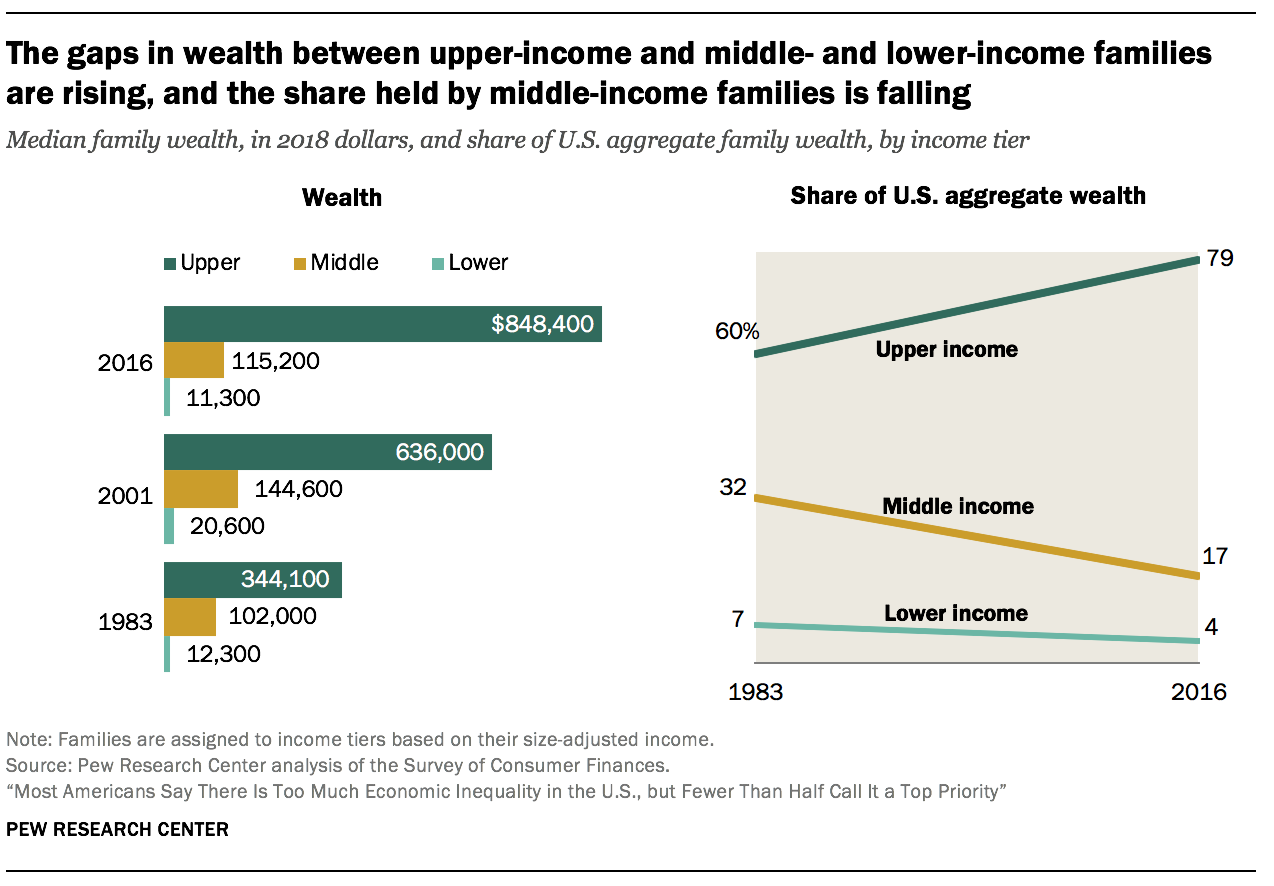
The gaps in wealth between upper-income and middle- and lower-income families are rising, and the share held by middle-income families is falling
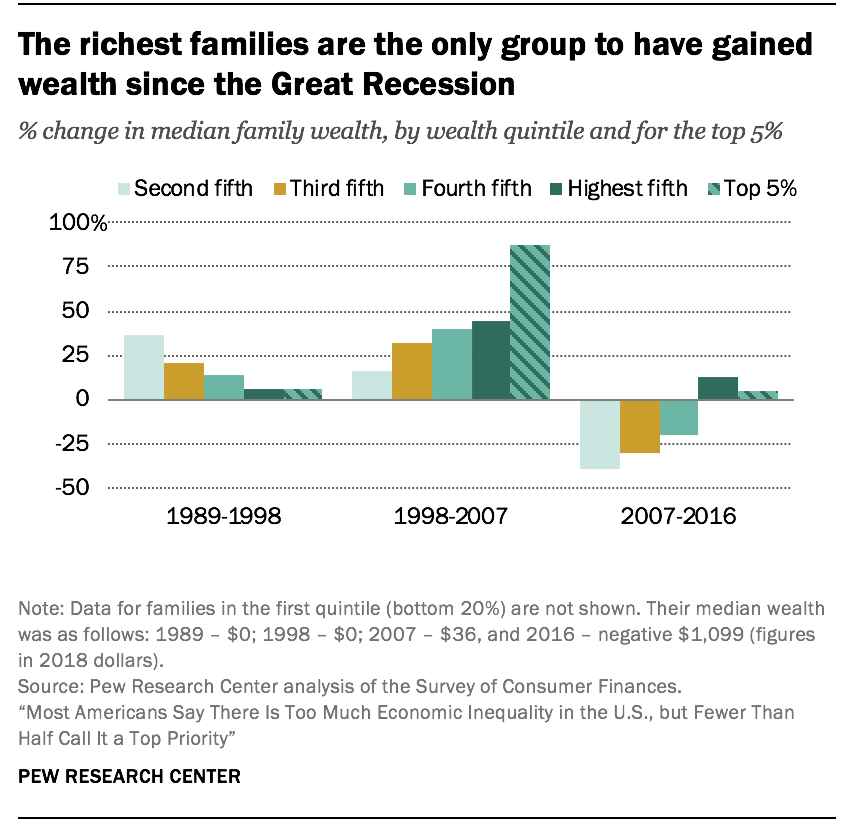
The richest families are the only group to have gained wealth since the Great Recession
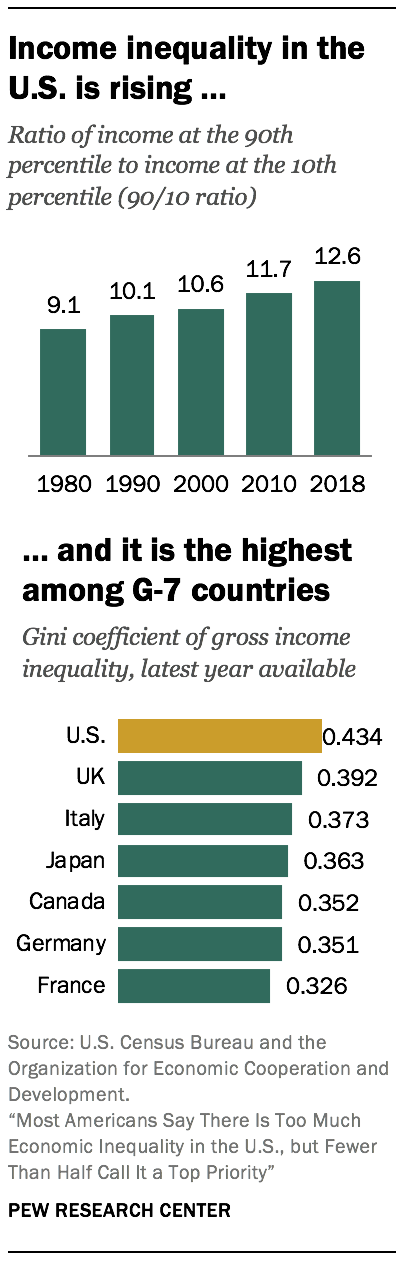
Income inequality in the U.S. is rising …

Barely 10 years past the end of the Great Recession in 2009, the U.S. economy is doing well on several fronts. The labor market is on a job-creating streak that has rung up more than 110 months straight of employment growth, a record for the post-World War II era. The unemployment rate in November 2019 was 3.5%, a level not seen since the 1960s. Gains on the jobs front are also reflected in household incomes, which have rebounded in recent years.

But not all economic indicators appear promising. Household incomes have grown only modestly in this century, and household wealth has not returned to its pre-recession level. Economic inequality, whether measured through the gaps in income or wealth between richer and poorer households, continues to widen.

Household incomes are growing again after a lengthy period of stagnation

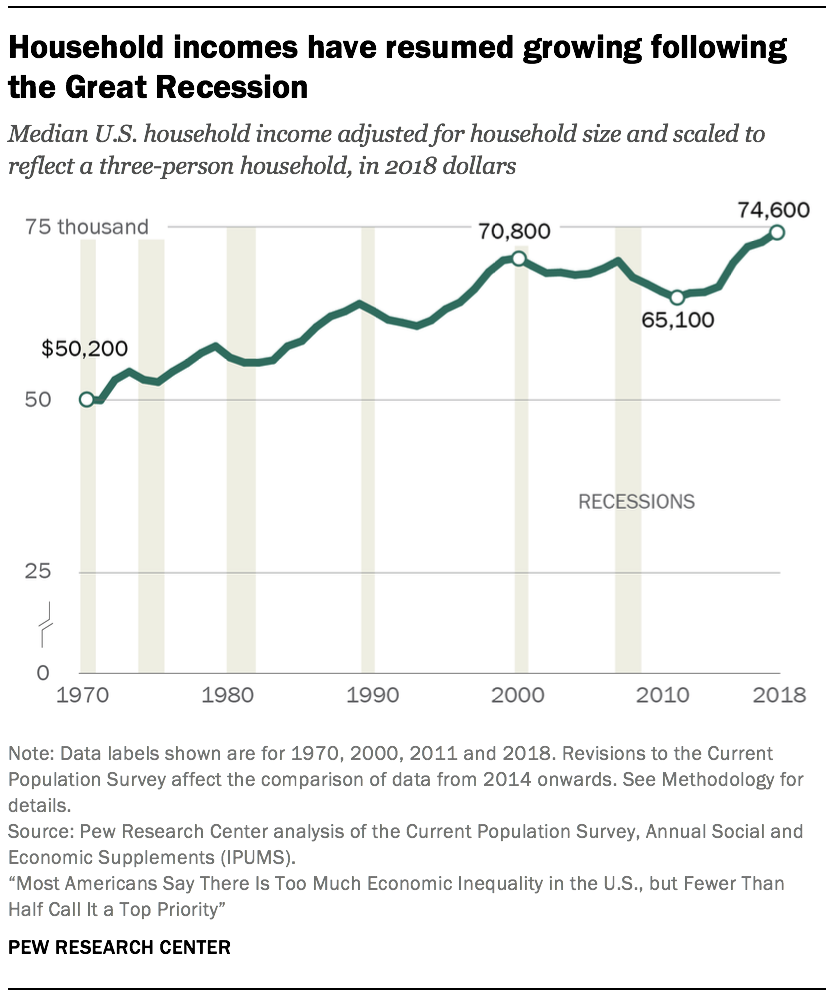
With periodic interruptions due to business cycle peaks and troughs, the incomes of American households overall have trended up since 1970. In 2018, the median income of U.S. households stood at $74,600.5 This was 49% higher than its level in 1970, when the median income was $50,200.6 (Incomes are expressed in 2018 dollars.)

But the overall trend masks two distinct episodes in the evolution of household incomes (the first lasting from 1970 to 2000 and the second from 2000 to 2018) and in how the gains were distributed.

Most of the increase in household income was achieved in the period from 1970 to 2000. In these three decades, the median income increased by 41%, to $70,800, at an annual average rate of 1.2%. From 2000 to 2018, the growth in household income slowed to an annual average rate of only 0.3%. If there had been no such slowdown and incomes had continued to increase in this century at the same rate as from 1970 to 2000, the current median U.S. household income would be about $87,000, considerably higher than its actual level of $74,600.

The shortfall in household income is attributable in part to two recessions since 2000. The first recession, lasting from March 2001 to November 2001, was relatively short-lived.7 Yet household incomes were slow to recover from the 2001 recession and it was not until 2007 that the median income was restored to about its level in 2000.

But 2007 also marked the onset of the Great Recession, and that delivered another blow to household incomes. This time it took until 2015 for incomes to approach their pre-recession level. Indeed, the median household income in 2015 – $70,200 – was no higher than its level in 2000, marking a 15-year period of stagnation, an episode of unprecedented duration in the past five decades.8

More recent trends in household income suggest that the effects of the Great Recession may finally be in the past. From 2015 to 2018, the median U.S. household income increased from $70,200 to $74,600, at an annual average rate of 2.1%. This is substantially greater than the average rate of growth from 1970 to 2000 and more in line with the economic expansion in the 1980s and the dot-com bubble era of the late 1990s.

Why economic inequality matters

The rise in economic inequality in the U.S. is tied to several factors. These include, in no particular order, technological change, globalization, the decline of unions and the eroding value of the minimum wage. Whatever the causes, the uninterrupted increase in inequality since 1980 has caused concern among members of the publicresearcherspolicymakers and politicians.

One reason for the concern is that people in the lower rungs of the economic ladder may experience diminished economic opportunity and mobility in the face of rising inequality, a phenomenon referred to as The Great Gatsby Curve. Others have highlighted inequality’s negative impact on the political influence of the disadvantaged, on geographic segregation by income, and on economic growth itself. The matter may not be entirely settled, however, as an opposing viewpoint suggests that income inequality does not harm economic opportunity.

Alternative estimates of economic inequality

This report presents estimates of income inequality based on household income as estimated in the Current Population Survey (CPS), a survey of households conducted by the U.S. Census Bureau in partnership with the Bureau of Labor Statistics. These estimates refer to gross (pretax) income and encompass most sources of income. A key omission is the value of in-kind services received from government sources. Because income taxes are progressive and in-kind services also serve to boost the economic wellbeing of (poorer) recipients, not accounting for these two factors could overstate the true gap in the financial resources of poorer and richer households.

The Congressional Budget Office (CBO) offers an alternative estimate of income inequality that accounts for federal taxes and a more comprehensive array of cash transfers and in-kind services than is possible with Current Population Survey data. The CBO finds that the Gini coefficient in the U.S. in 2016 ranged from 0.595, before accounting for any forms of taxes and transfers, to 0.423, after a full accounting of taxes and transfers. These estimates bracket the Census Bureau’s estimate of 0.481 for the Gini coefficient in 2016. By either estimate, income inequality in the U.S. is found to have increased by about 20% from 1980 to 2016 (The Gini coefficient ranges from 0 to 1, or from perfect equality to complete inequality). Findings from other researchers show the same general rise in inequality over this period regardless of accounting for in-kind transfers.

Yet another alternative is to focus on inequality in consumption, which implicitly accounts for all forms and sources of incomes, taxes and transfers. Some estimates based on consumption show that inequality in the U.S. increased by less than implied by estimates based on income, but other estimates suggest the trends based on consumption and income are similar. Empirically, consumption can be harder to measure than income.

Upper-income households have seen more rapid growth in income in recent decades

The growth in income in recent decades has tilted to upper-income households. At the same time, the U.S. middle class, which once comprised the clear majority of Americans, is shrinking. Thus, a greater share of the nation’s aggregate income is now going to upper-income households and the share going to middle- and lower-income households is falling.9

The share of American adults who live in middle-income households has decreased from 61% in 1971 to 51% in 2019. This downsizing has proceeded slowly but surely since 1971, with each decade thereafter typically ending with a smaller share of adults living in middle-income households than at the beginning of the decade.

The decline in the middle-class share is not a total sign of regression. From 1971 to 2019, the share of adults in the upper-income tier increased from 14% to 20%. Meanwhile, the share in the lower-income tier increased from 25% to 29%. On balance, there was more movement up the income ladder than down the income ladder.

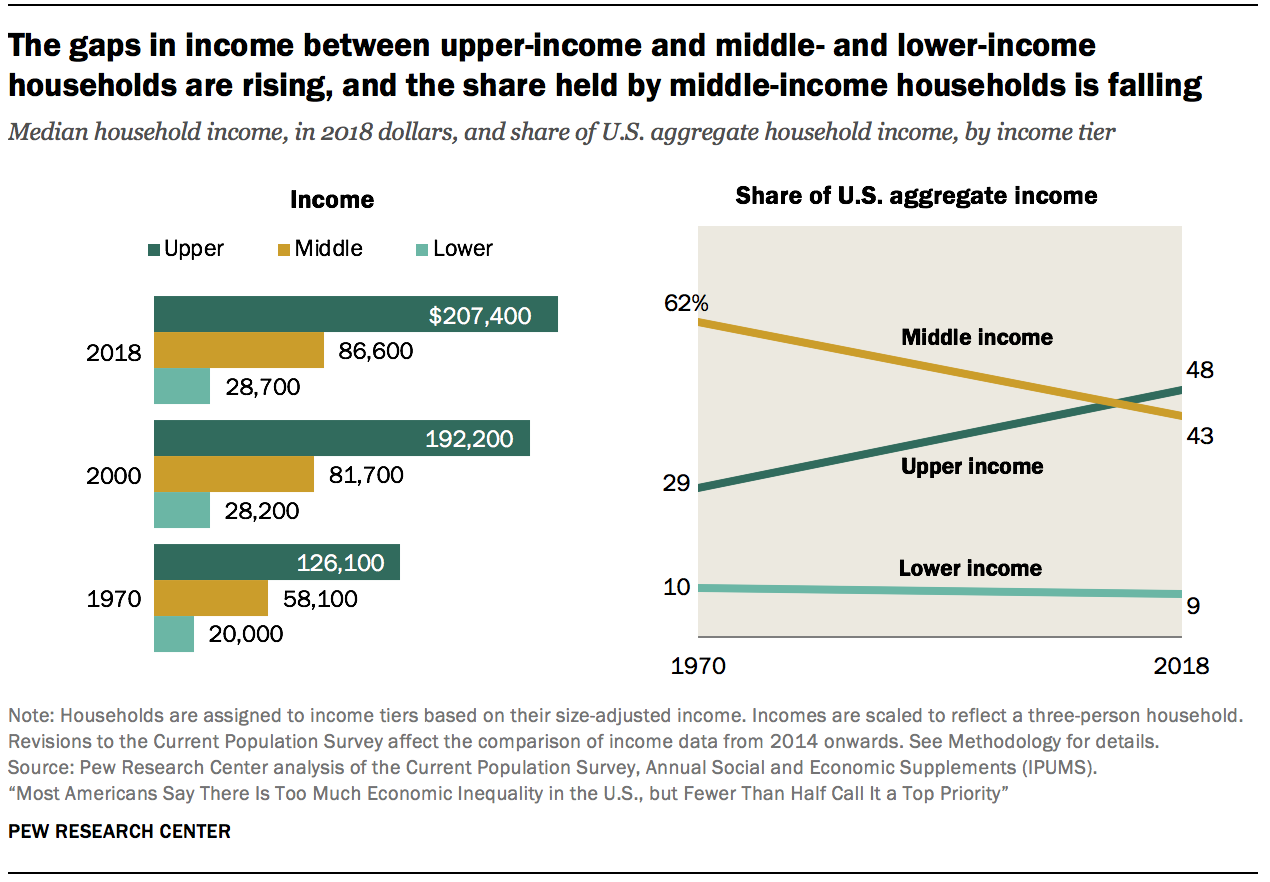
But middle-class incomes have not grown at the rate of upper-tier incomes. From 1970 to 2018, the median middle-class income increased from $58,100 to $86,600, a gain of 49%.10 This was considerably less than the 64% increase for upper-income households, whose median income increased from $126,100 in 1970 to $207,400 in 2018. Households in the lower-income tier experienced a gain of 43%, from $20,000 in 1970 to $28,700 in 2018. (Incomes are expressed in 2018 dollars.)

More tepid growth in the income of middle-class households and the reduction in the share of households in the middle-income tier led to a steep fall in the share of U.S. aggregate income held by the middle class. From 1970 to 2018, the share of aggregate income going to middle-class households fell from 62% to 43%. Over the same period, the share held by upper-income households increased from 29% to 48%. The share flowing to lower-income households inched down from 10% in 1970 to 9% in 2018.

These trends in income reflect the growth in economic inequality overall in the U.S. in the decades since 1980.

Income growth has been most rapid for the top 5% of families

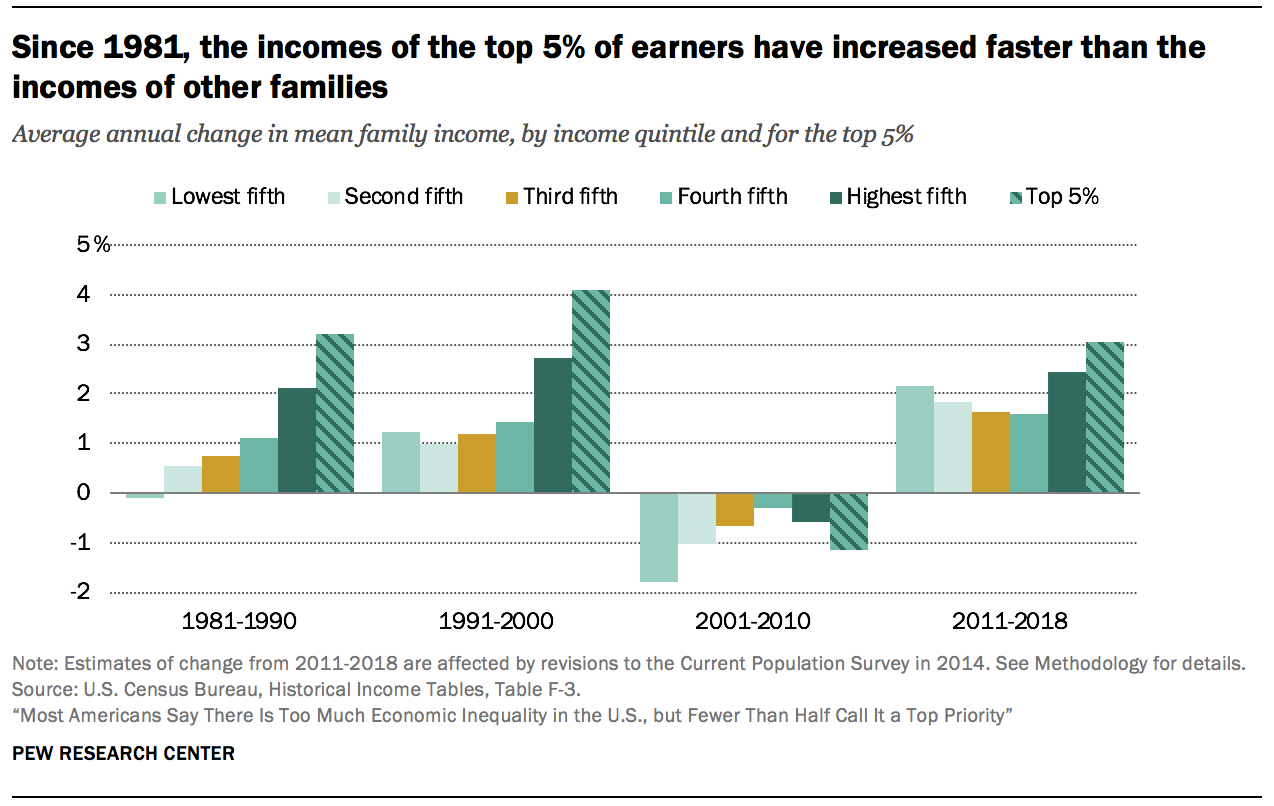
Even among higher-income families, the growth in income has favored those at the top. Since 1980, incomes have increased faster for the most affluent families – those in the top 5% – than for families in the income strata below them. This disparity in outcomes is less pronounced in the wake of the Great Recession but shows no signs of reversing.

From 1981 to 1990, the change in mean family income ranged from a loss of 0.1% annually for families in the lowest quintile (the bottom 20% of earners) to a gain of 2.1% annually for families in the highest quintile (the top 20%). The top 5% of families, who are part of the highest quintile, fared even better – their income increased at the rate of 3.2% annually from 1981 to 1990. Thus, the 1980s marked the beginning of a long and steady rise in income inequality.

A similar pattern prevailed in the 1990s, with even sharper growth in income at the top. From 1991 to 2000, the mean income of the top 5% of families grew at an annual average rate of 4.1%, compared with 2.7% for families in the highest quintile overall, and about 1% or barely more for other families.

The period from 2001 to 2010 is unique in the post-WWII era. Families in all strata experienced a loss in income in this decade, with those in the poorer strata experiencing more pronounced losses. The pattern in income growth from 2011 to 2018 is more balanced than the previous three decades, with gains more broadly shared across poorer and better-off families. Nonetheless, income growth remains tilted to the top, with families in the top 5% experiencing greater gains than other families since 2011.

The wealth of American families is currently no higher than its level two decades ago

Other than income, the wealth of a family is a key indicator of its financial security. Wealth, or net worth, is the value of assets owned by a family, such as a home or a savings account, minus outstanding debt, such as a mortgage or student loan. Accumulated over time, wealth is a source of retirement income, protects against short-term economic shocks, and provides security and social status for future generations.

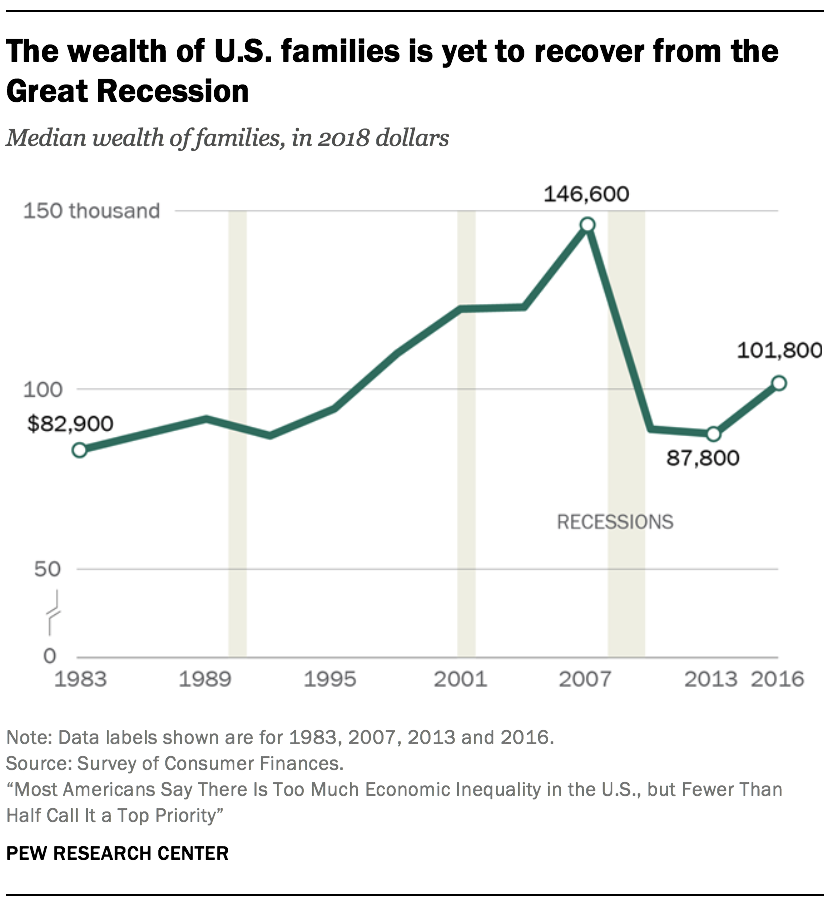
The period from the mid-1990s to the mid-2000s was beneficial for the wealth portfolios of American families overall. Housing prices more than doubled in this period, and stock values tripled.11 As a result, the median net worth of American families climbed from $94,700 in 1995 to $146,600 in 2007, a gain of 55%.12 (Figures are expressed in 2018 dollars.)

But the run up in housing prices proved to be a bubble that burst in 2006. Home prices plunged starting in 2006, triggering the Great Recession in 2007 and dragging stock prices into a steep fall as well. Consequently, the median net worth of families fell to $87,800 by 2013, a loss of 40% from the peak in 2007. As of 2016, the latest year for which data are available, the typical American family had a net worth of $101,800, still less than what it held in 1998.

The wealth divide among upper-income families and middle- and lower-income families is sharp and rising

The wealth gap among upper-income families and middle- and lower-income families is sharper than the income gap and is growing more rapidly.

The period from 1983 to 2001 was relatively prosperous for families in all income tiers, but one of rising inequality. The median wealth of middle-income families increased from $102,000 in 1983 to $144,600 in 2001, a gain of 42%. The net worth of lower-income families increased from $12,3oo in 1983 to $20,600 in 2001, up 67%. Even so, the gains for both lower- and middle-income families were outdistanced by upper-income families, whose median wealth increased by 85% over the same period, from $344,100 in 1983 to $636,000 in 2001. (Figures are expressed in 2018 dollars.)

The wealth gap between upper-income and lower- and middle-income families has grown wider this century. Upper-income families were the only income tier able to build on their wealth from 2001 to 2016, adding 33% at the median. On the other hand, middle-income families saw their median net worth shrink by 20% and lower-income families experienced a loss of 45%. As of 2016, upper-income families had 7.4 times as much wealth as middle-income families and 75 times as much wealth as lower-income families. These ratios are up from 3.4 and 28 in 1983, respectively.

The reason for this is that middle-income families are more dependent on home equity as a source of wealth than upper-income families, and the bursting of the housing bubble in 2006 had more of an impact on their net worth. Upper-income families, who derive a larger share of their wealth from financial market assets and business equity, were in a better position to benefit from a relatively quick recovery in the stock market once the recession ended.

As with the distribution of aggregate income, the share of U.S. aggregate wealth held by upper-income families is on the rise. From 1983 to 2016, the share of aggregate wealth going to upper-income families increased from 60% to 79%. Meanwhile, the share held by middle-income families has been cut nearly in half, falling from 32% to 17%. Lower-income families had only 4% of aggregate wealth in 2016, down from 7% in 1983.

The richest are getting richer faster

The richest families in the U.S. have experienced greater gains in wealth than other families in recent decades, a trend that reinforces the growing concentration of financial resources at the top.

The tilt to the top was most acute in the period from 1998 to 2007. In that period, the median net worth of the richest 5% of U.S. families increased from $2.5 million to $4.6 million, a gain of 88%.

This was nearly double the 45% increase in the wealth of the top 20% of families overall, a group that includes the richest 5%. Meanwhile, the net worth of families in the second quintile, one tier above the poorest 20%, increased by only 16%, from $27,700 in 1998 to $32,100 in 2007. (Figures are expressed in 2018 dollars.)

The wealthiest families are also the only ones to have experienced gains in wealth in the years after the start of the Great Recession in 2007. From 2007 to 2016, the median net worth of the richest 20% increased 13%, to $1.2 million. For the top 5%, it increased by 4%, to $4.8 million. In contrast, the net worth of families in lower tiers of wealth decreased by at least 20% from 2007 to 2016. The greatest loss – 39% – was experienced by the families in the second quintile of wealth, whose wealth fell from $32,100 in 2007 to $19,500 in 2016.

As a result, the wealth gap between America’s richest and poorer families more than doubled from 1989 to 2016. In 1989, the richest 5% of families had 114 times as much wealth as families in the second quintile, $2.3 million compared with $20,300. By 2016, this ratio had increased to 248, a much sharper rise than the widening gap in income.13

Income inequality in the U.S has increased since 1980 and is greater than in peer countries

Income inequality may be measured in a number of ways, but no matter the measure, economic inequality in the U.S. is seen to be on the rise.

One widely used measure – the 90/10 ratio – takes the ratio of the income needed to rank among the top 10% of earners in the U.S. (the 90th percentile) to the income at the threshold of the bottom 10% of earners (the 10th percentile). In 1980, the 90/10 ratio in the U.S. stood at 9.1, meaning that households at the top had incomes about nine times the incomes of households at the bottom. The ratio increased in every decade since 1980, reaching 12.6 in 2018, an increase of 39%.14

Not only is income inequality rising in the U.S., it is higher than in other advanced economies. Comparisons of income inequality across countries are often based on the Gini coefficient, another commonly used measure of inequality.15 Ranging from 0 to 1, or from perfect equality to complete inequality, the Gini coefficient in the U.S. stood at 0.434 in 2017, according to the Organization for Economic Cooperation and Development (OECD).16 This was higher than in any other of the G-7 countries, in which the Gini ranged from 0.326 in France to 0.392 in the UK, and inching closer to the level of inequality observed in India (0.495). More globally, the Gini coefficient of inequality ranges from lows of about 0.25 in Eastern European countries to highs in the range of 0.5 to 0.6 in countries in southern Africa, according to World Bank estimates.

Next: Views of economic inequality

← Prev Page

1234567

Next Page →

  1. The median income splits the income distribution into two halves – half the households earn less than the median and half the households earn more. Incomes are adjusted for household size and scaled to represent a household size of three. See methodology for details.
  2. Percentage changes are estimated, and other calculations are made, before numbers are rounded.
  3. The recession dates are as designated by the National Bureau of Economic Research.
  4. It is likely that household incomes did not return to their 2000 level till 2016 or later. A redesign of income questionsby the Census Bureau in 2014 is estimated to have given a boost of about 3% to median household income in the U.S. at the time of the redesign.
  5. Middle-income” Americans are adults whose annual household income is two-thirds to double the national median, after incomes have been adjusted for household size. Lower-income households have incomes less than 67% of the median and upper-income households have incomes that are more than double the median. See methodology for details. Previous Pew Research Center reports have examined the state of the American middle class in greater detail, including trends within U.S. metropolitan areas.
  6. The data source for these estimates is the Current Population Survey, Annual Social and Economic Supplement for 1971 to 2019. In the survey, respondents provide household income data for the previous calendar year. Thus, income data in this section refer to the 1970-2018 period and the counts of people from the same survey refer to the 1971-2019 period.
  7. The S&P/Case-Shiller U.S. National Home Price Index increased from 80 in January 1995 to 185 in June 2006 (January 2000=100). It fell to 134 in February 2012 and climbed thereafter, reaching 212 in August 2019. At the start of the Great Recession in December 2007, the S&P 500 index stood at about 1,500, three times its level of about 500 in 1995. After the peak in 2007, the S&P 500 fell below 1,000 in 2009. As of November 2019, the index had reached a level of about 3,000. (S&P 500 historical values downloaded from Yahoo! on Nov. 21, 2019.)
  8. Estimates of wealth are from the Survey of Consumer Finances (SCF). The SCF is conducted triennially by the Federal Reserve Board of Governors. It was first fielded in 1983 and the latest survey for which data are available was in 2016.
  9. It is not possible to compute the ratio of the wealth of the top 5% of families to the wealth of the poorest 20% because the median wealth of the poorest families is either zero or negative in most years examined.
  10. Per the U.S. Census Bureau, the source of these estimates, the 90th percentile household income in 2018 was $184,292 and the 10th percentile household income was $14,629 (incomes not adjusted for household size).
  11. The Gini coefficient encapsulates the share of aggregate income held by each person or household. If everyone has the same income, or the same share of aggregate income, the Gini coefficient equals zero. If the income distribution is perfectly unequal, a single person or household holds all aggregate income, the Gini coefficient is equal to one.
  12. The OECD is a group of 36 countries, including many of the world’s advanced economies. The OECD’s estimates of the Gini coefficient are for the following years: U.S. – 2017, UK – 2017, Italy – 2016, Japan – 2015, Canada – 2017, Germany – 2016, France – 2016, and India – 2011.
Icon for promotion number 1

Sign up for our weekly newsletter

Fresh data delivered Saturday mornings

Sign Up

reportJan 9, 2025

Economic Inequality Seen as Major Challenge Around the World

short readsMay 31, 2024

Income inequality is greater among Chinese Americans than any other Asian origin group in the U.S.

videoMar 27, 2024

1 in 10: Redefining the Asian American Dream (Short Film)

data essayMar 27, 2024

The Hardships and Dreams of Asian Americans Living in Poverty

short readsMar 6, 2024

A booming U.S. stock market doesn’t benefit all racial and ethnic groups equally

1The Experiences of LGBTQ Americans Today

2Trump’s Job Rating Drops, Key Policies Draw Majority Disapproval as He Nears 100 Days

3Bluesky has caught on with many news influencers, but X remains popular

4Biden granted more acts of clemency than any prior president

5Support for stricter environmental regulations outweighs opposition in a majority of states

Report Materials

Politics & Policy

International Affairs

Immigration & Migration

Race & Ethnicity

Religion

Age & Generations

Gender & LGBTQ

Family & Relationships

Economy & Work

Science

Internet & Technology

News Habits & Media

Methodological Research

© 2025 Pew Research Center

https://prc-app-prod.firebaseapp.com/__/auth/iframe?apiKey=AIzaSyCrK2dKMxf9Fmhpym2M4dajfcKyMY4_MBA&appName=%5BDEFAULT%5D&v=10.14.1&eid=p&usegapi=1&jsh=m%3B%2F_%2Fscs%2Fabc-static%2F_%2Fjs%2Fk%3Dgapi.lb.en.nJpyt-fjzo8.O%2Fd%3D1%2Frs%3DAHpOoo9fTqXSCmwMDsu9FH68l5KSqr6MBg%2Fm%3D__features__#id=I0_1749413752426&_gfid=I0_1749413752426&parent=https%3A%2F%2Fwww.pewresearch.org&pfname=&rpctoken=13592710