Psalm 90

Logos Sermons logo

The Future of Bible Study Is HereLearn more

Psalm 90

Jason VonBehren

Psalms- The 5 Books   •  Sermon  •  Submitted a year ago  •  Presented a year ago

Psalm 90

0 ratings

 · 19 viewsShare

Notes

Transcript

Introduction

I paid my life insurance bill a few weeks ago and it made me think more this time then usual

‌when i was young i never thought i would die.

‌‌well i have gotten older

‌i didn’t want to deal with things like high cholesterol

‌well i have high cholesterol

‌what hit me like a brick talking to Morgan was the realization i won’t always be with my boys

‌there will be a day when They will need me and i won’t be there

‌‌It made me really ask with some fear and hope

Will what i teach them last, Will my life count

i told Morgan i was heart broke and afraid

‌i told her i hated it

‌She looked at me and said “you should hate it. You are supposed to hate it“

‌I was facing fear and remembered the Gospel tells me God has done something epic about those very fears‌

Here is the question we all ask and the wisdom of Psalm 90‌

Do you long to achieve something worthwhile for Jesus? For your life to count for something? We all yearn for that. The big surprise at the end of Psalm 90 is that we are authorized to ask God to “establish the work of our hands” (v 17)—to make what we do last for eternity.

‌If you fear for the things I fear Psalm 90 is for you‌‌

Psalm 90 is a guided tour through all the hard reality we experience

we are going to see 3 things in psalm 90: knowing our place, knowing our greatest problem, the wonderful work of Christ‌

Knowing Our Place

Psalm 90:1–6 CSB

Lord, you have been our refuge in every generation. Before the mountains were born, before you gave birth to the earth and the world, from eternity to eternity, you are God. You return mankind to the dust, saying, “Return, descendants of Adam.” For in your sight a thousand years are like yesterday that passes by, like a few hours of the night. You end their lives; they sleep. They are like grass that grows in the morning— in the morning it sprouts and grows; by evening it withers and dries up.

We have been learning the 5 books of Psalms tell the story of Reality

‌The Psalms are the road map to God in the human experience we all know

‌Book 4 begins here

It begins with the people of God in the place I was talking about at the beginning

things do not go from cries of abandonment to praise in quick fashion. Book Four will end in praise, but it opens with a cry to God about a situation that feels as if it will never resolve itself

‌Longing for faithfulness bigger then their fears

‌‌Wondering if everything sad can come untrue when we all fall so much and the world is a mess

Here is the hope we can have right off the batPsalm 90:1–2 CSB

Lord, you have been our refuge in every generation. Before the mountains were born, before you gave birth to the earth and the world, from eternity to eternity, you are God.

How does that give me hope when I pay my life insurance

Before he made me he was who he is

The character of God was already there

The plan to save me and give me a hope and a future is the story of reality

Not my fears

A.W. Tozer said: Before we were. before God created a thing he wasn’t doing nothing. His mind was stirring with thoughts of you.

if that was who he was before he made you we can trust Him to get us home

And it means that my fears don’t get the last word

God does

If God who did not even spare his own son is the God reality centers on we can know his eternal faithfulness is our home

Not this world

If I think I am what will shape my sons into courageous men I will be paralyzed by every decision and word I say

But if God is my home he is the home I can point them too and know what I long for will be accomplished

So when we are faced with the reality of verses 3-6 we can stop running for the office of God because we remember our place Psalm 90:3–6 CSB

You return mankind to the dust, saying, “Return, descendants of Adam.” For in your sight a thousand years are like yesterday that passes by, like a few hours of the night. You end their lives; they sleep. They are like grass that grows in the morning— in the morning it sprouts and grows; by evening it withers and dries up.

Don’t worry Moses gets more depressing before it ends on an unreal hope

But this is the contrast that can make us realize running for the office of God is dumb

Psalms for YouSettled Affection and Sober Reality

We need this sober realism about our frailty, our mortality, our terrible transience

it makes us ask the central verse of this Psalm we will see later Psalm 90:12 CSB

Teach us to number our days carefully so that we may develop wisdom in our hearts.

Teach us in light that this life isn’t all there is to live in ways that really matter

There is so mush hope in that when we are loaded with the fear and regret of this life because we all are

None of this has gone how we thought it would

Who knows what Christopher Ash lays out?

We may be blighted by the great expectations loaded upon us, perhaps in childhood or early adulthood; perhaps our parents had hoped—and let us know that they had hoped—that we would succeed in particular ways. Maybe they wanted us to be the successes—in exams, or music, or sport, or jobs—that they had failed to be or never had the opportunity to be. How sad we feel when we begin to realise we shall never achieve what they have expected for us or what we hoped for ourselves.

Ever let yourself down?

Ever feel like you won’t live up to your own expectations?

We first find hope when we know there is a place where what we truly long for will be done

And it only comes when we realize he has the home where it wil all be accomplished one day

But it gets worse before it gets better

We have to know why we are in the mess we are in

Knowing Our Greatest Problem

Psalm 90:7–12 CSB

For we are consumed by your anger; we are terrified by your wrath. You have set our iniquities before you, our secret sins in the light of your presence. For all our days ebb away under your wrath; we end our years like a sigh. Our lives last seventy years or, if we are strong, eighty years. Even the best of them are struggle and sorrow; indeed, they pass quickly and we fly away. Who understands the power of your anger? Your wrath matches the fear that is due you. Teach us to number our days carefully so that we may develop wisdom in our hearts.

Not only are we transient we are in trouble

God hates things aren’t how they are supposed to be

And his hate for it is called his wrath and Moses will use that word alot in this Psalm

That can make us modern people shudder but its in here so lets talk through it

His wrath is not a lightning bolt‌

It is his right anger toward sin

And here is how this plays out

It is Him letting me have what I want apart from him to much

When we tell the God who made us and ordered this world to flourish is specific ways that we know better then Him he will tell us at some point your will be done

We think God is a bad guy for hell but here is the reality about hell C.S. Lewis says: Hells doors are locked from the inside

God hates we choose things and people other then him

Nto because he is some insecure being

But because he is a loving father telling the children he loves not to play in the street

But we love to play in the traffic like nut cases

‌God’s wrath is letting us pursue other loves that only steal kill and destroy‌

Wrath is God giving you too much of what you want apart from him anyway

‌Paul knew this in Romans 1 18 For God’s wrath is revealed from heaven against all godlessness and unrighteousness of people who by their unrighteousness suppress the truth, 19 since what can be known about God is evident among them, because God has shown it to them. 20 For his invisible attributes, that is, his eternal power and divine nature, have been clearly seen since the creation of the world, being understood through what he has made. As a result, people are without excuse. 21 For though they knew God, they did not glorify him as God or show gratitude. Instead, their thinking became worthless, and their senseless hearts were darkened. 22 Claiming to be wise, they became fools

‌‌When we realize the folly of our running from God we can reorder our lives and longings for what truly matters

‌Then we remember who we are and who He is …through the crushing of our falling

‌Moses pray’s in verse 12 : Teach us to number our days carefully so that we may develop wisdom in our longings, our perspective, how we interpret our world.

‌To get there he takes an honest road‌

You have probably heard somone say that for there to be good news there has to be bad.‌

this is the bad‌

5 times in as many verses the anger of God is laid out

‌It is the most brutal part of the bible I know

‌Paul says it in fewer words when he says in Romans 6: 23 For the wages of sin is death, but the gift of God is eternal life in Christ Jesus our Lord. No matter who you are‌

What you have accomplished‌

no matter if you have shunned God and become the most autonomous self or if you have told one lie and thought that good performance saves you we are all have the same problem

‌The haunt of death knowing we have all told God my will be done at times not His

‌I promise this ends on a note you cannot imagine of hope but this is the reality

‌Sin has brought God’s wrath against it

‌What does that mean?‌

He hates funerals so much he died to conquer them

‌But he hates that we die‌

He hates the self destructive ways we look for life apart from Him

Isn’t that good news?

We all hear God is love but you can’t have love without a right anger toward what hurts who you love

‌Do you love and care about Kids but just say I am love when they are abused‌

No there is a place for a right anger against what wounds us and breaks us because he loves us

‌When Jesus arrives at the tomb of his friend Lazarus in the book of John the language is intense

‌it says he was deeply moved

‌That word in the Greek is used to describe a bucking horse biting a bridle enraged

‌He hates it

‌Because creation was shattered we all will see our bodies give out in this life

‌You should hate it

‌He hates it

‌Because of what it has done and what it has cost

‌It costs more than we can imagine

Here is where the turn to unreal hope comes

The Wonderful Work of Christ

Psalm 90:13–17 CSB

Lord—how long? Turn and have compassion on your servants. Satisfy us in the morning with your faithful love so that we may shout with joy and be glad all our days. Make us rejoice for as many days as you have humbled us, for as many years as we have seen adversity. Let your work be seen by your servants, and your splendor by their children. Let the favor of the Lord our God be on us; establish for us the work of our hands— establish the work of our hands!

If there is anything Moses wants us to know it is the truth that faithfulness drives out fear

‌Where is that faithfulness most shown

‌Where was his commitment to rescue us on full display?

‌The Cross

‌Moses was pointing to it like a flashing sign on a desert highway

‌Look at verse 16

‌​Psalm 90:16 Let your work be seen by your servants, and your splendor by their children.

‌When was it seen?

His faithfulness was seen by the cosmos that day on the cross

‌It was there the Son took what we deserve and drank the cup of it dry

‌He knew the wrath of God poured out on Him so it would never darken our door

‌I say this often but we need to reimagine our savior

‌Popular pictures make him look so weak and passive

‌He was not weak on the cross he was the most epic warrior you can imagine‌

He was there to take the fight for your life to be made new right to hells front door

‌And he took the anger of God toward sin that day so all we will ever know is faithful love that will never leave you or forsake you

‌What he did was brought home for me 2 years ago

‌My baby boy Baker had to get a procedure when he was 3 weeks old at a pediatric urologist

‌They had to strap his little legs down and give him 2 local shots and do a procedure

‌i was allowed in with him

‌i had to let his little hands clasp my fingers as he wailed and screamed for 20 minutes

‌I spoke to him the whole time until i sweat

‌Its ok its ok its ok daddy is right here im right here

‌Im 6’3” 230 and i have been through some things

‌I can’t imagine how many people and what they would have to have done to me to get me away from him

‌It was so bad when it was done I went in the other room and cried so hard there was a puddle under my face

‌Because it hit me‌

Do you realize what he endured for us to make death a shadow.‌

What he did to take the stinger out of its horrible pain

‌The father wathced his son nailed to a tree

‌And in that moment he walked out of the room on his son so that he would never walk out on you

You want faithfulness that drives out fear ?

‌Tell me another reality better then that one

‌Jesus was abandoned so that you never would be

‌You can know God is still there

‌No matter what you have done

‌Whatever you fear the most

‌He faced the darkness of this wrath in the garden of gethsemane and didn’t run away

‌If he didn’t in his darkest hour he never will in yours

‌So learn to number your days in light of the Gospel‌

And learn your assurance is anchored in the wonderful work of Christ for us

Tim Keller said: “The central basis of Christian assurance is not how much our hearts are set on God, but how unshakably his heart is set on us.”

That is the wisom of Moses in Psalm 90

Related Media

See more

16 items

15 items

Related Sermons

See moreApply Your Heart to Wisdom

Bible Baptist Church  •  32 views  •  33:43How Are You Spending Your Days?

Bible Baptist Church  •  7 views  •  34:39Abundant Grace For Living: Five Reassurances for Future Gladness

Trinity BFC  •  26 views  •  31:10

Earn an accredited degree from Redemption Seminary with Logos.

Copyright 2025 LogosFeatures|Pricing|Privacy|Terms of Use|Support

Numbering Our Days

Faith • Biblical Reflections

Numbering Our Days: Psalm 90’s Paradoxical Way to a Satisfying Life

Patrick Quinn

13 min read

 DeathLifeOld TestamentPsalmsThe Psalms

When was the last time you listened to music on the radio? A couple of weeks ago, my phone died on my drive to work, so I decided to give the radio a shot. I hadn’t done so for more than five years, and it only took me about thirty seconds to remember why. There are so many commercials. After about fifteen minutes I decided I’d rather just sit in silence. There were ads on all sorts of things—new vacation destinations, new investment plans, new medicines, new insurance providers—all trying to convince me of how short, miserable, and meaningless life is without the things they’re selling. So, it’s no wonder we prefer to just turn them off. Seriously, how many people pay additional money each month for services just to remove ads? Spotify? Netflix?

Ads are annoying, but more than that, they make us think about things we’d rather just tune out. We don’t want to be reminded of all the problems we face, we don’t believe these advertisers really offer the solutions they promise, and honestly, we’d rather just get back to distracting ourselves with music.

Maybe you would feel the same way about Psalm 90:

90 Lord, you have been our dwelling place
in all generations.
Before the mountains were brought forth,
or ever you had formed the earth and the world,
from everlasting to everlasting you are God.

You return man to dust
and say, “Return, O children of man!”
For a thousand years in your sight
are but as yesterday when it is past,
or as a watch in the night.

You sweep them away as with a flood; they are like a dream,
like grass that is renewed in the morning:
in the morning it flourishes and is renewed;
in the evening it fades and withers.

For we are brought to an end by your anger;
by your wrath we are dismayed.
You have set our iniquities before you,
our secret sins in the light of your presence.

For all our days pass away under your wrath;
we bring our years to an end like a sigh.
10 The years of our life are seventy,
or even by reason of strength eighty;
yet their span is but toil and trouble;
they are soon gone, and we fly away.
11 Who considers the power of your anger,
and your wrath according to the fear of you?

12 So teach us to number our days
that we may get a heart of wisdom.
13 Return, O Lord! How long?
Have pity on your servants!
14 Satisfy us in the morning with your steadfast love,
that we may rejoice and be glad all our days.
15 Make us glad for as many days as you have afflicted us,
and for as many years as we have seen evil.
16 Let your work be shown to your servants,
and your glorious power to their children.
17 Let the favor of the Lord our God be upon us,
and establish the work of our hands upon us;
yes, establish the work of our hands!

This seems to be shoving a problem in our face, one we really don’t feel like dealing with right now. But really, we all know this: the problem Psalm 90 addresses cannot be ignored. It addresses explicitly what all the ads I heard on the radio touched on implicitly: we’re all living “on the clock.” Life is short. Time is so, so preciously scarce. Seventy to eighty years might feel long in the moment, but in the face of death and eternity, life is crushingly short. And just like those ads, Psalm 90 looks forward to a resolution—and it’s remarkable how similar that vision looks. A satisfying life, full of joy and wonder and meaningful work.

We all want that, right? That’s why companies spend spend billions of dollars annually on ad agencies. They recognize that the results they promise really are enticing to us; we all want a satisfying life. The question is, how do we get there? In Psalm 90, Moses gives us an answer. To arrive at a satisfying life with meaning and wonder and joy, we must learn to number our days that we may gain a heart of wisdom. Maybe that’s not the answer we expected or wanted, but it’s the only one that can really deliver on what it promises. Let’s work through this psalm together and see if we can arrive at that satisfying life. We have two questions for our very simple outline. First, what is the problem? Second, what is the solution?

What is the problem? We can’t get too deep into Psalm 90 without finding it. The psalm starts out in the same fashion many psalms do, with praising God:

Lord, you have been our dwelling place in all generations.
Before the mountains were brought forth,
or ever you had formed the earth and the world,
from everlasting to everlasting you are God.

The emphasis here is on God as eternal. His existence stretches forever in both directions, before the creation of the universe, now and forever. God’s eternality is a marvel; he is worthy to be praised. But Moses doesn’t stop at praise; pretty quickly he turns his attention to us, to humanity.

The picture he paints of us is sobering. God is eternal, but we certainly are not. The realization makes suddenly makes the praise feel like lament because we’re faced with the problem of our mortality.

At first the language here is poetic, but that doesn’t make it any less frightful. We return to dust: that’s our inevitable fate. Our lives will come to an end, our breath will cease, and our bodies will decay. Then the poetry pushes a step further, not just addressing the reality of death but also the shortness of life. Look at verses 5-6, we vanish like a dream and wither like grass. Maybe, just maybe, we could brush that off as sentimental, but then Moses really leans in. He drops euphemisms and gets as blunt as he can in verse 10:

The years of our life are seventy,
or even by reason of strength eighty;
yet their span is but toil and trouble;
they are soon gone, and we fly away.

This is not a comfortable topic of conversation. Most of us wouldn’t bring up the problem of mortality at the dinner table with company or in the classroom with our friends. Yet, the reality is that death never asks permission to be included in conversation. The problem of death doesn’t wait for an invitation into our lives; it barges in and confronts each one of us. For many of us, the problem of mortality is right in front of us today. Some of us have a parent or grandparent who is declining in health. Some of us have recently lost a loved one. Some of us are facing a diagnosis which makes death feel all too close. Whether it’s ourselves or our loved ones, death inevitably comes close to us all and demands a response.

When the problem of mortality meets us face-to-face, how do we respond? I think we can all recognize both healthy and unhealthy ways of responding. The obviously unhealthy way to respond is to live in to the early 2010’s catchphrase “YOLO.” I’m probably dating myself with this one. Do you remember YOLO? Do you know what it means? “You Only Live Once.” This is the mindset that throws all caution to the wind: live recklessly, shirk all responsibility, seek as much pleasure as possible, don’t worry about the consequences. YOLO says, “Life is too short to not have fun.” That’s not a very healthy response. Life might be exciting for a while, until you end up with a long list of broken relationships, burned bridges, scars, and regrets. It doesn’t deliver a satisfying life.

What about the opposite approach? Instead of seeking as much pleasure as possible, we could seek as much success as possible. We can fine-tune our life and become a productivity machine; optimize every minute of our day. We can optimize our job, obviously, but also our commute, our meal planning, our exercise, our showers, even our toothbrushing. We now optimize our sleep and our vacation. We might even try to optimize our friendships, our marriage, and our parenting. We try to squeeze as much value as possible out of every second we have.

This is a pretty common mindset here in the DC area where I live and in many other urban centers—after all, this is a very important city and we all have very important jobs, which makes us very important people. (We think.)  And that makes life really busy. This optimization mindset says, “Life is too short to not move forward.” If this is you, let me ask: you might be productive, but are you satisfied? Is your life satisfying?

I read an article in the Wall Street Journal some time back entitled, “Why High-Powered People Are Working in Their 80s.” In it the author writes this: “These workers joke about getting bored on the golf course or being pushed out of the house by a spouse who won’t tolerate idleness. Beneath the wisecracks is a sense of purpose that refuses to fade. They just can’t quit their careers.” Those interviewed expressed fear at becoming irrelevant, fear that they haven’t done enough to solidify their legacy, fear of loneliness in retirement and lack of purpose without work. Instead of delivering on a satisfying life, this optimization approach brings us to the exact same spot as a YOLO mentality: right at Psalm 90:10.

The years of our life are seventy,
or even by reason of strength eighty;
yet their span is but toil and trouble;
they are soon gone, and we fly away.

Neither of these approaches manage to deliver on what they promise, neither offer satisfying solutions to the problem of mortality. Which are you? Are you the pleasure seeker or the optimizer? Most of us tend toward one or the other. Maybe you take a different approach or maybe like we said at the start, you just try not to think about it too much. But take a minute to really reflect: how are you facing your mortality problem? And how’s it working out for you? Do you feel satisfied?

Moses offers us another way, a different solution to this problem.

But before he offers his solution, Moses actually complicates the problem further. Did you feel this in reading the psalm? The problem isn’t just death; it’s actually much bigger if we could believe it. We’re not just living “on the clock,” we’re also “under the curse.”

Look again at verse 5. It begins, “You sweep them away as with a flood.” Remember, this is a prayer to God. Verses 7-8 state, “We are brought to an end by your anger; by your wrath we are dismayed. You have set our iniquities before you, our secret sins in the light of your presence.” Verse 9 follows: “For all our days pass away under your wrath; we bring our years to an end like a sigh.”

For as much as people like to talk about the shortness of life, we like to talk about the wrath of God even less. But Moses is drawing a connection between these two things we can’t afford to miss: we face a mortality problem and a morality problem.

Whether you’re a Christian or not, you can agree humanity has a morality problem. A brief look at our history, our home life, and each of our hearts exposes that completely. For all the ways we address our mortality problem, we have just as many ways to respond to our morality problem. Maybe you try to write off morality as subjective or you make excuses for yourself whenever you’re in the wrong. Maybe you become as rigid as possible, you try to follow all the rules and justify every single decision you make. Maybe this is just another thing you try not to think about too much, and you simply do your best to make sure your good deeds outweigh the bad. But for all the wrong in our world, our homes, and our hearts, none of these approaches feel satisfying either.

Here’s the key insight Moses has for us: our morality problem and our mortality problem are integrally related. If you’re not a Christian, you probably don’t tie these two problems together. By the world’s measure, mortality is a matter of biology and morality is a matter of conscience. Christianity is actually more holistic; it recognizes the connection between body and soul. In fact, mortality and morality are two sides of the same coin. Both have been brought under judgment in a single event.

Verse three captures this the best. When Moses is describing death as a return to dust, that’s not just a comment on the physical state of our bodies. The image he’s using here is more shocking—it’s being ground to dust, crushed, pulverized.[1] This is a reference back to Genesis 3, when Adam and Eve disobeyed God in the garden of Eden. This is the judgment God lays on humanity: “By the sweat of your face you shall eat bread, till you return to the ground, for out of it you were taken; for you are dust, and to dust you shall return” (Gen 3:19). It is only by recognizing that mortality and morality are one and the same problem that we can properly understand: the solution has to address both.

So what is the solution? If it’s not reckless abandon or precise optimization, if it’s not ignoring the problem, what is it? Let’s look at the solution in three places: in the psalm, in Christ, and in our lives.

First, in the psalm. Moses gives his answer in verse twelve: “So teach us to number our days that we may get a heart of wisdom.” First, we see a request. Moses, still as a prayer, asks God to teach his people. That’s our first clue: the solution to our problem can only be found in God.

That might sound intimidating in light of the fact that it is God’s judgment which brings us to death; why would we want to get closer to the God who’s mad at us? But really, we all know this is how relationships work. If you wrong someone in a relationship, how do you make it right? By running away from that person and avoiding conflict for the rest of your life? By digging your heels in and refusing to reconcile? No, it’s by going to the person you’ve wronged and asking for forgiveness. Moses models that in this psalm. He recognizes his own sin and brings it before God in prayer, requesting for him to take action.

Let’s look at what Moses requests that God teach them: “number our days.” Again, nobody likes thinking about their own mortality and their own sin, but this is actually the first step in the solution. Numbering our days keeps this problem at the forefront of our mind. This is not a macabre preoccupation with death, but a proper perspective of our identity: we are sinners in need of grace, we’re both on the clock and under the curse. This problem is real, we have to understand it properly to keep our eyes out for the fitting solution.

Lastly, the goal of numbering our days is gaining a heart of wisdom. Wisdom can be defined as “skillful living.” It’s living life the way we were designed to, according to the intent and guidance of our creator. Moses recognizes that we need to realign ourselves with the life God means for us to live. And life itself is defined as being close with God, dwelling in the presence of God. Adam and Eve were driven from the garden and driven from God’s presence. Thus, Moses sees the need for reconciliation. Verse thirteen shows the turn, “Return, O Lord! How long? Have pity on your servants!”

Moses’ prayer is full of expectation. He looks ahead to a day when God’s people will be safe and satisfied. The days of hardship will be redeemed, and life will have rich meaning. See the ways he pleas for this to come. Verse fourteen says “Satisfy us in the morning with your steadfast love.” Verse sixteen continues “Let your work be shown to your servants, and your glorious power to their children.” He knows God has the solution, he trusts that God will do it, but the psalm doesn’t give a clear picture of what God’s answer looks like.

What Moses knew vaguely we know and see as clear as day: the reconciliation of our mortality and morality has been accomplished in the resurrection of Jesus Christ. The apostle Paul tells us in 2 Corinthians 5:21: “For our sake he made him to be sin who knew no sin, so that in him we might become the righteousness of God.” Rather than leaving us to our broken morals, our vices and hypocrisy, our sins against God, God comes to us. The truth is, we were no different than our first parents Adam and Eve. Rather than coming to God to right our wrongs and seek forgiveness, we ran away and hid. In Jesus, God came to us. He made his dwelling place with us so that he might be our dwelling place forever.

Later Paul writes, “When the fullness of time had come, God sent forth his Son, born of woman, born under the law, to redeem those who were under the law, so that we might receive adoption as sons” (Gal 4:4-5). Jesus came as a man to live in perfect alignment to God’s law—rather than living “under the curse” and God’s anger, he was the only one upon whom God could truly say “You are my beloved son, with you I am well pleased” (Mark 1:11). Jesus numbered his days precisely, always paying attention to when his hour would arrive. And at last, it did: for our sake Jesus bore the burden of God’s wrath upon his own shoulders on the cross. His death satisfied the wrath of God against all his people’s sin, solving our morality problem.

But that’s not the end of the story. Three days later Jesus solved our mortality problem, too. Romans 6 explains it like this “Now if we have died with Christ, we believe that we will also live with him. We know that Christ, being raised from the dead, will never die again; death no longer has dominion over him. For the death he died he died to sin, once for all, but the life he lives he lives to God” (Rom 6:8-10). This is the solution the people of God had been looking for since the time of Moses, even since the time of Adam. If you are in Christ, you have been saved by the steadfast love of our God, you have witnessed his glorious power and have been adopted as his child. That makes all the difference in how we live here and now.

Think about how this solution plays out in our lives. I am surprised when reading this psalm that Moses stays so grounded in our lives on earth. Often when I think about the Bible’s solution for death, I look forward to eternal paradise in heaven. Yes and amen, we can look forward to that life after death with great hope and expectation, but we’d be wrong to make this an either-or salvation. It’s not “Either we stay here on earth where life is meaningless and miserable, or we go to heaven and be at peace.” Instead, it’s a both-and salvation. Both the life we will enjoy in heaven and the life we have now has been redeemed and reformed by Jesus.

Look at Psalm 90:15. God has promised to make us glad “for as many days as you have afflicted us, and for as many years as we have seen evil.” This transforms the way we think about suffering. Suffering is unavoidable in this life, whether you’re a Christian or not. For someone who responds to our big problem with the YOLO mentality or with optimization, suffering is the ultimate defeater; it’s what makes life feel so miserable and meaningless. But for Christians who take Moses’ path, even our suffering can be redeemed.

I was reminded this past week of an article Tim Keller wrote shortly after he was diagnosed with pancreatic cancer. He had just published a book titled On Death which helped people think through these things—and then, all of a sudden, he was his own target audience. His article reveals the challenge of really living out the advice he had given as a pastor for some fifty years, like a surgeon finding himself on the operating table. The experience was raw, but in the end his faith weathered—and actually grew—through his suffering.

He wrote, “For me as a Christian, Jesus’s costly love, death, and resurrection had become not just something I believed and filed away, but a hope that sustained me all day.” The cross of Jesus is the paramount example of suffering redeemed. In Christ, our pain is not meaningless; it points us ahead to our resurrected savior. That actually infuses suffering with joy. Tim Keller notes exactly that in his closing reflection:

I can sincerely say, without any sentimentality or exaggeration, that I’ve never been happier in my life, that I’ve never had more days filled with comfort. But it is equally true that I’ve never had so many days of grief. One of our dearest friends lost her husband to cancer six years ago. Even now, she says, she might seem fine, and then out of nowhere some reminder or thought will sideswipe her and cripple her with sorrow. I have come to be grateful for those sideswipes, because they remind me to reorient myself to the convictions of my head and the processes of my heart. When I take time to remember how to deal with my fears and savor my joys, the consolations are stronger and sweeter than ever.

The gospel frees us to fully embrace both joy and grief in a way that no other response to sin and death can. Tim Keller passed away in May 2023—and though his last three years were marked by pain, he had found satisfaction in God as his dwelling place. Now he is perfectly satisfied as he rests in the presence of God. That same satisfaction is open to you.

This is a small window into what it looks like to be a Christian: not living “on the clock” or “under the curse,” but “in the presence of God.” What would it look like for us to “number our days”? How might we make Psalm 90 our own prayer?


[1] Psalm 90:3 uses “dust” (דַּכָּ֑א, dakka) which is different than Genesis 2-3 (עָפָר֙, afar) “soil.” The one used in Ps 90:3 can be used in a literal sense of physically crushing or grinding something, or in a metaphorical sense of coming under divine punishment. Dan Lioy, “Teach Us to Number Our Days: An Exegetical and Theological Analysis of Psalm 90.” Conspectus 5 (March 2008): 89–112.

Patrick Quinn

Patrick is the Director of Community and Young Adults at Capital Presbyterian Fairfax in Fairfax, VA. After graduating from Christopher Newport University and spending two additional years there as an intern with Reformed University Fellowship, Patrick returned to Northern Virginia where he grew up, met and married his wife Erin, and is currently pursuing his MDiv at Reformed Theological Seminary.Meet Patrick

Related Articles

Faith • Biblical ReflectionsLamenting in WartimeRandy Newman

Faith • Biblical ReflectionsKurt Cobain, Verve,…and Heman the Ezrahite?Rev. Austin Kettle

Faith • Theological ReflectionsAnd Crying TooDr. Steven Garber

 Subscribe

© 2025 McLean Presbyterian Church

Church Website Design by Landslide Creative

12 Types of Anger

Join our Newsletter

Get helpful tips and the latest information

Choosing Therapy on Facebook
Choosing Therapy on Instagram
Choosing Therapy on Twitter
Choosing Therapy on Linkedin
Choosing Therapy on Pinterest
Choosing Therapy on Tiktok
Choosing Therapy on Youtube
ChoosingTherapy.com Logo
Search Icon

Find a therapist (enter your state)

Anger Articles

Anger TherapyTypes of AngerOnline Anger Management

12 Types of Anger

Headshot of Renee Skedel, LPCC

Author: Renee Skedel, LPC

Rajy Abulhosn, MD
Licensed medical reviewer

Medical Reviewer: Rajy Abulhosn, MD 

Published: February 8, 2025

Click here to open and close the table of contents.

Table of Contents

Anger is a natural emotion, but its intensity, triggers, and expressions vary widely. Research shows that anger can be divided into 12 distinct types, each with its own causes, behaviors, and management strategies.1 Identifying which type of anger you’re experiencing is crucial for improving your response to it and managing its impact on your life and relationships.ADVERTISEMENT

A Therapist Can Help You Control Your Anger.

BetterHelp has over 30,000 licensed therapists who provide convenient and affordable online therapy. BetterHelp starts at $65 per week and is FSA/HSA eligible by most providers. Take a free online assessment and get matched with the right therapist for you.Free Assessment

Why Recognizing the Types of Anger Matters

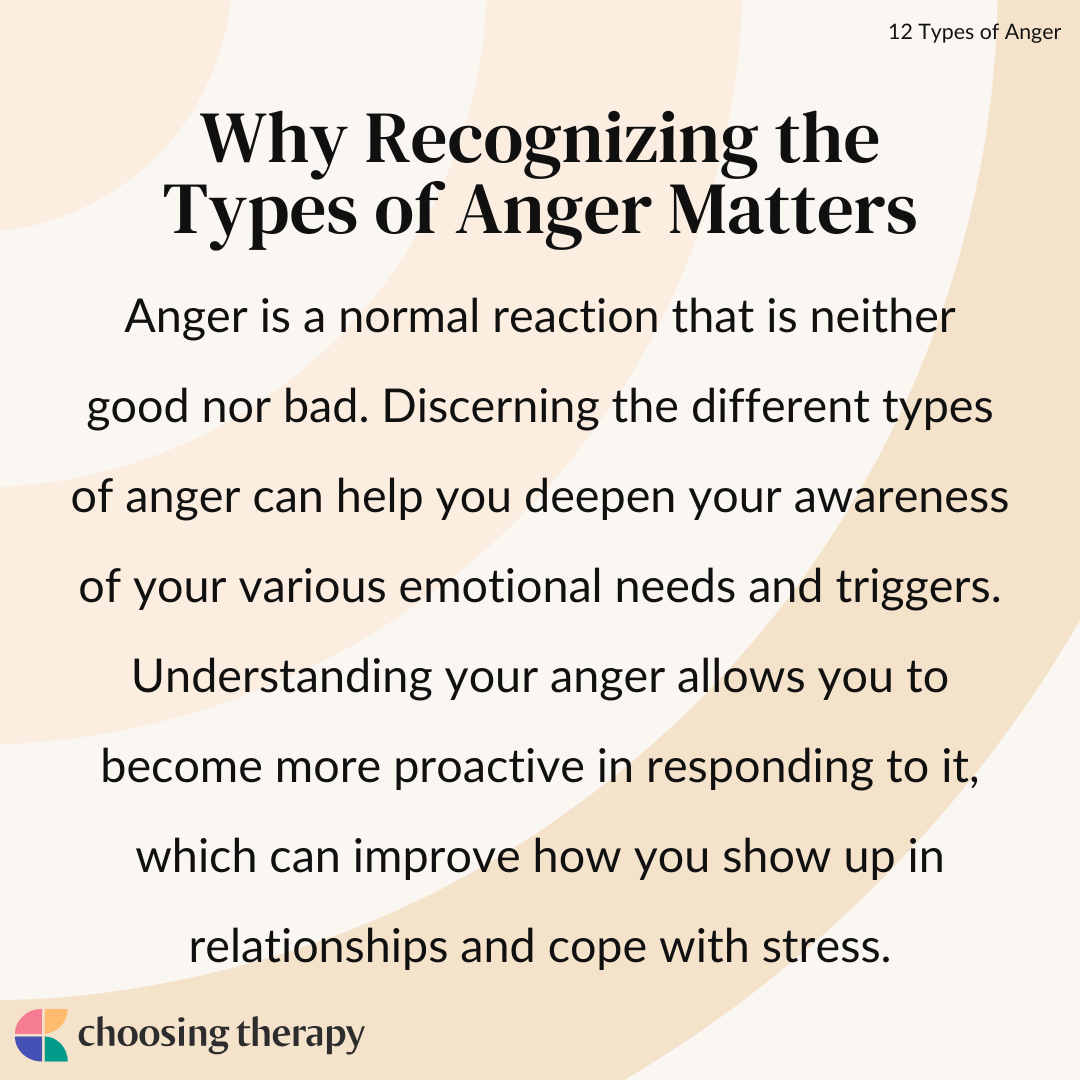
Anger is a normal reaction that is neither good nor bad. Discerning the different types of anger can help you deepen your awareness of your various emotional needs and triggers. Understanding your anger allows you to become more proactive in responding to it, which can improve how you show up in relationships and cope with stress.

12 Types of Anger & How to Manage Them

Because anger can display in different ways depending on the individual and situation, and because anger is a secondary emotion which makes it complex, it is often broken down into specific categories. Common examples include assertive, chronic, and overwhelmed anger, among others. While anger can be challenging to manage, learning how to identify which type you are experiencing can be helpful when working to control your anger.

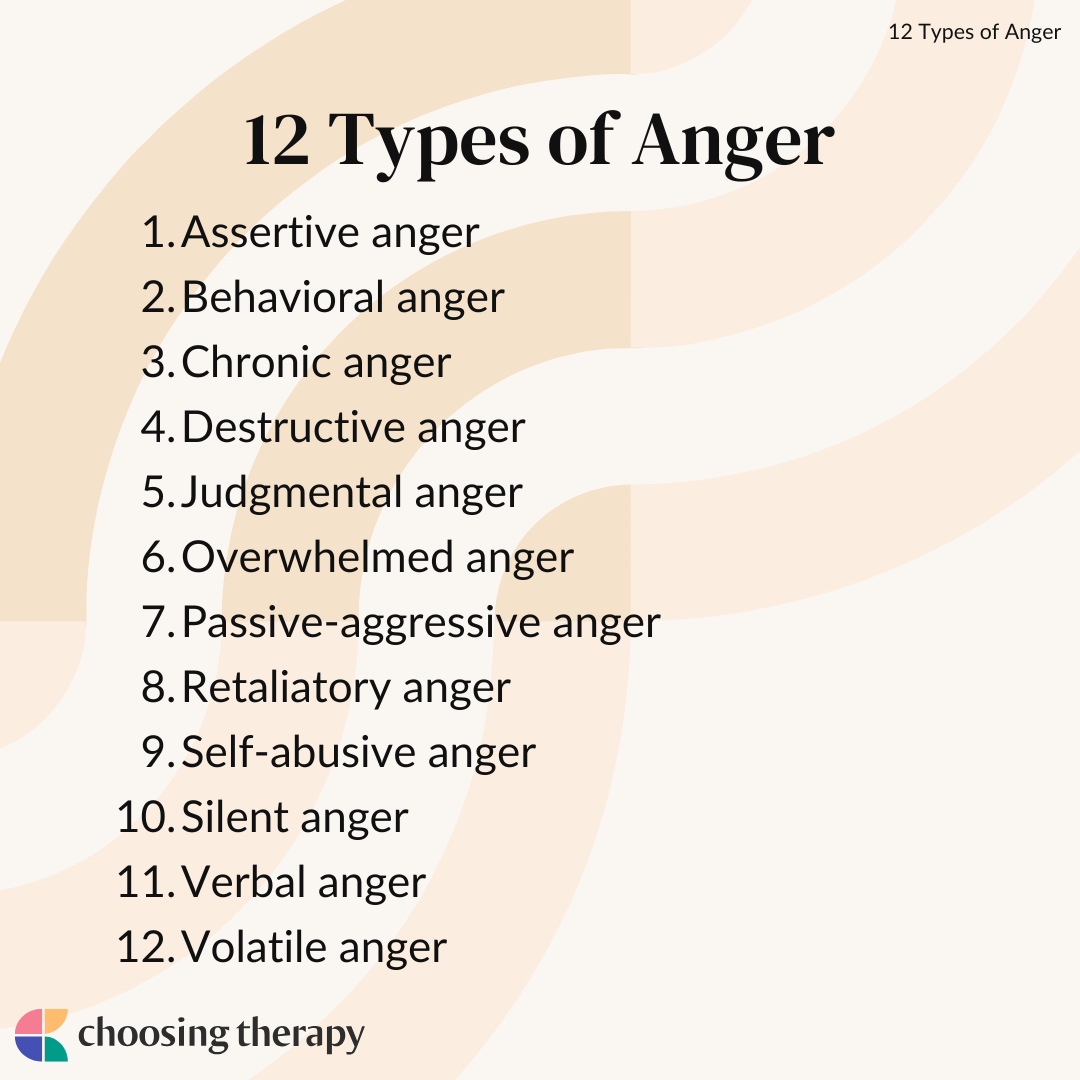
Here are 12 types of anger issues and tips for managing each type:

1. Assertive Anger

Assertive anger is considered a constructive form of anger expression. Rather than avoiding a conversation or being prone to outbursts of screaming or yelling, assertive anger is used as a healthy and productive expression of frustration to make positive change. This can look like expressing how you feel in a positive, safe way.

For example, you might start a statement with, “I feel angry when…” or, “I think…”. Assertive anger is combined with appropriate body language and, sometimes, pre-set expectations about methods to resolve or process the situation. This gives you the chance to express your anger in a way that enables positive change.1, 2, 3, 4, 6

Tips for Managing Assertive Anger

Practice assertiveness in safe situations. If you don’t feel regulated enough to speak in a friendly, collaborative tone, give yourself enough time to calm down. It’s generally better to wait than speak prematurely. Allow yourself to really feel your anger and recognize the unmet needs coexisting beneath it. Triggers aren’t always obvious, so reflecting inward can help you understand what your anger is really about.

2. Behavioral Anger

Behavioral anger is a physical reaction and is common in men with anger issues. This can be dangerous as it may be expressed through violence, potentially slipping into destructive or displaced anger. Behavioral anger is impulsive and unpredictable, sometimes ending with unhealthy legal or interpersonal consequences.

Behavioral anger can present as intimidating behaviors (e.g., cornering someone or raising your voice), throwing or shoving things, breaking things, or attacking someone. It’s important to identify whether your anger is slipping into this area due to potential legal or interpersonal consequences.1, 2, 3, 4, 6

Tips for Managing Behavioral Anger

Be honest with yourself about your behavioral anger tendencies. Spend some time identifying how and when this type of anger shows up for you. Think about other ways you can cope if you feel yourself getting escalated. Grounding yourself is key- you need to practice consistent emotional regulation to tame impulsive desires.  The more you can do this, the easier it feels to manage this type of anger.

3. Chronic Anger

Chronic anger is typically directed towards other people, situations, and even yourself, which can impact self-esteem. Sometimes, it can fly under the radar while simultaneously causing a lot of damage. Chronic anger often looks like a continuous, low-level feeling of anger, resentment, irritability, and frustration. Because of how you experience anger, you may have difficulty processing and expressing your needs, which can impact your health, stress levels, and relationships.1, 2, 4, 6

Tips for Managing Chronic Anger

Many people aren’t even aware they’re holding chronic anger. That’s because it can appear like sadness or low self-esteem. However, note the resentments you may have toward yourself or others. What messages do they tell you? What would it be like to let go of those resentments? What benefit do you have in holding onto them? Answering these questions can help you start the initial work of unpacking your anger.

4. Destructive Anger

Destructive anger is a significantly unhealthy experience of anger that can have multiple negative impacts. While there is limited research on this type of anger, it’s often seen in connection with the extreme end of behavioral anger. This may include extreme irritability or hatred of others, even when it isn’t warranted.

Destructive anger can look like verbal or physical actions used to hurt others such as throwing and breaking something that is important to the person you’re angry with. In relationships, this can sometimes present as stonewalling or shutting out your significant other emotionally. Destructive anger can impact many areas of your life in extremely unhealthy ways, potentially destroying important social connections.5

Tips for Managing Destructive Anger

Destructive anger can unquestionably hurt you and your loved ones. Managing this type of anger may require professional support and more concentrated interventions. But if you’re just starting out, pay attention to your earliest warning signs. You need to know your destructive anger triggers, and you must identify other ways to manage stress. Try to focus on mitigating stress in the ways that you can- even small steps can make a big difference.

5. Judgmental Anger

Judgmental anger is often a reaction to some perceived slight, someone else’s flaws (if you feel they impact you), or an injustice against you or someone else. Judgmental anger is identified in people’s core beliefs and basic perspective or understanding of the world. This core belief is generally one of feeling like you’re better or worse than others, leading you to judge them and become angry about their actions or expressions.

Judgmental anger often manifests as “justified fury,” where anger arises from a perceived injustice or personal slight. It may involve criticizing others, making disparaging remarks, or venting frustrations about unfair situations. Over time, this pattern can strain relationships, hinder emotional support systems, and contribute to feelings of isolation and diminished self-worth.1, 2, 4, 6

Tips for Managing Judgmental Anger

Try to consider how judgment is a form of self-protection. Often, we judge what we don’t understand. Sometimes we judge because we dislike something in someone else that represents something we either lack or want. Instead of trying to change your judgment, try to lean into compassion. What good can you find in that other person? What may have led them to act in the ways they do now?

6. Overwhelmed Anger

Overwhelmed anger is unpredictable and can impact your mental health over time. This type of anger builds up, especially when you don’t find ways to express or communicate how you feel. It may show itself when things hit a “boiling point,” or your ability to cope with anger and stress has been overwhelmed due to certain situations, feelings, or interactions.

Overwhelmed anger can look like a sudden snap of irritability and resentment following a long stretch of repression. While the expression of overwhelmed anger appears different for everyone, it will come on suddenly and may be preceded by a stressful event.1, 2, 4, 6

Tips for Managing Overwhelmed Anger

Managing overwhelmed anger often requires earlier intervention. You need to recognize what’s happening inside of you before reaching your threshold. Early warning signs come in many forms, but they may include fatigue, irritability, disconnect, and passive-aggression. Pay attention to these shifts and try to dial in on more self-care. This can help prevent your anger from “spilling over.”

ADVERTISEMENT

Help for Anger Management

Talk Therapy

A therapist can help you control your anger. BetterHelp has over 30,000 licensed therapists who provide convenient and affordable online therapy. BetterHelp starts at $65 per week and is FSA/HSA eligible by most providers. Take a free online assessment and get matched with the right therapist for you.

Help With Relationship Repair

Affordable Online Relationship Support – OurRelationship has been proven to help couples improve communication, intimacy, and trust. 94% would recommend it to a friend. Get Started

7. Passive-Aggressive Anger

Passive-aggressive anger is an avoidant form of expression. This kind of anger occurs when you suppress how you feel and attempt to avoid all types of conflicts. This can be dangerous, as your self-esteem levels are often impacted by anger. As such, passive-aggressive anger can have a negative influence on your relationships.

Passive-aggressive anger, which can be verbal or physical, includes emotional repression and avoidance of conflict. This may present as passive-aggressive comments (e.g., “I like your outfit, even though it doesn’t fit you”), sarcasm, or an intentional lack of response. Passive aggression is most common in the verbal form, but it can also look like closed-off body language or continuous procrastinating at work.1, 2, 3, 4, 6

Tips for Managing Passive-Aggressive Anger

Recognize the unmet needs existing underneath your passive-aggression. What are you really trying to convey? What fears do you have about actually being honest with your needs? Passive-aggression tends to be rooted in attachment insecurity, so trying to strengthen vulnerability with yourself and others can help you manage this type of anger.

If you do get passive-aggressive, try to stop the cycle as soon as you recognize it and repair it immediately.

8. Retaliatory Anger

Retaliatory anger is a common reaction and an instinctive response to being attacked. It can be influenced by a need for revenge after experiencing perceived hurt. This kind of anger is usually deliberately aimed at someone who hurt you and can be influenced by a need to gain control over an event. You may find yourself targeting your anger at specific people after feeling verbally or physically attacked. Retaliatory anger can potentially increase discomfort and anger levels in relationships.1, 2

Tips for Managing Retaliatory Anger

Identify what you’re hoping to achieve by retaliating against someone else. Really play this desire out in your mind. Note any satisfaction or discomfort that may arise. It’s sometimes helpful to really distinguish why you want to attack, and it can also be valuable to normalize that fantasy. This type of mindfulness also allows you to recognize the risks associated with doing so, and that can lead to behavioral changes.

9. Self-Abusive Anger

Self-abusive anger tends to be connected with shame. This type of anger is seen in people experiencing low self-esteem or feelings of worthlessness and hopelessness. Self-abusive anger is commonly used to help cope with these feelings, even though it only pushes people further away.

Self-abusive anger can affect you internally and externally. It can look like internalizing negative feelings and taking them out on yourself through self-harming behavior, alcohol or drug use, unhealthy and disordered eating, or negative self-talk (e.g., “You are a failure.”). On an external level, this may include lashing out or attacking others verbally.1, 2

Tips for Managing Self-Abusive Anger

The opposite of self-abuse is self-compassion. Self-compassion refers to treating yourself with kindness and love, the way you might treat a friend you really care about. The next time you feel critical toward yourself, pause. Ask yourself, What would I tell a friend experiencing something like this right now? How would I try to help them feel better? 

10. Silent Anger

Silent anger is a non-verbal, internal way of experiencing anger. Although you may not verbally express it, it is possible for others to read that you are angry. People who experience silent anger tend to keep these feelings inside and allow them to build up, which can lead to increased stress, tension, and behavior related to overwhelmed anger.

Silent anger can be an internal or external experience. Internally, this type of anger can create a build-up of uncommunicated frustration, anger, and resentment, causing undue stress and low levels of ongoing tension. Externally, it can present as closed-off body language and facial expression and restricted or minimal speech and tone.7

Tips for Managing Silent Anger

Silent anger is not inherently wrong, and it may be necessary for allowing yourself to process certain emotions safely. But there are risks associated with shutting others out. If you resonate with silent anger, it may be helpful to practice simply expressing yourself with one safe person. If that feels too challenging, consider just writing your feelings out. This allows you to process what’s inside you.

11. Verbal Anger

Verbal anger is an aggressive type of anger that can become abusive. Those who experience this type of anger are noted to feel remorseful after lashing out at the target of their anger and may even apologize after an episode. Verbal anger can present as lashing out or “going off” on someone verbally. Specific behaviors can include loud shouting, threatening behaviors, sarcastic comments, continuous and intense criticism, and ridicule. Keep in mind that verbal anger can transition into verbal abuse and also keep you from being able to maintain stable, healthy relationships.1, 2, 3, 4, 6

Tips for Managing Verbal Anger

It’s important to create clear boundaries for how you want to convey your anger. It’s not okay to criticize other people or shout at them. If you struggle with these patterns, identify all the reasons why you want to change. Write them down so they’re easily accessible, especially during heightened moments. Then, get in the habit of pausing when you feel that verbal anger coming on. Take a break, regroup, and then allow yourself to reconvene when you feel more regulated.

12. Volatile Anger

Volatile anger is an explosive type of anger that is sometimes called “sudden anger.” It can happen when someone experiences an annoyance, big or small, and explodes verbally or physically, potentially becoming destructive. This type of anger makes it difficult for the individual to express themselves, process, and communicate.

Volatile anger can look like a rapid progression from status quo to outrage over real or perceived slights. It is frequently destructive and can include shouting, yelling, throwing things, and physical aggression. This type of anger may keep you from being able to maintain stable and trustworthy relationships.1, 2, 4, 6

Tips for Managing Volatile Anger

Volatile anger is tricky because it often feels so sudden and intense. However, if you struggle with this, it just means you need more practice with emotional regulation. Get in the habit of regularly identifying your various emotions. Note what evokes anger within you. Pay attention to how it feels in your body before you react to it. Building this awareness offers you a greater capacity to change your habits.

Free Anger Management Worksheets

This collection of worksheets provides practical tools and strategies for managing your anger. Find the one you need below, or browse our full collection of anger management worksheets.

Complete WorkbookDownload

Nervous System RegulationDownload

Identifying Anger TriggersDownload

Exploring Hidden EmotionsDownload

Challenging Unhelpful ThinkingDownload

Setting Healthy BoundariesDownload

STOP Before RespondingDownload

Practicing GratitudeDownload

How Therapy Can Help Reduce Anger Issues

To process what is fueling or influencing your anger, it can help to engage with a therapist. By seeing a therapist or attending counseling, you can learn ways to process, communicate, and cope. Self-help techniques and coping mechanisms can also help when it comes to anger management. By combining therapy for anger and self-help techniques, you can begin to treat your anger and learn constructive ways to express it. Consider starting your search for the right therapist on an online therapist directory or by using one of the many online therapy platforms available for virtual therapy services.

ADVERTISEMENT

Is Your Anger Driving Away the People You Care About?

Therapy can help. BetterHelp has over 30,000 licensed therapists who provide convenient and affordable online therapy. BetterHelp starts at $65 per week and is FSA/HSA eligible by most providers. Take a free online assessment and get matched with the right therapist for you.Free Assessment

In My Experience

“If you are struggling with your anger, you’re not alone. It can be difficult to explore and express your emotions, especially if you have experienced abuse or trauma in the past. Help does exist though. Don’t be afraid to reach out to a therapist.”

Headshot of Renee Skedel, LPCC

Renee Skedel, LPC

Types of Anger Infographics

Why Recognizing the Types of Anger Matters
12 Types of Anger & How to Manage Them

Sources Update History

ChoosingTherapy.com strives to provide our readers with mental health content that is accurate and actionable. We have high standards for what can be cited within our articles. Acceptable sources include government agencies, universities and colleges, scholarly journals, industry and professional associations, and other high-integrity sources of mental health journalism. Learn more by reviewing our full editorial policy.

Click here to open the article sources container.

Show more

Your Voice Matters

Can’t find what you’re looking for?

Request an article! Tell ChoosingTherapy.com’s editorial team what questions you have about mental health, emotional wellness, relationships, and parenting. Our licensed therapists are just waiting to cover new topics you care about!

Request an Article

Leave your feedback for our editors.

Share your feedback on this article with our editors. If there’s something we missed or something we could improve on, we’d love to hear it.

Our writers and editors love compliments, too. 🙂

Leave Feedback

Additional Resources

To help our readers take the next step in their mental health journey, ChoosingTherapy.com has partnered with leaders in mental health and wellness. ChoosingTherapy.com is compensated for marketing by the companies included below.

Talk Therapy 

Online-Therapy.com – Get support and guidance from a licensed therapist. Online-Therapy.com provides 45 minute weekly video sessions and unlimited text messaging with your therapist for only $64/week. Get Started

Learn Self Calming Techniques

Mindfulness.com – Change your life by practicing mindfulness. In a few minutes a day, you can start developing mindfulness and meditation skills. Free Trial

Mental Health Newsletter

A free newsletter from the experts at ChoosingTherapy.com for those interested in mental health issues and fighting the stigma. Get helpful tips and the latest information. Sign Up

ChoosingTherapy.com Directory 

Find local therapists that offer online and in-person therapy. Search for therapists by specialty, experience, insurance, and location. Find a therapist near you.SPONSORED

Online Anxiety Test

A few questions from Talkiatry can help you understand your symptoms and give you a recommendation for what to do next.

Take Test

Best Online Therapy Services

There are a number of factors to consider when trying to determine which online therapy platform is going to be the best fit for you. It’s important to be mindful of what each platform costs, the services they provide you with, their providers’ training and level of expertise, and several other important criteria.

Read more

Anger Newsletter

A free newsletter for those impacted by mental health issues. Get helpful tips and the latest information.Submit

Find a therapist in your state

Get the help you need from a therapist near youCity or zipSearch

Alabama
Arizona
California
Colorado
Connecticut
District of Columbia
Florida
Georgia
Illinois
Indiana
Maryland
Massachusetts
New York
North Carolina
Ohio
Pennsylvania
Texas
Virginia

Are you a Therapist?Get Listed Today

ChoosingTherapy.com Logo White

FOR IMMEDIATE HELP CALL:

Medical Emergency: 911

Suicide Hotline: 988

View More Crisis Hotlines

Choosing Therapy on Facebook
Choosing Therapy on Instagram
Choosing Therapy on X
Choosing Therapy on Linkedin
Choosing Therapy on Pinterest
Choosing Therapy on Tiktok
Choosing Therapy on Youtube

© 2025 Choosing Therapy, Inc. All rights reserved.