What You Need to Know About The Apostle’s Creed?

What You Need to Know about the Apostle’s Creed

Larry White | Writer

Saturday, March 7, 2020

The Apostles’ Creed has been with the church from almost the very beginning (in some form). It is a statement of belief that contains the important facets of what Christians should hold as true. The Apostles’ Creed is not a statement to be made that guarantees a person salvation if they recite it, it is a condensed theological system that reflects what is right for a follower of Jesus Christ to believe. The English version is as follows:

I believe in God the Father Almighty,
maker of heaven and earth;

And in Jesus Christ, his only Son, our Lord,
who was conceived by the Holy Spirit,
born of the Virgin Mary,
suffered under Pontius Pilate,
was crucified, died, and was buried;

he descended to the dead.
On the third day he rose again;
he ascended into heaven,
is seated at the right hand of the Father,
and will come again to judge the living and the dead.

I believe in the Holy Spirit,
the holy catholic church,
the communion of saints,
the forgiveness of sins,
the resurrection of the body
and the life everlasting. Amen.

History of the Apostle’s Creed

Why would something like the Apostles’ Creed come into existence and then become very widely disseminated and used? Consider the early days of the Christian faith. Even as the letters of the New Testament were being written, there are hints that the writers were responding to beliefs about the nature of Jesus Christ that were not considered true by the founding members of the church.

Secular and religious ideas, such as Gnosticism, the worship of Diana, and the Roman Imperial Cult, were migrating into local congregations and these would have eventual effects as they spread around the world. The Gospel message of salvation by grace through faith can become very difficult to perceive if the nature of Jesus’ existence is not actually believed. How could they keep the faith true and uncorrupted? Add to this that most of the world in that day were uneducated and illiterate, and teaching everyone theological ideas becomes a difficult, almost impossible task.

A creedal statement that is easy to memorize fits the bill nicely. The earliest known form of creed was called the Roman Symbol and is known to have existed by the mid-second century AD. It contains most of the main components of what is now known as the Apostles’ Creed. The earliest documented reference to the current Apostles’ Creed is from a letter to Pope Siricius in 390 AD, as explained here by Herbert Thurston for the Catholic Encyclopedia. These creeds appear to have become popular because of the Christian belief that people must confess/profess their beliefs with their mouths to be saved. Early church leaders would have taught the creeds so that a person could recite them to the congregation and witnesses to their baptisms.

Are There Other Creeds?

Another creed that is perhaps more used than the Apostles’ Creed is the Nicene Creed. Its name comes from the area of Nicea near Constantinople where the Council of Nicea was held in 325 AD. This council was held to address the Arian Heresy which disputed the nature of Christ. Church leaders of the day were pressured to resolve the issue by Emperor Constantine of the Roman Empire so that the empire itself would maintain a more peaceful status and not descend into a religious conflict.

As such, the Nicene Creed builds on a similar formula as the Apostles’ Creed by keeping a Trinitarian formula that describes the nature of God, but it further explains the substance of Jesus as being the same as God the Father and the Holy Spirit. Essentially, one God with three distinct natures. The following is a translation from the Latin version (note the language regarding the substance issues):

I believe in one God,
the Father almighty,
maker of heaven and earth,
of all things visible and invisible.

I believe in one Lord Jesus Christ,
the Only Begotten Son of God,
born of the Father before all ages.

God from God, Light from Light,
true God from true God,
begotten, not made, consubstantial with the Father;
through him all things were made.

For us men and for our salvation
he came down from heaven,
and by the Holy Spirit was incarnate of the Virgin Mary,
and became man.

For our sake he was crucified under Pontius Pilate,
he suffered death and was buried,
and rose again on the third day
in accordance with the Scriptures.

He ascended into heaven
and is seated at the right hand of the Father.

He will come again in glory
to judge the living and the dead
and his kingdom will have no end.

I believe in the Holy Spirit, the Lord, the giver of life,
who proceeds from the Father and the Son,
who with the Father and the Son is adored and glorified,
who has spoken through the prophets.

I believe in one, holy, catholic and apostolic Church.
I confess one Baptism for the forgiveness of sins
and I look forward to the resurrection of the dead
and the life of the world to come. Amen.

Among the other creeds is one called the Athanasian Creed and it focuses on the nature of God as the Holy Trinity and the nature of Jesus Christ as being fully human and fully divine. There has been considerable argument recently as to the authorship of this creed, but the Roman Catholic and Orthodox Churches have considerable weight of argument available to support Saint Athanasius as the author of said creed.

All that being considered, if you read it, you will discover a very beautiful description of the nature of the Godhead and the Christ. It is an unusual creed in that not only does it prescribe what a person should believe about God, it also describes specific condemnations for those that do not believe the truth found in these statements.

Variations and Controversy

The Apostles’ Creed does vary within denominational contexts. The Roman Catholic and Orthodox versions both refer to believing in a “catholic Church”, while Protestants use an uncapitalized “church.” The lower-case version is an emphasis on the broader or more universal nature of the entire church due to a perception that capitalizing “Church” emphasizes the specific Roman portion of the church. The word “catholic” actually means “universal”, so some church bodies reflect that word in their versions of the Apostles’ Creed to avoid the controversy within their contexts.

Along this same line of thought, there is a difference in understanding regarding the “Communion of the Saints” belief contained within the Apostles’ Creed. For Orthodox and Catholic Christians, this statement describes succinctly the belief that on earth, we have the ability to communicate with the church-canonized saints (usually martyrs) who have passed to eternity, and ask them to pray for us in their proximity to God in heaven. This concept is explained more here by Catherin O’Connell-Cahill.

For many Protestants, this presents a theological problem as most do not hold a belief that allows for praying to the dead (in heaven) or praying for the dead (in purgatory). A Protestant understanding of this expression is that all believing Christians are saints and that we have a commonality of belief and eternal hope with those who have gone before us in the faith. In both expressions, it is held that all Christians – past, present, and future – have a shared heritage and faith regarding the coming kingdom of God, and that the honored dead should be remembered in prayer.

Another controversy deals with the teaching that Jesus “descended into Hell” or “descended to the dead.” As an example, the United Methodist Church has a version of the creed that removes this teaching, but John Wesley, the founder of Methodism, always included it when recounting it in his writings.

The Apostles’ Creed has normally included this statement and is a reference to the Apostle Peter’s teaching that between the death and resurrection events, Jesus descended to the dead and preached the message of deliverance to the prior dead (1 Peter 3:18-20) (1 Peter 4:6). Some claim that this teaching is not validated enough in the scriptures, and so they exclude the statement from their version of the creed.

Is the Apostle’s Creed Biblical?

The Apostles’ Creed has been broken down into twelve sections by most of the older branches of the Church. Each of these sections contains Biblical support that has been cited over the millennia. There have also been significant arguments regarding some of these beliefs and their Biblical support.

This article does not propose to make an argument for or against the items of the creed, but it does intend to share what parts of the Bible have been cited as support. Some of the creedal items have several Bible verses that support them, some only a few. I will share one or two per section for the sake of brevity and I would encourage you to read the verses and prayerfully decide for yourself.

1. I believe in God the Father almighty, creator of heaven and earth. (Deuteronomy 6:4) (Gen 1:1)

2. I believe in Jesus Christ, his only Son, our Lord. (John 3:16)

3. He was conceived by the power of the Holy Spirit and born of the Virgin Mary. (Luke 1:26-38)

4. Under Pontius Pilate, He was crucified, died, and was buried. (Luke 23:23-25)

5. He descended to the dead. On the third day he rose again. (1 Peter 3:18-20) (1 Cor. 15:3-5)

6. He ascended into heaven and is seated at the right hand of the Father. (Mark 16:19)

7. He will come again to judge the living and the dead. (2 Timothy 4:1)

8. I believe in the Holy Spirit, (John 15:26)

9. the holy Catholic Church, the communion of saints, (1 Cor 12:12-13) (Revelation 8:3-4)

10. the forgiveness of sins, (Matthew 6:14-15)

11. the resurrection of the body, (John 6:35-40)

12. and the life everlasting. (1 John 5:11-12)

While the Apostles’ Creed contains the main message of the Gospel within it, it actually has a broader scope. The creed was used as a confessional statement (and still is) for people preparing for baptism so they are already saved. The role of the creed in those moments is to formulate a statement of belief that incorporates ideas regarding God’s nature and the nature of the Church.

Though there has been controversy over the Apostles’ Creed over many years of the history of the Church, it has been a part of church life for a very long time. It is a powerful tool for teaching Christian doctrine that a person can access from memory. When we do this, we are acknowledging the wisdom of the ancient Church in creating an educational product that combats subversive ideas that can be dangerous to a person’s faith. So read the Apostles’ Creed. Get to know it and let it help you grow in your faith.

What Does Jeremiah 29:11 Mean?

What Does Jeremiah 29:11 Mean? ►

For I know the plans I have for you”-[this is] the Lord’s declaration-“plans for [your] welfare, not for disaster, to give you a future and a hope.

Jeremiah 29:11(HCSB)

Verse Thoughts

Jeremiah warned Israel to stop their idol worship, which had replaced their devotion to God. He demanded the destruction of the pagan gods they hold dear and every false deity in which they trusted. BUT GOD Who is loving and gracious, long-suffering and faithful, pronounced His bitter rod of severe chastening.. due to their apostasy, would also prove to be a blossoming staff of sweet comfort and peace, grace and mercy – love and hope and joy.

And so Jeremiah wrote a message of comfort to the Jew who had been exiled to Babylon, with King Jeconiah. His letter was addressed to the elders and priests, the prophets and the queen mother, the court officials, princes, craftsmen, and all the people. He promised that God’s future plans for His people were rooted in His never-failing faithfulness towards them. He gave them a promise of future peace and wonderful hope – not a pledge of punishment that would result in their ultimate disaster and destruction.

They were to acknowledge that God had ordered their exile in Babylon and not Nebuchadnezzar. Their deportation from the promised land was to be recognised as a punishment for the nation’s apostasy. But despite their disobedience toward the holy one of Israel, the gracious thoughts God has towards His people, and the future plans He had prepared for them, were designed to prosper them and bring them peace and comfort, safety and success. it was not a scheme to harm them or bring them disaster.

God’s instruction to His people was to settle in Babylon and not expect to return immediately to their homeland. They were to settle down and build houses. They were to plant gardens, get married, have children, and even look forward to their grandchildren. They were to live quiet lives in Babylon and contribute to the welfare of the city and the well-being of its citizens. And they were instructed to pray for blessings on their captors.

God promised that if they were patient and submitted to His words, they would thrive as a nation, and the city would prosper. Indeed, over the years, the stigma of being in bondage as slaves would reduce and their autonomy as a people-group would flourish. They were to harken to God’s word and be careful not to be hood-winked by the deceptive teachings of false prophets, and they were given a promise that at the end of 70 years, the Lord would restore them to their homeland.

Jeremiah’s letter to the Babylonian exiles encouraged the people and brought with it a beautiful promise: “For I know the plans I have for you” declares the Lord, “they are plans for your welfare and good, and not for disaster. They are plans to give you a future and a hope.

Jeremiah’s prophecy was fulfilled, in part, when God graciously started to bring back His people to their land and reestablish them in the holy city of Jerusalem. It began with an edict of Cyrus the Great, and continued with other great kings of Babylon and Persia. Those that obeyed God’s word returned to their homeland with Ezra and Nehemiah, while those who remained were really disobeying God’s call to return.

But God in His grace even used exiles, like Esther and Mordecai, who chose not to return to their homeland, at the end of the 70-year long exile, as instruments to save many Jewish lives from the evil plot of wicked men like Haman, and He graciously blessed many Men of Israel on The Day of Pentecost: “Parthians and Medes and Elamites, and residents of Mesopotamia, Judea and Cappadocia, Pontus and Asia, Phrygia and Pamphylia, Egypt and the districts of Libya around Cyrene, and visitors from Rome, both Jews and proselytes, Cretans and Arabs- for these people would have been descendants of Babylonian exiles, who heard the gospel of Christ in their own language and tongue – and were saved.

God still has a future plan for Israel’s well-being, just as He has for all God’s children. His plan of redemption is designed to give all who believe a future… filled with hope and not with calamity. This glorious verse of comfort sparkles with reassuring radiance, that the future plan God has for all of His people, (both for Israel and the Church), are for our eternal good and spiritual welfare, as well as our temporal and physical needs.

The Lord desires the best for His children even though we may stray far from Him. His plan for His children is to give us a future and a hope. He knows that only as we sever our reliance on the world’s destructive securities and rest our trust entirely on Christ Jesus our Lord, will we break free from the yoke of this world’s slavery.

We have an assurance that whatever we may have to face today, God’s thoughts toward us are only good continually – “for I know the plans that I have for you”, declares the LORD. “They are plans for peace and not disaster – plans to give you a future filled with hope”.

D

My Prayer

Thank You, Lord, for the good plans You have purposed for me and for all Your children. Enlarge my vision of You and enable me to trust Your word of truth through all the circumstances of my life, knowing that Your thoughts towards me are only good continually. Thank You, Father, that all things work together for good, for those that love You and are fitting into Your plans and purposes. Continue to keep and protect Your people Israel and we pray that many would come to trust in Jesus, their Messiah, and King. This we ask in Jesus’ precious name and for his greater glory and joy, AMEN.

What Does Jeremiah 29:13 Mean?

 What Does Jeremiah 29:13 Mean? ►

‘You will seek Me and find Me when you search for Me with all your heart.

Jeremiah 29:13(NASB)

Verse Thoughts

The promises of God pepper the pages of scripture like crystal droplets of sparkling rain, sprinkling life into a dry and dusty desert and scattering hope into the hearts of all God’s people. The promises of God tumble and glimmer through the Word of God like a myriad of twinkling stars, peeping through the glowering skies of doubt and sorrow – refreshing the soul; giving hope to the faint-hearted and providing encouragement to the weary.

Though the context of this verse is Israel’s Babylonian captivity and their eventual restoration and redemption, this precious verse states an eternal principle and timeless promise – that the Lord is ever near to all who seek Him, and those that search for Him aright, are certain of finding Him. This is a verse that promises all those who seek the Lord, in spirit and in truth, will be sure to find Him, for the Lord has promised: you shall seek Me, and find Me, when you shall search for Me with all your heart.

Israel had been carried into captivity as a consequence of their sin and apostasy, and the people are encouraged by Jeremiah to prepare for a prolonged sojourn in Babylon. They were exhorted to build houses, grow crops, get married and have children, because God had ordained that the punishment they justly deserved would last for 70 years. Some would die in the land of their captivity, but God had plans for His people. He had plans for their good and not their harm. He had plans to prosper them and to give them a secure future and a great hope.

But during their exile, when they are separated from their promised land, the people were not to forget the Lord. They were to continue to trust Him and teach their children to do the same. And they were given a very special and encouraging promise, “You will seek Me and you will find Me… when you search for Me with all your heart.”  God would not be lost to His people forever, but they must set their heart to search diligently for the Lord – to search for Him with ALL their heart; ALL their soul, ALL  their mind and ALL their strength.

The promise given to Israel by Jeremiah was that those who earnestly sought the Lord would find Him. They would discover Him to be the godly Way; the singular Truth, and the Path to perfect peace with God. They were given the assurance that those who diligently and conscientiously look for Him, WILL find Him. They will find Him to be the only Way, the singular Truth, and Life eternal. Those that sincerely search for the Lord will gain the abundant Life He promises – a life that only comes through faith in Christ.

The majority of Israel have yet to discover that the One for Whom they are to diligently seek is the Lord Jesus Christ. He is their Messiah, Who came to rescue them at God’s appointed time, as foretold by Scripture. He is their kinsman-Redeemer and their Dayspring from on High. He is the prophet of the Most High God and a light to lighten the Gentiles. He is the glory of His people Israel and the One Who will heal their soul and guide their feet into the way of peace.

He is the Word made flesh Who came to dwell among His people and to shine light into their darkened hearts. He came to His own people at God’s appointed time – but they did not recognise Him as the only Way, the singular Truth and Life eternal and He was rejected and cruelly crucified.

As Christians, we already know Him as Jesus, our Saviour, for Christ died to bridge the unbridgeable gap between a holy God and the imperfect race of man. But like Israel, we are promised a much deeper knowledge and closer communion with Him, if we will plough into the depths of His Word; reach into the heights of His Truth and look steadily into the Light of His Countenance – the face of the Lord Jesus Christ.

Like Israel, we have been promised that when we seek Him and search for Him with ALL our heart will find Him. Let us, therefore, with wholeness of heart; fervency of spirit; sincerity of soul and diligence of mind freely abandon the good to search for the very best, knowing that ALL who seek the Lord, will find Him to be rest for their soul; healing for their heart; hope for the future and life everlasting.

Praise God that ALL who seek Him and search for Him have been promised, in His WORD, that He will be everything they need, when they search for Him with their whole heart.

B

My Prayer

Thank You, heavenly Father, that I am Your child. I want to know You more and pray that as I seek You through Your Word and come before Your throne of grace, in prayer and praise, You will show me more of Yourself. Instil in my heart a desire to seek You more and search for You with my whole heart and I pray that  I will discover a depth of Your perfect character that I have never seen before. Let me reflect You in thought, word, and deed, as Christ is being formed in me, in His name I pray, AMEN.

1st Thessalonians 5:19 and what does it mean to All People?

1st Thessalonians 5:19 and what it means to All People?

By: Anthony Joseph Hopkins/ March 6, 2020

C

        Praise The Lord Saints!!  Praise The Lord Everyone!!  How are you doing today?  Fine, I hope.  I would like to ask everyone a very important question.  What does 1st Thessalonians 5:19 Mean?

 The word quench means to put out as of a fire.  The word quench also means to drown.  I want to say that for 18 years, I was solely responsible for quenching my Holy Spirit by drinking alcohol and smoking marijuana.  I am beginning to realize that my Holy Spirit, which is inside of me, is very important.  It enables me to know the truth from Jesus Christ.  I will admit that I was hearing voices that were not the Holy Spirit for the past 10 years.

D


Next, I want to inform all of you that it is not very easy hearing voices that are not the Holy Spirit.  This actually means that you are losing your mind.  I know that; the voices that I have heard for 10 years were principalities, and powers.  I know that I was not aware that I was hearing voices.

 I know that it is not very easy hearing something that consists of curse words, and other vulgarities that are from an unknown spirit.  I know that this is not very easy to deal with right now.  During the time that I was involved in active addiction, I was putting out the Spirit’s Fire.  I know that I still have a whole lot to learn.  I still have a very long way to go in my Christian Walk right now. 

E

Further, I want to say that I love people.  I love everything that God has created with His Word.  Everything was spoken from the Mouth of God.  He even knew my own existence.  He knew me when I was inside of my Mother’s womb.  He knows everything about me more than man himself.  If someone tells you that they know all about you, they are telling a lie.  If this person knew me, then, they would actually know my own existence.  Back to the subject at hand, I was smothering my Holy Spirit by drinking beer and wine on a daily basis for 18 years. 

Moreover, I want to inform all of you that my life has not been very easy growing up in the streets of Dayton, Ohio.  My mother and my stepfather used to drink alcohol on a daily basis.  I did not know any better because I actually started drinking at an early age.  My own family members do not even know exactly what I was doing at the time.  I have kept things to myself.  I rarely drunk anything in front of my younger siblings.  I did not like for my nieces and nephews to drink alcohol. 

F

In Addition, I was responsible for quenching my Holy Spirit by drinking alcohol and smoking marijuana.  This is the truth because I graduated from high school 3 years late.  I was solely responsible for being a Juvenile Delinquent.  I will admit that I was anti-social by all means.  At that time, from 1979 -1986, I was very anti-social.  I was a follower of the streets.  I did whatever the world was doing.  I am telling the truth because I do not want my nieces and nephews to follow my footsteps in life.

Also, I want to inform all of you that I earned bad grades in school.  I really hated math.  I hated authority.  I want to inform all of you that my nieces and nephews are following my footsteps.  Therefore, this message is for them.  This message is for everyone who is living in darkness by choice.  It is not very easy for people to attend church, and adhere to the New Covenant.  I know that there a millions of people are getting tattoos and piercings on their bodies.  This is very sad!!  God does not like it when we defile and destroy our own bodies.

Finally, the Holy Spirit is very important to all of us.  The Holy Spirit that is inside of all of us, is solely responsible for helping us.  The Holy Spirit is not supposed to be quenched over our own foolishness.  Please take care of yourselves.  God loves you and so do I.


Faithfully Submitted,


Anthony Joseph Hopkins

Can We Really Pray Without Ceasing?

Can We Really “Pray without Ceasing”?

Pamela Palmer

Friday, March 6, 2020
Prayer is a powerful way to connect with God, to develop a relationship with Him, and to cast your cares upon Him. There are countless examples of prayer throughout Scripture. It is apparent that prayer is significant to the faith of a believer. When we read about the life and ministry of Jesus in the Gospel accounts, we find that He prayed often and made this spiritual discipline a priority in His life. Jesus took time to get away and spend time with God. Prayer is incredibly important for every believer’s spiritual growth.

The Apostle Paul affirmed the significance of prayer, and wrote in one of the epistles, “Rejoice always, pray without ceasing, give thanks in all circumstances; for this is the will of God in Christ Jesus for you” (1 Thessalonians 5:16-18).

To pray is God’s will for us. But, as inspiring as that sounds, is it possible to pray without ceasing? What did Paul mean by such a statement? Pray without ceasing means to have a heart inclined to prayer, to pray often, and to make the discipline of prayer a high priority, just as Jesus did.

Photo credit: ©Getty Images/palidachan

Who Wrote 1 Thessalonians?

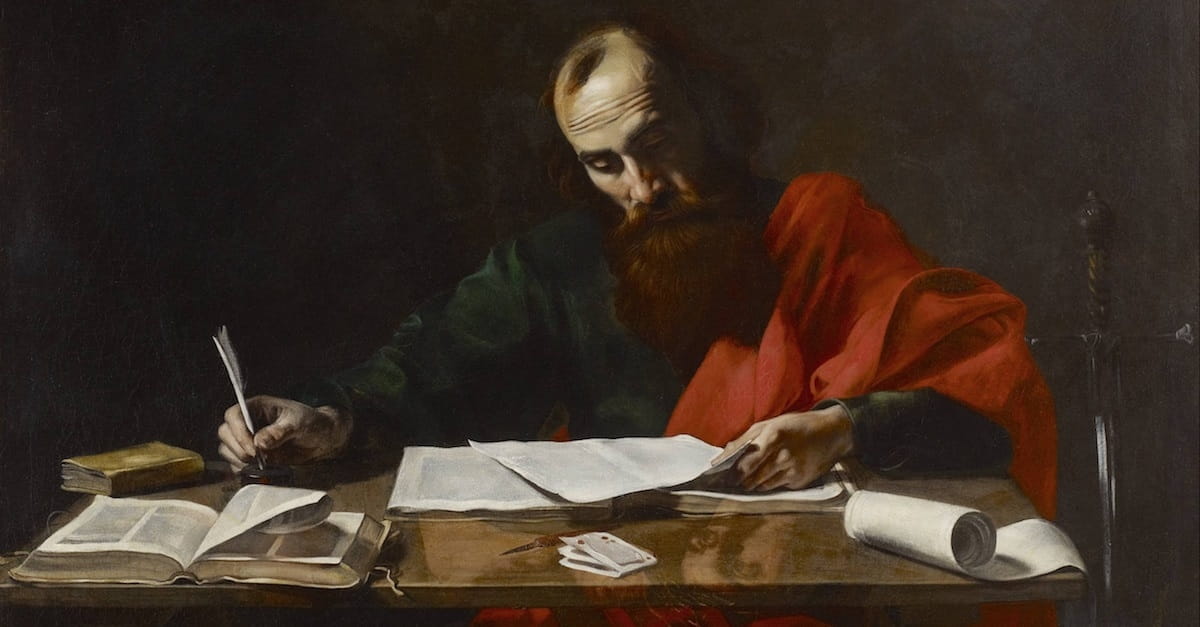
The Apostle Paul wrote the epistle we know as 1 Thessalonians to the church of Thessalonica. He sent it shortly after he had established the congregation there. In the letter, he affirmed and commended their ongoing love and passion for Jesus. Paul also warned the church of Thessalonica to be prepared for the second coming of Jesus by keeping their hearts pure and holy for His return. It is in this context that we find Paul’s assertion to “pray without ceasing.”

In the fifth chapter of this epistle to the Thessalonians, Paul urged the church to cling to the Gospel they had received and to hold onto what was good and righteous. They were to continue living holy lives and prayer was essential to that instruction. Paul reminded them of the importance of prayer to keep their faith strong and to stay connected to God’s truth so that they would not be deceived by false messages.

Photo credit: Wikimedia Commons/Public Domain Image/Valentin de Boulogne

Does Translation Impact Meaning?

The Greek word translated to “without ceasing” is αδιαλειπτως (adialeíptōs), which means constantly or without intermission. In most Bible translations, this word is interpreted as “without ceasing,” but other versions also translate to continually (NIV) or all the time (The Message).

Whichever version of the Bible you read, the meaning remains the same and consistent with the Greek word. The various translations of the Bible help emphasize the same message, which is to pray often and diligently.

What Does the Bible Say about Prayer?

In the Bible, there are many kinds of prayers demonstrated. In your own life, you may also be accustomed to saying a variety of prayers. The verses and prayers that we read throughout Scripture can become the prayers we use in our time with God. Below are several examples of different prayers throughout the Bible:

Photo credit: ©Sparrowstock

Can We Really Pray without Ever Stopping?

It would be impossible to actually pray without ever stopping. We have thoughts, we read, we sleep, we eat, we converse with others, we work, and have a whole host of responsibilities to tend to throughout the day that would disrupt our attempts at constantly praying. There are plenty of tasks and roles we need to participate in that would naturally hinder our ability to pray without ever stopping.

When we take into account the context of what Paul wrote, we recognize that Paul wasn’t instructing believers to give up their responsibilities and only pray. Rather, this passage teaches us that we need to commit ourselves to prayer and make it a top priority in our lives. By doing so, we will remain holy and pure, having hearts ready for when Jesus returns. Prayer helps us stay accountable to living righteously.

Photo credit: ©Getty Images/liderina

The Lord’s Prayer (The Model Prayer Taught By Jesus)

“This, then, is how you should pray: ‘Our Father in heaven, hallowed be your name, your kingdom come, your will be done, on earth as it is in heaven. Give us today our daily bread. And forgive us our debts, as we also have forgiven our debtors. And lead us not into temptation, but deliver us from the evil one’” (Matthew 6:9-13).

Thanksgiving (Gratitude), Worship (Reverent Devotion), or Praise (Expressed Admiration)

“I will give thanks to you, Lord, with all my heart; I will tell of all your wonderful deeds” (Psalm 9:1).

“There is no one holy like the Lord; there is no one besides you; there is no Rock like our God” (1 Samuel 2:2).

“My soul magnifies the Lord, and my spirit rejoices in God my Savior, for he has looked on the humble estate of his servant” (Luke 1:46-48).

Prayers Seeking Forgiveness

“Be merciful to me, O God, because of your constant love. Because of your great mercy wipe away my sins! Wash away all my evil and make me clean from my sin!” (Psalm 51:1).

“If we confess our sins, he is faithful and just and will forgive us our sins and purify us from all unrighteousness” (1 John 1:9).

Photo credit: iStock/Getty Images Plus/4maksym

Prayers for Various Needs, Healing, and Guidance

“Hear my voice when I call, Lord; be merciful to me and answer me” (Psalm 27:7).

“Guide my steps by your word, so I will not be overcome by evil” (Psalm 119:133).

“Heal me, O Lord, and I will be healed; save me and I will be saved, for you are the one I praise” (Jeremiah 17:14).

“”So I say to you: Ask and it will be given to you; seek and you will find; knock and the door will be opened to you” (Luke 11:9).

“Do not be anxious about anything, but in every situation, by prayer and petition, with thanksgiving, present your requests to God” (Philippians 4:6).

Prayers of Intercession (Praying for Others, for Healing, or Deliverance)

“Again I say to you, that if two of you agree on earth about anything that they may ask, it shall be done for them by My Father who is in heaven. For where two or three have gathered together in My name, I am there in their midst” (Matthew 18:19-20).

“Then some children were brought to Him so that He might lay His hands on them and pray” (Matthew 19:13).

“Is anyone among you sick? Let them call the elders of the church to pray over them and anoint them with oil in the name of the Lord. And the prayer offered in faith will make the sick person well; the Lord will raise them up. If they have sinned, they will be forgiven” (James 5:14-15).

Photo credit: ©Getty Images/CandyBoxImages

Individual Prayers (Praying to God and Spending Time with Him One-on-One)

“When you pray, go away by yourself, shut the door behind you, and pray to your Father in private. Then your Father, who sees everything, will reward you” (Matthew 6:6).

“It was at this time that Jesus went off to the mountain to pray, and He spent the whole night in prayer to God” (Luke 6:12).

Communal Prayers (Praying with Other Believers)

“They all met together and were constantly united in prayer, along with Mary the mother of Jesus, several other women, and the brothers of Jesus” (Acts 1:14).

“Therefore confess your sins to each other and pray for each other so that you may be healed. The prayer of a righteous person is powerful and effective” (James 5:16).

Photo credit: ©Getty Images/rawpixel

How Can We Apply This Verse to Our Lives?

1 Thessalonians 5:17 serves as a serious reminder to all believers how significant prayer is to our faith. Prayer is the way we talk to God, hear from God, and keep our minds on Him. Prayer is the channel in which we can let go of fears and concerns, and how we lift up our praises and thanks to God.

Prayer is vital to our spiritual formation and growth. Just as Jesus was often seen taking time away to go pray, we should do the same. Paul knew that prayer was key to guarding our hearts against evil and to keeping ourselves in line with God’s will.

As Christians, it is important to pray to God and to carve out time throughout the day to speak to Him and worship Him. Paul was right when he wrote to the church of Thessalonica, urging them to pray often because prayer is what helps us find our way through difficult times, tough decisions, or expressing our hopes and joy. Prayer draws us closer to God and helps us practice our faith. Prayer has been a spiritual practice since the beginning of time and the point Paul made was that prayer is still something that all Christians need to integrate into our lives.

What Does Leviticus 1:2 Mean?

◄ What Does Leviticus 1:2 Mean? ►

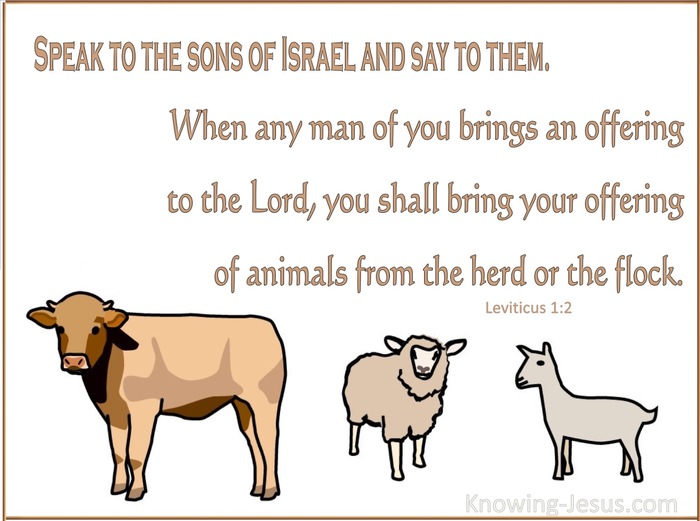
“Speak to the sons of Israel and say to them, ‘When any man of you brings an offering to the LORD, you shall bring your offering of animals from the herd or the flock.

Leviticus 1:2(NASB)
Picture courtesy of Marian van der Kruijt

Verse Thoughts

Leviticus is the third book of Moses. It is a continuation from his writings in Exodus, which follows on, chronologically from the book of Genesis. While Genesis takes us from the beginning of creation to the call of Abraham and his migration to Egypt because of a worldwide famine, and Exodus relays Israel’s escape from slavery, the giving of the Law and their wilderness wanderings, Leviticus is the book that outlines the Feasts of the Lord, the Levitical priesthood and the various sacrificial offering and requirements of the Mosaic Law. But like all books of the Bible, they all point us to the Lord Jesus.

Exodus finishes with the construction of the Tabernacle and the glory of the Lord descending onto the Tent of Meeting. “Then‘, we read in the opening verse of Leviticus, “THEN the Lord summoned Moses and spoke to him from the Tent of Meeting. Once the Tabernacle was completed and the glory of the Lord rested thereon, we turn the page to Leviticus, where Moses is summoned by God, and instructed to- ‘Speak to the Israelites and tell them, ‘When any of you brings an offering to the Lord from the livestock, you may bring your offering from the herd or the flock’.'”

Early in their wilderness wanderings, the Lord made a covenant with Israel, who promised to do ALL He commanded them. They were chosen to be the people of God, through Whom He would bring salvation to a lost and dying world. They were to be a holy people, who were separated from the world and consecrated to God. They were not to follow after the practices of their pagan neighbours, but to be recognised as a peculiar people, who trusted in the true and living God. Once the Tabernacle had been completed in Exodus, the Israelites were given instructions, in Leviticus, on offering sacrifices, that were acceptable to the Lord.

In Old Testament times, sacrificial offerings provided sinful man access to a holy God. They were practiced by Noah, Abraham and other holy men of God and became an integral part of Israel’s ceremonial and civil laws. From the beginning, thank-offerings were made to worship God and return fallen man into fellowship with Him. But through Moses, the Lord introduced specific sacrificial offerings and special feasts days to teach His people, certain lessons and to point them to the promised SEED, Who would come to crush the serpent’s head – and through Whom all the families of the earth would be blessed.

There were three voluntary and two compulsory sacrifices given to Israel and while certain sacrifices were bloodless offerings, most feast days and sacrificial offerings necessitated the shedding of innocent blood. A short, limited list of clean, domesticated animals was used as sacrifices. They were to be chosen from the herd, or the flock. They were to be either cows and oxen from their herds, or sheep and goats from their flocks. In addition, only animals that were free from physical blemishes could be selected as a sacrificial offering.

Bringing a sacrifice from their own livestock showed there was a real, and personal cost to their offering. The people had to be taught that God is worthy of all praise and that sin cannot go unpunished. These sacrifices taught that sin and defilement causes a barrier to be raised between a holy God and sinful man, which can only be removed, (or atoned for), with the shed blood of a sacrifice, stipulated by God.

The sacrificial offerings and feast days were introduced to Israel, to prepare the heart of man to participate in holy worship. They were to develop a godly attitude of heart and spiritual preparedness. Participation in any sacrificial service was designed to be an outward display of the repentant, inner man. The outward action of each man was meant to reflect an inner change of a heart, that glorifies God but grieves over their sin.

Bringing offerings to the Lord in the times of Moses promoted personal responsibility and accountability to God. It was the outward participation in a ceremony that praised God for His greatness or petitioned Him for the forgiveness of trespasses and sin. Personal offerings to God and national sacrifices for sin kept the need to be holy to the Lord, at the forefront of Israel’s collective mind. Every sacrifice became a pointer to Christ and a reminder of the need for redemption and righteousness.

We in the Church do not have to engage in sacrificial offerings or participate in Israel’s feast days to please the Lord or fulfil His word. We do not have to offer a burnt offering in order to praise God or provide a sin offering to cover our trespasses. It is not selecting a sacrifice from the herd or the flock that restores fellowship with God or grants access into the throne-room of God. However, we have principles and practices that are laid out in the New Testament for the remission of our sin, that will restore us into fellowship, when we sin or disobey His Word.

We do not have to select a sacrificial animal from our own flocks or herds and have its blood spilled, to obey the word of the Lord and honour His name. However, we have no less a responsibility to the Lord, Who made us and died for us. We are equally accountable to Him., for He not only created us but has purchased us with the precious shed blood of His dear Son. Not only did the shed blood of Christ bring forgiveness of sin and life everlasting, but returns us into fellowship with the Father, when we confess our wrongdoing – for He is our Mediator and great High Priest, Who intercedes between man and God.

In this Dispensation of Grace, may we be ready and willing to apply the principles and practices that are laid out in Scripture for our learning, and learn all that God would teach us in the whole counsel of Scripture, for ALL Scripture points to Christ. May we offer ourselves as a living sacrifice, holy and acceptable to the Lord.

B

My Prayer

Heavenly Father, thank You that I am not bound by the Mosaic Law. Thank You that I do not have to offer sacrifices from the herd or shed blood from the flock to honour Your name. Thank You that I do not have to offer an animal to be returned into fellowship when I sin and fail You. May my sacrifice of a broken, contrite heart, and a consecrated life, honour Your name and be acceptable in Your sight. Thank You that through the shed blood of Christ I am forgiven of my sin and have access into the throne-room of Your presence, every moment of the day and night. Thank You that in Him I have mercy to find help in time of need. Help me to obey Your word and adhere to the principles and practices laid out in Scripture, for Christians and learn lessons from those given to Israel – this I ask in Jesus’ name, AMEN.

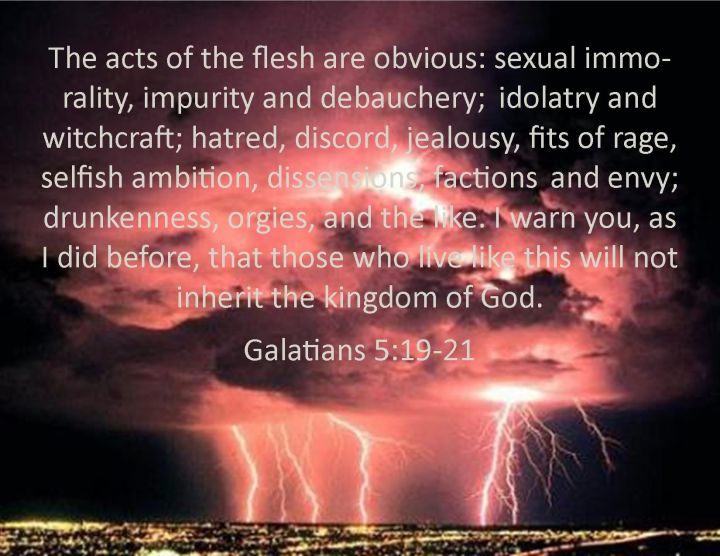
Galatians 5:19-21 And What It Means To All People?

Galatians 5:18-21 and how it pertains to All People?

By: Anthony Joseph Hopkins/ March 5, 2020

E

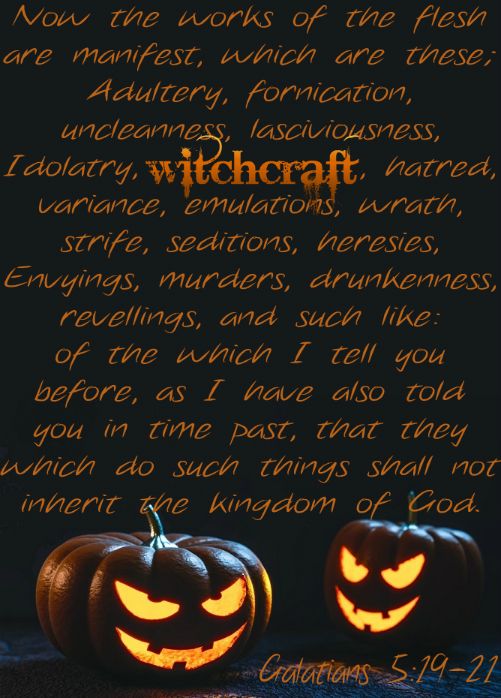
        Praise The Lord Saints!!  Praise The Lord Everyone!!  How are all of you doing today?  Fine, I hope.  I would like to write this essay just to address the things that some people tend to talk about in contemporary times.  I want to say that those who place emphasis on their personal horoscopes are getting involved in witchcraft.

F


        Next, I want to inform all of you that God does not want any of His Children placing emphasis on these things.  To be perfectly honest with you, I used to place emphasis on my horoscope until someone at church stated to me that it is demonic.  I do not have any business talking about my personal horoscopes.  This is a sin!!  Witchcraft is those who are involved in darkness.  I want you to know that I would prefer to become an Angel of Light for real, than to dwell inside of deep darkness.  This is a subject that I really need to talk about because there are many conversations inside of Facebook, Mocospace, WhatsApp, and Instagram.  Certain people are talking about this as if they actually worship deep darkness. 

        Further, I want the Word of God to find me.  I want to be covered inside of the Hands of The Living God.  I know that I have been making mistakes by telling all of my family members that this is demonic to talk about astrology.  This is actually witchcraft.  This is the works of darkness!!  I want to inform all of you that if you cover me, I will cover you in a positive manner.  I know that I am not perfect, but I am considered as a Work in Progress.

G

Moreover, I want to inform all of you that I used to drink alcohol and smoke marijuana for 18 years.  From 1972 -1990, I used to cover myself with alcohol and marijuana just to cover up, and mask all of my personal problems.  My Grandmothers used to tell me in my face that I was destroying my own Temple of the Living God; which is my body. 

        Also, I used to dwell inside of the streets of Dayton, Ohio for over 18 years by drinking alcohol as a child.  I started drinking at an early age.  I know that my family members really do not know my personal history.  I am filled with the Spirit rather than anything that is capable of killing me.  I know that I am a 54 year old man, who has a whole lot of common sense.  I know that I only try to allow all of my nieces and nephews to live their lives in a way that feasible for you.  I know that this is something that I want to talk about because I do not want anyone going to the Lake of Fire over our personal choices.

H


Finally, I want to say that it is not very easy talking about things that are detestable to God.  I want to say that your absence is my agony.  I want to say that Witchcraft has been practiced since the 1400s.  During the 14th Century, this is the Century of death.  There are people who exist today are called Psychics, who will consult with you for $30.00 dollars for a 30 minute conversation about your concerns.  There are millions of those who practice such things.  This is also witchcraft by all means.  I do not want anyone that I know, and those that I do not know to converse with Psychics and reading of their horoscopes.

 If you want to know the truth, I was born on June 24, 1965 at 7:30PM.  For those who want to know.  I have more common sense than average people.  I can say for myself that I used to read my horoscope, and I actually believed in everything that they really say.  I want to say that every problem that is inside of the world: Is Definitely inside of the Bible.  Please read it for yourself.  This message is for all of those who know me, and do not know me.  This witchcraft situation is very serious right now.  There are those who are literally teaching their children witchcraft, and they do not even know it.  Please avoid reading your horoscope because it is Satan who is talking inside of your brain.  This is for real!!  This is the reason why I do not listen to secular music.  The word secular means of the world.  Please do not get tossed inside of the Lake of Fire over your choices. 

Is God The Same in the Old and New Testament?

Is God the Same in the Old and New Testaments?

Sheila Alewine | Author

Thursday, March 5, 2020

Growing up, Old Testament stories were my favorites. Daniel in the lion’s den. David and Goliath. Joshua and the battle of Jericho. Moses and the burning bush. The crossing of the Red Sea. Gideon and his small army of 300. The sun standing still. Shadrach, Meshach, and Abednego in the fiery furnace. Those stories came alive for me through colorful illustrations in picture books read to me before I could read, flannel-graph stories in Sunday School, and a pastor who preached much about the Old Testament.

Coming to Christ as a young child, my faith was built on a God who could do miraculous and supernatural things. Later, as an adult, I began to discover why those stories meant so much to me; God gave me the spiritual gift of faith. As a result, I never questioned that the God I read about in the New Testament was any different than the one I grew up on in the Old Testament.

For others, that may not be the case. If you were introduced to faith in God only through New Testament scriptures, the Old Testament may come as a shock. Read in its entirety, (not just the exciting highlights), we discover things about God that are harder to understand. Why did He allow slavery? Why so much emphasis on animal sacrifice? Why couldn’t the Jews marry other cultures? Why was polygamy acceptable? How could God strike down thousands of His people for their sin? What was the point of all those laws, covering everything from what you ate, what kind of material your clothes were made of, and who you could marry?

In the New Testament, we view God through the lens of His mercy and grace in sending His Son, Jesus, as the perfect sacrifice, to rescue us from sin and death. We see love and redemption so clearly at the cross. Jesus is made like us, in human flesh; we can relate to Him in some fashion, even though He was God. How can this be the same God of the Old Testament? We like Jesus, but we’re not quite sure about the God who demonstrates His wrath so effectively against His enemies.

How do we reconcile the different pictures of God presented in the Old and New Testaments? Here are three truths to consider.

One Imperfect Story

The entire Bible tells one story. The Word is perfect and true, but the story it tells weaves its way through imperfect people. Bible scholars have interpreted God’s revelation and dealings with humanity in distinct periods, known as dispensations or covenants. These are concepts for another article, but basically, God has unfolded the history of mankind in a sovereign way to move us along to His intended purposes. Each stage reveals more of His plan, as well as more of Himself, and will ultimately end in a redeemed people worshipping Him for eternity in the new heavens and new earth.

From the beginning of the Old Testament to the end of the New Testament, God is telling one story, the true account of a sovereign, righteous God redeeming imperfect people. Miraculously, it was written by 35-40 different authors over a period of 1500 years. It is a collection of 66 books, all without error, and all without contradiction, despite man’s finite mind which is unable to reconcile some of its deeper truths with our limited, human perspective.

New Testament scriptures help us to understand the Old Testament. Hebrews 1:1-3 shows us that the same God was speaking at all times:

“God, after He spoke long ago to the fathers in the prophets in many portions and many ways [i.e., the Old Testament], in these last days has spoken to us in His Son, whom He appointed heir of all things, through whom also He made the world [i.e. the life of Jesus as told in the New Testament].”

John 1:18 says it even more succinctly: “No one has seen God at any time; the only begotten God who is in the bosom of the Father [i.e., Jesus], He has explained Him.”

The New Testament, containing the story of Jesus, the coming of the Holy Spirit, the birth of the church, and the doctrines upon which it would be built, explains and fulfills the Old Testament historical, prophetical and literary books. They are inseparable, just as God the Father is inseparable from God the Son, who is inseparable from God the Holy Spirit.

One Imputed Salvation

One of the best ways to see that God is the same in the Old Testament as the New Testament is to examine how salvation was achieved. Salvation is the process by which human beings are counted righteous before a holy God, extended forgiveness for sin, and granted eternal life.

In the Old Testament, God gave certain laws to be obeyed. Each law had a consequence, but ultimately, disobedience to the law of God brought death. He provided a sacrificial system of bulls, lambs and goats that could be followed in the event a person sinned. As we know, sin is inevitable, so for several thousand years, people tried to keep God’s law, and brought offerings when they failed. As long as the sacrifices were made, God withheld His judgment, and death was averted.

In the New Testament, Jesus became the final, perfect sacrifice by His death on the cross. New Testament believers are saved when they place their faith and trust in Christ, repent of their sins, and accept the gift of salvation by grace (Ephesians 2:8-9). Instead of continuous sacrifices, only one sacrifice was needed – the sinless Savior.

At first, this seems to be a discrepancy in the character of God. Did He suddenly change His mind, and make a different way of salvation for the New Testament believers? Did keeping the law make OT saints righteous? Did the sacrifices atone for their sin?

Not at all! Romans 4 explains that the Old Testament sacrifices and laws were simply a foreshadowing (a picture, or illustration) of Christ’s sacrifice. In fact, Abraham was “counted righteous” by faith, four hundred years before the Law was given and the sacrificial laws instituted for the children of Israel.

 “For what does the Scripture say, ‘Abraham believed God, and it was credited to him as righteousness.’ … How then was it credited? While he was circumcised, or uncircumcised? Not while circumcised, but while uncircumcised; and he received the sign of circumcision, a seal of the righteousness of the faith he had while uncircumcised, so that he might be the father of all who believe without being circumcised, that righteousness might be credited to them” (Romans 4:3, 10-11).

Galatians 3:8 tells us that God preached the gospel to Abraham by promising that through his descendant, all the nations would be blessed. He was talking about Jesus, who would come through the line of the Jewish people – a people who were not yet even formed! Because Abraham took God at His word and believed the promise, God “counted his faith as righteousness.” Christ’s righteousness was “imputed” to Abraham by faith; it was credited to his account, and his sin was credited to Christ, who would one day nail those sins to the cross.

Salvation has always been by faith. Hebrews 10:4 says “It is impossible for the blood of bulls and goats to take away sins.” Roman 3:25 explains that God “passed over the sins previously committed” in anticipation of the final atonement that would be made by the blood of Jesus, thus confirming His righteousness and justice. By offering a lamb, an Old Testament saint was indicating his faith in the coming sacrifice and God’s promise of redemption, not in the blood of the animal that could never cleanse his sin.

The cross stands in the middle of God’s redemption story. Old Testament saints looked forward to it in faith; New Testament believers look backward in faith. One salvation, by faith alone, through the grace of God.

One Immutable Savior

There are not two (or three) different Gods, but one triune, eternal divine being who has revealed Himself in three distinct persons, God the Father, God the Son, and God the Holy Spirit. God is inherently immutable. His character and nature are the same from Genesis 1 to Revelation 22.

Malachi 3:6 says “For I, the Lord, do not change; therefore you, O sons of Jacob, are not consumed.

Hebrews 13:8 – “Jesus Christ is the same yesterday and today and forever.”

God does not change. He is at all times fully Himself. Here are just a few places where we see the character of God described in both Old and New Testaments.

-God is just (Deuteronomy 32:4; 1 Peter 3:18).

-God is righteous (Deuteronomy 32:4; 2 Thessalonians 1:5; Revelation 15:3).

-God is compassionate (Isaiah 30:18; Matthew 9:36; James 5:11).

-God is faithful (Deuteronomy 7:9; 1 Corinthians 1:9; 2 Thessalonians 3:3).

-God is gracious (Deuteronomy 34:6; Psalm 116:5; Ephesians 2:8).

-God is merciful (Joel 2:13; Luke 6:36; James 5:11).

-God is impartial (Deuteronomy 10:17; Romans 2:11).

-God is good (Ezra 7:9; 1 Chronicles 16:34; Psalm 143:10; Mark 10:18).

-God is loving (Exodus 34:6; Psalm 25:6; 1 John 4:8; John 3:16).

-God is holy (Psalm 99:9; Psalm 22:3; Psalm 51:11; 1 Peter 1:16; Revelation 4:8).

-God is jealous (Deuteronomy 4:24; James 4:5).

-God is patient (Psalm 86:15; Nahum 1:3; Romans 2:4; 2 Peter 3:9).

Our story, the story of mankind, began in a garden created by God. There, God placed the tree of life, offered freely to Adam and Eve. Instead of accepting the eternal life it would have given them, they chose to disobey and eat of the tree of the knowledge of good and evil, a decision which still affects us today and set in motion God’s eternal plan of redemption (Genesis 1-3).

One day, the story of mankind will end in a new garden created by God, in a new heaven and new earth, and a new city of God. There, by the river of life, those redeemed by the blood of the Lamb will eat of the tree of life for all eternity. God’s redemptive work will be finished (Revelation 22).

The imperfect story will have a perfect ending.

The imputed salvation will reap its promised reward.

The immutable Savior will be present, worshipped for all eternity.

The Bible is a richly woven tapestry with layers of revelation from an unknowable God. When you encounter things that are hard to understand (and you will, if you become a true student of the Word), don’t let them be a distraction from the big picture. Instead, ask God to give you insight and wisdom to how the pieces fit in His story, for our salvation, to the glory of the Savior.