James 1:19

James 1:19 And What It Means to All People.

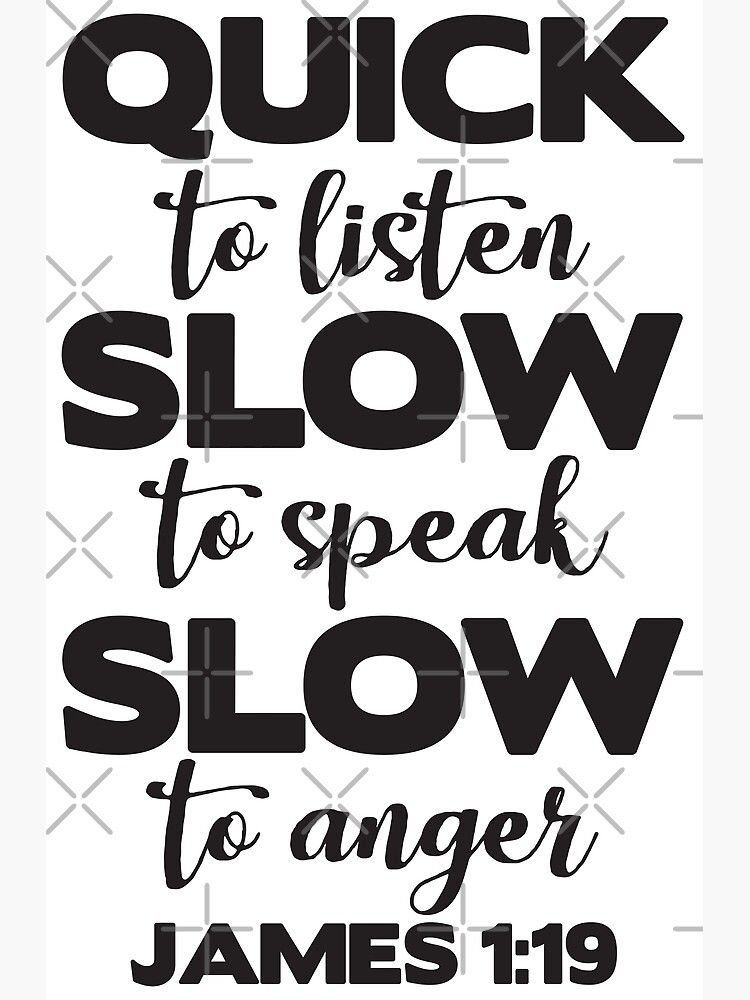
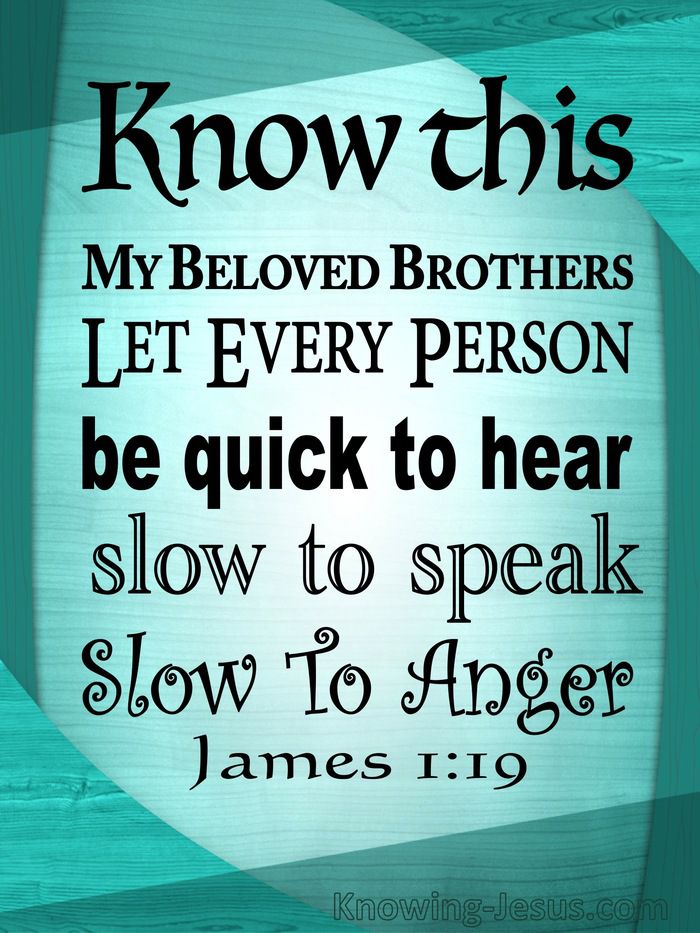
James 1:19 says: My Dear beloved brethren, be quick to listen, slow to speak, and slow to get angry.   To me personally it means that we must watch what we are doing at all times. 

Next, I want to inform all of you that something like this takes a lot of practice.  This is a skill that someone does not learn overnight.  It takes years of practice.  I really think that something like this should be utilized.

Moreover, I want to inform all of you that I have to learn this new skill because I have been very angry all of the time.  I know that I tend to struggle with listening to people. 

Also, I want to say that it takes a lot of practice to learn all three things.  First, listening.  Listening is a process of learning how to understand the spoken word.  I want to inform all of you that if someone tells you something, you should be able to repeat it right back to them.  I know for me; I have to learn how to accept what it is being said out of the person’s mouth.

Another problem that I have is that I do not believe everything that people tell me.  This is true because people will tell a lie in your face.  They even want you to accept it.

 Then, if you do not fully accept what they are saying: There is a major problem.  I want to say that certain people especially if they are from a different culture; can say something to you that you do not agree with.  I know that I have been living inside of an environment that consists of people who comes from different countries.  A person from another country can say something to you, it would offend you.

In Addition, I want to inform all of you that people can cuss you out and get away with it.  This is the reason why you have to pay attention to another person’s non-verbal communication.  I want to inform you that everyone has to pay attention to a person’s movements of their arms and legs as well as fingers.

I also have to pay attention to their verbal communication as well.  If it is in a language that you do not understand, then you have to ask them what they are saying.

 If they are offended with you after you asked them a question, then there is another problem.  Quick to listen is another way of paying close attention to what is being said out of a person’s mouth as well as movements called gestures.  I know that in my neighborhood, it is integrated.  I know that there are people from diverse backgrounds and cultures.  Quick to Listen is just paying attention to what is being said as a person’s language.

Slow to Speak is a way of interpretation.  It is a way of understanding what someone else is saying.  I know for me, I have to learn how to fully understand another person’s speech.  If it is different from what I am used to, then I must take a stand.  I want to inform you that I have learned how to take a non-violent approach when it comes to dealing with other people.

Slow to Speak means that we have to ingest what another person is saying.  To fully understand what they are saying out of their mouth.  Sometimes people who are younger tend to act impulsive.  They also use language that only millennials are able to understand even if it is a threat.  Sometimes a person can say things just to provoke you in some kind of way.

Slow to Speak means that if the communication is different, then you have to defend yourself.  With me personally, I have to fully explain what I actually think they said as long as it is not a form of vulgarity. 

You see, I am a 58-year-old man who fully understand vulgarity in many different cultures.  I even know if it is street slang or gang language.  I understand young people because I have nieces and nephews who are much younger than me.  Therefore, I understand street slang that comes from different regions of the United States.  This is because I used to live in the Midwest and the Southeast USA.

I am more of the proper type, and highly educated.  Just because someone is acting the fool does not mean that I have to act like them. 

You see, I was told by my AA Sponsors to always take a long walk and calm down.  Some young people do not respect older people.  This means that they think that everyone think that you have to yield to them.  I will not yield to anyone but God and Jesus Christ.  I know that inside of a changing culture, there are people who have personalities that are different than yours.  This is the reason why I listen with the intent of exchanging whatever a person is feeling at a particular time.

Slow to Get Angry Means: to learn how to never allow anyone else push your buttons.  Anger is a universal emotion.  I know that a people today are pugnacious.  I understand that my primary intention is to understand your point of view.  It is best for a mature person to walk away from a cowardice fight.  This means that people who are younger than you will try to kill you over nonsense. 

Another intention that I have is to respect you in the long run.  I want to inform you that I am trying to prevent myself from fighting in the first place. 

Slow to Get Angry Means: to think about your consequences in advance.  I know that my objective is to not fight anyone even though they are much angrier than me.  I am trying to stay out of trouble in the first place.  I am trying to diffuse any situation before it gets worse.  I am trying to learn how to forgive everyone 490 times in life.  This means that I have to forgive each person a total of 490 times.  This is the reason why I have to avoid you, if we cannot make peace.

Slow to Get Angry Means: that you do not have to always act like the next person all of the time.  I am still learning how to act like a mature adult.  I really do not like fighting verbally or physically.  Therefore, I will not kiss anyone’s Gluteus Maximus in any way.  I cannot complete that task on myself.  Respect me and I will respect you.  This is my interpretation of James 1:19 inside of the Bible.

Another Spelling Test

gettyimages

You are highly intelligent!!

You are definitely highly intelligent. You IQ range is at least 148-156, and your 3 dominant traits are: curiosity, open-mindedness, and self-control. Share the news with the world.

Spelling Test Results

gettyimages

Passed;)

You passed a spelling test that only 2 in 50 Americans can. Good spellers are intuitive, self-disciplined, and sharp-eyed. Let us know in a comment if you agree, and share this quiz with every American you know.

Emotional Unavailability in the Family

Search

Ad

nullabout:blank

What Does It Mean to Be Emotionally Unavailable?

By 

Sanjana Gupta 

Updated on November 22, 2023

 Reviewed by 

Steven Gans, MD

couple not speaking to each other
PeopleImages / Getty Images

Table of Contents

If someone has described you as emotionally unavailable, you may wonder what exactly that means and what you can do about it. People who aren’t emotionally available tend to have difficulty with sharing their emotions and being receptive to the emotions of those around them, says Sabrina Romanoff, PsyD, a clinical psychologist and professor at Yeshiva University.

Someone who is emotionally available is able to express emotions in a healthy manner and form emotional attachments with people.1 On the other hand, someone who is emotionally unavailable may struggle with feeling the extent of their own emotions without shutting down or denying them, Dr. Romanoff explains.

This article explores some of the potential causes and characteristics of emotional unavailability, as well as some coping strategies that may be helpful.

How Trauma Can Affect Your Relationship

Characteristics of Emotional Unavailability

These are some characteristics of people who are emotionally unavailable, according to Dr. Romanoff:

  • Distant, cold, or aloof demeanor
  • Difficulty talking about feelings and emotions
  • Lack of closeness and emotional intimacy in relationships
  • Inability to understand and relate to others’ feelings
  • Defensiveness when asked to change or let others in
  • Tendency to shut down or avoid topics that require emotional openness
  • Withdrawal from people or situations that provoke emotional reactions

Emotional unavailability can look different from person to person, Dr. Romanoff explains. “Some people may be emotionally available in some areas of their life but closed off in others.”

Causes of Emotional Unavailability

These are some of the potential causes of emotional unavailability, according to Dr. Romanoff:

  • Cultural and social factors: Some people are taught that overt displays of emotion are a sign of weakness. Instead, they develop strategies and patterns of responding to that emotion by shutting down or repressing overt signals of emotionality.
  • Childhood experiences: Many emotionally unavailable adults were once children who felt that their parents were unable to respond to their needs.2 These children learned to adapt by suppressing their emotions and minimizing others’ access to their emotional life, therefore denying others the opportunity to invalidate or neglect them again.
  • Traumatic events: There could also be situational causes such as a break-up, divorce, or traumatic experience that can cause people to shut down emotionally in order to maintain everyday functioning, because if they were to feel the extent of their emotions it might be challenging for them to go on living their lives.
  • Past experiences: People may become emotionally unavailable if they have learned in earlier relationships that showing their emotions only leads to pain and suffering.

How Accepting Difficult Emotions Can Improve Emotional Health

Impact of Emotional Unavailability

Below, Dr. Romanoff describes how emotional unavailability can impact you and your relationships.

null

Impact on You

People who are emotionally unavailable usually view conversations about hurt feelings, requests to change behavior, and discussions of their relationship dynamics as off-limits. Not only will they shut down, they might even get angry or find ways to blame the other person and make them feel like they are the problem, to displace focus from their own discomfort and limitations.

It may also be difficult to emotionally connect with other people. Because they are so accustomed to turning off their emotions, it might be hard to empathize, relate, and honor the needs of others.

They are also likely to have landmines that they are constantly navigating and avoiding. Emotional triggers will tend to spark defensiveness and an automatic habit of putting up walls when people try to get close to them. 

Impact on Your Relationships

Emotional unavailability can take a toll on your relationships, both romantic and otherwise.

null

Emotional unavailability prevents emotional intimacy.

— Sabrina Romanoff, PsyD

Potential romantic partners are likely to quickly grow frustrated when the emotionally unavailable partner refuses to let down their walls. Partners of emotionally unavailable people might also take it personally and assume their partners don’t trust them or like them enough.

Emotionally unavailable people also avoid commitment. This could look like avoiding labels in relationships or postponing the progression of a relationship. For instance, they may find it difficult to commit to moving in or getting married.

null

Instead of committing and deepening a relationship and connection with one person, emotionally unavailable people are more likely to have multiple superficial relationships and cut things off with people when they become too serious. 

This is not exclusive to romantic relationships, as they might not want emotional intimacy in friendships as well. They might become uncomfortable when people confide in them, tell them intimate information or become emotionally attached to them.

The Best Online Couples Therapy, According to a Therapist

Coping With Emotional Unavailability

Below, Dr. Romanoff suggests some strategies that can help you cope, if you think you may be emotionally unavailable to others:

  • Identify the causes: It’s helpful to start by understanding the causes of your emotional unavailability. It could be situational due to a recent trauma or loss. In this case, it’s important to be patient with yourself and give yourself time to process what happened. Alternatively, if the source is attachment trauma or childhood neglect, it can be helpful to work on processing these experiences. It’s not helpful to neglect your own emotions the way your caregivers once did.
  • Practice expressing emotions: Find safe ways to access, sit with, and share your emotions. The best way to start is by yourself. You can do this by journaling or checking in with yourself to see how you are feeling. You can then branch out to a trusted friend, sibling, or partner to begin sharing your emotions with others.
  • Seek therapy: Therapy is another great way to gain insights into your emotional response patterns and potentially use the therapy relationships as an opportunity to experience greater emotional availability.

null

Get Help Now

We’ve tried, tested, and written unbiased reviews of the best online therapy programs including Talkspace, BetterHelp, and ReGain. Find out which option is the best for you.

7 Habits of Emotionally Intelligent People

Keep in Mind

Your upbringing, childhood experiences, or traumatic events may have taught you that it’s better to maintain emotional distance from others to avoid getting hurt or dealing with messy emotional entanglements. However, emotional availability is an essential aspect of our healthy relationships, so it’s important to learn to be vulnerable and open yourself up.

How to Be More Emotionally Available in Your Relationships

Read more:

2 Sources

Sanjana Gupta Bio Photo

By Sanjana Gupta
Sanjana is a health writer and editor. Her work spans various health-related topics, including mental health, fitness, nutrition, and wellness.

See Our Editorial Process

Meet Our Review BoardShare Feedback

Related Articles

6 Signs You Should Consider Calling Off the Wedding, According to a Relationship Coach“Is Everyone Looking At My Skin?” How I Was Blindsided By Adult Eczema

null

Compassion Fatigue: The Toll of Caring Too MuchInappropriate Affect Explained: What It Means and Why It Happens

Wait, Did I Just Get Scammed? The Emotional Rollercoaster Before RecoveryDisplacement in PsychologyWhat Does Grieving Do to Your Body?The Power of Emotional Validation in Building Stronger RelationshipsWhat Happens in Your Brain When You’re Angry, According to PsychologyWhat Happens in Your Brain When You’re Hangry?How Strong Is Your Emotional Literacy?Is It Better to Be Kind or Nice?

Daily Tips for a Healthy Mind to Your Inbox

Follow Us

Verywell Mind’s content is for informational and educational purposes only. Our website is not intended to be a substitute for professional medical advice, diagnosis, or treatment.

Ⓒ 2025 Dotdash Media, Inc. — All rights reserved

Verywell Mind is part of the Dotdash Meredith publishing family.https://i.liadm.com/sync-container?duid=5463ac6af343–01jtrj9wd2e8dx1vcb8vjce2ba&appId=a-07sw&euns=0&s=CjEKBgj3ARDdGgoFCAwQ5hoKBgiiARDhGgoJCP____8HEOYaCgYI0gEQ4RoKBQh-EN0aEkcN_GAv7BJACgYI5AEQ3RoKBgiTARDfGgoGCOUBEN0aCgYI9AEQ3xoKBgiUARDfGgoGCOYBEN0aCgYI5wEQ3RoKBgjoARDdGhIPDbYrJ0gSCAoGCJMBEN8aEg8N_R7iHhIICgYIkwEQ3xo&version=v3.11.3&cd=.verywellmind.com&pv=309b7d82-7bed-4c44-aea9-091e5267da2b

The Problem

Adult Children of Alcoholics & Dysfunctional Families

 310-534-1815  Contact Us Form  Shop WSO Store

The Problem

Adapted from The Laundry List

Many of us found that we had several characteristics in common as a result of being brought up in an alcoholic or dysfunctional household. We had come to feel isolated and uneasy with other people, especially authority figures. To protect ourselves, we became people-pleasers, even though we lost our own identities in the process. All the same we would mistake any personal criticism as a threat. We either became alcoholics (or practiced other addictive behavior) ourselves, or married them, or both. Failing that, we found other compulsive personalities, such as a workaholic, to fulfill our sick need for abandonment.

We lived life from the standpoint of victims. Having an overdeveloped sense of responsibility, we preferred to be concerned with others rather than ourselves. We got guilt feelings when we stood up for ourselves rather than giving in to others. Thus, we became reactors, rather than actors, letting others take the initiative. We were dependent personalities, terrified of abandonment, willing to do almost anything to hold on to a relationship in order not to be abandoned emotionally. Yet we kept choosing insecure relationships because they matched our childhood relationship with alcoholic or dysfunctional parents.

These symptoms of the family disease of alcoholism or other dysfunction made us “co-victims”, those who take on the characteristics of the disease without necessarily ever taking a drink. We learned to keep our feelings down as children and kept them buried as adults. As a result of this conditioning, we confused love with pity, tending to love those we could rescue. Even more self-defeating, we became addicted to excitement in all our affairs, preferring constant upset to workable relationships.

This is a description, not an indictment.

To download a printable PDF of The Problem click here.

To access The Problem in different languages click here.

Copyright © 2023 by Adult Children of Alcoholics® & Dysfunctional Families World Service Organization, Inc.
All rights reserved.

en

 en 

What are Love Styles?

Edition

                        Africa                                   Australia                                   Brasil                                   Canada                                   Canada (français)                                   España                                   Europe                                   France                                   Global                                   Indonesia                                   New Zealand                                   United Kingdom                                   United States                  Donate

Newsletters

There’s not just one way to feel or express love. Shutterstock


Link copiedShare article

Love is a complex and powerful force, one that plays out in a number of emotional, cognitive and social ways.

When we love a person, we feel emotional arousal in their presence. We will also have a set of thoughts (or cognitions) about that person, and our previous experiences can shape our ideas about what we expect in our relationships. For example, if you believe in love at first sight, then you are more likely to experience it.

But we use love in many different contexts. You might say that you love your partner, or your family, or your best friend, your job or even your car. Clearly, you’re using the term in different ways that highlight the various dimensions of love.

The ancient Greeks described several different types of love. Following the Greeks, the sociologist and activist John Alan Lee suggested that there are six broad styles of love.

It is good to keep in mind that although these love styles can be thought of as “types”, we are not necessarily locked into only one. We might have a predominant love style, but we will also have some elements of the other styles.

Similarly, our love style might change over time based on our experiences and interactions with our partners.

How The Conversation is different: We explain without oversimplifying.

Learn more

Eros

This style is typically experienced as a romantic, fairytale-type love. Physical beauty is important to this love style. Attraction is intense and immediate (“head over heels”), and the Eros lover feels an urgent drive to deepen the relationship emotionally and physically.

Because these individuals love the feeling of being in love, they tend to be serial monogamists, staying in a relationship as long as it feels fresh and compelling, then moving on so they can experience those same feelings again with someone new.

Storge

Storgic types tend to be stable and committed in their relationships. They value companionship, psychological closeness and trust. For these individuals, love relationships can sometimes grow out of friendships, so that love sneaks up on the pair. This love style is enduring, and these individuals are in it for the long haul.

Ludus

People with a ludic style view love as a game that they are playing to win. Often this can be a multiplayer game! Ludic individuals are comfortable with deception and manipulation in their relationships. They tend to be low on commitment and are often emotionally distant.

Because ludic individuals are more focused on the short term, they tend to place greater importance on the physical characteristics of their mate than do the other love styles. They are also more likely to engage in sexual hookups.

Love is eternal, or at least as long as the tree lasts. Scott Meis/Flickr, CC BY-ND

Pragma

Practicality rules for this type. Logic is used to determine compatibility and future prospects. This doesn’t mean that these individuals use an emotionless, Spock-like approach to their relationships, rather they a place a high importance on whether a potential mate will be suited to meeting their needs.

These needs might be social or financial. Pragmatists might wonder if their prospective partner would be accepted by family and friends, or whether they’re good with money. The might also evaluate their emotional assets; for example, does a would-be partner have the skills to be calm in times of stress?

Mania

This refers to an obsessive love style. These individuals tend to be emotionally dependent and to need fairly constant reassurance in a relationship. Someone with this love style is likely to experience peaks of joy and troughs of sorrow, depending on the extent to which their partner can accommodate their needs.

Because of the possessiveness associated with this style, jealousy can be an issue for these individuals.

Agape

Agapic individuals are giving and caring, and are centred on their partner’s needs. This is largely a selfless and unconditional love. An agapic partner will love you just as you are. But they will also be particularly appreciative of acts of care and kindness that they receive back from their partner.

Perhaps because these individuals are so accepting, they tend to have very high levels of relationship satisfaction.

The truth about love

The kind of love that we feel towards our significant other is likely to change over time. At the start of a relationship we feel anticipation about seeing our partner and we are excited every time we see them.

These are the heady feelings we associate with being in love, and are very characteristic of romantic love. But in almost all relationships, these intense emotions are not sustainable, and will fade over months to a couple of years.

Those passionate feelings will then be replaced by deeper connection as the people in the partnership grow to truly know each other. This stage is “companionate love” and can last a lifetime (or beyond).

Unfortunately, many people do not realise that the evolution from romantic love to companionate love is a normal – and indeed healthy – transition. Because the ardent feelings of adoration subside, sometimes people will think that they have fallen out of love, when in fact the intimacy and closeness of companionate love can be extremely powerful, if only given the chance.

This is a shame, as these individuals might never experience the life satisfaction that is associated with companionate love.

Helping you understand the news

When complicated stories are in the news, The Conversation is especially relevant. Our editors specialize in finding experts and helping them write articles explaining the key concepts clearly, but always accurately, based on years or decades of study. The future of AI is a perfect example of this. There’s been a lot of facile analysis in the media from pundits who either position it as the greatest advancement of all time or posit horror stories about it running amok. But readers of The Conversation have benefitted from thoughtful analysis and research from dozens of experts, from disciplines ranging from information retrieval to ethics, law, education to art. If you give today, we’ll send you two e-books. The first compiles seven of our most insightful articles on the future of work, ranging across topics from the impact of generative AI to how workers are taking more control over their work lives. The second brings together articles on the wisdom of ancient texts. It’s our way of thanking the readers who make what we do possible, and it will enable us to continue toprovide this trustworthy journalism for free to readers around the world. Thank you.

Pitch in with your gift

Avatar

Brittney Price

Data Specialist

You might also like

Can you revive the spark in a long-term relationship? Science reveals all

Happy Valentine’s Day? Depends how you invest in your relationship

What is love? Here’s the science …

Why you should date your best friend

9 Comments

Oldest Newest

Comments are open on selected articles and must comply with our community standards.

Show all comments

Want to write?

Write an article and join a growing community of more than 203,500 academics and researchers from 5,197 institutions.

Register now

Privacy policyTerms and conditionsCorrections

Green and Salutations

Good Morning Everyone   I want to thank all of you for your prayers and support.   I have to spend another week in the hospital for an epilepsy evaluation.   I know that my family members will be glad that I will be gone from the apartment for a week.   However, I  know that I will be taking my Bible with me and all of your love as well.  Please pray for me and my entire family members as well as my friends.  Please pray for my neighbors who reside above me and across from me.  I know that I have been feeling sluggish and tired for a while now.   I love all of you.   Please take care of yourselves as well as your pets.  I love all of you!

What is a Mother?

What is a mother? This is a very important blog that pertains to the importance of motherhood. I started this blog off by asking this very important question because motherhood has numerous of definitions. What is a mother? A mother is a female who according to God is a helper or a companion for man. A female is the flesh of man; meaning that God has created woman from the womb of a man. The man himself whose name is Adam.

Eve is her name; which was selected by Adam himself because she was created through the rib of him as he was sleeping. Next, the purpose of woman is to take care of children, and to become a helper for man. A mother is a person who is a doctor, teacher, counselor, and even a father to her own children; if their father is not around. According to the United States Department of Health and Human Services, at least 55% of single parent households are conducted by women. This means that single women are taking care of their own children all by themselves. However, when I was a child, my mother raised 9 children all by herself. This means that my mother had to raise 6 boys and 3 girls all by herself. Although my stepfather was physically present inside of the home. It was my mother who was responsible for doing the majority of the work. I know that Mother’s Day really mean a whole to me as a man. I salute my mother on this very special day for always being there for me. I salute my grandmother who is also responsible for raising me as a little boy in Dayton, Ohio to the man that I am today. In addition, my mother and two grandmothers raised me to become a very responsible person. I still remember my eldest grandmother taking me to Bethel Church of God in Christ in Dayton, Ohio as a little boy for several years. My grandparents raised me as well as my mother who taught me a lot about on how to be responsible and assisting me with my siblings as well. They have instilled in me social and moral values that I need to become a mature adult. My mother and grandmothers are the three women who are elders who I give credit in my life when it comes to learning about the opposite sex. My aunt taught me how to develop a strong work ethic as well as my mother and grandmothers. The elder women in my family did not tolerate any foolishness. My grandmothers and mother always told me if I wanted something out of life, I had to work hard for it. Moreover, independence is something that my mother and female elders in my family have taught me. My mother always told me as a child to always work really hard at anything that you want out of life; without asking anyone for anything. I was also told to always try to get anything for myself first before seeking help from anyone else. Always rely on God and Jesus Christ for all of my help!!! My great aunt has always taught me a great deal about striving for success. I called my mother’s best friend my great aunt because she has always been a motivator when it comes to education.

She has earned two masters degrees from college and I really miss her whole lot. When I felt like giving up; she was always there to inspire me and motivate me so that I can stay positive and focus on the future. A mother is a leader, teacher, supporter, life coach, philosopher, police officer, and president in the family. My mother as well as all of the female elders in my family controlled the household. I thank God for my mother and my female elders in my family. I thank God for my mother because if it wasn’t for my mother I would not exist. When my own biological father had forsaken me; my mother stepped up to the plate and took over and raised me as well as the female elders in my family. I love you mom for being the person that you are in my life.

My mother is queen always in my life. She will always be the queen in my life as well as the woman who I will marry someday. I could not ask for no other person to be her but her. Happy Mother’s Day to each and every single woman who are mothers or those who have the potential to become mothers. This day is for your special day. Happy Mother’s Day!!!!!!

Sincerely,

Anthony Joseph Hopkins

Honest and Self Appraisal

NA World Services, Inc.

11 May

Honest Self-Appraisal in the Steps

Page 136

“The steps help us to increase our ability to be honest with ourselves and others.”

Living Clean, Chapter 1, “Growing Pains”


To say that honesty wasn’t a top priority when we were using may be an understatement. We gain a new awareness of honesty’s value once we clean up. With a clear head and a restored conscience, we find that dishonesty comes at a price. Regret is no joke, so we try to avoid it. Practicing honesty with ourselves can be a little more complicated. Self-deception creates some major blind spots that have a nasty habit of reemerging. Fortunately, our ability to be honest with ourselves deepens as we work the Twelve Steps.

We admit our powerlessness and begin to reckon with our unmanageability. We come to recognize that we’re, frankly, screwed on our own and decide to accept some help. Taking action that’s aligned with that decision begins with an honest evaluation of how we’ve lived our lives so far. Sometimes we get as many insights in sharing our inventories as we do in writing them. We go on to dig a bit deeper, examining how aspects of our character had become disproportionate to their intended purpose. We turn this bag of dirty tricks over to a Higher Power–and over and over and over again as we strive to be better people with help from that Power, whatever we conceive that to be. Taking another look at the harm we caused, we make an earnest effort to right our past wrongs.

Continuing on this path takes daily commitment and, honestly, we all slack off from time to time. Our experience with the Steps means we’re quicker to notice when old patterns of thinking and behavior creep back up on us. Oh, I’m doing that again. We may find that we’ve shut down emotionally, become disconnected from our spiritual lives, resumed a hurtful interior monologue, or taken up some other outmoded approach to life. We put in the work to restore wholehearted honesty to our lives and in our relationships, including those with ourselves and with a Higher Power. We tune in to reality, to the truth, to our higher selves. And we help others to do the same–to live and to thrive through the daily application of spiritual principles.


I will engage in some honest self-assessment today. I will shore up my foundation and restore my zest for learning how to live.All NAWS subscriptions are free. We are able to provide this service due, in part, to the generous contributions of our members. If you are a member, you can make a contribution here: www.na.org/contribute

UNSUBSCRIBE to stop receiving all NAWS emails.

UPDATE SUBSCRIPTION PREFERENCES to update which emails you receive.

NA World Services, Inc.
19737 Nordhoff Place
Chatsworth, CA 91311

Copyright © 2025 by Narcotics Anonymous World Services, Inc. All Rights Reserved.