Before you is the ultimate memory quiz – to ace it would place you in the upper 1% of the world’s population. Don’t worry if you don’t make the cut though – you can also be in the upper 25, 50 or 99% range! Ready to find out? You are in the 1% Wow! You have a photographic memory, which is extremely rare, especially amongst adults. You have the ability to look at a picture and memorize every single detail of it. Then, you can retrieve this image from your memory at will and examine it thoroughly. It is a truly phenomenal gift you possess. Share your results with friends to learn more about them! Share Result Share Quiz
Life on Life Terms
Good Morning Everyone! I want to inform all of you that I am still in need of your prayers. The reason why is because I am only looking for directions from God right now. I am not saying that I am lost like a lamb, but it sure seems like it right now. I have lost a lot of weight because I had been suffering from Covid 19 and Pneumonia for a total of 5 weeks. At least, my appetite has increased during the past few days right now. My half siblings and other family members have excommunicated me because of my personal behavior that I had displayed during the past 7 weeks now. I am still clean and sober despite all of my actions and stress that I had to deal with from my family members. I still love them, but I feel like an outsider right now. Therefore, I am powerless over people, places, and things. My recovery is my own response. I am only a work in process still. I am very happy just to put things into a better perspective right now
Whoever is trying to computer hack me, and commit cybrrcrimes against me I do not have anything to offer you but my presence right now
This is the reason why edification is very important right now. If I can help you then you can help me.
Male Menopause

Where Wellness & Culture Connect
Where Wellness & Culture Connect
Home / Wellness / Mens Health
Is “Male Menopause” A Real Thing?
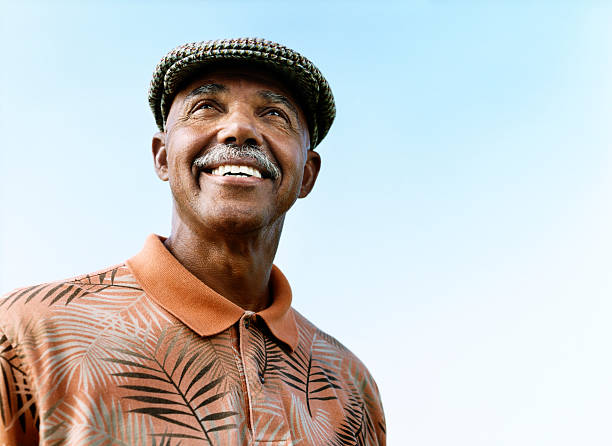
Ten to forty percent of men will experience a testosterone deficit. Other names for this condition include andropause, late-onset hypogonadism, and androgen insufficiency, but the most well-known one is male menopause. Here is all the information you need to know about it.
Why Male Menopause Is Not Talked About
Several causes drive the lack of information about male menopause.
Trending Articles
Advertisement

First, males are less likely than women to visit their doctors for routine checks.
Men with health issues are much less likely than women to have recently consulted a doctor, according to research published in The National Library of Medicine (NLM). Men don’t visit the doctor as frequently as women do, making the chances for these phase-of-life chats less common.
You May Also Like

Our team is looking for children diagnosed with moderate to severe lupus.
Another difficulty is that males do not feel as comfortable talking to a doctor about private subjects like sexual dysfunction or mental health difficulties.
According to a Myotonic Dystrophy Foundation study, approximately 37% of men say they feel uncomfortable discussing sexual matters with their doctor. And according to the NLM, men are less likely than women to seek mental health care.
Male menopause symptoms frequently revolve around these two problems: sexual dysfunction and mental health decrease. Menopause is not frequently detected in men, which is not unexpected.
RELATED: Top Health Concerns Impacting Black Men & Screening Guidelines
What Does Male Menopause Really Mean?
The easiest way to think of male menopause is as reverse puberty. Boys’ bodies produce more testosterone as they get closer to puberty. The following stage is a rise in sexual function, an increase in body hair, a decrease in voice, and an increase in muscle mass.
You May Also Like

8 Facts Every Brother Should Know About Prostate Cancer
Men may experience a loss of muscular mass, a loss of body hair, and even a decrease in libido drive due to
low testosterone levels during male menopause. There is, however, more to it than that.
According to MayoClinic, males aged 30 and older have an annual decline in testosterone levels of 1%. The decline may occur more quickly when a man enters male menopause (about age 50 and up). So, males may suddenly go through more severe versions of the modest physical and mental changes they have been experiencing for years.
What Distinctions Exist Between Male and Female Menopause?
Male and female menopause share certain commonalities but also significant distinctions.
Men who have gone through menopause can have kids. The complete shutdown of the reproductive organs is brought on by female menopause. A woman is no longer able to become pregnant after menopause. Most men can theoretically reproduce far into their later years.
Male menopause develops gradually. Similar to male menopause, female menopause entails a reduction in certain hormone levels. Women, on the other hand, experience the hormonal transition quickly. For men, the transition may occur gradually over several years.
Not all males experience it. The main distinction is that while menopause affects women, it does not affect all men.
RELATED: 6 Things Every Healthy Man Knows
Menopause In Males: Symptoms
Male vitality, physical stamina, muscle mass, and the flight-or-fight reaction are all influenced by testosterone levels. Therefore, as they drop, the following signs could manifest:
- Depression
- Fatigue
- A low sense of self
- Sleep problems
- Gaining weight
- Male breast development
- Poor libido
- A challenge getting an erection
- Reduced testicle size
- Loss of body hair
- A hot flash
- Low bone mass
Menopause Treatment for Males
Unless male menopause significantly impairs a patient’s quality of life, most doctors won’t recommend anything more than simple lifestyle modifications. These could consist of the following:
- Increasing sleep
- Increasing activity, especially weightlifting, to increase muscle
- Performing relaxation techniques like yoga and meditation
- Consuming a balanced diet
For males suffering from severe depression or seeing changes in their mental health due to the condition, a doctor may occasionally prescribe antidepressants or suggest treatment.
There is hormone therapy available, including synthetic testosterone. However, it is rarely advised due to its possible negative effects.
null
The Latest In Mens Health
Black Men Aren’t Superman: Health Screenings For Black Men at Any Age
17 Embarrassing Men’s Health Questions…Answered!
A Guide for Black Men: Health Screenings to Start in Your 40s
Prostate Cancer 101: What Black Men Need To Know Now
More Black Men are Embracing Therapy in 2024, Here’s Why…
Real Talk – Is Sperm a Factor in Miscarriages?
Primary Sidebar
Subscribe to our newsletter
Never miss a beat. From articles about the latest trends in Health & Wellness to everyday topics that affect you!Sign up!
Poll
What do you believe is the biggest challenge to early diagnosis of Multiple Myeloma?
- Lack of awareness about symptoms
- Limited access to specialists
- Fear or stigma surrounding cancer
- I’m not sure
223 votes
Trending Articles
6 Benefits of Stretching Every Day

Hip-Hop Mogul and Producer for Ashanti, Ja Rule Passes Away at 54

5 Complications Black Folks with PA Commonly Face (And What to Do)

How Old Beliefs About Clinical Trials Are Holding Us Back

6 Things Black People Should Stop Doing to Our Hair


Footer
Where Wellness & Culture Connect
BDO is the world’s largest and most comprehensive online health resource specifically targeted to African Americans. BDO understands that the uniqueness of Black culture – our heritage and our traditions – plays a role in our health. BDO gives you access to innovative new approaches to the health information you need in everyday language so you can break through the disparities, gain control and live your life to its fullest.
Connect With Us
Join Us!
Resource Centers
Copyright © 2025, BlackDoctor, Inc. All rights reserved.

The Top 10 Religions Worldwide













The 10 Largest Religions in the World
After millennia of passing down knowledge through rich oral and written traditions, each of the world’s major religions has carried ambitious philosophies through countless eras. Woven throughout these mystical theologies are the epic sagas of humanity’s ancestors, who fought every day to uncover their purpose in life, just the same as us. Different approaches often utilize the same foundational myths, such as Eastern religions and the concept of the Dao, or the Abrahamic faith’s shared understanding of monotheism. Worth remembering is that humankind has been infatuated with religion for at least as long as people have pursued agriculture, approximately 10 thousand years. By studying these 10 ongoing faiths, one glimpses into an ancient history involving forefathers who gambled their souls on what they believed.
Read MoreSacred Texts Of Major World Religions
Christianity
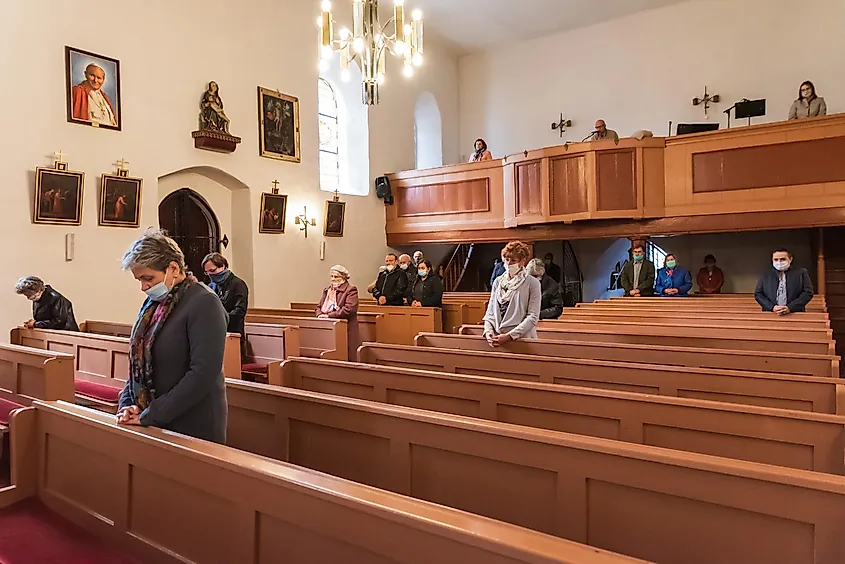
Holy Mass in the Church Our Lady of Queen in Poland
At well over 30% of the global population, Christianity is a religion that resonates with over 2 billion believers. The core of the belief, despite the glaring differences between Protestants, Catholics, and Orthodox, revolves around the 1st-century figure that is Jesus of Nazareth. As an Abrahamic religion, Christians claim a belief in a singular god, who represents himself through three identities: Jesus, the Holy Spirit, and God the Father.A Christian Cross on a wooden platform
Another essential aspect is the death and resurrection of Jesus, in which humanity is allowed to repent of all misdeeds, and eventually spend the afterlife with their beloved deity. The philosophical values and codes of Christianity have been influential enough to form the backbone of Western institutions, despite a growing acceptance of secularism.
Read MoreWhat Is The Difference Between Catholic And Christian?
Islam
The Blue Mosque of Istanbul or Sultan Ahmet Mosque, Turkey
null
Most active towards the end of the 6th century, the Prophet Muhammed is celebrated by Muslims today for founding the religion of Islam. Roughly 1.8 billion followers populate the world, the majority of which are spread between northern Africa, west Asia, and Indonesia. The prophet desired to repair the Abrahamic religions, which he believed to be corrupted.Silhouette of a woman against the background of traditional Iranian architecture
null
Islam is marked by its adherence to discipline, in which abstinence from worldly behaviors as well as observance of daily rites is rigorously demanded. Notable historic discoveries have come from Islamic institutions, in fields such as algebra, surgery, architecture, and even coffee. The two main branches of Islam that cohabitate the Muslim world are Sunni and Shia, which are said to have been divided 14 hundred years ago over an issue of succession.
Read MoreIslam: History, Beliefs, And Modern Significance
Hinduism
A statue of Vishnu, a god in Hinduism
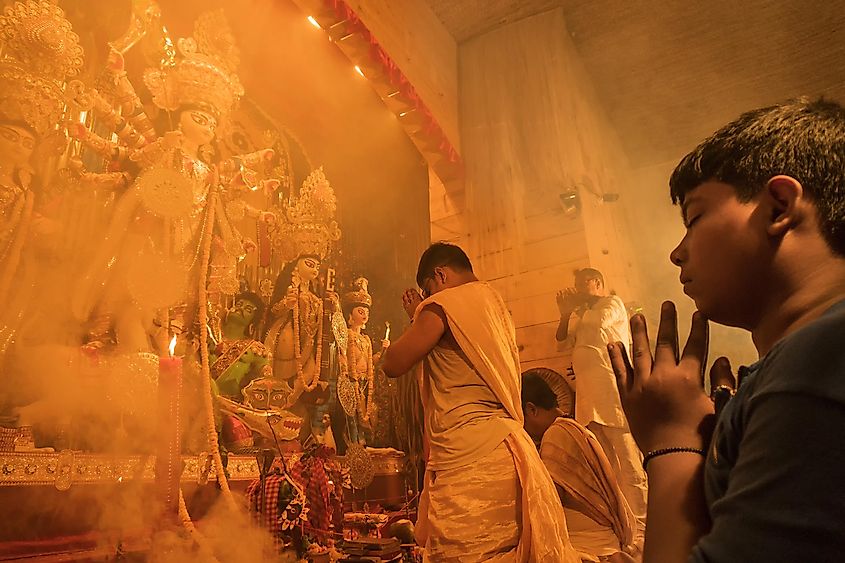
The origin of Hinduism, a religion with 1.1 billion followers, is difficult to pin down because it began as an amalgamation of different beliefs. Officially formed between 2300 B.C. and 1500 B.C., the Indus Valley near modern-day Pakistan is the location in which it first blossomed. Typically thought of as the ‘religion with 33 million gods,’ the majority of Hindus worship one god alone, albeit they accept the existence of other gods.Hindu people worshipping Goddess Durga under holy smoke, which is a Durga Puja festival ritual
Core values are ones such as Karma and Samsara. Karma dictates that the moral sum of the deeds we produce will be returned to us eventually, through consequence or reward. Samsara is a model for the cyclical nature of life, a symptom of which is reincarnation. Historical contributions to the world include mathematics as well as astronomy and yoga.
Read MoreCountries With The Largest Hindu Populations
Buddhism
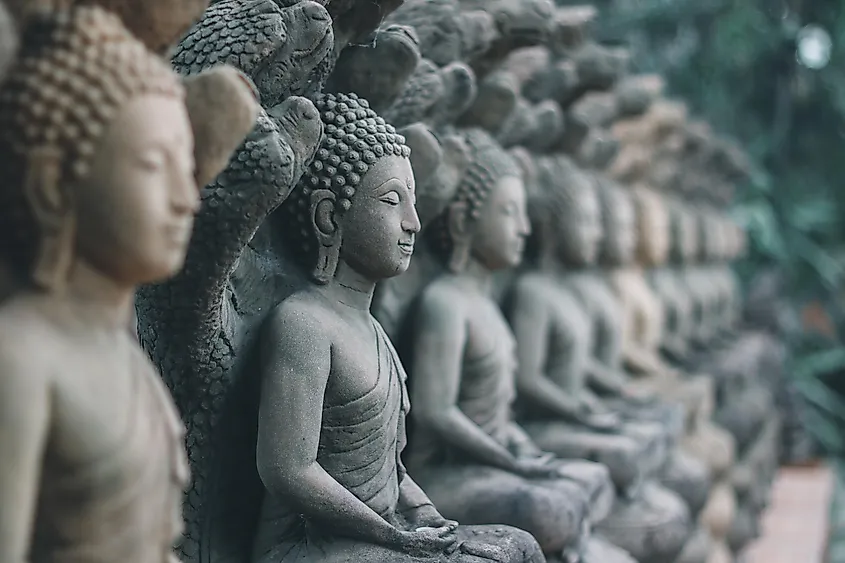
A Rock statue of Buddha
null
A prince who renounced his wealth to pursue wisdom, the Buddha is an eclectic figure from the 5th century B.C. who brought together many different beliefs in order to develop a revolutionary philosophy on human identity and purpose. The goal is to achieve an enlightenment called Nirvana, through meditation, kindness, and hard work. Values revolve around the absence of an ‘essential self,’ impermanence, and the reality that life is suffering. Therefore, a primary aim for mankind is the elimination of suffering in all its forms.A young Buddhist monk
null
The orange tunic, that the monks famously adorn, represents a fire that burns away impurities. Two different sects exist, the Theravada Buddhists and the East Asian Buddhists, which differ in their selection of texts. At 500 million followers, Buddhism has been lauded for its effective use of an egalitarian philosophy that has worked to dismantle caste systems worldwide.
Read MoreBuddhism
Shinto
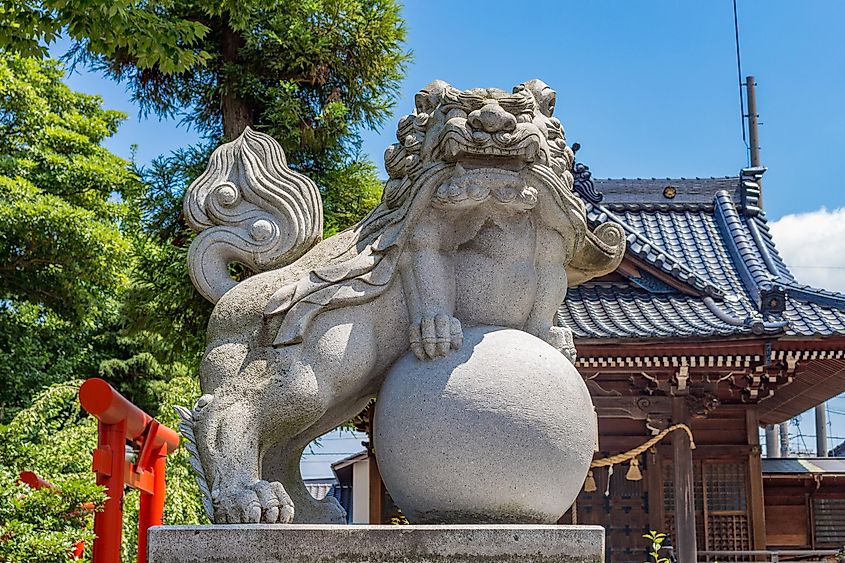
The Kumano Hongu Taisha, one of the three grand shrines of Kumano, in traditional shinto architecture in Tanabe, Wakayama, Japan
Shinto, the ever-nebulous religion of Japan, has no settled doctrine or origin story. At its simplest, Shinto beliefs gravitate towards a fluid idea of kami. Kami are the personified concepts of wind, rivers, trees, and other natural elements. Due to the influence of Christianity, the concept of an afterlife was introduced, and some followers believe humans become kami after death.Lion-dog, or komainu, at Miumajinja shinto shrine, Kanazawa, Japan. These traditional statues are seen in pairs in most shrines and are intended to ward off evil spirits.
null
The religion became more concrete in the events surrounding WWII, wherein the Japanese government instituted it as a state religion that aimed to venerate the emperor as a living, human, kami. Otherwise, Shinto beliefs have developed since the 6th century as a nature-focused series of scattered beliefs, that merged and then split with Buddhism as well as Confucianism. With 104 million followers and a focus on ancestry and nature, the belief can be understood through indulging in Japanese storytelling; wherein, the horror of 20th-century industry threatens the magic of the world around us.
Read MoreWhere Is The Shinto Religion From?
Sikhism
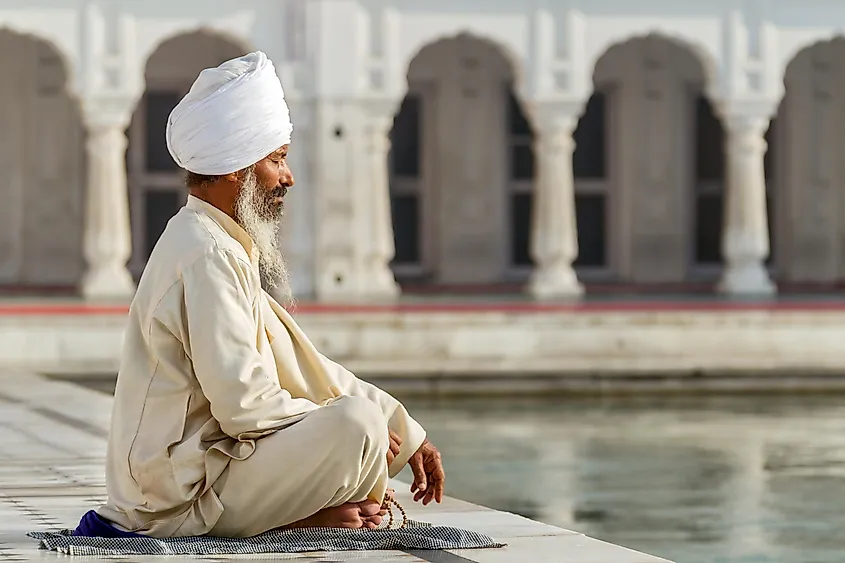
A Sikh person praying while in the lotus position
In 1469, the first Guru of Sikhism was born. Guru Nanak, a northeast Pakistan native, migrated to India and began to record and teach his revelations during journeys around the Islamic and Hindu world throughout the early 1500s. These revelations are few but substantial: Share with others, earn an honest living, meditate on God’s name and resist negative behaviors.Sunset at Golden Temple (the preeminent spiritual site of Sikhism) in Amritsar, Punjab, India
Currently, the 25 million followers organize to promote universal egalitarian principles and believe that all faiths ultimately worship a singular divine being. A well-known example of this mindset is the tendency for Sikh temples to have a community kitchen dedicated to serving meals to anyone, for free. Sadly, Sikh history is marked by political difficulty and deadly rebellion against intolerant regimes. Several of the original Gurus, leaders that carry on Nanak’s spiritual empowerment, were executed by the state authority of their time.
Read MoreSikhism
Judaism
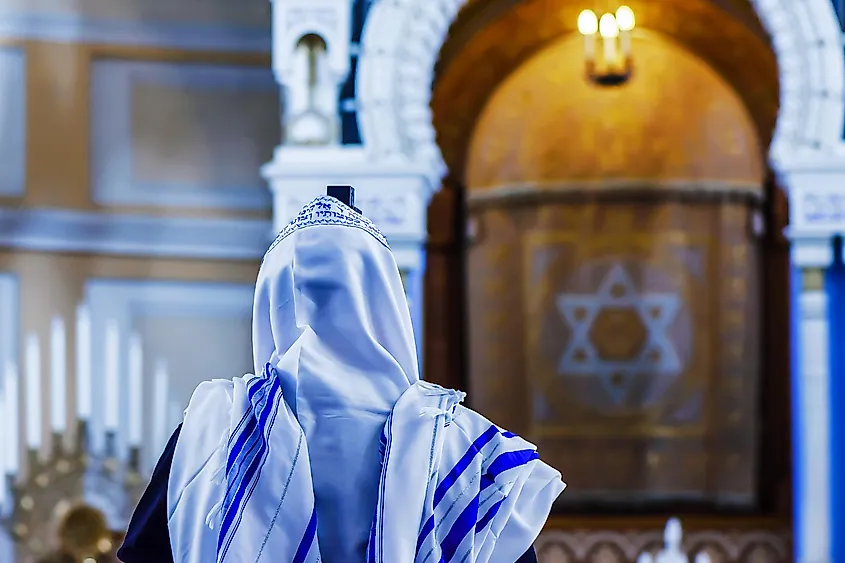
The Hebrew handwritten Torah, on a synagogue alter, with Kippah and Talith
The original Abrahamic faith, Judaism has been practiced for over 3500 years. Archaeological evidence confirms the existence of two adjacent Jewish kingdoms between 900 and 700 B.C., and the religious texts assume a confederacy of 12 tribes united in faith before that. Each tribe, and subsequent kingdom, claim descent from Abraham.A Jewish person praying at a Synagogue
The faith is monotheistic, in contrast to the ancient Levant’s polytheistic history. The devotion to their god, “Yahweh,” comes from his commitment to them as a chosen people, while constantly being urged by him to return to pious behaviors. Unlike Christianity and Islam, there is no detailed assumption of the afterlife other than a deep sleep called “Sheol.” Roughly 14 million Jews continue to practice the faith today, despite extreme persecution during World War II.
Read MoreJudaism
Taoism
Laojun Mountain, Luoyang, Chinese Taoist Holy Land
A ‘one-size-fits-all’ belief, Taoism is a series of principles and axioms that attempts to guide followers towards balance. Two ‘persons’ sit at the heart of Taoism; the Tao itself, and Laozi, a 6th-century contemporary of Confucius. Laozi and his school decreed that the Tao is undefinable, and only engaged through lived experience. It is a powerful force that runs throughout the universe and encourages “De,” which is adherence to the Tao.The Taoism Book of Harmony, with the Taoism Symbol on the Book Cover
The Tao is the natural order of the universe and is not worshipped as a god, and it is believed that humans merge with the Tao upon death. By adhering to the lifestyle of De, the 12 million followers of Taoism trust that they will experience less suffering. Inaction and a passive effort to synchronize with this balance is the key differentiation from the more intentional Confucianism.
Read MoreTaoism
Confucianism
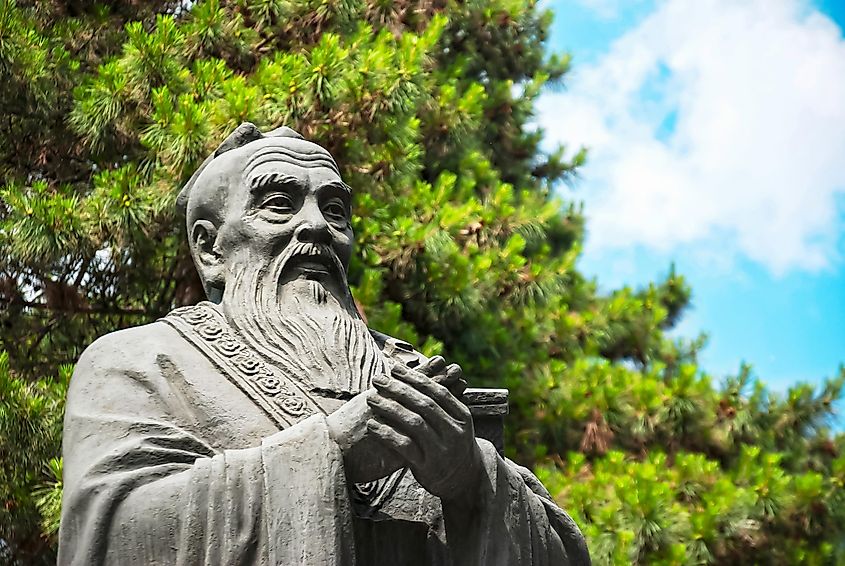
A statue of Confucius, located in Harbin Confucian Temple, Heilongjiang, China
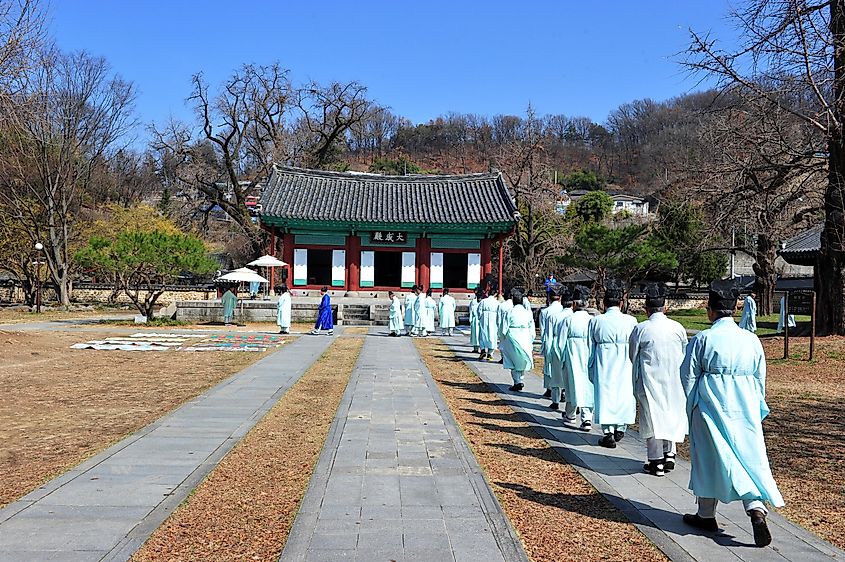
Despite dancing around spirituality, leading many to consider Confucianism as a philosophy only, the religion establishes a theological understanding of the Universe, albeit an impersonal one. In it, the priority of humankind is to strive to synchronize with the order of the universe in order to achieve oneness with heaven for the tranquility of community and self. This order is defined by “Tiān,” a non-speaking ‘God of Heaven’ which can be best translated as “the way things are.”Confucian rite (Incense burning ceremony) held at the Jeonju Confucian Temple in Jeonju-si, South Korea
Moreover, Confucianism argues that the way humankind should act is a way that conforms to the most evident morals: charity, obedience to mentors, humility, and compassion. All people are inherently good and must work to realign themselves with that nature. Since its establishment by Confucius and his writings in 500 B.C., the faith currently hosts over 6 million followers.
Read MoreWhat Are The Holy Sites Of Confucianism?
Caodaism
Traditional funerals of people Cao Dai religion, in Ho Chi Minh city – Tay Ninh province, Vietnam
A melting pot of many of the world’s largest faiths, Caodaism is a recent creation originating in 1921 when a vision came to an assembled group of mediums located in Vietnam. Nearly 4.4 million believers align themselves with the core tenets that teach harmony, unity with a monotheistic deity, reincarnation, and anti-materialism. Besides the association with Buddhism, Confucianism, and Taoism, Caodaism asserts the existence of several creator spirits as well as devils led by a being resemblant of Satan; this is a dynamic similar to Abrahamic faiths.The Gate and Tower In Tay Ninh Holy See (Cao Dai Great Temple) in Tay Ninh City, South of Vietnam
Naturally, to achieve heaven, a soul must evolve its spirit through good behavior during successive reincarnations. The belief was influential in Vietnam during the 1930s, not only because of its quick spread, but also due to the anti-colonialist sentiment that it cultivated against the French occupation. In 1997, after being banned for 22 years, the practice of the religion was permitted in Vietnam once again.
Read MoreCaodaism
The shocking reality about each faith, side to side, is that they tend to possess more similarities than differences. For instance, students of each belief spend years honing their self-control and ability to grow through introspection. Countless tales can be heard of disciples who swear by the fact that these faiths transformed them into proud and more joyful members of society. Furthermore, the scholars of each belief are happy to borrow from each other when the opportunity presents itself. For example, famed Christian theologian C.S. Lewis cleverly integrated the concept of Tao into his own writings. After examining the history and core values of each faith, it is evident that the secret to how they might morph and evolve further is buried in the future.RankReligionNumber of Followers1Christianity2.38 billion2Islam1.90 billion3Hinduism1.16 billion4Buddhism506 million5Shinto104 million6Sikhism25 million7Judaism14 million8Taoism12 million9Confucianism6 million10Caodaism4.4 million
Share
Cory Price November 21 2022 in Society
More in Society

Teams That Have Never Qualified For The FIFA World Cup Finals

Simone de Beauvoir’s Perspective On Existential Feminism

10 Countries Where Women Far Outnumber Men

The 10 Oldest Cricket Grounds In The World
10 Countries Where Men Far Outnumber Women

Countries with the Shortest Average Heights

10 Countries Where People Smoke The Most

10 Creepy Urban Legends from Around the World

10 Urban Legends That Are Actually Based On Real Facts

Largest School Districts in the United States

Ethnic Groups and Demographics of France

Countries With The Most Olympic Medals

All maps, graphics, flags, photos and original descriptions © 2025 worldatlas.com
- Continents
- Countries
- Geography
- Education
- Social Science
Search WorldAtlas
null
American Government
It’s system of government is one that reflects the complexity of its 50 states. How much do you know the American system of government? Let’s check it out… Magnificent! Congratulations, it seems as though you are VERY knowledgeable about the USA’s political system. Very few people get a perfect score (or close to it) on this test, so your knowledge of the American system of Government is really something that you ought to be proud of! You are clearly a life-long learner, which is something that’s far less common than you might like to believe. You got 11 out of 14 right – 79% (Show Mistakes)
I am a very calm person
. You are a very calm person You are part of a select few with a resilient mindset, adept at discerning urgent matters from those that warrant your attention in due course. Your life, potentially filled with stressors, doesn’t succumb to overwhelming pressure. This stems from your practice of attending to tasks in their own time, without overextension or multitasking excessively. With an understanding that some things can wait until tomorrow while others demand today’s focus, you’ve cultivated a habit that significantly tempers stress levels in various scenarios. This ability to allocate mental resources where they are needed most at any given time serves you well. Kudos to you! Share your results with friends to learn more about them! Share Result
Knowledge of Animals
Can you identify the animals just by the partial photos we have? Please help us find the poor animals. If you’d like to know if you got it right, the full photos will be in the ‘Show Mistakes’ section. You Know Your Animals! You’ve really got the eyes and knowledge for this quiz! You must love animals and nature shows and rarely miss an opportunity to stare at a landscape or animal shot, enjoying the majesty and beauty of this planet’s wildlife. We hope you pass this passion on to others. If you failed to get 100% of the answers correctly, though, have a look at our answers to know for sure! You got 9 out of 12 right – 75% (Show Mistakes) Share your result with friends and see how they compare! Share Result Share Quiz
World Quiz Results
Look for little clues in the photos that are difficult for you and let your logic disqualify the countries one by one until you reach the only one it could be. Good Work! You must be quite a worldly person and have seen quite a few photos of distant lands. Perhaps you have traveled to some of these countries, or you’re just interested in geography and the wide world outside your country’s borders. It’s a huge world out there, and it’s great to know more about it. Check out your mistakes by clicking on “show mistakes”. You got 7 out of 12 right – 59% (Show Mistakes) Share your result with friends and see how they compare! Share Result
How Observant are You?
Restored Church of God Real Truth World to Come WCG Background?
The Restored Church of GodSearch
Pillar January-february 2025
How Observant Are You?
by Charlie M. Sarracco
Discover a practical tool for gaining knowledge about yourself and others.
FacebookXLinkedInRedditEmailCopy LinkShare
Save
Attend a Congregation
What is God doing right now? Psalm 33 provides the answer: “The Lord looks from heaven; He beholds all the sons of men. From the place of His habitation He looks upon all the inhabitants of the earth” (vs. 13-14).God is watching us. Zechariah 4:10 adds that “the eyes of the Lord…run to and fro through the whole earth.”The eyes of God are observing all mankind collectively, as well as each of us individually in our lives. David understood this. In Psalm 139, he wrote: “O Lord, You have searched me, and known me. You know my downsitting and my uprising, You understand my thought afar off. You compass my path and my lying down, and are acquainted with all my ways” (vs. 1-3). We could each say the same.God is the most observant Being in the universe. He is all-knowing and all-powerful, yet cares about the small details of what man is doing here on Earth. This is comforting to know. For example, Luke 12:7 says “even the very hairs of your head are all numbered.”Do you consider yourself an observant person? How observant are you? We all notice things around us to some degree. But you will see there is more to this important characteristic than meets the eye.Although we cannot be as observant as our Creator, God has set a perfect example from which to learn. We have also been given other helpful examples in the Bible to help us understand how effective the skill of observation can be.Jesus Christ observed people putting money into the treasury and noticed the poor widow putting in all she had. He highlighted this moving act of giving as an example of the proper attitude when giving an offering (Mark 12:41-44). The apostle Paul noted the many gods the Athenians worshipped and used this observation to introduce them to the true God (Acts 17:22-23). King Solomon observed an overrun and neglected vineyard while out for a walk, which led him to reflect on the importance of diligence (Prov. 24:30-34).These biblical examples and others show us the power of observation, which can help us connect with others, recognize opportunities and see lessons in everyday life.Tools of the TradeWhile observation may seem obvious and automatic, it does not always come naturally. It is a learned behavior that can be improved over time with practice.God gave us tools to help us observe. Just as a paintbrush is a tool for an artist or a shovel is a tool for a gardener, our five basic senses are the tools for the trade of observation. Proverbs 20 states: “The hearing ear, and the seeing eye, the Lord has made even both of them” (vs. 12). We can see with our eyes and hear with our ears, as the verse says. He has also given us the senses of smell, taste and touch.Exercising your senses will help you observe. By paying close attention to what is happening around you, you will notice needs waiting to be filled. For example, there could be an opportunity to offer help and guidance to someone. Maybe a friend needs someone to talk to about a difficult time they are going through, or a work colleague is showing signs of struggling with a project.In these situations, we can step in and offer a helping hand. But we have to first notice the need before we can act. This can come from words a person uses in conversation, body language, tone of voice, or just noticing a person acting in a way that is out of the ordinary.Our senses help us a lot if we are not passive or idle. For instance, you could smell a gas leak, smoke, or chemical fumes and protect others who may not notice from danger. While driving, you can keenly look out for icy patches or potholes.Yet building observation skills takes time and practice.How to Sharpen Your SensesIn today’s world, a lot can distract us from being observant. From smartphone notifications to the temptation to do too much multitasking at one time, it can be hard to be fully aware of what is going on around us.Setting clearly defined goals when dealing with areas that tend to take our focus will help. For example, try not to use your smartphone when you are talking with someone in person—give them your full attention. Avoid being in a distracted rush by setting a manageable schedule for yourself throughout the day. When we are in a hurried state, we are more likely to miss the finer details.Asking questions is also a great way to boost your observation. You can ask questions to others and even to yourself. For instance, maybe you lack the energy that you normally have. You could ask, “What have I been eating that could be impacting how I feel?” Or “Have I been getting enough sleep lately?”By asking questions, we challenge ourselves to think differently and take steps to adjust.Jesus Christ showed the importance of asking questions during the Sermon on the Mount: “Ask, and it shall be given you; seek, and you shall find; knock, and it shall be opened unto you; for every one that asks receives; and he that seeks finds; and to him that knocks it shall be opened” (Matt. 7:7-8).Christ would often ask His disciples questions to get them to reflect on what they were experiencing. Read Matthew 16:15.We can all think back to when we were in a hurry to get somewhere, and the trip seemed like a blur. It is hard to remember the small details of our surroundings when we are racing around hurriedly. Our brains can only process so much information at a fast pace.Psalm 46 says, “Be still, and know that I am God” (vs. 10). To “be still” can mean to relax, slacken, or cease. To appreciate and know God, we are told to relax or slow down. The same applies to observation. We must avoid being hasty (Prov. 21:5). Hastiness diminishes our ability to observe.Part of this process is reflecting on what you see. When we reflect—this can be defined as serious thought and consideration—we are taking the necessary time to analyze what we have observed. It helps us to process the information collected. This will help ensure you do not come to the wrong conclusions.For example, if someone greets you with an unenthusiastic hello, you might assume they are upset with you. Later, however, you remember they mentioned struggling with a health issue. What seemed like rudeness now becomes a reminder to check in with a kind text or call.Personal GrowthMost have heard the phrase, “A picture is worth a thousand words.” Put another way, what we see holds a lot of meaning. We can learn a lot from others that fuels our own growth.Hebrews 10 says, “And let us consider [observe] one another to provoke unto love and to good works” (vs. 24). By carefully watching others, you learn from what you see and are provoked to do the same. What an amazing picture of the power of observation!Paul told the Corinthians: “Be you followers of me, even as I also am of Christ” (I Cor. 11:1). He further emphasized this in Philippians 3:17. While no one, minister or otherwise, is perfect, observing the Christ-like qualities in others is a great way to see how to live God’s Way.Anyone setting the right example—maybe they are taking the lead to organize an element of a social, or they offer to use their truck to help someone move into a new home without being asked—would be someone to observe and emulate.Conversely, there are certain behaviors or habits you can learn to avoid through observation. Let’s dig deeper into King Solomon’s observation mentioned earlier: “I went by the field of the slothful, and by the vineyard of the man void of understanding; and, lo, it was all grown over with thorns, and nettles had covered the face thereof, and the stone wall thereof was broken down. Then I saw, and considered it well: I looked upon it, and received instruction” (Prov. 24:30-32).In this passage, Solomon paints a picture of how he learned from a bad example. This dilapidated and unkempt land symbolized the negative outcomes of laziness. He identified the person who lived there as a “man void of understanding” and knew not to follow that example.You can likely think of a time when you saw something similar. By observing what others are doing or not doing, you are receiving instruction.While we can learn a lot from observing others, we must be mindful of our actions too. Others are watching what we do. Be careful not to spend too much time looking at other people and not enough time examining yourself. Take time to regularly reflect on your own conduct and evaluate where you can improve through the lens of God’s Word.Matthew 7:3 asks, “And why behold you the mote that is in your brother’s eye, but consider not the beam that is in your own eye?” We must not look down on others while casting a blind eye to our own weaknesses.When we pause and consider our works (Hag. 1:7; II Cor. 13:5), we are more likely to view the actions of others with the right attitude.By improving our own conduct, we will help others see a good example, too. And this could give them something to apply in their lives. It is a win for everyone!Observation in RelationshipsBy growing in our observation skills, we are less likely to be out of tune with the feelings and emotions of others. An example of observing certain emotions in others and then implementing them is found in Romans 12: “Rejoice with them that do rejoice, and weep with them that weep” (vs. 15).By being observant of others, you are being outwardly focused and show outgoing care and concern. This is why Paul mentioned in Philippians 2: “Look not every man on his own things, but every man also on the things of others” (vs. 4).For instance, if you notice a friend or family member struggling through a trial, take the next step and ask them if there is anything you can do to help. This will help you show empathy—sharing the feelings of another—in conversation, leading to stronger and more meaningful relationships. Read Galatians 6:2.Author Dale Carnegie explained the importance of taking an interest in others in his famous book How to Win Friends and Influence People. He wrote, “You can make more friends in two months by becoming interested in other people than you can in two years by trying to get other people interested in you.”For example, you might notice that a person in your congregation really comes to life when certain topics are brought up. You can seize the opportunity to ask them more and give them the opportunity to share with you. This could be stories from their childhood, how they were called into the truth, their passion for gardening, or anything else. Observing and supporting others’ interests is a great way to make them feel appreciated.“Observation is not just a skill—it is a gift from God that enables us to grow, serve and strengthen our relationships with Him and others.”Putting It into PracticeObservation is not just a skill—it is a gift from God that enables us to grow, serve and strengthen our relationships with Him and others. By observing the world around us and reflecting on what we see, we gain valuable insights into ourselves, the needs of those around us, and the lessons God places before us.But observation alone is not enough. As the apostle James teaches us: “For if anyone is a hearer of the word and not a doer, he is like a man observing his natural face in a mirror; for he observes himself, goes away, and immediately forgets what kind of man he was” (1:23-24, New King James Version).We would never notice a piece of spinach in our teeth or a dirty smudge on our cheek while looking in a mirror and walk away without removing them. Likewise, we also must not be passive about what we observe. Take action on what you see and learn.God’s Holy Spirit is essential in this process. John 16:13 calls it “the Spirit of truth” that “will guide you into all truth.” It sharpens our spiritual vision, helping us discern truth, identify opportunities to serve, and recognize areas in our own lives that need improvement.Chapter 14 adds that the Spirit “shall teach you all things, and bring all things to your remembrance” (vs. 26). It empowers us to go beyond surface-level observation and see deeper into the heart of a matter, aligning our thoughts and actions with God’s will.Take comfort in knowing that God Himself is the ultimate observer. He sees us, knows us and is lovingly guiding us every day.So slow down. Be still. Take the time to observe. Ask questions. Reflect deeply. And most importantly, let God’s Spirit guide you in turning those observations into meaningful actions.
FacebookXLinkedInRedditEmailCopy LinkShare
My RCG
General
More
Related Websites
The Real Truth The World to Come WCG Background?
Copyright © 2025 The Restored Church of God. All Rights Reserved.
The Restored Church of God is a 501(c)(3) not-for-profit organization.
Geography Results
PASS
Congratulations! You are a geographical genius and part of the world’s 3% who know EVERYTHING about this lovely planet of ours.
 Site Title