Staph Infection

Skip to Content

Search

Subscribe

sign in

Search

0Best Post-Holiday DealsPlanners to Buy Right NowBrooks January SalesTested Nike Walking ShoesHoka Vs. Asics

  1. Health

What Is a Staph Infection? Here’s 6 Symptoms to Look For and When to See a Doctor

When left untreated, staph infection symptoms can become life-threatening.by Markham HeidKorin Miller and Madeleine HaaseUpdated: Mar 1, 2023

bookmarks

Save Article

How To Wash Your Hands

Good Housekeeping US

Current Time  0:35

Total Duration  0:48

Play Icon
preview for How To Wash Your Hands

We may earn commission from links on this page, but we only recommend products we back. Why Trust Us?

Jump to:

Any kind of infection can sound scary at first, but it’s important to understand what’s going on with you and your body so that you can get the help you need. Staph infections, given how common they are, can particularly trigger panic if you aren’t sure what to attribute your symptoms to. Here, we’ve consulted both dermatologists and infectious disease experts to explain exactly what staph infection symptoms you should look for if you suspect something’s wrong.

Advertisement – Continue Reading Below

What is a staph infection?

Put simply, a staph infection is caused by a specific type of bacteria, typically Staphylococcus aureus, though other strains can also cause infection, says William B. Miller, Jr. M.D., infectious disease expert, evolutionary biologist, and author of Bioverse: How the Cellular World Contains the Secrets to Life’s Biggest Questions. “Staphylococcus bacteria are very widely distributed on nearly all surfaces and some staph normally live on our skin.” Staph infections are extremely common, estimated at over one million cases annually in the United States, he adds. “Most are mild and do not need treatment.”

Staphylococcus is a group of bacteria and there are more than 30 different types, per the U.S. National Library of Medicine. They are known as “commensal” microorganisms because they’re friendly enough to live on our bodies without causing any problems, says Paul Fey, Ph.D., medical director of the University of Nebraska Medical Center’s department of pathology and microbiology. “You can find staph in your nose, on your skin, and sometimes in other mucous membranes like your anus,” he explains.

Advertisement – Continue Reading Below

null

null

Types of staph infections

While staph bacteria are courteous houseguests when confined to their normal quarters, they can cause infections and illness (most commonly caused by Staphylococcus aureus) if they gain access to areas of your body where they don’t belong. There are different types of staph infections, Dr. Fey says, and they show up in different ways.

“Staph infections most commonly develop when there is a break in the skin, giving the staph an entry point for infection,” explains Joshua Zeichner, M.D., director of cosmetic and clinical research in dermatology at Mount Sinai Hospital in New York City. “This may occur after regular cuts and scrapes, nicks from shaving, or even open skin because of athlete’s foot.”

Advertisement – Continue Reading Below

null

In addition to minor local infections, staph can also cause a serious immune system reaction to an infection known as sepsis, says Gary Goldenberg, M.D., assistant clinical professor of dermatology at the Icahn School of Medicine at Mount Sinai Hospital. “People can die from a staph infection if it gets into the bloodstream or infects internal organs,” he says.

Who is at risk for staph infections?

Anyone can get a staph infection, says Dr. Miller. “Some people carry staph bacteria that are harmless to them but can cause symptomatic infection in others which can be spread by person-to-person contact.” In other cases, there are identifiable underlying risk factors.

Advertisement – Continue Reading Below

In particular, individuals who are immunosuppressed because of chronic diseases (e.g. types of diabetes, HIV), cancer treatment, or recently post-operative, are more susceptible. Anyone with a heart valve, indwelling catheter, or artificial joint is at higher risk. Drug use is specifically associated with a higher risk for staph infections. Staphylococcus infections can also be spread through improper food handling, leading to food poisoning.

Most staph infections, especially those that involve the skin, are transmitted by skin-to-skin contact, adds Richard Watkins, M.D., infectious diseases physician and a professor of medicine at the Northeast Ohio Medical University. Because staph infections are typically transmitted through close contact, incarcerated people and athletes also have higher risk, he says.

Advertisement – Continue Reading Below

Signs and symptoms of a staph infection

Not sure what to watch for? Here are the telltale signs of a staph infection you should know how to recognize.

1. Skin boils or pustules
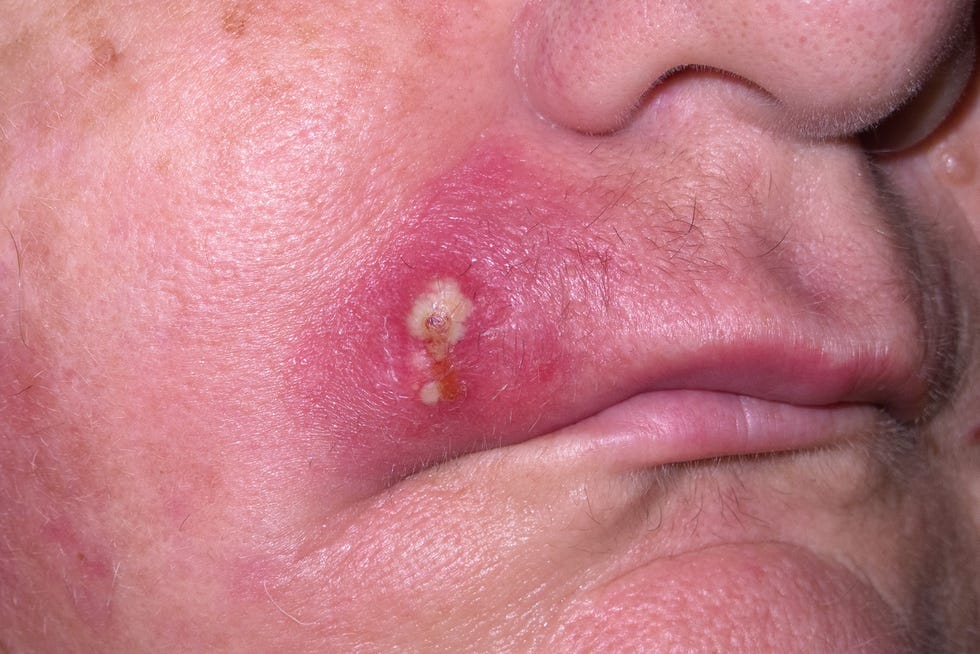
Mature woman with staph infection on face 4

Wendy Townrow//Getty Images

Advertisement – Continue Reading Below

Pus-filled or inflamed skin blemishes are by far the most common type of staph infection, Dr. Fey says.

“Let’s say you have a mosquito bite on your arm, and you have staph on your finger because you’ve been scratching or touching your nose,” he says. If you scratch your bug bite or some other place where your skin is broken, the staph bacteria on your finger can infect that wound and cause a big, red, painful, pus-filled blemish to form. You could also develop a rash-like cluster of raised blisters called impetigo, he says.

Advertisement – Continue Reading Below

“It’s fairly common in the ER for people to come in thinking they have a large spider bite, when really they have a staph infection,” Dr. Fey says.

2. Skin infections

Staph is actually the most common cause of cellulitis, a common and potentially serious bacterial skin infection, Dr. Goldenberg says. “It can occur in completely healthy people or in those with weak immune systems,” he says.

Advertisement – Continue Reading Below

Staph usually enters the skin through a cut or eczema patch and causes a local infection, leading to skin inflammation, Dr. Goldenberg explains. This can present as a warm, red, swollen area of skin that is tender or painful to the touch, most commonly on the lower legs, face, or arms.

While it may seem like no big deal, any skin condition that feels unusually painful or irritated should be evaluated by your doctor ASAP, as cellulitis can progress rapidly. “Deep infections like boils or infections of the legs should get immediate attention,” says Dr. Zeichner.

Advertisement – Continue Reading Below

3. Food poisoning

When a food is exposed to staph, the bacteria multiply and produce toxins. It’s those toxins that can make you sick, and they can lead to symptoms like vomiting, diarrhea, and stomach pain, typically within 30 minutes to 8 hours after ingesting the contaminated food, according to the Centers for Disease Control and Prevention (CDC). However, it’s important to note that a fever is not typically something you’d experience from staph-related food poisoning, Dr. Fey says.

The best ways to avoid staph-related food poisoning is to make sure your food is handled at the right temperature, the CDC says. Hot foods should be kept at 140°F or hotter and cold foods at 40°F or colder. And, of course, it doesn’t hurt to wash your hands thoroughly for at least 20 seconds with soap before cooking or eating.

Advertisement – Continue Reading Below

4. Fever and low blood pressure

In some cases—usually when someone’s exposed to staph in a hospital setting, like during surgery—staph bacteria can get into your bloodstream, Dr. Fey says.

This can cause a blood infection known as bacteremia, which can initially lead to a fever and low blood pressure. Once in your blood, this kind of staph infection can spread to your heart, bones, and other organs—and result in a number of serious or even deadly infections. Those include pneumonia, and also a type of bone infection called osteomyelitis, which could lead to swelling or warmth in the infected area, according to resources from the Mayo Clinic.

Advertisement – Continue Reading Below

Bacteremia could also lead to an infection of the lining of your heart known as endocarditis. Symptoms—like fever, chillsnight sweatsjoint pain, pale skin, and weakness—can develop very slowly, suddenly, or even come and go, per the U.S. National Library of Medicine.

5. Toxic shock syndrome

When the toxins staph produces accumulate, they can cause a particular type of blood poisoning known as toxic shock syndrome (TSS). This could lead to a sudden fever, vomiting or diarrhea, muscles aches, headaches, and a rash resembling sunburn on your palms and the soles of your feet, research shows.

Advertisement – Continue Reading Below

TSS is rare, though. The condition affects fewer than one in 100,000 people in the U.S., according to data from the CDC.

6. Sepsis

If a staph skin infection is left untreated, it can eventually enter the bloodstream and lead to sepsis, Dr. Goldenberg says, which is an intense immune system reaction to an infection that sends harmful inflammatory chemicals into the blood and other internal organs. This can block proper blood flow and potentially cause your organs to shut down, which can be fatal. Someone with sepsis might have one or more of the following symptoms, according to the CDC:

Advertisement – Continue Reading Below

  • A high heart rate
  • Fever, shivering, or feeling very cold
  • Confusion or disorientation
  • Shortness of breath
  • Extreme pain or discomfort
  • Clammy or sweaty skin

How is a staph infection diagnosed?

Simple infections can be diagnosed clinically, says David Cennimo, M.D., assistant professor of medicine-pediatrics infectious disease at Rutgers New Jersey Medical School. “Often, you want to drain a collection, meaning drain the pus of any boils and send it to the lab, and see what bacteria is there.” He adds that if the staph infection has traveled to the bloodstream, your doctor will likely take blood samples to grow a blood culture to determine if the infection is indeed caused by staph bacteria.

Advertisement – Continue Reading Below

How is a staph infection treated?

There are several antibiotics that treat staph infections, both oral and intravenous ones, says Dr. Watkins. “Usually, the person is no longer contagious once the symptoms are resolved.” However, some people become carriers of staph and can pass it on even when they don’t have symptoms of active infection.

Depending on the resistance, some staph infections are pretty sensitive to most antibiotics and some have more resistance, says Dr. Cennimo. He says that the usual course for treatment can “anywhere between a week and 6 weeks of antibiotics.”

Advertisement – Continue Reading Below

What is MRSA?

You’ve probably heard of MRSA—pronounced “mer-sa”—which stands for “methicillin-resistant Staphylococcus aureus,” Dr. Fey explains. As the name states, this is a type of staph that has developed resistance to certain antibiotic drugs, including a commonly used type called methicillin.

In most cases, MRSA infections manifest just the same as other types of staph infections—meaning they show up as skin boils or pustules, he says. But MRSA can also lead to some of the more serious skin and blood infections mentioned above. In those cases, MRSA’s drug resistance may make it tougher to treat.

Advertisement – Continue Reading Below

“Staph infections need to be treated immediately.”

That’s why “staph infections need to be treated immediately,” Dr. Goldenberg says, which could range anywhere from topical or oral antibiotics for superficial skin infections to IV antibiotics for more serious infections.

Advertisement – Continue Reading Below

While anyone can develop a staph infection, those with weakened immune systems and diabetes are at a higher risk, Dr. Goldenberg says. People with eczema also tend to get more superficial staph infections, he says.

How to prevent a staph infection

Washing your hands thoroughly and often—especially when you’ll be handling food or touching a wound or broken skin—is the best way to prevent a staph infection, Dr. Fey says.

Neosporin Original Antibiotic Ointment

Now 28% Off

Check Price at Amazon

You should also try to keep broken skin (such as itchy rashes, cuts, and sores) away from gym equipment and other surfaces that may be harboring bacteria. “Make sure you tend to any open skin by cleaning the area, applying over-the-counter antibiotic ointment and then cover with a bandage to protect the area,” Dr. Zeichner says. “Do not share personal care products like razors, as they can spread bacteria, and avoid direct contact of the skin with someone who has crusts, scabs, or signs of an active infection themselves.”

Advertisement – Continue Reading Below

If you have eczema, make sure it’s treated and see a doctor if you have any uncontrolled or infected-looking flare-ups, Dr. Goldenberg adds.

While you may be tempted to give yourself an intense scrubbing in the shower to optimize your hygiene, Dr. Cennimo advises against it. “Don’t dry out your skin (or scrub too hard in the shower) because if you have dry cracked skin, bacteria can hide in those cracks.” So after your shower or following any kind of exfoliation, be sure to moisturize!

Advertisement – Continue Reading Below

And lastly, whenever you’re engaging in healthcare, make sure that everybody that is seeing you is washing their hands, says Dr. Cennimo. “It’s ok to ask ‘did you wash your hands?’ and alcohol hand sanitizers can do just as well.”

When to see a doctor about staph infection symptoms

Anybody that is having high fever or signs of systemic infection (fever, chills, change in activity level) should seek urgent medical care, says Dr. Cennimo. “Things that look like a skin infection that are lasting more than a day that are expanding rapidly, that are making you have a fever, that are particularly painful, you really need to be evaluated.”

Advertisement – Continue Reading Below

Also, if someone you have had contact with has a staph infection and you have new symptoms on your skin, seeing a doctor would be a good idea, adds Dr. Watkins.

Unless you have an angry skin boil or blemish, spotting a staph infection is going to be difficult, since the symptoms can overlap with all sorts of health conditions, Dr. Fey says. When in doubt, see your doctor, who can give you a proper diagnosis and treatment plan.

Advertisement – Continue Reading Below

Related Stories

..

Advertisement – Continue Reading Below

Health

Which State Is the Best for Women’s Health?An Editor’s Review of the Gravity Weighted BlanketSausage Links Recalled in 3 StatesWhy It Matters If You Have Flu A or B

Advertisement – Continue Reading Below

Odell Beckham Jr. Reveals Health DiagnosisChocolate Recall Updated to ‘Deadly’ by FDAStudy Links Processed Red Meat With DementiaThe Most Dangerous Ozempic Side Effects

What Causes White Bumps on Lips?How to Stop Post-Nasal Drip QuicklyLay’s Potato Chips Recall Elevated to Class ITesters and Dietitians Rec These Women’s Vitamins

Advertisement – Continue Reading Below

Hearst Lifestyle and Design Group - A Part of Hearst Digital Media
Logo
x
youtube
facebook
instagram
pinterest

About Prevention.comNewsletterPress RoomGive A GiftCommunity GuidelinesSubscribeMedia KitAdvertise OnlineOther Hearst SubscriptionsCustomer Service

A Part of Hearst Digital Media

We may earn commission from links on this page, but we only recommend products we back.

©2025 Hearst Magazines, Inc. All Rights Reserved.

Privacy NoticeCA Notice at CollectionYour CA Privacy Rights/Shine the LightDAA Industry Opt OutTerms of UseSite Map

Opt-Out Icon

Your Privacy Choices: Opt Out of Sale/Targeted Ads

null

Resolving Issues in a Positive Manner

From The Experts Mouth (FTEM) - Elixir of Excellence

From The Experts Mouth (FTEM) - Elixir of Excellence

 Sign up

Living Life on Your Own Terms by Sonal Chhibber at fromtheexpertsmouth.com

Living Life On Your Own Terms

December 11, 2020

5 Comments

+51+

How to live life on your own terms?

I believe in being yourself and living life the way you want and get success on your terms. It’s tough, but achievable and you can be living life on your own terms!

Define success on your own terms, achieve it by your own rules, and build a life you’re proud to live.Anne Sweeney

Listen to the audio narration of Living Life On Your Own Terms:https://workdrive.zohoexternal.com/embed/ehxo1dbb376cd17da4c23a997f6c0c3aad58d?toolbar=false&appearance=light&themecolor=green

Audio Narration By: Tanvee Maheshwari

Meaning Of Living Life On Your Own Terms

The phrase “Living life on own terms” means living life meaningfully. You have the ability and inherent power to lead a happy and fulfilling life. It is possible to enjoy a purposeful career that gives you financial freedom and balance it with enjoying quality time with your family. It also includes having the freedom, time and flexibility to pursue things that matter most to you whether it is travel, volunteering, fitnessmeditationmental health or the pursuit of any sports, hobby or interest.

Twitter

WhatsApp

Happiness By Living On Your Terms

I believe that you need not live a life which you do not enjoy. It is possible to live a life that you love – a life on your own terms. Living life on your own terms, will make you a happier person and give you a sense of fulfillment. It will help you become a better spouse. A happier you will become a better parent and a better child to your parents too.

Living life on your own terms means having a purposeful life. It includes having the freedom and flexibility to do what matters most to you. This is important because how happy and fulfilled you feel about your work and life, affects not only you but also the people around you. It is in your hands to achieve these goals. You can make this happen starting today by taking action!

People can be happy only in one way, and that is if they are authentically themselves. Then the springs of happiness start flowing; they become more alive, they become a joy to see, a joy to be with; they are a song, they are a dance.Osho

Twitter

WhatsApp

Related Reads:

Inspiring Wanderer - Vimal Geethanandan - Stories of a full-time traveller - From The Experts Mouth (FTEM)

Inspiring Wanderer – A traveler on his own terms

Crispy Maheshwari shares her thoughts on How to overcome confusion? How do we empower ourselves to make the right choice when paralyzed by dilemma and indecision?

Action trumps confusion

Find Your Wholeness by Namita Barik at FTEM, From The Experts Mouth

Find your wholeness

Living Life On My Own Terms

There are some fundamental questions in the life of an individual, which need to be addressed at the right time. We need to focus on questions specific to our inner life and quality of existence. My philosophy is insightful and simple. It says be rebellious but not revolutionary. Be authentic and be who you truly are, this is the ultimate way of living. Don’t follow others. Don’t live in the past or future but live in the now, in the present. Realize your self-worth. As Buddha said, “Be a light unto Yourself”. Each one of us should live life on our own terms. We need not come under pressure or coerced influence of others and lead a life as desired or dictated by them.

Be a light unto YourselfBuddha

Related Read: about how to give wings to your dreams – When You Talk About Your Dreams

What about society? Live Life With Your Own Rules

Realize that it is immensely difficult to live on your own terms because society wants you to play by its rules. It judges you immensely if you decide to be different from the others and act differently from the expected normal. But society isn’t the only thing that should matter to us in life.

What we should all be striving for should be that which takes us closer to a brighter future, to our craziest dreams, our insane goals, and closer to achieving our endless potential. Society though may not see us eye to eye on the same. Hence rebellion – as it would be described by others, to some extent seems appropriate. It would be the right thing to do for you and anybody else who is willing to follow your lead.

Related Reads: Age isn’t a limiting factor when it comes to fulfilling dreams – Turning into an entrepreneur at 78

How To Find My Talents And Hidden Potential

Find Your Hidden Potential

When You Talk about your Dreams, Tanvee Maheshwari - Poem & Thoughts

Talk about your dreams

The Art Of Self Love

Art of Self Love

Slowly and steadily, you will find yourself walking towards a life on your own terms. Remember to never give up on your dreams, though it is painful to wait but it is more painful to regret.

Twitter

WhatsApp

Editor’s Note:

The value of the thoughts presented by Sonal Chibber have been recognized by Google through a Featured Snippet on this article. Read the details at the FTEM Success Story.

Living Life On Own Terms FTEM Success Story - From The Experts Mouth

Featured Snippet on Google – A FTEM Success Story.

Interested in Writing?
Get Featured

Join Telegram
Group

Subscribe to
YouTube

PIC FEAT 8 Sonal - From The Experts Mouth

Sonal Chhibber

About The Author

Sonal Chhibber is an Indian expat living in Dubai. She is a lifestyle blogger. She is an award winning poetess and a motivational speaker.

Her debut book Living life on my own terms contains timeless and contemporary poems vital to our personal search for meaning and purpose in life.

Related Reads:

Saying YES to Life - Embracing Life's Joys, Challenges and Happiness

Say YES to Life

Spiritual Journey - Alisha Sharma - From The Experts Mouth

Lost Found and Awakened

Mindfulness - A Way of Looking at Your Present Life - Vidisha Tripathi - From The Experts Mouth (FTEM)

Mindfulness

Related Videos:

Watch these videos revolving around the theme of identifying your potential, living life on your own terms, and loving yourself. Remember to like and subscribe to YouTube channel.

https://www.youtube.com/embed/3L6F_zNmPYI?feature=oembedGrandmother lives life on own terms

https://www.youtube.com/embed/ZPFPabwWnfM?feature=oembedSurprise: Your hidden talent

https://www.youtube.com/embed/49d3J_hcbM0?feature=oembedLove yourself

Related Books by Contributing Authors at From The Experts Mouth:

q? encoding=UTF8&ASIN=1911079603&Format= SL250 &ID=AsinImage&MarketPlace=IN&ServiceVersion=20070822&WS=1&tag=rajivmah 21&language=en IN - From The Experts Mouth
q? encoding=UTF8&ASIN=B07Y5NZ1VH&Format= SL250 &ID=AsinImage&MarketPlace=IN&ServiceVersion=20070822&WS=1&tag=rajivmah 21&language=en IN - From The Experts Mouth
q? encoding=UTF8&ASIN=B086KTP76P&Format= SL250 &ID=AsinImage&MarketPlace=IN&ServiceVersion=20070822&WS=1&tag=rajivmah 21&language=en IN - From The Experts Mouth

+51+

 Categories: YOU version 2.0Experts Mouth

 Tagged: BooksHappinessPositivitySelf Improvement

Responses

Your email address will not be published. Required fields are marked *

Name

Website

  1. PoonamMarch 12, 2022Well articulated ..we all can choose to live on our termsReply
  2. nitinMay 12, 2021Great read, absolutely agree !! When you’re living your life on your own terms, you get inspired to do more be more because you’re living a life that’s aligned with your authentic self…Reply
  3. Sonal ChhibberDecember 11, 2020You are right. We need to go with flow of life and do our best, no matter what challenges life throws at us. We can rise & shine and live life on our own terms even if odds are against us. All we need is faith and will power to do our best!Reply
  4. Poonam HaritashDecember 11, 2020“Living life on your terms” the meaning has changed with time. Once it meant to pursue your goals in a whole hearted way. Then it meant to follow your gut instincts and be true to your self. Now it means to surrender to the natural flow and rhythm and go with the flow with faith in the goodness of life.Reply
    1. Sonal ChhibberDecember 11, 2020Very well said poonam. Faith is the ultimate power.Reply

Tags

Business Careers Change Management Children Creativity Digital Education Entrepreneur Environment Events Finance fitness GenZ Gratitude Happiness Health Innovation Leadership Learning Life Hacks Management Mental Health Mindset Money Motivation Nature New Normal New Year People Perception Personal Development Planet Poem Positivity Psychology Relationship Review Self Improvement Society Startup Sustainability Technology UnleashWithFTEM Value Women

Top Reads

What is Poppin’? : Pop Culture and its influence on society
Top 24 Reads: Top Articles To Read In 2024
13 ways on How to Stop Dwelling in the Past
Home to Hostel
Why Is 2025 A Special Year? Fair And Square!
Lost, Found and Awakened- Charting My Spiritual Journey
The Wrath of Mother Earth
Theory of Deadlines
Implementation of GST: Looking Back and The Road Ahead
The Power of Curiosity | My Experience at International Conferences

Recent Posts

Categories

Follow Us At:

FacebookInstagramPinterestLinkedInMediumTwitterYouTube ChannelFeed

Categories

Recent Posts

Recent Comments

From The Experts Mouth (FTEM) - Elixir of Excellence

From The Experts’ Mouth – Elixir of Excellence

© 2025 – From The Experts’ Mouth

Hi there!Chat now

null

Knowing Jesus

Verse of the Day
Devotions
Search
Search

◄ What Does Proverbs 15:1 Mean? ►
A gentle answer turns away wrath, But a harsh word stirs up anger.

Proverbs 15:1(NASB)

Picture courtesy of Geralt – Pixabay
Verse of the Day
Many verses in the book of Proverbs are contrasting couplets that stand-alone as a wise piece of advice for men and women of every generation. But like this first verse in chapter 15 which says: “A gentle answer turns away wrath, but a harsh word stirs up anger,” it is also linked to a much wider body of teaching that could impact the lives of all who take note of its intrinsic wisdom and apply it in their lives.

The verse in question, not only deals with the immense power of speech, for good or ill, but also touches on the issue of ones controlled actions or unguarded reactions to the words, behaviour, language, and speech of others.

Words can be helpful and healing. They can provide hope and encouragement. Wise and gracious words are a powerful tool in ‘pouring oil on troubled waters’ or diffusing a situation that could quickly escalate into a serious conflict.

Our Latest Videos

However, the words we speak and the messages from our lips should also be spoken in spirit, in truth, in grace, and in love. For just as a gentle, controlled, thoughtful, or caring word can calm the troubled breast, bring hope to the hopeless, healing to the injured, or grace to an offender, so a harsh, hateful, cruel, or careless comment, can as easily be used to wound or discourage, hurt or hinder, harm or handicap, or speedily stir up strife and anger.

Although this proverb is applicable to every category of humankind, and if used in the corridors of power, the interactions of everyday life, or the privacy of our own homes would impact our local community and the wider world for good. Its target audience are the redeemed of God. How much influence for good this proverb would command if it were applied within the churches of Christendom and practiced in the individual lives and homes of Christians?

Not only does this first verse highlight the need for good, gracious, and gentle answers, but five further verses in the same chapter give greater insight into the need for godly interactions and wise words rather than ungodly speech or careless remarks.

Verse 2 explains: “The tongue of the wise makes knowledge acceptable, but the mouth of fools spouts folly.” Verse 4 suggests: “A soothing tongue is a tree of life, but perverse speech, crushes the spirit.” And verse 7 gives us an important reminder: “The lips of the wise spread knowledge, but this is not so from the hearts of fools.”

The chapter concludes with three further wise sayings connected with words and language. Verse 23: “A man has joy in an apt answer, and how delightful is a timely word!” Verse 26: “Evil plans are an abomination to the Lord, but pleasant words are pure.” And verse 28: “The heart of the righteous ponders how to answer, but the mouth of the wicked pours out evil things.”

Every verse in this proverb and every reference in Scripture on the correct use of gracious speech and wise language encourages us to give thoughtful questions and circumspect answers, timely words and godly interactions, controlled comments and a refusal to engage in unnecessary chit-chat and unwholesome gossip.

What a difference the Church would make in the world, if the simple message that: “A soft answer turns away wrath, but harsh words incites anger,” were applied in lives of all who have been saved by grace through faith in Christ. What a change could be wrought if we simply followed Christ’s example, Who only said and did those things He heard from His Father in heaven. No surprise that the people: “Wondered at the gracious words which proceeded out of the mouth of our Lord Jesus Christ.”

My Prayer
Dear Father in heaven, I pray that I may take note of the godly and gracious way to speak to others and apply it in my life. Help me to be careful when responding to the words of others so that I do not promote anger. Help me to turn away any bitterness or wrath with a soft and gentle answer. May my speech be a tree of life to others, and prevent me from ever crushing the heart or soul of another, through careless speech. I pray that my lips spread wisdom and knowledge, truth and love. May my speech and language reflect the gracious words that fell from the lips of the Lord Jesus during His sojourn on earth, and may I only say and do those things that honour His name. In Jesus’ name, AMEN.

Picture courtesy of Geralt – Pixabay
◄ Previous: Proverbs 14:12
Next: Proverbs 16:1 ►
Choose a Verse from Proverbs 15
123456789101112131415161718192021222324252627282930313233

Matthew 3:11

1 Peter 1:17

Philippians 2:1

Colossians 1:23

Follow us

Proverbs 15:1 Further Study
Proverbs 15:1 in the Parallel Bible
Proverbs 15:1 in the Thematic Bible
Proverbs 15:1 Cross References
Proverbs 15:1 Treasury of Scripture Knowing
Proverbs 15:1 Sermons
Proverbs 15:1 Prayers
Proverbs 15:1 Images
Proverbs 15:1 Devotionals
Choose Chapter
Subscribe to the Verse of the day
Today’s Devotionals

The Anointing Light Within Our Dwellings

Luke 11:34

Psalm 78:20

Peace And Rest

God’s Way is Christ (JOB-study 20)

His Loving Wisdom
Doctrinal Statement
Privacy Policy
Use of Pictures
Donate
Contact Us
© Copyright [2011 – 2025] Knowing-Jesus.com – All Rights Reserved

×
Information from your device can be used to personalize your ad experience.

Do not sell or share my personal information.

Source: https://dailyverse.knowing-jesus.com/proverbs-15-1

Proverbs 15:1 Commentary

Blue Letter Bible
Facebook
X
Instagram
YouTube

Menu

Search (e.g. John 3:16Jesus faith love)KJV

HelpQuick Nav

CitePrint

The Blue Letter Bible

← Back to Matthew Henry’s Bio & Resources

Matthew Henry :: Commentary on Proverbs 15

Chapter 15

Pro 15:1

Solomon, as conservator of the public peace, here tells us,

  • 1. How the peace may be kept, that we may know how in our places to keep it; it is by soft words. If wrath be risen like a threatening cloud, pregnant with storms and thunder, a soft answer will disperse it and turn it away. When men are provoked, speak gently to them, and give them good words, and they will be pacified, as the Ephraimites were by Gideon’s mildness (Jdg. 8:1-3); whereas, upon a like occasion, by Jephthah’s roughness, they were exasperated, and the consequences were bad, Jdg. 12:1-3. Reason will be better spoken, and a righteous cause better pleaded, with meekness then with passion; hard arguments do best with soft words.
  • 2. How the peace will be broken, that we, for our parts, may do nothing towards the breaking of it. Nothing stirs up anger, and sows discord, like grievous words, calling foul names, as Raca, and Thou fool, upbraiding men with their infirmities and infelicities, their extraction or education, or any thing that lessens them and makes them mean; scornful spiteful reflections, by which men affect to show their wit and malice, stir up the anger of others, which does but increase and inflame their own anger. Rather than lose a jest some will lose a friend and make an enemy.

Pro 15:2

Note,

  • 1. A good heart by the tongue becomes very useful. He that has knowledge is not only to enjoy it, for his own entertainment, but to use it, to use it aright, for the edification of others; and it is the tongue that must make use of it in pious profitable discourse, in giving suitable and seasonable instructions, counsels, and comforts, with all possible expressions of humility and love, and then knowledge is used aright; and to him that has, and thus uses what he has, more shall be given.
  • 2. A wicked heart by the tongue becomes very hurtful; for the mouth of fools belches out foolishness, which is very offensive; and the corrupt communication which proceeds from an evil treasure within (the filthiness, and foolish talking, and jesting) corrupts the good manners of some and debauches them, and grieves the good hearts of others and disturbs them.

Pro 15:3

The great truths of divinity are of great use to enforce the precepts of morality, and none more than this-That the eye of God is always upon the children of men.

  • 1. An eye to discern all, not only from which nothing can be concealed, but by which every thing is actually inspected, and nothing overlooked or looked slightly upon: The eyes of the Lord are in every place; for he not only sees all from on high (Ps. 33:13), but he is every where present. Angels are full of eyes (Rev. 4:8), but God is all eye. It denotes not only his omniscience, that he sees all, but his universal providence, that he upholds and governs all. Secret sins, services, and sorrows, are under his eye.
  • 2. An eye to distinguish both persons and actions. He beholds the evil and the good, is displeased with the evil and approves of the good, and will judge men according to the sight of his eyes, Ps. 1:611:4. The wicked shall not go unpunished, nor the righteous unrewarded, for God has his eye upon both and knows their true character; this speaks as much comfort to saints as terror to sinners.

Pro 15:4

Note,

  • 1. A good tongue is healing, healing to wounded consciences by comforting them, to sin-sick souls by convincing them, to peace and love when it is broken by accommodating differences, compromising matters in variance, and reconciling parties at variance; this is the healing of the tongue, which is a tree of life, the leaves of which have a sanative virtue, Rev. 22:2. He that knows how to discourse will make the place he lives in a paradise.
  • 2. An evil tongue is wounding (perverseness, passion, falsehood, and filthiness there, are a breach in the spirit); it wounds the conscience of the evil speaker, and occasions either guilt or grief to the hearers, and both are to be reckoned breaches in the spirit. Hard words indeed break no bones, but many a heart has been broken by them.

Pro 15:5

Hence,

  • 1. Let superiors be admonished to give instruction and reproof to those that are under their charge, as they will answer it in the day of account. They must not only instruct with the light of knowledge, but reprove with the heat of zeal; and both these must be done with the authority and affection of a father, and must be continued, though the desired effect be not immediately perceived. If the instruction be despised, give reproof, and rebuke sharply. It is indeed against the grain with good-humoured men to find fault, and make those about them uneasy; but better so than to suffer them to go on undisturbed in the way to ruin.
  • 2. Let inferiors be admonished, not only to submit to instruction and reproof (even hardships must be submitted to), but to value them as favours and not despise them, to make use of them for their direction, and always to have a regard to them; this will be an evidence that they are wise and a means of making them so; whereas he that slights his good education is a fool and is likely to live and die one.

Pro 15:6

Note,

  • 1. Where righteousness is riches are, and the comforts of them: In the house of the righteous is much treasure. Religion teaches men to be diligent, temperate, and just, and by these means, ordinarily, the estate is increased. But that is not all: God blesses the habitation of the just, and that blessing makes rich without trouble. Or, if there be not much of this world’s goods, yet where there is grace there is true treasure; and those who have but little, if they have a heart to be therewith content, and to enjoy the comfort of that little, it is enough; it is all riches. The righteous perhaps are not themselves enriched, but there is treasure in their house, a blessing in store, which their children after them may reap the benefit of. A wicked worldly man is only for having his belly filled with those treasures, his own sensual appetite gratified (Ps. 17:14); but a righteous man’s first care is for his soul and then for his seed, to have treasure in his heart and then in his house, which his relations and those about him may have the benefit of.
  • 2. Where wickedness is, though there may be riches, yet there is vexation of spirit with them: In the revenues of the wicked, the great incomes they have, there is trouble; for there is guilt and a curse; there is pride and passion, and envy and contention; and those are troublesome lusts, which rob them of the joy of their revenues and make them troublesome to their neighbours.

Pro 15:7

This is to the same purport with v. 2, and shows what a blessing a wise man is and what a burden a fool is to those about him. Only here observe further,

  • 1. That we then use knowledge aright when we disperse it, not confine it to a few of our intimates, and grudge it to others who would make as good use of it, but give a portion of this spiritual alms to seven and also to eight, not only be communicative, but diffusive, of this good, with humility and prudence. We must take pains to spread and propagate useful knowledge, must teach some that they may teach others, and so it is dispersed.
  • 2. That it is not only a fault to pour out foolishness, but it is a shame not to disperse knowledge, at least not to drop some wise word or other: The heart of the foolish does not so; it has nothing to disperse that is good, or, if it had, has neither skill nor will to do good with it and therefore is little worth.

Pro 15:8

Note,

  • 1. God so hates wicked people, whose hearts are malicious and their lives mischievous, that even their sacrifices are an abomination to him. God has sacrifices brought him even by wicked men, to stop the mouth of conscience and to keep up their reputation in the world, as malefactors come to a sanctuary, not because it is a holy place, but because it shelters them from justice; but their sacrifices, though ever so costly, are not accepted of God, because not offered in sincerity nor from a good principle; they dissemble with God, and in their conversations give the lie to their devotions, and for that reason they are an abomination to him, because they are made a cloak for sin, ch. 7:14. See Isa. 1:11.
  • 2. God has such a love for upright good people that, though they are not at the expense of a sacrifice (he himself has provided that), their prayer is a delight to him. Praying graces are his own gift, and the work of his own Spirit in them, with which he is well pleased. He not only answers their prayers, but delights in their addresses to him, and in doing them good.

Pro 15:9

This is a reason of what was said in the foregoing verse.

  • 1. The sacrifices of the wicked are an abomination to God, not for want of some nice points of ceremony, but because their way, the whole course and tenour of their conversation, is wicked, and consequently an abomination to him. Sacrifices for sin were not accepted of those that resolved to go on in sin, and were to the highest degree abominable if intended to obtain a connivance at sin and a permission to go on in it.
  • 2. Therefore the prayer of the upright is his delight, because he is a friend of God, and he loves him who, though he have not yet attained, is following after righteousness, aiming at it and pressing towards it, as St. Paul, Phil. 3:13.

Pro 15:10

This shows that those who cannot bear to be corrected must expect to be destroyed.

  • 1. It is common for those who have known the way of righteousness, but have forsaken it, to reckon it a great affront to be reproved and admonished. They are very uneasy at reproof; they cannot, they will not, bear it; nay, because they hate to be reformed, they hate to be reproved, and hate those who deal faithfully and kindly with them. Of all sinners, reproofs are worst resented by apostates.
  • 2. It is certain that those who will not be reproved will be ruined: He that hates reproof, and hardens his heart against it, is joined to his idols; let him alone. He shall die, and perish for ever, in his sins, since he would not be parted from his sins. 2 Chr. 25:16I know that God has determined to destroy thee, because thou couldst not bear to be reproved; see also ch. 29:1.

Pro 15:11

This confirms what was said (v. 3) concerning God’s omnipresence, in order to his judging of evil and good.

  • 1. God knows all things, even those things that are hidden from the eyes of all living: Hell and destruction are before the Lord, not only the centre of the earth, and its subterraneous caverns, but the grave, and all the dead bodies which are there buried out of our sight; they are all before the Lord, all under his eye, so that none of them can be lost or be to seek when they are to be raised again. He knows where every man lies buried, even Moses, even those that are buried in the greatest obscurity; nor needs he any monument with a Hic jacet-Here he lies, to direct him. The place of the damned in particular, and all their torments, which are inexpressible, the state of separate souls in general, and all their circumstances, are under God’s eye. The word here used for destruction is Abaddon, which is one of the devil’s names, Rev. 9:11. That destroyer, though he deceives us, cannot evade or elude the divine cognizance. God examines him whence he comes (Job 1:7), and sees through all his disguises though he is sly, and subtle, and swift, Job 26:6.
  • 2. He knows particularly the hearts of the children of men. If he sees through the depths and wiles of Satan himself, much more can he search men’s hearts, though they be deceitful, since they learned all their fraudulent arts of Satan. God is greater than our hearts, and knows them better than we know them ourselves, and therefore is an infallible Judge of every man’s character, Heb. 4:13.

Pro 15:12

A scorner is one that not only makes a jest of God and religion, but bids defiance to the methods employed for his conviction and reformation, and, as an evidence of that,

  • 1. He cannot endure the checks of his own conscience, nor will he suffer it to deal plainly with him: He loves not to reprove him (so some read it); he cannot endure to retire into his own heart and commune seriously with that, will not admit of any free thought or fair reasoning with himself, nor let his own heart smite him, if he can help it. That man’s case is sad who is afraid of being acquainted and of arguing with himself.
  • 2. He cannot endure the advice and admonitions of his friends: He will not go unto the wise, lest they should give him wise counsel. We ought not only to bid the wise welcome when they come to us, but to go to them, as beggars to the rich man’s door for an alms; but this the scorner will not do, for fear of being told of his faults and prevailed upon to reform.

Pro 15:13

Here,

  • 1. Harmless mirth is recommended to us, as that which contributes to the health of the body, making men lively and fit for business, and to the acceptableness of the conversation, making the face to shine and rendering us pleasant one to another. A cheerful spirit, under the government of wisdom and grace, is a great ornament to religion, puts a further lustre upon the beauty of holiness, and makes men the more capable of doing good.
  • 2. Hurtful melancholy is what we are cautioned against, as a great enemy to us, both in our devotion and in our conversation: By sorrow of the heart, when it has got dominion and plays the tyrant, as it will be apt to do it if be indulged awhile, the spirit is broken and sunk, and becomes unfit for the service of God. The sorrow of the world works death. Let us therefore weep as though we wept not, in justice to ourselves, as well as in conformity to God and his providence.

Pro 15:14

Here are two things to be wondered at:-

  • 1. A wise man not satisfied with his wisdom, but still seeking the increase of it; the more he has the more he would have: The heart of him that has understanding, rejoices so in the knowledge it has attained to that it is still coveting more, and in the use of the means of knowledge is still labouring for more, growing in grace, and in the knowledge of Christ. Si dixisti, Sufficit, periisti-If you say, I have enough, you are undone.
  • 2. A fool well satisfied with his folly and not seeking the cure of it. While a good man hungers after the solid satisfactions of grace, a carnal mind feasts on the gratifications of appetite and fancy. Vain mirth and sensual pleasures are its delight, and with these it can rest contented, flattering itself in these foolish ways.

Pro 15:15

See here what a great difference there is between the condition and temper of some and others of the children of men.

  • 1. Some are much in affliction, and of a sorrowful spirit, and all their days are evil days, like those of old age, and days of which they say they have no pleasure in them. They eat in darkness (Eccl. 5:17) and never eat with pleasure, Job 21:25. How many are the afflictions of the afflicted in this world! Such are not to be censured or despised, but pitied and prayed for, succoured and comforted. It might have been our own lot, or may be yet, merry as we are at present.
  • 2. Others enjoy great prosperity and are of a cheerful spirit; and they have not only good days, but have a continual feast; and if in the abundance of all things they serve God with gladness of heart, and it is oil to the wheels of their obedience (all this, and heaven too), then they serve a good Master. But let not such feast without fear; a sudden change may come; therefore rejoice with trembling.

Pro 15:16-17

Solomon had said in the foregoing verse that he who has not a large estate, or a great income, but a cheerful spirit, has a continual feast; Christian contentment, and joy in God, make the life easy and pleasant; now here he tells us what is necessary to that cheerfulness of spirit which will furnish a man with a continual feast, though he has but little in the world-holiness and love.

  • I. Holiness. A little, if we manage it and enjoy it in the fear of the Lord, if we keep a good conscience and go on in the way of duty, and serve God faithfully with the little we have, will be more comfortable, and turn to a better account, than great treasure and trouble therewith. Observe here,
    • 1. It is often the lot of those that fear God to have but a little of this world. The poor receive the gospel, and poor they still are, Jam. 2:5.
    • 2. Those that have great treasure have often great trouble therewith; it is so far from making them easy that it increases their care and hurry. The abundance of the rich will not suffer them to sleep.
    • 3. If great treasure bring trouble with it, it is for want of the fear of God. If those that have great estates would do their duty with them, and then trust God with them, their treasure would not have so much trouble attending it.
    • 4. It is therefore far better, and more desirable, to have but a little of the world and to have it with a good conscience, to keep up communion with God, and enjoy him in it, and live by faith, than to have the greatest plenty and live without God in the world.
  • II. Love. Next to the fear of God, peace with all men is necessary to the comfort of this life.
    • 1. If brethren dwell together in unity, if they are friendly, and hearty, and pleasant, both in their daily meals and in more solemn entertainments, that will make a dinner of herbs a feast sufficient; though the fare be coarse, and the estate so small that they can afford no better, yet love will sweeten it and they may be as merry over it as if they had all dainties.
    • 2. If there be mutual enmity and strife, though there be a whole ox for dinner, a fat ox, there can be no comfort in it; the leaven of malice, of hating and being hated, is enough to sour it all. Some refer it to him that makes the entertainment; better have a slender dinner and be heartily welcome than a table richly spread with a grudging evil eye.
      • Cum torvo vultu mihi conula nulla placebit,
      • Cum placido vultu conula ulla placet.
      The most sumptuous entertainment, presented with a sullen brow, would offend me; while the plainest repast, presented kindly would delight me.

Pro 15:18

Here is,

  • 1. Passion the great make-bate. Thence come wars and fightings. Anger strikes the fire which sets cities and churches into a flame: A wrathful man, with his peevish passionate reflections, stirs up strife, and sets people together by the ears; he gives occasion to others to quarrel, and takes the occasion that others give, though ever so trifling. When men carry their resentments too far, one quarrel still produces another.
  • 2. Meekness the great peace-maker: He that is slow to anger not only prevents strife, that it be not kindled, but appeases it if it be already kindled, brings water to the flame, unites those again that have fallen out, and by gentle methods brings them to mutual concessions for peace-sake.

Pro 15:19

See here,

  • 1. Whence those difficulties arise which men pretend to meet with in the way of their duty, and to be insuperable; they arise not from any thing in the nature of the duty, but from the slothfulness of those that have really no mind to it. Those that have no heart to their work pretend that their way is hedged up with thorns, and they cannot do their work at all (as if God were a hard Master, reaping where he had not sown), at least that their way is strewed with thorns, that they cannot do their work without a great deal of hardship and danger; and therefore they go about it with as much reluctance as if they were to go barefoot through a thorny hedge.
  • 2. How these imaginary difficulties may be conquered. An honest desire and endeavour to do our duty will, by the grace of God, make it easy, and we shall find it strewed with roses: The way of the righteous is made plain; it is easy to be trodden and not rough, easy to be found, and not intricate.

Pro 15:20

Observe here,

  • 1. To the praise of good children, that they are the joy of their parents, who ought to have joy of them, having taken so much care and pains about them. And it adds much to the satisfaction of those that are good if they have reason to think that they have been a comfort to their parents in their declining years, when evil days come.
  • 2. To the shame of wicked children, that by their wickedness they put contempt upon their parents, slight their authority, and make an ill requital for their kindness: A foolish son despises his mother, that had most sorrow with him and perhaps had too much indulged him, which makes his sin in despising her the more sinful and her sorrow the more sorrowful.

Pro 15:21

Note,

  • 1. It is the character of a wicked man that he takes pleasure in sin; he has an appetite to the bait, and swallows it greedily, and has no dread of the hook, nor feels from it when he has swallowed it: Folly is joy to him; the folly of others is so, and his own much more. He sins, not only without regret, but with delight, not only repents not of it, but makes his boast of it. This is a certain sign of one that is graceless.
  • 2. It is the character of a wise and good man that he makes conscience of his duty. A fool lives at large, walks at all adventures, by no rule, acts with no sincerity or steadiness; but a man of understanding, the eyes of whose understanding are enlightened by the Spirit (and those that have not a good understanding have no understanding), walks uprightly, lives a sober, orderly, regular life, and studies in every thing to conform himself to the will of God; and this is a constant pleasure and joy to him. But what foolishness remains in him, or proceeds from him at any time, is a grief to him, and he is ashamed of it. By these characters we may try ourselves.

Pro 15:22

See here,

  • 1. Of what ill consequence it is to be precipitate and rash, and to act without advice: Men’s purposes are disappointed, their measures broken, and they come short of their point, gain not their end, because they would not ask counsel about the way. If men will not take time and pains to deliberate with themselves, or are so confident of their own judgment that they scorn to consult with others, they are not likely to bring any thing considerable to pass; circumstances defeat them which, with a little consultation, might have been foreseen and obviated. It is a good rule, both in public and domestic affairs, to do nothing rashly and of one’s own head. Plus vident oculi quam oculus-Many eyes see more than one. That often proves best which was least our own doing.
  • 2. How much it will be for our advantage to ask the advice of our friends: In the multitude of counsellors (provided they be discreet and honest, and will not give counsel with a spirit of contradiction) purposes are established. Solomon’s son made no good use of this proverb when he acquiesced not in the counsel of the old men, but because he would have a multitude of counsellors, regarding number more than weight, advised with the young men.

Pro 15:23

Note,

  • 1. We speak wisely when we speak seasonably: The answer of the mouth will be our credit and joy when it is pertinent and to the purpose, and is spoken in due season, when it is needed and will be regarded, and, as we say, hits the joint. Many a good word comes short of doing the good it might have done, for want of being well-timed. Nor is any thing more the beauty of discourse than to have a proper answer ready off-hand, just when there is occasion for it, and it comes in well.
  • 2. If we speak wisely and well, it will redound to our own comfort and to the advantage of others: A man has joy by the answer of his mouth; he may take a pleasure, but may by no means take a pride, in having spoken so acceptably and well that the hearers admire him and say, “How good is it, and how much good does it do!”

Pro 15:24

The way of wisdom and holiness is here recommended to us,

  • 1. As very safe and comfortable: It is the way of life, the way that leads to eternal life, in which we shall find the joy and satisfaction which will be the life of the soul, and at the end of which we shall find the perfection of blessedness. Be wise and live. It is the way to escape that misery which we cannot but see ourselves exposed to, and in danger of. It is to depart from hell beneath, from the snares of hell, the temptations of Satan, and all his wiles, from the pains of hell, that everlasting destruction which our sins have deserved.
  • 2. As very sublime and honourable: It is above. A good man sets his affections on things above, and deals in those things. His conversation is in heaven; his way leads directly thither; there his treasure is, above, out of the reach of enemies, above the changes of this lower world. A good man is truly noble and great; his desires and designs are high, and he lives above the common rate of other men. It is above the capacity and out of the sight of foolish men.

Pro 15:25

Note,

  • 1. Those that are elevated God delights to abase, and commonly does it in the course of his providence: The proud, that magnify themselves, bid defiance to the God above them and trample on all about them, are such as God resists and will destroy, not them only, but their houses, which they are proud of and are confident of the continuance and perpetuity of. Pride is the ruin of multitudes.
  • 2. Those that are dejected God delights to support, and often does it remarkably: He will establish the border of the poor widow, which proud injurious men break in upon, and which the poor widow is not herself able to defend and make good. It is the honour of God to protect the weak and appear for those that are oppressed.

Pro 15:26

The former part of this verse speaks of thoughts, the latter of words, but they come all to one; for thoughts are words to God, and words are judged of by the thoughts from which they proceed, so that,

  • 1. The thoughts and words of the wicked, which are, like themselves, wicked, which aim at mischief, and have some ill tendency or other, are an abomination to the Lord; he is displeased at them and will reckon for them. The thoughts of wicked men, for the most part, are such as God hates, and are an offence to him, who not only knows the heart and all that passes and repasses there, but requires the innermost and uppermost place in it.
  • 2. The thoughts and words of the pure, being pure like themselves, clean, honest, and sincere, are pleasant words and pleasant thoughts, well-pleasing to the holy God, who delights in purity. It may be understood both of their devotions to God (the words of their mouth and the meditations of their heart, in prayer and praise, are acceptable to God, Ps. 19:1469:13) and of their discourses with men, tending to edification. Both are pleasant when they come from a pure, a purified, heart.

Pro 15:27

Note,

  • 1. Those that are covetous entail trouble upon their families: He that is greedy of gain, and therefore makes himself a slave to the world, rises up early, sits up late, and eats the bread of carefulness, in pursuit of it-he that hurries, and puts himself and all about him upon the stretch, in business, frets and vexes at every loss and disappointment, and quarrels with every body that stands in the way of his profit-he troubles his own house, is a burden and vexation to his children and servants. He that, in his greediness of gain, takes bribes, and uses unlawful ways of getting money, leaves a curse with what he gets to those that come after him, which sooner or later will bring trouble into the house, Hab. 2:9, 10.
  • 2. Those that are generous as well as righteous entail a blessing upon their families: He that hates gifts, that shakes his hands from holding the bribes that are thrust into his hand to pervert justice and abhors all sinful indirect ways of getting money-that hates to be paltry and mercenary, and is willing, if there be occasion, to do good gratis-he shall live; he shall have the comfort of life, shall live in prosperity and reputation; his name and family shall live and continue.

Pro 15:28

Here is,

  • 1. A good man proved to be a wise man by this, that he governs his tongue well; he that does so the same is a perfect man, Jam. 3:2. It is part of the character of a righteous man that being convinced of the account he must give of his words, and of the good and bad influence of them upon others, he makes conscience of speaking truly (it is his heart that answers, that is, he speaks as he thinks, and dares not do otherwise, he speaks the truth in his heart, Ps. 15:2), and of speaking pertinently and profitably, and therefore he studies to answer, that his speech may be with grace, Neh. 2:45:7.
  • 2. A wicked man is proved to be a fool by this, that he never heeds what he says, but his mouth pours out evil things, to the dishonour of God and religion, his own reproach, and the hurt of others. Doubtless that is an evil heart which thus overflows with evil.

Pro 15:29

Note,

  • 1. God sets himself at a distance from those that set him at defiance: The wicked say to the Almighty, Depart from us, and he is, accordingly, far from them; he does not manifest himself to them, has no communion with them, will not hear them, will not help them, no, not in the time of their need. They shall be for ever banished from his presence and he will behold them afar off. Depart from me, you cursed.
  • 2. He will draw nigh to those in a way of mercy who draw nigh to him in a way of duty: He hears the prayer of the righteous, accepts it, is well pleased with it, and will grant an answer of peace to it. It is the prayer of a righteous man that avails much, Jam. 5:16He is nigh to them, a present help, in all that they call upon him for.

Pro 15:30

Two things are here pronounced pleasant:-

  • 1. It is pleasant to have a good prospect to see the light of the sun (Eccl. 11:7) and by it to see the wonderful works of God, with which this lower world is beautified and enriched. Those that want the mercy know how to value it; how would the light of the eyes rejoice their hearts! The consideration of this should make us thankful for our eyesight.
  • 2. It is more pleasant to have a good name, a name for good things with God and good people; this is as precious ointment, Eccl. 7:1It makes the bones fat; it gives a secret pleasure, and that which is strengthening. It is also very comfortable to hear (as some understand it) a good report concerning others; a good man has no greater joy than to hear that his friends walk in the truth.

Pro 15:31

Note,

  • 1. It is the character of a wise man that he is very willing to be reproved, and therefore chooses to converse with those that, both by their words and example, will show him what is amiss in him: The ear that can take the reproof will love the reprover. Faithful friendly reproofs are here called the reproofs of life, not only because they are to be given in a lively manner, and with a prudent zeal (and we must reprove by our lives as well as by our doctrine), but because, where they are well-taken, they are means of spiritual life, and lead to eternal life, and (as some think) to distinguish them from rebukes and reproaches for well-doing, which are rather reproofs of death, which we must not regard nor be influenced by.
  • 2. Those that are so wise as to bear reproof well will hereby be made wiser (ch. 9:9), and come at length to be numbered among the wise men of the age, and will have both ability and authority to reprove and instruct others. Those that learn well, and obey well, are likely in time to teach well and rule well.

Pro 15:32

See here,

  • 1. The folly of those that will not be taught, that refuse instruction, that will not heed it, but turn their backs upon it, or will not hear it, but turn their hearts against it. They refuse correction (margin); they will not take it, no, not from God himself, but kick against the pricks. Those that do so despise their own souls; they show that they have a low and mean opinion of them, and are in little care and concern about them, considered as rational and immortal, instruction being designed to cultivate reason and prepare for the immortal state. The fundamental error of sinners is undervaluing their own souls; therefore they neglect to provide for them, abuse them, expose them, prefer the body before the soul, and wrong the soul to please the body.
  • 2. The wisdom of those that are willing, not only to be taught, but to be reproved: He that hears reproof, and amends the faults he is reproved for, gets understanding, by which his soul is secured from bad ways and directed in good ways, and thereby he both evidences the value he has for his own soul and puts true honour upon it.

Pro 15:33

See here how much it is our interest, as well as duty,

  • 1. To submit to our God, and keep up a reverence for him: The fear of the Lord, as it is the beginning of wisdom, so it is the instruction and correction of wisdom; the principles of religion, closely adhered to, will improve our knowledge, rectify our mistakes, and be the best and surest guide of our way. An awe of God upon our spirits will put us upon the wisest counsels and chastise us when we say or do unwisely.
  • 2. To stoop to our brethren, and keep up a respect for them. Where there is humility there is a happy presage of honour and preparative for it. Those that humble themselves shall be exalted here and hereafter.

Introduction to Psalms← Prior Book

Introduction to EcclesiastesNext Book →

Commentary on Proverbs 14← Prior Chapter

Commentary on Proverbs 16Next Chapter →Return to Top

← Back to Matthew Henry’s Bio & Resources

← Back to all Commentaries

CONTENT DISCLAIMER:

The Blue Letter Bible ministry and the BLB Institute hold to the historical, conservative Christian faith, which includes a firm belief in the inerrancy of Scripture. Since the text and audio content provided by BLB represent a range of evangelical traditions, all of the ideas and principles conveyed in the resource materials are not necessarily affirmed, in total, by this ministry.

View Desktop Site


BLB Institute BLB Blog Newsletters

facebook
instagram
x
youtube

DonateContact


Blue Letter Bible study tools make reading, searching and studying the Bible easy and rewarding.

Blue Letter Bible is a 501(c)(3) nonprofit organization

How to Become a Very Honest Person?

All

Short videos

Videos

Images

Forums

Shopping

Web

News

Books

Maps

Flights

Finance

Search tools

Feedback

Search Results

AI Overview

AI Overview

+5

To be a more honest person, focus on being truthful with yourself and others, acknowledge your mistakes, be straightforward in communication, and actively choose to prioritize honesty even when it’s difficult, avoiding situations where you might be tempted to lie or embellish the truth; essentially, strive for authenticity in your actions and words

Key strategies to practice honesty:

  • Be honest with yourself: Reflect on your thoughts and feelings, and acknowledge when you might be tempted to deceive yourself or others. 
  • Admit mistakes: Own up to your errors and take responsibility for your actions. 
  • Be straightforward: Communicate clearly and directly, avoiding unnecessary embellishments or vagueness. 
  • Practice transparency: Share information openly and honestly, especially when it might be uncomfortable. 
  • Keep your promises: Follow through on commitments you make to others. 
  • Seek the truth: Actively try to understand situations fully before making judgments or sharing information. 
  • Set boundaries: Be clear about what you are comfortable sharing and when you need to decline to participate in dishonest behavior. 
  • Choose your company wisely: Surround yourself with people who value honesty and integrity. 
  • Consider the consequences: Think about the potential negative impact of dishonesty on yourself and others before making a decision. 

How to be a more honest person? Are there good exercises to try … – Quora

Sep 20, 2021 — Tell the truth, always. · Be honest with yourself. · STOP relying on others’ opinions. · Do not associate with hypocrites, liars, manipulators or an…

Quora

How Can I Learn to Be More Honest? – The Guest House Ocala

Jun 4, 2021 — Be Straightforward When we are straightforward, it is easier to be honest. When we are straight to the point about situations, we will not be tempted…

The Guest House Ocala

What is the best way to become honest?

Apr 6, 2015 — Observe what they do that is different from the actions of dishonest people. Figure out what you are doing that is dishonest, and stop doing it. If y…

Quora

How to be honest with myself

Aug 7, 2015 — Being honest with yourself means being able to face the truth about who you are, what you want, and how you feel. It means being able to acknowledge …

Quora

12 Effective Ways to Promote Honesty in a Relationship

Dec 13, 2024 — Admit mistakes. Owning up to your mistakes is a fundamental aspect of honesty in a relationship. It’s about accepting responsibility, apologizing, a…

Marriage.com

6 Ways To Be More Honest In Your Everyday Life

Mar 3, 2016 — Figure Out Who You Are. Oftentimes people lie because they don’t know who they are, and so they lie to fit in. This may work well in the hallowed hal…

Bustle

11 Tips For Having A More Truthful & Honest Relationship

Aug 5, 2016 — The scariest part about being more honest and truthful is just that — actually knowing the truth. If dishonesty has been afoot for a while, this migh…

Bustle

7 Ways to Become Trustworthy – Experience Life Magazine

Dec 19, 2018 — 7 Ways to Become Trustworthy * Be Transparent and Accountable. “Make your intentions known. … * Keep Confidences. … * Set and Respect Boundarie…

Experience Life

Generative AI is experimental. Learn more

Export

Save

Ads

Sponsoreddalecarnegie.comhttps://www.dalecarnegie.comCommunication Skills Training

Dale Carnegie Training — Proven Methods Used By Corporate Business Leaders. Schedule Your Session Today.

Sponsoredpsychotherapynetworker.orghttps://www.psychotherapynetworker.org/The Liberating Power of Honesty – Psychotherapy Networker

Engaging, Thought-Provoking Articles, Case Studies & Practical Therapeutic Strategies. For More Than 40…

SponsoredGet The Friends You Wanthttps://www.getthefriendsyouwant.comHow To Be More Authentic And Genuine – Get The Friends You Want

Make friends, learn social skills and conversation, overcome shyness and loneliness. Build your social…

Web results

Reddit · r/selfimprovement6 comments · 9 years agoHow to become a more honest person? : r/selfimprovement

The second thing is to come clean, and take responsibility. This is especially important if you just made a mistake. People may not like it when …

How do I be more honest? : r/selfimprovementJan 28, 2023

Have you ever tried to be a 100% percent honest ALL the time?Jul 8, 2022

How do i be more honest? : r/AdviceMar 20, 2024

More results from www.reddit.com

People also ask

How do I train myself to be honest?

How can I learn to be more honest?

Why do I struggle to be honest?

How do I become fully honest?

Feedback

Web results

andrew-davidson.ukhttps://www.andrew-davidson.ukBeing honest with yourself and with others

So how do you become more honest? · 1. Being honest with yourself and your intentions · 2. Making your words match your actions · 3. Be sincere with your responses.

People also search for

Top 10 ways to be honest

How to be more honest in a relationship

How to be more honest with yourself

5 qualities of an honest person

Example of honest person

What are the qualities of an honest person

Web results

theguesthouseocala.comhttps://www.theguesthouseocala.comHow Can I Learn to Be More Honest? – The Guest House Ocala

Jun 4, 2021 — How Can I Learn to Be More Honest? · Self-Reflection · Avoid Comparisons · Be Straightforward · Roleplay Positive Behaviors.

John Templeton Foundationhttps://www.templeton.orgWATCH: What Makes an Honest Person? It May Be More Complex …

Nov 10, 2021 — Thinking of honesty as virtue necessitates that it must be cross-situationally consistent, stable over time, and manifest as excellence of …

Quorahttps://www.quora.comHow to be a more honest person? Are there good exercises to try that can …

How can I be a more honest person? Are there good exercises to try that can help me be more honest and trustworthy, especially for a relationship?

Try to be more thoughtless. Don’t think first, just immediately say what you have in mind. Don’t calculate risks (about what things to tell, and …More

Top answer · 1 vote

What is the best way to become honest? – QuoraApr 6, 2015

How to become an honest person without being scared of any outcome …Jun 19, 2020

What is the best way to be honest, nice and simple as a human being? – QuoraDec 5, 2023

How do you tell someone they need to be more honest? – QuoraJul 24, 2022

More results from www.quora.com

dengemhttps://dengem.chHonesty: What makes an honest person?

Be open and honest with yourself: To become an honest person, you must first be honest with yourself. Evaluate your own thoughts and behaviour honestly and …

Marketing91https://www.marketing91.comHow to be Honest? 14 Ways To Be More Honest and Practice Honesty

Dec 13, 2024 — 1) Be truthful · 2) Take time to reflect · 3) Be Straightforward · 4) Stop comparing yourself to others · 5) Change your habits · 6) Be the best …

1) Be truthful3) Be Straightforward4) Stop comparing yourself to…6) Be the best version of yourself7) Do not exaggerate or…8) Stop impressing others9) Exercise tact

wikiHowhttps://www.wikihow.com3 Ways to Be Honest

Emphasize the positive. Shift the focus away from what, in all honesty, you think is negative. Instead of saying “No, I don’t think you look good …

Videos

2:17How to Be an Honest PersonYouTube · BahaiTeachings.orgJun 5, 2021

Honesty is being truthful even if you disappoint someone our actions and words have met.

6:33How To Be Honest (BE TRUTHFUL TO YOURSELF AND OTHERS!)YouTube · PRINCE KERRJul 10, 2019

Here are the six steps of how to be honest.

11:05How To Be Honest With Yourself (THE TRUE POWER OF HONESTY!)YouTube · PRINCE KERRSep 30, 2020

Being honest with yourself means accepting who you are and living your truth regardless of the many factors that may not encourage that.

More videos

Feedback

Web results

Canadian Livinghttps://www.canadianliving.com5 ways to be more honest

Jun 6, 2013 — 1. Be gentle with yourself. · 2. Remember the “What the hell?” effect. · 3. Think about the issues you are most likely to lie about. · 4. Don’t …

People also search for

Being honest with yourself in a relationship

How to be honest with others

7 revealing traits of an honest person

Page Navigation

More search results

Footer Links

Results are not personalized

Forest Ridge Quail Hollow, Dayton, OH – From your device

Update location

Terms

How To Practice Gratitude

Skip to Content

Search

Subscribe

sign in

Search

0Best Post-Holiday DealsPlanners to Buy Right NowBrooks January SalesTested Nike Walking ShoesHoka Vs. Asics

  1. Health
  2. Mental Health

How to Practice Gratitude for a Happier, Healthier Life, According to Psychologists

And try our special tool to jumpstart your path to happiness.Published: Jul 17, 2023 10:21 AM EDT

bookmarks

Save Article

thank you message and yellow envelope

anilakkus//Getty Images

Jump to:

How often do you feel—and express—gratitude in your everyday life? Perhaps you’re thinking of the numerous times that you’ve said “thank you” to someone for holding the door—or maybe you’re remembering the last time you felt grateful to be spending time with friends. Whatever the case, you might also be wondering: How much impact can these small, sometimes fleeting moments of gratitude really have on your life?

Advertisement – Continue Reading Below

As it turns out, the answer is: A lot. According to experts, the act of practicing gratitude (which goes way beyond just saying “thank you,” by the way!) has been shown to have myriad benefits for your mental and physical health—from increasing feelings of optimism and hope to strengthening your relationshipsboosting immunity, and even improving sleep.

choose a path

🪩

Self-Reflection & Acceptance

❤️

Relationships & Connections

Joy & Gratitude

🍃

Nature & Mindfulness

🎯

Purpose & Motivation

🤗

Resilience & Kindness

But wait: What exactly is gratitude, anyway—and can it actually make us happier? To find out, we tapped psychologists and mental health experts to weigh in—including on what gratitude really means, its long-term benefits on your health, and the best ways to practice it in your daily life.

Advertisement – Continue Reading Below

null

null

More From Prevention
This Is Your Body On Intermittent Fasting

This Is Your Body On Intermittent Fasting

Play Icon
preview for Prevention Watch Next

What is gratitude?

Gratitude is “a positive state of mind evoked by focusing on and appreciating the good in one’s life,” explains Erin Wiley, M.A., L.P.C.C., a licensed clinical psychotherapist and executive director of The Willow Center. “It is being conscientious about living in a state of thankfulness.”

But gratitude goes beyond just recognizing the good in your life—it also entails acknowledging that the good comes from factors outside of yourself, says Mary Ann Little, Ph.D., a clinical psychologist and author of the forthcoming book Childhood Narcissism: Strategies to Raise Unselfish, Unentitled, and Empathetic Children. “Gratitude works to encourage recognition of the sources of goodness as being outside of the self,” she explains. “This requires an appreciation for the contributions of others and external events. In this way, it is an unselfish practice, as the focus of gratitude is on the world around us, on both people and activities—externalities—that are not ourselves.”

Advertisement – Continue Reading Below

null

Why should we practice gratitude?

According to experts, gratitude has been shown to have a multitude of benefits on our mental health and wellbeing—and even on our social relationships with other people. “Psychologically, it is associated with greater optimism, happiness, alertness, and overall positivity,” says Dr. Little. “Socially, it is associated with more helpful, generous, and compassionate behavior, a tendency to be more forgiving, diminished feelings of isolation and loneliness, and both building and maintaining better relationships.”

In fact, research specifically shows that “people who regularly engage in a practice of gratitude report being more optimistic and feeling more hopeful,” says Wiley. In one key 2003 study conducted by leading psychologists and gratitude experts Dr. Robert A. Emmons and Dr. Michael E. McCullough, people who wrote down things they were grateful for during a period of 10 weeks had considerably more positive changes in their mood than those who wrote about wrote about things that annoyed them or those who merely wrote about life events—including feeling more optimistic about the upcoming week, more connected with other people, and more satisfied with their lives as a whole.

Advertisement – Continue Reading Below

The benefits extended beyond just mental wellbeing, too. In the same study, those who wrote about things they were grateful for also reported fewer physical complaints, more time exercising, and longer sleep duration as well as better sleep quality than the other two groups. “Physically, [gratitude] is associated with lowered blood pressure, better sleep, fewer aches and pains, and stronger immune systems,” notes Dr. Little.

Does gratitude really make us happier?

According to a growing body of research, yes—it really can! Those who regularly practice gratitude may experience more positive emotions like optimism, hope, satisfaction, and a sense of connection with other people—which can ultimately lead to more happiness in the long run. “Grateful people experience more happiness and satisfaction than others,” says Wiley.

Advertisement – Continue Reading Below

Studies even show that living in a state of continued gratitude can help reduce the risk and symptoms of depression, according to Wiley. In fact, one study conducted in 2005 found that writing and delivering a letter of gratitude to someone for five days in a row resulted in an increase in self-reported happiness scores—and a reduction of depressive symptoms—for at least one month afterwards.

But what exactly is the mechanism by which gratitude makes us happier? Ultimately, it may all come down to perspective. “Gratitude gives people a lens through which negative life events can be interpreted more fruitfully,” explains Dr. Little. “Anxietydepression, or negativism are limited in the face of appreciation for the many good things the world offers and bestows on us…in the end, gratitude changes one’s perspective and reorients attention and focus on others and the world beyond.”

Advertisement – Continue Reading Below

How to practice gratitude

1. Keep a gratitude journal.

One of the most popular—and easiest—ways to practice gratitude is keeping a gratitude journal, which entails regularly recording the things for which you are grateful for and maintaining it for days, weeks, or months, says Dr. Little. Asha Tarry, psychotherapist and life coach, specifically recommends writing down up to five things you’re grateful for at the end of each day. “Spending five minutes before bed simply listing just three gratitudes is a great way to end the day on a positive and thankful note, likely leading to a better night’s sleep,” adds Wiley.

2. Say what you’re grateful for out loud.

Beyond just writing down the things you’re grateful for, Tarry also suggests vocalizing them so you can hear yourself say them out loud. “By the end of the week, return to your journal and read each day’s journal entry aloud,” she advises. “Reciting your words aloud is a practice that positively alters one’s thinking…It’s also helpful to recite your words aloud so your mind begins to override mental chatter you’ve inherited from other sources.”

Advertisement – Continue Reading Below

3. Share your gratitude with others.

Why not spread the positivity to others? Dr. Little suggests “exercises that convey appreciation for someone specific in your life,” such as writing a gratitude letter or paying a “gratitude visit”—which can entail anything from hand-delivering a thank you note or gift to a friend or calling a parent to say how grateful you are for them. Not only can it make us feel happier—as demonstrated in the 2005 gratitude letter study—it can also spread that happiness to others, and even boost our relationships with loved ones.

4. Reframe your complaints and negative thoughts.

Complaining about the annoying or bad things that happen in your life is often a part of our natural everyday dialogue—but reframing your thinking around these events can help transform your feelings to make you feel more grateful, says Tarry.

Advertisement – Continue Reading Below

One specific exercise that she recommends is to sit in silence for 10 minutes at the end of each day and rewind your conversations with other people quietly in your mind. “Ask yourself, ‘How many times did I hear myself complain today?’ Make a mental note. Then commit to a short-term goal of integrating another practice when you communicate with others,” Tarry advises. “For example, tell yourself that the next time someone asks you about something you would normally complain about, pause and then find an alternative thought to say—and let it not be a complaint.”

5. Set up visual reminders.

Sometimes you need to be reminded to take a moment out of your day to be thankful—which is where visual reminders come in. These can help trigger thoughts of gratitude, and serve as quick cues to reflect on the things you’re grateful for throughout your day. For instance, Wiley recommends turning to photographs of loved ones. “Whether it’s old school photos or a digital slideshow, gathering and organizing images of all of the good things in your life is a way to intellectually bring your mind into a state of thankfulness,” she says. “Spend time once a week adding to your photo collection and take time to enjoy with the images as they remind you of all of the good that surrounds you.”

Advertisement – Continue Reading Below

Other ideas for visual reminders can be a note where you’ve written down an uplifting message or a quote that inspires you, or even a special gift that you’ve received from a loved one. Put them in places you’re likely to look often throughout the day—such as your mirror, your fridge, or your laptop—which can help make practicing gratitude a daily habit.

6. Volunteer and give to others.

One great way to count your blessings—and give back those blessings—is through acts of service. “Giving to others is a great way to conscientiously live in a state of appreciation for the things we have in our lives,” says Wiley. Whether it’s donating to a charity, volunteering your time to a cause you care about, or even enacting small random acts of kindness to strangers, giving back to others can help strengthen your sense of purpose and strengthen your ties with your community.

Advertisement – Continue Reading Below

7. Notice and appreciate the small things.

When you think of the things you’re grateful for, some of the most obvious answers might be your good health, your family and friends, or your job—but what about the smaller things you don’t often notice every day? “While these [bigger] experiences are important, the practice of gratitude can extend to simple everyday pleasures that often go unnoticed: a hug from a child, a smile of delight, laughter with a friend, sunshine in the trees, a gentle rain, or a walk through the neighborhood,” says Dr. Little. “These smaller, less obvious experiences are equally important and offer more numerous opportunities for appreciation.”

Related Stories

Advertisement – Continue Reading Below

Premium Exclusives

Why Are My Ears Itchy?What Causes Muscle Twitches? Experts ExplainIs Intermittent Fasting Bad for Your Heart?My Diagnosis: Why Was I Always in Pain—Everywhere?

Advertisement – Continue Reading Below

5 Thyroid Myths Doctors Say to Stop Believing NowEase Your Eczema Using These Natural FixesA Psychologist’s Tips for a Happy WinterWhat Causes Eye Crust—or Morning ‘Sleep’?

Your Simple Travel Workout Plan to Build Muscle5 Myths About Vaginas Gynos Want You to KnowMy Diagnosis: I Knew My Chest Pains Weren’t NormalA Peek Inside the Mind of a Registered Dietitian

Advertisement – Continue Reading Below

Hearst Lifestyle and Design Group - A Part of Hearst Digital Media
Logo
x
youtube
facebook
instagram
pinterest

About Prevention.comNewsletterPress RoomGive A GiftCommunity GuidelinesSubscribeMedia KitAdvertise OnlineOther Hearst SubscriptionsCustomer Service

A Part of Hearst Digital Media

We may earn commission from links on this page, but we only recommend products we back.

©2025 Hearst Magazines, Inc. All Rights Reserved.

Privacy NoticeCA Notice at CollectionYour CA Privacy Rights/Shine the LightDAA Industry Opt OutTerms of UseSite Map

Opt-Out Icon

Your Privacy Choices: Opt Out of Sale/Targeted Ads

How to put things into a better perspective?

All

Images

Videos

Short videos

Forums

Shopping

Web

News

Books

Maps

Flights

Finance

Search tools

Feedback

Search Results

AI Overview

AI Overview

+2

To put things into a better perspective, try to consider the bigger picture, actively listen to different viewpoints, compare your situation to others, remind yourself of what’s going well, and practice gratitude; essentially, step back from your immediate emotions and analyze a situation from a broader, more rational lens. 

Key strategies:

  • Think long-term:Instead of focusing solely on the present moment, consider how the current situation might impact your life in the future. 
  • Compare to others:Reflect on how your situation compares to others facing similar challenges, or those who might have it significantly worse. 
  • Practice gratitude:Actively list things you are grateful for to shift your focus towards the positive aspects of your life. 
  • Seek different perspectives:Talk to trusted friends, family, or even a professional to hear different viewpoints on the situation. 
  • Reframe your thoughts:Challenge negative self-talk by consciously rephrasing thoughts into a more positive light. 
  • Visualize the future:Imagine how you would like things to turn out and use that as motivation to navigate current challenges. 
  • Learn from experience:Analyze past situations and identify lessons learned to apply to the current situation. 

Five Tips to Help You Put Things in Perspective – MyWellbeing

Here are a few tips. * To create a sense of perspective, picture yourself in the future. … * Another way to gain perspective is to brainstorm alternate point…

MyWellbeing

What it Means to Put Things into Perspective | by Graceygee – Medium

Jun 2, 2021 — According to The Free Dictionary, to put something into perspective means to: “To clarify, appraise, or assess the true value, importance, or signifi…

Medium · 

Graceygee

Keeping things in perspective – Stress Management

Keeping Things In Perspective * Turn the statistics around. … * Remind yourself of what is going well. … * Consider the best and worse that could happen. .

Stress Management

PERSPECTIVE | definition in the Cambridge English Dictionary

to think about a situation or problem in a wise and reasonable way: You must keep things in perspective – the overall situation isn’t really that bad. See more.

Cambridge Dictionary

How to Change Your Perspective: 15 Tips to Shift Your Mindset – BetterUp

Feb 21, 2024 — A great way to gain perspective is to see a situation from a third-party point of view, like that of a friend or family member. What would they tell…

BetterUp

How to Shift Your Perspective to Have a Positive Outlook – MasterClass

Jun 7, 2021 — Shifting your perspective isn’t an easy process, but these tips can provide a helpful guide. * Reframe your thoughts. … * Recite a positive inner …

MasterClass

Developing Perspective Taking Skills for Improved Everyday Speech

Engaging in role-playing scenarios. Role-playing allows us to step into someone else’s shoes and experience a situation from their perspective. By taking on dif…

Everyday Speech

Developing Empathy: How to Strengthen Perspective Taking Skills

Active listening is a fundamental skill for perspective taking. By truly listening to others, we can gain a deeper understanding of their thoughts and feelings.

Everyday Speech

Generative AI is experimental.

Export

Save

Featured snippet from the web

Keeping Things In Perspective

  1. Turn the statistics around. …
  2. Remind yourself of what is going well. …
  3. Consider the best and worse that could happen. …
  4. See every situation as a learning opportunity. …
  5. Keep calm. …
  6. Think rationally. …
  7. Focus on the bigger picture and your longer term goals.

More items…

http://makinithappen.co.uk

Keeping things in perspective – Stress Management

Feedback

About featured snippets

People also ask

How to gain a better perspective?

What does it mean to put a new perspective on something?

How to have a good perspective on life?

What does it mean to have a better perspective?

Feedback

Web results

MyWellbeinghttps://mywellbeing.comFive Tips to Help You Put Things in Perspective

To put things in perspective, name your emotions and then try to flip the script. Very often, our own self talk is what sends our brains into overdrive. Still, …

Medium · Graceygee820+ likes · 3 years agoWhat it Means to Put Things into Perspective | by Graceygee | Curious

To put something into perspective means to: “To clarify, appraise, or assess the true value, importance, or significance of something.”

Videos

21:14How to Place Anything into Perspective in PhotoshopYouTube · PHLEARNJun 16, 2020

10 key moments in this video

17:06This Book Put Everything Into Perspective…YouTube · Newel of KnowledgeOct 25, 2023

The main point he makes is that trying to maximize productivity trying to do everything and be the best at everything that you’re doing only allads to busier lives frantic minds and more

2:11Perspective Distort A Single Object In IllustratorYouTube · Design Made SimpleMar 25, 2021

In this tutorial I’ll be demonstrating how you can distort the perspective of an object using adobe illustrator.

More videos

Feedback

Web results

Well+Goodhttps://www.wellandgood.com13 Strategies Therapists Personally Use To put Things in Perspective

Aug 4, 2020 — Meditate regularly. “Meditation is a time-tested practice for finding perspective and getting more in touch with what matters,” Klow says. “It …

People also search for

How to put things into a better perspective quotes

How to put things into a better perspective psychology

Put things into perspective examples

How to put things into a better perspective in life

How to put things into a better perspective examples

Put life into perspective meaning

Web results

Quorahttps://www.quora.comHow to keep things in perspective

How do you keep things in perspective?

I try to remember what my life could be like under different circumstances. I try not to forget …More

Top answer · 3,596 votes

Just earlier today I visited my grandmother, an expert in the fine art of keeping things …More

132 votes

I remember something that seemed earth shattering in the past. Then I think if that matters …More

1 vote

View all posts

What are some ways to put things in perspective when it seems …Jan 28, 2016

How to put everything into proper perspectiveApr 5, 2024

What is the meaning of ‘to put things in perspective’?Mar 17, 2018

Which phrase is more effective: ‘putting things into perspective’ or …Jan 5, 2024

More results from www.quora.com

Psychology Todayhttps://www.psychologytoday.comZooming Out: The Power of Putting Things in Perspective

Feb 28, 2023 — Putting things in perspective is a master skill, capable of showing you what really matters and what doesn’t, what’s within your control and what isn’t.

Psychology Todayhttps://www.psychologytoday.comPutting Things in Perspective

Feb 27, 2017 — Cognitive therapy can help us put things in perspective and take the fuel and flame out of our responses to everyday events.

Discussions and forums

How do you put things into perspectiveReddit · r/CasualUK · 110+ comments · 7mo

try going on a walk when they come home together. gives them some breathing room, as well as being good for you to get out for a bit and away …

How to put everything into proper perspectiveQuora · 2 answers · 10mo

Putting things into perspectiveReddit · r/howtonotgiveafuck · 40+ comments · 4y

See more

Web results

JetpackApp installedKEEPING THINGS IN PERSPECTIVE – Author Becky Johnen – WordPress.com

Jul 13, 2015 — Common relaxation techniques include deep breathing, guided imagery, listening to calming music, and activities like yoga and tai chi.

People also search for

Putting things into perspective Quotes

Putting things in perspective

To put something into perspective in a sentence

Keep things in perspective meaning

Keep things in perspective synonym

Put things into context

Page Navigation

More search results

Footer Links

Results are personalized-Try without personalization

Riverside, Ohio – From your device

Update location

Terms

AI overview is ready

Realizations about My Life Personally

LET’S CHANGE YOUR LIFE!

LET’S CHANGE YOUR LIFE!

What ‘Living Life on Life’s Terms’ Really Means to Those in Recovery

Apr 28, 2017 | BlogRecovery

Living Life on Life’s Terms

‘Living life on life’s terms’ is a commonly heard phrase in recovery communities around the world. It originated in 12 Step programmes, and now it’s a widely embraced view. Learn what this means for your addiction recovery.

Living Life on Life’s Terms

Sharelines

  • More than a motto, ‘living life on life’s terms’ is one of the secrets to a successful recovery.
  • Visit our blog to learn how ‘living life on life’s terms’ can help you strengthen your recovery.

When you’ve just come out of rehab, the mere prospect of living your day-to-day life can be overwhelming. As a new member of the recovery community, you have undertaken the task of completely restructuring your life. Old, addictive habits and behaviours have been identified with the hopes of eliminating them, and a litany of healthier habits and behaviours have been selected to replace them. This is the essence of addiction recovery.

But simply knowing what you want to do does not necessarily mean that you’ll be able to do it. Old habits truly do die hard, and there are bound to be addictive thought patterns (i.e. means of acting out addictively) buried in your thinking. It’s essential that you are able to identify and respond to these thought patterns as they arise.

The struggle to release yourself from your former way of living and thinking and replace it with more effective thought patterns lies at the very core of the recovery model. In fact, many champions of recovery have devised a sort of recovery motto that expresses this struggle:

Living life on life’s terms.

In this post, we’ll explore what this means to the recovery community and offer some advice on how you can implement this way of thinking in your onward journey.

What Are Life’s Terms?

Author and psychotherapist, Paul Dunion, defines life’s terms as the ‘conditions determining what it means to be alive’. He says there are two elements to this condition:

  1. Our desires, intentions and actions
  2. The role (and inevitability) of fate

It’s important to note the difference between these two elements. The first one has everything to do with our own terms – the things we want, the things we aspire to and the actions that we take in light of that. The second encompasses everything that is out of our control. And to be honest, a great number of things fall into the latter category.

You don’t have to call it ‘fate’ if you’re uncomfortable with this notion. You could also think of it as luck or mere circumstance. But the reality is that there are many aspects of our environment that are completely out of control. These are life’s terms.

When you decide to live life on life’s terms, you’re rejecting the warped thinking that fuelled your addiction. Substance abusers often have difficulty accepting reality, and this persistent state of denial allows them to create an ultimate reality in which they live life on their own terms. The problem, of course, is that this simply doesn’t work.

You Deserve to be Happy

How to Live Life on Life’s Terms

When we decide that we are ready to live life on life’s terms, we acknowledge that life is bigger and more complicated than us. But this is easier said than done. That’s why the act of acceptance is such an important tenet of recovery.

Once we understand that we can’t control every aspect of life and our environment, we usually experience one of three responses:

1. Trying to Defy the Nature of Life

Perhaps we feel that life isn’t fair (a reasonable assertion), or that things should be fundamentally different. Rather than accepting that we cannot change the nature of life, we may decide to live in protest of this. Doing so creates the illusion of power, despite the fact that everything from the weather to the behaviour of other drivers on the road is completely out of our control.

2. Deciding That Our Intentions Trump Fate

We’ve already acknowledged that our intentions, desires and actions are part of what it means to be alive. But it can be easy for us to decide that these elements of our existence should take precedence. In other words, fate takes a back seat. The problem is that, with so much out of our control, this decision often contradicts our life experience. Anger and cynicism result – both of which can serve as relapse triggers.

3. Deciding That Life is Simply Too Much

This is a scary one, but it’s common for those struggling with acceptance in recovery to decide that it’s simply all too much to deal with. This is a form of fatalism, in which the person ultimately determines that there’s no reasonable way forward. At this point, you give up on your own intentions and desires and resign yourself to the grim reality of life.

Any of the above can be common reactions to a lack of control over your own life. But it doesn’t have to be this way. Instead, you can resolve to live life on life’s terms – and make the most of your experience in spite of it.

Get Help Now

Honest Living in Addiction Recovery Can be a Beautiful Experience

It isn’t easy to deal with the complications and curve balls that life sends your way. But with strong resolve, an appropriate outlook on life and the support of a recovery community, you can make this happen. And the result is absolutely beautiful.

Living life on life’s terms is all about honouring who you are as a person whilst accepting that there are many aspects of your life that are out of your control. This requires a profound state of humility, but the payoff is worth it.

When you have harmonised your own desires and ambitions with the reality of life, you’ll find yourself in a sublimely serene state of existence. You’ll discover how to find fulfilment in daily life as well as how to appreciate the role you play in the grand scheme of things. An immense sense of gratitude for the simple joys of life will result – and this is a fantastic position to find yourself in.

The Edge Can Help, With Ongoing Recovery Support

This approach to life is an integral aspect of recovery. It is taught in 12 Step Groups around the world. We also teach the young men enrolled in our programme to embrace this attitude. Whether you are still trapped in the cycle of addiction or are looking for ways to strengthen your resolve in recovery, our innovative addiction treatment programme can help. Contact us today and prepare yourself for a new life in recovery.

RECOMMENDED POSTS:

Is My Son’s Constant Gaming a Parenting Fail?

Is My Son’s Constant Gaming a Parenting Fail?

Does it feel like you’re losing your son to video games? He’s spending increasingly more time in front of that screen. He’s less interested than ever in real-life situations….

read more

Why Teenagers Use Drugs: What Every Parent Needs to Know

Why Teenagers Use Drugs: What Every Parent Needs to Know

Being a teenager is difficult – and so is raising one. For parents, it can be especially hard to understand why their teens sometimes act in ways that seems blatantly out of…

read more

Am I Turning My Son Into a Gaming Addict?

Am I Turning My Son Into a Gaming Addict?

A parent acting with the best intentions may actually increase their child’s risk of becoming a gaming addict – or deepen an existing addiction. In this post, we explore the…

read more

The Cabin Logo

EXPLORE LINKS:

RECENT POSTS:

Why Australian Parents are Worried About Fortnite Addiction

What Parents Need to Know About PUBG

Straightforward Advice for Arming Your Kids Against Gaming Addiction

CONTACT INFO:

The Edge Rehab
9 Khua Mung,
Saraphi District,
Chaing Mai 50140
Thailand

+66 20 385 469

Copyright @ 2023 The Cabin All right reserved.

Cookie Policy Privacy Policy

I Finally Understand Life on Life Terms

LET’S CHANGE YOUR LIFE!

LET’S CHANGE YOUR LIFE!

What ‘Living Life on Life’s Terms’ Really Means to Those in Recovery

Apr 28, 2017 | BlogRecovery

Living Life on Life’s Terms

‘Living life on life’s terms’ is a commonly heard phrase in recovery communities around the world. It originated in 12 Step programmes, and now it’s a widely embraced view. Learn what this means for your addiction recovery.

Living Life on Life’s Terms

Sharelines

  • More than a motto, ‘living life on life’s terms’ is one of the secrets to a successful recovery.
  • Visit our blog to learn how ‘living life on life’s terms’ can help you strengthen your recovery.

When you’ve just come out of rehab, the mere prospect of living your day-to-day life can be overwhelming. As a new member of the recovery community, you have undertaken the task of completely restructuring your life. Old, addictive habits and behaviours have been identified with the hopes of eliminating them, and a litany of healthier habits and behaviours have been selected to replace them. This is the essence of addiction recovery.

But simply knowing what you want to do does not necessarily mean that you’ll be able to do it. Old habits truly do die hard, and there are bound to be addictive thought patterns (i.e. means of acting out addictively) buried in your thinking. It’s essential that you are able to identify and respond to these thought patterns as they arise.

The struggle to release yourself from your former way of living and thinking and replace it with more effective thought patterns lies at the very core of the recovery model. In fact, many champions of recovery have devised a sort of recovery motto that expresses this struggle:

Living life on life’s terms.

In this post, we’ll explore what this means to the recovery community and offer some advice on how you can implement this way of thinking in your onward journey.

What Are Life’s Terms?

Author and psychotherapist, Paul Dunion, defines life’s terms as the ‘conditions determining what it means to be alive’. He says there are two elements to this condition:

  1. Our desires, intentions and actions
  2. The role (and inevitability) of fate

It’s important to note the difference between these two elements. The first one has everything to do with our own terms – the things we want, the things we aspire to and the actions that we take in light of that. The second encompasses everything that is out of our control. And to be honest, a great number of things fall into the latter category.

You don’t have to call it ‘fate’ if you’re uncomfortable with this notion. You could also think of it as luck or mere circumstance. But the reality is that there are many aspects of our environment that are completely out of control. These are life’s terms.

When you decide to live life on life’s terms, you’re rejecting the warped thinking that fuelled your addiction. Substance abusers often have difficulty accepting reality, and this persistent state of denial allows them to create an ultimate reality in which they live life on their own terms. The problem, of course, is that this simply doesn’t work.

You Deserve to be Happy

How to Live Life on Life’s Terms

When we decide that we are ready to live life on life’s terms, we acknowledge that life is bigger and more complicated than us. But this is easier said than done. That’s why the act of acceptance is such an important tenet of recovery.

Once we understand that we can’t control every aspect of life and our environment, we usually experience one of three responses:

1. Trying to Defy the Nature of Life

Perhaps we feel that life isn’t fair (a reasonable assertion), or that things should be fundamentally different. Rather than accepting that we cannot change the nature of life, we may decide to live in protest of this. Doing so creates the illusion of power, despite the fact that everything from the weather to the behaviour of other drivers on the road is completely out of our control.

2. Deciding That Our Intentions Trump Fate

We’ve already acknowledged that our intentions, desires and actions are part of what it means to be alive. But it can be easy for us to decide that these elements of our existence should take precedence. In other words, fate takes a back seat. The problem is that, with so much out of our control, this decision often contradicts our life experience. Anger and cynicism result – both of which can serve as relapse triggers.

3. Deciding That Life is Simply Too Much

This is a scary one, but it’s common for those struggling with acceptance in recovery to decide that it’s simply all too much to deal with. This is a form of fatalism, in which the person ultimately determines that there’s no reasonable way forward. At this point, you give up on your own intentions and desires and resign yourself to the grim reality of life.

Any of the above can be common reactions to a lack of control over your own life. But it doesn’t have to be this way. Instead, you can resolve to live life on life’s terms – and make the most of your experience in spite of it.

Get Help Now

Honest Living in Addiction Recovery Can be a Beautiful Experience

It isn’t easy to deal with the complications and curve balls that life sends your way. But with strong resolve, an appropriate outlook on life and the support of a recovery community, you can make this happen. And the result is absolutely beautiful.

Living life on life’s terms is all about honouring who you are as a person whilst accepting that there are many aspects of your life that are out of your control. This requires a profound state of humility, but the payoff is worth it.

When you have harmonised your own desires and ambitions with the reality of life, you’ll find yourself in a sublimely serene state of existence. You’ll discover how to find fulfilment in daily life as well as how to appreciate the role you play in the grand scheme of things. An immense sense of gratitude for the simple joys of life will result – and this is a fantastic position to find yourself in.

The Edge Can Help, With Ongoing Recovery Support

This approach to life is an integral aspect of recovery. It is taught in 12 Step Groups around the world. We also teach the young men enrolled in our programme to embrace this attitude. Whether you are still trapped in the cycle of addiction or are looking for ways to strengthen your resolve in recovery, our innovative addiction treatment programme can help. Contact us today and prepare yourself for a new life in recovery.

RECOMMENDED POSTS:

Is My Son’s Constant Gaming a Parenting Fail?

Is My Son’s Constant Gaming a Parenting Fail?

Does it feel like you’re losing your son to video games? He’s spending increasingly more time in front of that screen. He’s less interested than ever in real-life situations….

read more

Why Teenagers Use Drugs: What Every Parent Needs to Know

Why Teenagers Use Drugs: What Every Parent Needs to Know

Being a teenager is difficult – and so is raising one. For parents, it can be especially hard to understand why their teens sometimes act in ways that seems blatantly out of…

read more

Am I Turning My Son Into a Gaming Addict?

Am I Turning My Son Into a Gaming Addict?

A parent acting with the best intentions may actually increase their child’s risk of becoming a gaming addict – or deepen an existing addiction. In this post, we explore the…

read more

The Cabin Logo

EXPLORE LINKS:

RECENT POSTS:

Why Australian Parents are Worried About Fortnite Addiction

What Parents Need to Know About PUBG

Straightforward Advice for Arming Your Kids Against Gaming Addiction

CONTACT INFO:

The Edge Rehab
9 Khua Mung,
Saraphi District,
Chaing Mai 50140
Thailand

+66 20 385 469

Copyright @ 2023 The Cabin All right reserved.

Cookie Policy Privacy Policy

Life on Life Terms Meaning

Filters and Topics

All

Images

Short videos

Forums

Videos

Shopping

News

Web

Books

Maps

Flights

Finance

Search tools

Feedback

Search Results

AI Overview

AI Overview

“Life on life’s terms” means accepting the reality of life as it is, including both the good and bad, without trying to force things to be different; it signifies embracing the natural flow of life and adapting to whatever challenges or situations arise, rather than fighting against them or having unrealistic expectations. 

Key points about “life on life’s terms”:

  • Acceptance: It involves acknowledging that you cannot control everything in life and accepting what is beyond your power to change.
  • Flexibility: Being open to adapting to unexpected situations and making adjustments as needed.
  • Gratitude: Appreciating the positive aspects of life, even during difficult times.
  • Humility: Recognizing your limitations and not trying to be something you’re not. 

Where it’s often used:

  • Recovery programs:This phrase is commonly used in recovery communities like Alcoholics Anonymous to emphasize the importance of accepting one’s situation and living authentically without trying to resist the challenges of sobriety. 
  • Personal growth:It can also apply to broader life situations where someone is working on personal growth by letting go of unrealistic expectations and embracing the present moment. 

What ‘Living Life on Life’s Terms’ Really Means to Those in Recovery

Apr 28, 2017 — Living life on life’s terms is all about honouring who you are as a person whilst accepting that there are many aspects of your life that are out of…

The Edge Rehab

Living Life On Life’s Terms – Sage Hill

Apr 17, 2020 — Living life on life’s terms is to: * Tell the truth about what is really happening in life. * Accept my feelings about what life is giving me at th…

Sage Hill

Life on life’s terms – Alcoholics Anonymous

The answers are in the Big Book of Alcoholics Anonymous, and life on life’s terms is about accepting who you really are and what is truly meant for you.

Alcoholics Anonymous Great Britain

Generative AI is experimental. Learn more

Export

Save

Web results

theedgerehab.comhttps://www.theedgerehab.comWhat ‘Living Life on Life’s Terms’ Really Means to Those in Recovery

Apr 28, 2017 — What Are Life’s Terms? Author and psychotherapist, Paul Dunion, defines life’s terms as the ‘conditions determining what it means to be alive’.

People also ask

What is the meaning of life on life’s terms?

What does living life on your terms mean?

What does life on life mean?

How do you handle life on life’s terms?

Feedback

Web results

Addiction Centerhttps://www.addictioncenter.comLearning to Take Life on Life’s Terms

May 9, 2024 — Those of us who have spent any time in recovery circles have heard the term, “Taking life on life’s terms.” But what does that really mean?

Quorahttps://www.quora.comWhat does it mean to live life on life’s terms?

What does it mean to live life on life’s terms?

It’s a man-made aphorism. In very simple terms, it’s a correct observation of the fact …More

Top answer · 8 votes

Great question.Life terms mean your own Karma coming at you full speed. Every act a human …More

7 votes

Thank you for the answer request, great question! For me living on life’s terms is to strive …More

6 votes

What does it mean to live life on life’s terms? This questions begs another one. Do we have …More

5 votes

It means aligning our plans, goals with the goals, our purpose that’s included, predetermined …More

4 votes

It means that there are no free rides. “Life” owes you NOTHING. Follow the unwritten …More

3 votes

It means to deal with the world as it is, not as you wish it were. If you discover your spouse …More

3 votes

“But that’s life innit. You’re born and then you die. That stuff in the middle is called life! …More

2 votes

We all want meaning and especially when it comes to life and its mysteries. I can only …More

1 vote

Regardless of your belief in God, the serenity prayer by Reinhold Neibuhr contains the basics …More

1 vote

View all posts

What does it mean when someone says they live their life on …Jul 23, 2023·8 answers

What is the meaning of ‘ live the life’?Feb 23, 2016·13 answers

More results from www.quora.com

People also search for

Life on life’s terms quotes

Life on life’s terms Big Book

Life on life’s terms NA

Life on life’s terms Worksheet pdf

How to accept life on life’s terms

Life on life’s terms podcast

Web results

sagehill.cohttps://www.sagehill.coLiving Life On Life’s Terms – Sage Hill

Apr 17, 2020 — What does it mean to live life on life’s terms? It is to say, “OK, Life, I see you. I don’t really like what you are saying or doing, …

Take The 12https://takethe12.orgLife On Life’s Terms

Mar 29, 2021 — Dealing with life on life’s terms is nothing more than a struggle of the mind. My thinking does not want to accept whatever is in front of me as real.

Sober Recoveryhttps://www.soberrecovery.comLiving Life on Life’s Terms

Nov 1, 2006 — To me “Living life on life’s terms” means living the best one can even though there are many disagreeable events and realities that one wishes …

life on life’s terms – SoberRecovery : Alcoholism Drug Addiction Help and …Apr 4, 2024

AA Thoughts For The Day-Life On Lifes Terms – SoberRecoverySep 15, 2017

More results from www.soberrecovery.com

Elite Recoveryhttps://www.eliterecoverymn.comEmbracing Life on Life’s Terms

Sep 15, 2023 — Recovery teaches you to handle life on life’s terms. Its celebrating the wins and embracing the losses. It’s not always sunshine and rainbows.

My 12 Step Storehttps://blog.my12stepstore.comAccepting Life on Life’s Terms

Jun 1, 2020 — Life on life’s terms means that when life shows up, accept it as it comes and don’t run from the reality, situation, or problem.

Reddit · r/Codependency4 comments · 3 years ago“Living life on life’s terms” what does it mean to you? : r/Codependency

I hear a lot of people in recovery refer this to me and I’m always curious what it means to each of us.

Accepting life as it comes at us; the good, bad, and the ugly.

Top answer · 4 votes

Think it means to go with the flow. Maybe this is helpful for people who like control …

2 votes

Good responses

1 vote

It’s acceptance that everything that crosses my path was allowed by God, for the good or the …

1 vote

View all posts

Alcoholics Anonymous Great Britainhttps://www.alcoholics-anonymous.org.ukLife on life’s terms

The answers are in the Big Book of Alcoholics Anonymous, and life on life’s terms is about accepting who you really are and what is truly meant for you.

Missing: meaning ‎| Show results with: meaning

Page Navigation

More search results

Footer Links

Results are not personalized

Riverside, Ohio – Based on your past activity

Update location

Dark theme: offHelpFeedbackPrivacyTerms