ArticleFunny Facts About President Abraham Lincoln
Funny Facts About President Abraham Lincoln
- Abraham Lincoln, 1863
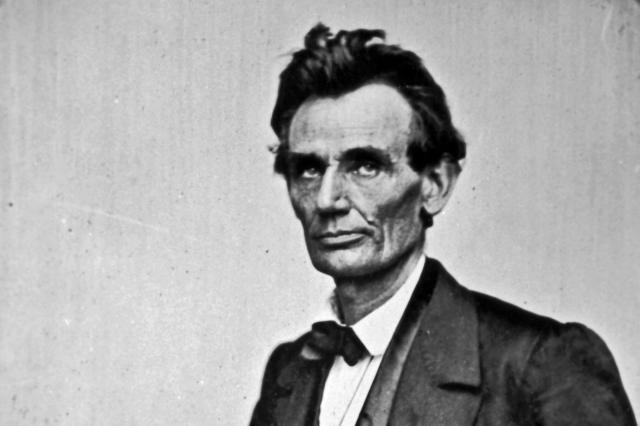
Abraham Lincoln led the United States through the Civil War and helped bring about the abolition of slavery. But the 16th president also had a lighter side. Lincoln had a varied list of interests outside of politics — he was a farmer, carpenter, animal lover, and inventor — and was known for his keen sense of humor. Here are five funny facts you might not know about the man known as the Railsplitter, Honest Abe, and, according to many historians, the nation’s greatest president.
Advertisement
https://e9d02798e6ef13a96e0bd2fe359cd71f.safeframe.googlesyndication.com/nameframe.htmlPhoto credit: Fotosearch/ Archive Photos via Getty Images
Lincoln Was Known to Respond to Insults With Jokes
Abraham Lincoln stood out, visually. He was the tallest president, at 6 feet, 4 inches (at a time when the average American male was 2 inches shorter than today), and he had the largest feet of any president, at a size 14. Consequently, Lincoln’s political opponents frequently took absurd shots at his appearance. In 1860, The Houston Telegraph wrote that he had “the leanest, lankiest, most ungainly mass of legs, arms, and hatchet face ever strung upon a single frame.” The Southern Confederacy similarly published a poem stating that “his nose was as long and as ugly and big / as the snout of a half-starved Illinois pig.” Lincoln took it all with characteristic good humor and was not above the occasional self-deprecating joke. He once recounted a story in which someone called him a “self-made man,” to which he replied, “Well, all I’ve got to say is that it was a damned bad job.” And when Illinois Senator Stephen Douglas called him “two-faced” in a debate, Lincoln famously replied, “If I had another face, do you think I’d wear this one?”
Continue Reading Below
More from our network
History Facts is part of Optimism, which publishes content that uplifts, informs, and inspires.

How Well Do You Know Your U.S. Geography?History Quiz

Go Retro With This 1960s Fashion QuizQuiz Daily

6 Tricks Grocery Stores Use To Influence What You BuyInteresting Facts

8 Hidden Car Features That Will Change Your Driving GameBetter Report

Do You Know What the “P” in “P.M.” Stands For?Word Smarts
Advertisement
null
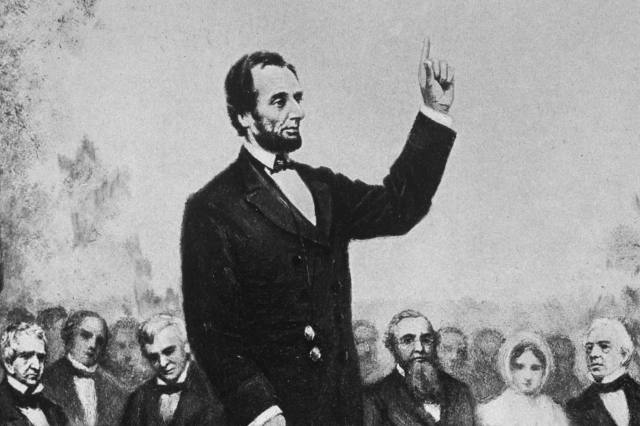
Photo credit: Archive Photos via Getty Images
Lincoln Grew His Beard at the Suggestion of an 11-Year-Old Girl
Lincoln’s opponents may have made fun of his appearance, but it was a letter from a supporter that led to him becoming the first fully bearded president. An 11-year-old named Grace Bedell saw a poster of a clean-shaven Lincoln that her father brought home from a county fair, and decided she needed to encourage the candidate to go for a glow-up. Bedell wrote Lincoln, “I have yet got four brothers and part of them will vote for you any way and if you let your whiskers grow I will try and get the rest of them to vote for you. You would look a great deal better for your face is so thin.” Lincoln wrote back to Bedell, seemingly considering her advice with the response, “Do you not think people would call it a piece of silly affection?” He ultimately grew out his beard after being elected president in November 1860. Just a few months later, Lincoln met Bedell when his train tour stopped in New York, and let her know that she was behind his makeover: “You see,” Lincoln told her, “I let these whiskers grow for you, Grace.”
Advertisement
Related:7 Interesting Facts About Napoleon BonapartePhoto credit: Bettmann via Getty Images
Lincoln Let his Cat Eat at the Dining Room Table
An animal lover, Lincoln owned dogs and cats throughout his life, and he let his sons Tad and Willie keep rabbits, turkeys, horses, and goats at the White House. The animal that got the most special treatment, however, was Lincoln’s cat Tabby, whom he let dine at the table, including once during a formal dinner at the White House. When Mary Todd Lincoln said it was “shameful in front of their guests,” the president replied, “If the gold fork was good enough for [former President James] Buchanan, I think it is good enough for Tabby.” Lincoln thought highly of his cat Dixie, as well; he once remarked that she was “smarter than my whole Cabinet!”
Advertisement
null
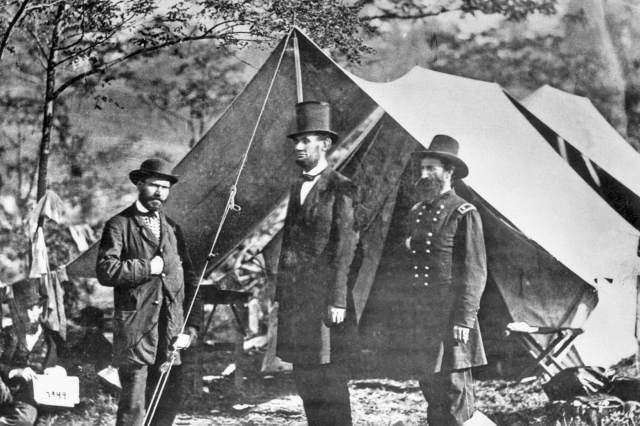
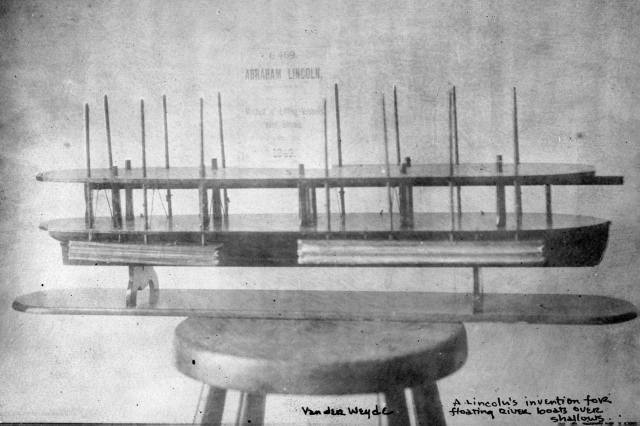
Photo credit: Bettmann via Getty Images
Lincoln Kept Documents in His Top Hats
The stovepipe hat was one of Lincoln’s signature accessories, and the final hat he ever wore is now kept at the Smithsonian’s National Museum of American History. The top hat helped the 6-foot-4 president tower over crowds even more than he naturally did, but the adornment wasn’t just used for looks: The president actually kept documents in the hat while he was wearing it. Lincoln would often remove papers (letters from friends, as well as speeches), from his hat while addressing constituents, and he was also known to take documents from atop his head and throw them down in front of generals in anger. According to some historians, the phrase “keep it under your hat” — meaning to keep something secret — comes from Lincoln’s habit.
Advertisement
Related:What Did Leonardo da Vinci Invent?Photo credit: Three Lions/ Hulton Archive via Getty Images
Lincoln Was Granted a Patent for an Invention That Didn’t Work
In May 1849, right after the end of his term in the U.S. House of Representatives, Lincoln was granted a patent for “adjustable buoyant air chambers,” which were meant to help buoy boats over shoals. He got the idea from his time working as a ferryman, when on two different occasions he was on a riverboat that got stuck after running aground on the Mississippi River. Lincoln whittled the patent model himself, and submitted sketches showing how the invention would work. The air chambers would be attached to the side of the boat and inflated to lift the vessel over an obstruction — at least, that was the theory. The device was never produced and it turned out that the amount of force needed to lower and fill the air chambers made it impractical. Nevertheless, Lincoln remains the only U.S. president ever to receive a patent.
More on Presidents
- 10 Strange Presidential Nicknames
- What’s Hidden Beneath the White House?
- Surprising Facts About Every U.S. President
AuthorKevin McCaffrey
August 3, 2023
Love it?214
7 Common Last Names That Are Linked to Nobility
Love it?23
World History
Recommendations For You
- 01.Famous Figures7 Facts About the Life and Reign of Queen Victoria
- 02.Famous Figures7 Interesting Facts About Napoleon Bonaparte
- 03.Famous FiguresWhat Did Leonardo da Vinci Invent?
- 04.Famous Figures5 Things You May Not Know About Genghis Khan
Advertisement
null
5 Ways Albert Einstein Changed the World
- Physicist Albert Einstein
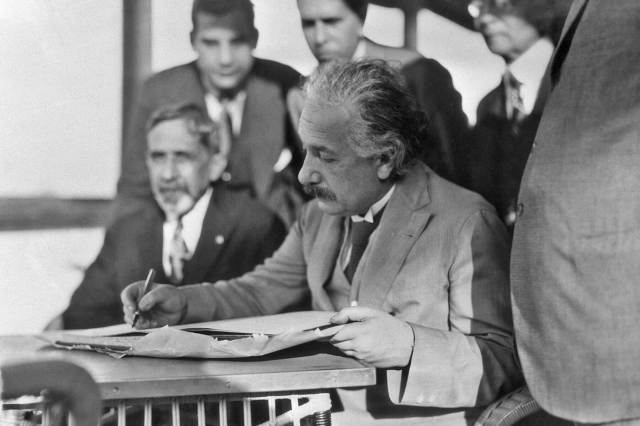
German-born physicist Albert Einstein (1879-1955) was so influential, his very name has become synonymous with genius. While working as a patent clerk in 1905 at the age of 26, Einstein submitted four papers to the German journal Annalen der Physik that changed humanity’s perception of time, gravity, and light. Today, historians mark the year as Einstein’s annus mirabilis, or “miracle year” — and he was just getting started.
Advertisement
Much of Einstein’s work is famously dense. Few people other than physicists need to fully comprehend the mind-bending ideas behind the general theory of relativity and Einstein’s other theories, but these discoveries form the bedrock of technologies the rest of us enjoy every day. Here are five ways Einstein’s ideas changed the world, and continue to provide a roadmap for humanity’s future. Photo credit: Bettmann via Getty Images
GPS Would Be Impossible Without the General Theory of Relativity
Some 10,900 nautical miles above our heads, 31 satellites orbit Earth as part of the Global Positioning System (GPS) — but if it wasn’t for Einstein, those satellites would be little more than space junk. The very foundation of GPS is accurate timekeeping, as satellites need to keep time to correctly log the distance from a ground-based receiver (such as your smartphone). GPS satellites are so precise, the atomic clocks on board are accurate to within three-billionths of a second, a feat impossible without Einstein’s special and general theories of relativity. The special theory of relativity states that time flows differently depending on velocity. Because satellites travel at 8,700 miles per hour, they “lose” 7 microseconds per day compared to Earth-based receivers. Additionally, Einstein’s general theory of relativity — an idea published in 1915 that basically elaborates on his previous theory by throwing gravity in the mix — similarly states that distance from a source of mass, in this case the Earth, also affects the flow of time. This means that technically speaking, your head ages slightly faster than your feet because your feet are closer to the Earth (on time scales that are ultimately negligible). Today, GPS takes into account this “time dilation,” so satellites always know where you are when you open Google Maps.
Continue Reading Below
More from our network
History Facts is part of Optimism, which publishes content that uplifts, informs, and inspires.
How Well Do You Know Your U.S. Geography?History Quiz
Go Retro With This 1960s Fashion QuizQuiz Daily
6 Tricks Grocery Stores Use To Influence What You BuyInteresting Facts
8 Hidden Car Features That Will Change Your Driving GameBetter Report
Do You Know What the “P” in “P.M.” Stands For?Word Smarts
Advertisement
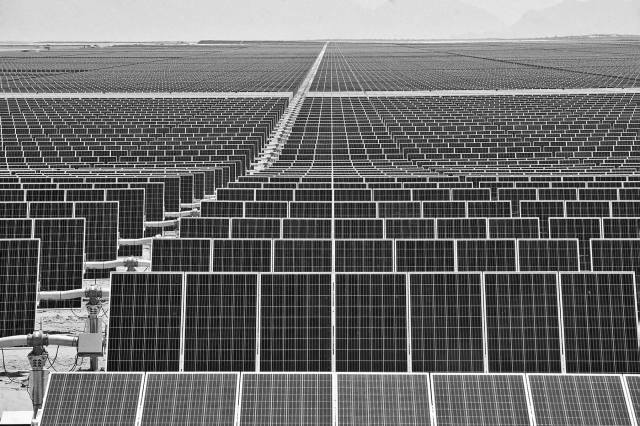
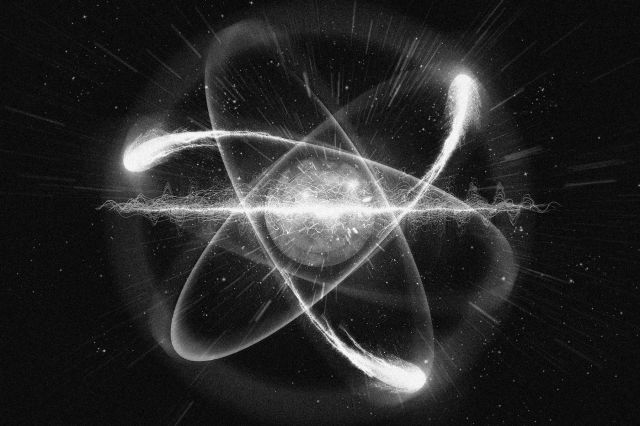


Photo credit: ALFREDO ESTRELLA/ AFP via Getty Images
The Explanation of Photoelectric Effect Helped Make Modern Solar Power Possible
It probably comes as no surprise that Einstein won the Nobel Prize for physics in 1921, but what many people don’t realize is that the award wasn’t honoring the wunderkind’s groundbreaking general theory of relativity, but rather his revolutionary yet often overlooked explanation of the photoelectric effect. The initial discovery of the photoelectric effect came in 1887 from German physicist Heinrich Rudolf Hertz (yes, that Hertz), who noticed that when ultraviolet light hit a metal plate, it created sparks. What was puzzling was that different metals required different frequencies to produce the same effect. Then, in 1905, 26-year-old Einstein solved this conundrum by introducing a new conception of light, which he published in his first paper submitted to Annalen der Physik. He argued that light wasn’t just a wave, as some scientists suggested, but also a stream of particles, later known to science as “photons.” Einstein posited that these photons contained a fixed amount of energy depending on their frequency, and his theory — though derided for years — successfully explained the photoelectric phenomenon. Though solar cells predated Einstein’s discovery by dozens of years, it wasn’t until Einstein’s theory that scientists understood why they worked, which helped make solar panels even more efficient. Photo credit: Ezume Images/ Shutterstock
Lasers Were Developed Thanks to Einstein’s Quantum Theory of Radiation
Lasers (an acronym for “Light Amplification by Stimulated Emission of Radiation”) scan your groceries at the supermarket, make self-driving cars possible, and form the backbone of optical communication. And yes, we can thank Einstein for this one, too. In 1917, Einstein published a paper detailing his quantum theory of radiation. The theory basically states that atoms can be stimulated to change energy levels when hit with a specific frequency. If that excited atom is hit with another photon of the same frequency, it’ll produce two coherent photons (traveling in the same direction) while the atom’s electron returns to its ground state. This means you can artificially create a sudden burst of coherent light as atoms discharge in a chain reaction, otherwise known as “stimulated emission of radiation” (the “ser” in “laser”). It wasn’t until after World War II that scientists found a use for Einstein’s discovery; the laser was developed by using mirrors to create light amplification. Photo credit: MPI/ Archive Photos via Getty Images
The E=MC2 Equation Formed the Scientific Basis for the Nuclear Bomb
The final discovery of Einstein’s “miracle year” was the concept that light and energy are equivalent, and that their relationship can be explained with the elegantly simple equation E=MC2, meaning energy equals mass times the speed of light squared. Describing mass as essentially super-dense energy, Einstein’s equation shows how even small amounts of mass at atomic levels can produce a tremendous amount of energy when multiplied by the speed of light squared — and you probably see where this is going.
This process explains how a neutron fired from a uranium atom splits it into smaller atoms while releasing a tremendous amount of energy. It’s known as nuclear fission, and when the process is controlled, it provides low-emission nuclear energy. When released in an uncontrolled state, it can be used to produce an atomic bomb. Einstein himself never worked on the Manhattan Project, the secret government program to make the first nuclear bomb, but he rubber-stamped the idea in a 1939 letter to Franklin D. Roosevelt that argued for the U.S. to make the bomb before Nazi Germany. Einstein later regarded that letter as the “one great mistake in my life.”
Advertisement
Related:7 Interesting Facts About Napoleon BonapartePhoto credit: Bettmann via Getty Images
The E=MC2 Equation Could Point to the Future of Energy
As previously described, nuclear fission works by breaking apart an element such as a heavy uranium-235 atom into two smaller atoms (krypton and barium). However, something interesting also occurs: If two light nuclei (i.e., hydrogen) can overcome electrostatic repulsion, they fuse together to form a heavy helium-4 atom — sort of like fission but in reverse. Similarly, following the E=MC2 equation, this process produces a tremendous amount of energy and heat. This is known as nuclear fusion, and it’s the atomic science that is the energy-producing engine of stars.
On paper, nuclear fusion could provide the answer to humanity’s expanding energy needs. There’s no enriched material involved; nuclear proliferation with fusion reactors isn’t a worry; a meltdown is scientifically impossible; there’s no radioactive material produced as a byproduct; it’s completely carbon-free; and fusing atoms together releases 4 million times more energy than the chemical process of burning coal. There’s just one catch: Building a fusion reactor is immensely complicated. That’s never stopped people before, though. An international coalition of scientists and agencies is hard at work creating the International Thermonuclear Experimental Reactor, or ITER, which is set to go online in 2025.
More on Science
- What’s the Real Story of Isaac Newton and the Apple?
- Why Did Doctors Wear Beak Masks During the Bubonic Plague?
- 7 Shocking Medical Beliefs From Ancient Greece
AuthorDarren Orf
August 15, 2023
Love it?122
7 Popular 1950s Items You Never See Anymore
Love it?55
U.S. History
Recommendations For You
- 01.Famous Figures7 Facts About the Life and Reign of Queen Victoria
- 02.Famous Figures7 Interesting Facts About Napoleon Bonaparte
- 03.Famous FiguresWhat Did Leonardo da Vinci Invent?
- 04.Famous Figures5 Things You May Not Know About Genghis Khan
Advertisement
x
nullhttps://i.liadm.com/sync-container?duid=6f24b1ebfb2b–01k7cw8t7f2hrbwahraknmr7cp&appId=a-0947&euns=0&s=&version=v3.13.1&cd=.historyfacts.com&pv=28c8fcd3-5dd0-4b74-8a9f-9329fce39d9dnull
 Site Title