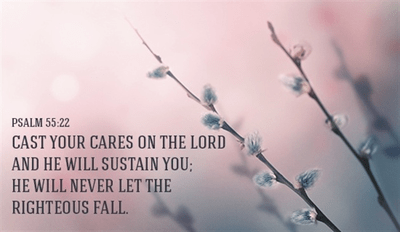
Psalm55:22 And What It Means to All People!!
By: Anthony Joseph Hopkins March 12, 2023
Praise the Lord Everyone!! Praise the Lord!! How are you doing today? Fine, I hope. I would like to inform all of you that this is an essay that pertains to Psalm 55:22. I want to say that 1st Peter 5:7 are similar.

The Bible verse says cast your cares on the Lord and He will sustain you: He will never let the righteous fall. 1st Peter 5:7 says Cast your cares on Him because He cares for you. When I compare the two Bible verses, it specifically states that we are supposed to cast all of our burdens on the Lord. He really cares for you. The only difference is that Psalm 55:22 is expressed differently.
Next, it says that the Lord will sustain you, and he will not let the righteous fall. I want to say that I have casted all of my burdens to the Lord years ago.


I have a question to ask everyone. How do you cast all of your burdens on the Lord? Frankly, I have to submit all of my problems, habits, and tactics to the Lord. The definition of the word cast means to 1. To throw, fling or send; that is, to drive from, by force, as from the hand, or from an engine.
Further, I want to say that the definition that I am looking for means to submit as if to God, or a higher authority. What I am saying is that I am giving up old habits and problems to God. I know that this is something that we all need to work on a daily basis. It reminds me of taking a personal inventory in Alcoholics Anonymous. What I am doing is taking a personal inventory of ourselves. This is the 4th step of recovery. The 10th step says continue to take a personal inventory; when we are wrong promptly admitted it. This is a complete analysis of our behavior by writing it down on a piece of paper.
Moreover, I want to inform all of you that the word cares mean the following: Care [N]
In the Old Testament several Hebrew words are translated as “care” or a similar word (e.g., “worry” or “anxious”). In 1 Samuel 10:2, when Samuel anoints Saul as king, a series of signs are predicted by Samuel to prove God’s favor on Saul, culminating in the indwelling of God’s Spirit. The first sign is that two men will say to Saul, “The donkeys that you went to seek are found, and now your father has stopped worrying about them and is worrying about you” (NRSV).
The connotation of caring about something to the point of “worrying” about it is picked up in the New Testament. As in the Old Testament, the undertone can be positive or negative. In the New Testament, the principal utilization is negative. The most common Greek word that is translated “care” is the noun merimna [mevrimna] (or the verb merimnao [merimnavw]).
In Matthew 13:22 in Christ’s parable of the four seeds, the third person is represented by the seed that was choked out by the “cares of the world.” The enigmatic meaning of the parable is that preoccupation with the world depletes one’s devotion to God. Because the world is temporal, inordinate care for the world causes preoccupation with the result of not caring for eternal things; consequently, the Word does not become deeply implanted.
In Luke 21:34 believers are warned to be watchful of the Lord’s return and not to be “weighed down with … the worries of this life” (NRSV). In 2 Corinthians 11:28 Paul lists his sufferings as his glory in his defense against the “super apostles.” Besides his external sufferings, his care for all the churches and the subsequent heartache because of an intense concern for those he loved is Paul’s mark of true apostleship. It can be seen that care to the point of burden is intended.
Another Greek word for “care” is melo. It, too, can denote anxiety or earnest concern, depending on the context. In 1 Peter 5:7 both the verb melo and the noun merimna [mevrimna] are used: “Cast all your anxiety (merimna [mevrimna]) on him, because he cares (melo [ejpimelw'”]) for you” (NRSV).
Care to the point of anxiety is seen as harmful and as contrary to faith in God. Matthew 6:25 says, “Do not worry about your life.” It is necessary that a person gives basic attention to having food and shelter. The fact that the same words for “care” are also translated “anxiety” or “worry” shows that the derivation of anxiety could be a reasonable care turned awry. When one’s desires are inordinate with the result being a focus on temporal existence instead of eternal life, the consequence can be harmful. For example, the negative effects of anxiety can be seen in one’s health status. Too much stress can cause manifold health problems. Worry cannot add a single hour to our life span, according to Matthew 6:27, and therefore, it is a waste of time. Trusting in God when one cannot change a situation is biblical faith. Inactive, worrisome reasoning is diametrically opposed to the Jewish and Christian concept of faith.
Paul says in Philippians 4:6, “Do not worry about anything” (NRSV). The word merimnao [merimnavw] does not mean “do not ‘care’ about anything.” Rather, Paul wants the Philippians to “in everything by prayer and supplication with thanksgiving let your requests be made known to God.” In other words, thankfulness, which is a part of faith, resolves the quandary of anxiety.
Finally, I want to end this essay by saying that I am still a work in progress. What is the definition of the word Work in Progress? A work in progress means
work in progress
noun
- an unfinished project that is still being added to or developed. “the book itself is still a work in progress”
- (in accounting) the total value of the materials and labor for unfinished projects. “the board had estimated the value of its work in progress” However, we are God’s Masterpiece. We are already a completed work. It is that behaviorally, we might not think so. There are times that we hinder or impede in our own progress. This means procrastination. I have casted all of my cares to the Lord. I am still a piece of work that needs to be handled with care!!!!
 Site Title