What is Probability?

Probability

Top Banner

Probability means possibility. It is a branch of mathematics that deals with the occurrence of a random event. The value is expressed from zero to one. Probability has been introduced in Maths to predict how likely events are to happen. The meaning of probability is basically the extent to which something is likely to happen. This is the basic probability theory, which is also used in the probability distribution, where you will learn the possibility of outcomes for a random experiment. To find the probability of a single event to occur, first, we should know the total number of possible outcomes.

Learn More here: Study Mathematics

Table of contents:DefinitionFormulaExamplesTreeTypesEventsEqually Likely EventsComplementary EventsProbability TheoryProbability Density FunctionTermsSolved ProblemsVideo LecturePractice ProblemsFAQs

Probability Definition in Math

Probability is a measure of the likelihood of an event to occur. Many events cannot be predicted with total certainty. We can predict only the chance of an event to occur i.e., how likely they are going to happen, using it. Probability can range from 0 to 1, where 0 means the event to be an impossible one and 1 indicates a certain event. Probability for Class 10 is an important topic for the students which explains all the basic concepts of this topic. The probability of all the events in a sample space adds up to 1.

For example, when we toss a coin, either we get Head OR Tail, only two possible outcomes are possible (H, T). But when two coins are tossed then there will be four possible outcomes,  i.e {(H, H), (H, T), (T, H), (T, T)}.

Download this lesson as PDF: –Download PDF Here

Formula for Probability

The probability formula is defined as the possibility of an event to happen is equal to the ratio of the number of favourable outcomes and the total number of outcomes.

Probability of event to happen P(E) = Number of favourable outcomes/Total Number of outcomes

Sometimes students get mistaken for “favourable outcome” with “desirable outcome”. This is the basic formula. But there are some more formulas for different situations or events.

Solved Examples

1) There are 6 pillows in a bed, 3 are red, 2 are yellow and 1 is blue. What is the probability of picking a yellow pillow?

Ans: The probability is equal to the number of yellow pillows in the bed divided by the total number of pillows, i.e. 2/6 = 1/3.

2) There is a container full of coloured bottles, red, blue, green and orange. Some of the bottles are picked out and displaced. Sumit did this 1000 times and got the following results:

  • No. of blue bottles picked out: 300
  • No. of red bottles: 200
  • No. of green bottles: 450
  • No. of orange bottles: 50

a) What is the probability that Sumit will pick a green bottle?

Ans: For every 1000 bottles picked out, 450 are green.

Therefore, P(green) = 450/1000 = 0.45

b) If there are 100 bottles in the container, how many of them are likely to be green?

Ans: The experiment implies that 450 out of 1000 bottles are green.

Therefore, out of 100 bottles, 45 are green.

Probability Tree

The tree diagram helps to organize and visualize the different possible outcomes. Branches and ends of the tree are two main positions. Probability of each branch is written on the branch, whereas the ends are containing the final outcome. Tree diagrams are used to figure out when to multiply and when to add. You can see below a tree diagram for the coin:
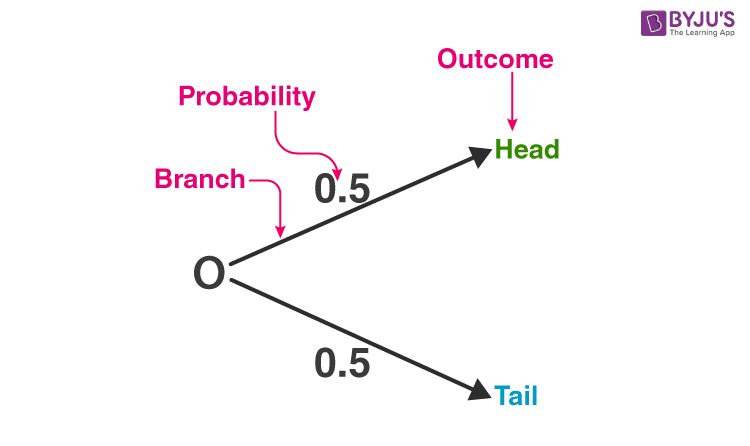
Probability Tree

Types of Probability

There are three major types of probabilities:

  • Theoretical Probability
  • Experimental Probability
  • Axiomatic Probability

Theoretical Probability

It is based on the possible chances of something to happen. The theoretical probability is mainly based on the reasoning behind probability. For example, if a coin is tossed, the theoretical probability of getting a head will be ½.

Experimental Probability

It is based on the basis of the observations of an experiment. The experimental probability can be calculated based on the number of possible outcomes by the total number of trials. For example, if a coin is tossed 10 times and head is recorded 6 times then, the experimental probability for heads is 6/10 or, 3/5.

Axiomatic Probability

In axiomatic probability, a set of rules or axioms are set which applies to all types. These axioms are set by Kolmogorov and are known as Kolmogorov’s three axioms. With the axiomatic approach to probability, the chances of occurrence or non-occurrence of the events can be quantified. The axiomatic probability lesson covers this concept in detail with Kolmogorov’s three rules (axioms) along with various examples.

Conditional Probability is the likelihood of an event or outcome occurring based on the occurrence of a previous event or outcome.

Probability of an Event

Assume an event E can occur in r ways out of a sum of n probable or possible equally likely ways. Then the probability of happening of the event or its success is expressed as;

P(E) = r/n

The probability that the event will not occur or known as its failure is expressed as:

P(E’) = (n-r)/n = 1-(r/n)

E’ represents that the event will not occur.

Therefore, now we can say;

P(E) + P(E’) = 1

This means that the total of all the probabilities in any random test or experiment is equal to 1.

What are Equally Likely Events?

When the events have the same theoretical probability of happening, then they are called equally likely events. The results of a sample space are called equally likely if all of them have the same probability of occurring. For example, if you throw a die, then the probability of getting 1 is 1/6. Similarly, the probability of getting all the numbers from 2,3,4,5 and 6, one at a time is 1/6. Hence, the following are some examples of equally likely events when throwing a die:

  • Getting 3 and 5 on throwing a die
  • Getting an even number and an odd number on a die
  • Getting 1, 2 or 3 on rolling a die

are equally likely events, since the probabilities of each event are equal.

Complementary Events

The possibility that there will be only two outcomes which states that an event will occur or not. Like a person will come or not come to your house, getting a job or not getting a job, etc. are examples of complementary events. Basically, the complement of an event occurring in the exact opposite that the probability of it is not occurring. Some more examples are:

  • It will rain or not rain today
  • The student will pass the exam or not pass.
  • You win the lottery or you don’t.

Also, read: 

Probability Theory

Probability theory had its root in the 16th century when J. Cardan, an Italian mathematician and physician, addressed the first work on the topic, The Book on Games of Chance. After its inception, the knowledge of probability has brought to the attention of great mathematicians. Thus, Probability theory is the branch of mathematics that deals with the possibility of the happening of events. Although there are many distinct probability interpretations, probability theory interprets the concept precisely by expressing it through a set of axioms or hypotheses. These hypotheses help form the probability in terms of a possibility space, which allows a measure holding values between 0 and 1. This is known as the probability measure, to a set of possible outcomes of the sample space.

Probability Density Function

The Probability Density Function (PDF) is the probability function which is represented for the density of a continuous random variable lying between a certain range of values. Probability Density Function explains the normal distribution and how mean and deviation exists. The standard normal distribution is used to create a database or statistics, which are often used in science to represent the real-valued variables, whose distribution is not known.

Important Topics in Maths :Probability And StatisticsProbability FormulasRandom VariableProbability Class 9Probability Class 10Probability Class 11Probability Class 12Important Questions Class 9 Maths Chapter 15 ProbabilityImportant Questions Class 11 Maths Chapter 16 ProbabilityImportant Questions Class 12 Maths Chapter 13 Probability

Probability Terms and Definition

Some of the important probability terms are discussed here:

TermDefinitionExample
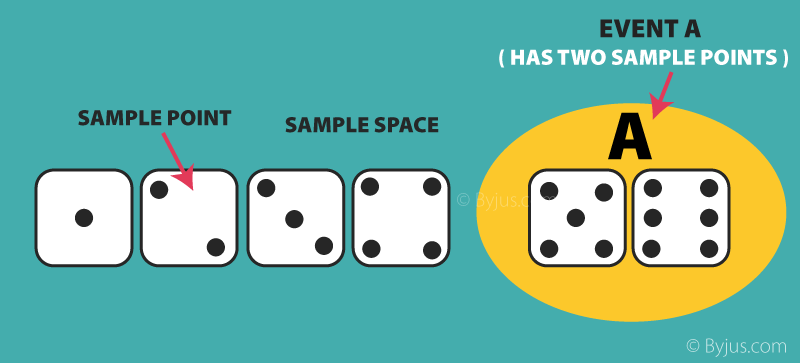
Sample SpaceThe set of all the possible outcomes to occur in any trialTossing a coin, Sample Space (S) = {H,T}Rolling a die, Sample Space (S) = {1,2,3,4,5,6}
Sample PointIt is one of the possible resultsIn a deck of Cards:4 of hearts is a sample point.The queen of clubs is a sample point.
Experiment or TrialA series of actions where the outcomes are always uncertain.The tossing of a coin, Selecting a card from a deck of cards, throwing a dice.
EventIt is a single outcome of an experiment.Getting a Heads while tossing a coin is an event.
OutcomePossible result of a trial/experimentT (tail) is a possible outcome when a coin is tossed.
Complimentary eventThe non-happening events. The complement of an event A is the event, not A (or A’)In a standard 52-card deck, A = Draw a heart, then A’ = Don’t draw a heart
Impossible EventThe event cannot happenIn tossing a coin, impossible to get both head and tail at the same time
Probability of an Event

Applications of Probability

Probability has a wide variety of applications in real life. Some of the common applications which we see in our everyday life while checking the results of the following events:

  • Choosing a card from the deck of cards
  • Flipping a coin
  • Throwing a dice in the air
  • Pulling a red ball out of a bucket of red and white balls
  • Winning a lucky draw

Other Major Applications of Probability

  • It is used for risk assessment and modelling in various industries
  • Weather forecasting or prediction of weather changes
  • Probability of a team winning in a sport based on players and strength of team
  • In the share market, chances of getting the hike of share prices

Problems and Solutions on Probability

Question 1: Find the probability of ‘getting 3 on rolling a die’.

Solution:

Sample Space = S = {1, 2, 3, 4, 5, 6}

Total number of outcomes = n(S) = 6

Let A be the event of getting 3.

Number of favourable outcomes = n(A) = 1

i.e. A  = {3}

Probability, P(A) = n(A)/n(S) = 1/6

Hence, P(getting 3 on rolling a die) = 1/6

Question 2: Draw a random card from a pack of cards. What is the probability that the card drawn is a face card?

Solution:

A standard deck has 52 cards.

Total number of outcomes = n(S) = 52

Let E be the event of drawing a face card.

Number of favourable events = n(E) = 4 x 3 = 12 (considered Jack, Queen and King only)

Probability, P = Number of Favourable Outcomes/Total Number of Outcomes

P(E) = n(E)/n(S)

= 12/52

= 3/13

P(the card drawn is a face card) = 3/13

Question 3: A vessel contains 4 blue balls, 5 red balls and 11 white balls. If three balls are drawn from the vessel at random, what is the probability that the first ball is red, the second ball is blue, and the third ball is white?

Solution:

Given,

The probability to get the first ball is red or the first event is 5/20.

Since we have drawn a ball for the first event to occur, then the number of possibilities left for the second event to occur is 20 – 1 = 19.

Hence, the probability of getting the second ball as blue or the second event is 4/19.

Again with the first and second event occurring, the number of possibilities left for the third event to occur is 19 – 1 = 18.

And the probability of the third ball is white or the third event is 11/18.

Therefore, the probability is 5/20 x 4/19 x 11/18 = 44/1368 = 0.032.

Or we can express it as: P = 3.2%.

Question 4: Two dice are rolled, find the probability that the sum is:

  1. equal to 1
  2. equal to 4
  3. less than 13

Solution:

To find the probability that the sum is equal to 1 we have to first determine the sample space S of two dice as shown below.

S = { (1,1),(1,2),(1,3),(1,4),(1,5),(1,6)

(2,1),(2,2),(2,3),(2,4),(2,5),(2,6)

(3,1),(3,2),(3,3),(3,4),(3,5),(3,6)

(4,1),(4,2),(4,3),(4,4),(4,5),(4,6)

(5,1),(5,2),(5,3),(5,4),(5,5),(5,6)

(6,1),(6,2),(6,3),(6,4),(6,5),(6,6) }

So, n(S) = 36

1) Let E be the event “sum equal to 1”. Since, there are no outcomes which where a sum is equal to 1, hence,

P(E) = n(E) / n(S) = 0 / 36 = 0

2) Let A be the event of getting the sum of numbers on dice equal to 4.

Three possible outcomes give a sum equal to 4 they are:

A = {(1,3),(2,2),(3,1)}

n(A) = 3

Hence, P(A) = n(A) / n(S) = 3 / 36 = 1 / 12

3) Let B be the event of getting the sum of numbers on dice is less than 13.

From the sample space, we can see all possible outcomes for the event B, which gives a sum less than B. Like:

(1,1) or (1,6) or (2,6) or (6,6).

So you can see the limit of an event to occur is when both dies have number 6, i.e. (6,6).

Thus, n(B) = 36

Hence,

P(B) = n(B) / n(S) = 36 / 36 = 1

What is Bipartisanship?

All

Images

News

Videos

Shopping

Books

Maps

Flights

Finance

Search tools

Feedback

Search Results

Featured snippet from the web

In a two-party system, like in the United States, bipartisan typically refers to any bill, act, resolution or any other action of a political body in which both of the major political parties, Republicans and Democrats, are in agreement.

https://ballotpedia.org › Bipartisan

Bipartisan – Ballotpedia

Feedback

About featured snippets

People also ask

What is an example of bipartisan?

What is bipartisan in politics?

What era in American politics is notable for a high level of bipartisanship?

What is party polarization?

Feedback

Web results

Merriam-Websterhttps://www.merriam-webster.com › …Bipartisan Definition & Meaning

5 days ago — The meaning of BIPARTISAN is of, relating to, or involving members of two parties; specifically : marked by or involving cooperation, …

Wikipediahttps://en.m.wikipedia.org › wikiBipartisanship

Partisanship is the antonym, where an individual or political party adheres only to its interests without compromise.

UsageBipartisanship in different party…Global examples of bipartisan…CanadaUnited KingdomRepublic of Ireland

NBC Newshttps://www.nbcnews.com › politicsSenate introduces a bipartisan bill to avoid a government shutdown

Sep 26, 2023 — Senate leaders released a short-term funding bill Tuesday to avoid a government shutdown at the end of the month.

Missing: meaning ‎| Show results with: meaning

Parliament of Australiahttps://www.aph.gov.au › section2. Defining bipartisanship

The uses of ‘bipartisanship’ in debates on Australian defence policy since 1901 and the changing role of parliamentary engagement are outlined below. History of …

Institute for Policy Research – Northwesternhttps://www.ipr.northwestern.edu › …PDFAre Bipartisan Lawmakers More Effective?

by L Harbridge-Yong · Cited by 3 — Bipartisanship is linked to increases in members’ overall legislative effectiveness, and especially to moving legislation through committee and on the floor.

48 pages·873 KB

Missing: meaning ‎| Show results with: meaning

The White House (.gov)www.whitehouse.govGuidebook to the Bipartisan Infrastructure Law | Build.gov

It further reauthorizes federal surface transportation programs for five years and invests billions in transformational projects that will create good-paying …

Congress.govhttps://www.congress.gov › help › l…Glossary of Legislative Terms

Literally, “two chambers;” in a legislative body, having two houses (as in the House of Representatives and the Senate comprising the U.S. Congress). bill: The …

Missing: Bipartisan ‎| Show results with: Bipartisan

The Balancehttps://www.thebalancemoney.com › …Bipartisan: Definition, Benefits, Examples

May 9, 2021 — Bipartisanship is a political situation that occurs when two opposing parties work together to achieve common goals. Americans prefer it.

Bipartisan Policy Centerbipartisanpolicy.orgHistory of Bipartisanship

As smaller political parties were evolving into what was to become the modern Republican party, each faction, representing differing viewpoints on slavery and …

Missing: meaning ‎| Show results with: meaning

People also search for

Bipartisan definition

Bipartisan example

Bipartisan bill 2023

Why is bipartisanship important

Bipartisan support meaning

Bipartisan 

What is A Needs Assessment?

Join us: Learn how to build a trusted AI strategy to support your company’s intelligent transformation, featuring ForresterRegister now

Get started

What is a needs assessment? 3 types and examples article banner image

What is a needs assessment? 3 types and examples

Team Asana contributor imageTeam Asana

February 23rd, 2024

7 min read

View Templates

Summary

A needs assessment is a process for determining the needs, otherwise known as “gaps,” between current and desired outcomes. When used properly, this assessment provides valuable insight into your team’s processes and highlights areas for efficiency improvements.

When you’re balancing multiple growth initiatives and new projects, it’s hard to know which team improvements to prioritize. Where do you even begin?

When in doubt, try a needs assessment. A needs assessment helps you determine the most important process gaps so you can achieve your desired outcome in the shortest amount of time. Not only will assessing your current processes give you insight into how your team works, but it can also help identify areas of potential efficiency improvements.

Reducing work about work and streamlining processes doesn’t just increase productivity—it also boosts team morale. By listening to your team members and improving any painful processes, you can help them achieve their highest-impact work faster. We’ve written a practical guide to creating a needs assessment of your own.

What is a needs assessment?

A needs assessment is a process for determining the needs, or “gaps,” between a current and desired outcome. It’s a part of strategic planning—essentially, a needs assessment helps you pinpoint how you’ll accomplish your strategic goals. 

A need is an opportunity for improvement within a particular process or system. When you identify—and resolve—needs, you can act on potential new opportunities, like making processes more efficient, streamlining resource allocation, and identifying resource gaps in your current workflow.  

For example, say your team is working on a process to organize customer data. A needs assessment would be a great way to understand where gaps exist in the data collection process—such as missing or inaccurate information—and where internal resources could be better utilized.Create a strategic planning template

What is the purpose of a needs assessment?

A needs assessment identifies areas within your organization that need improvement. Use a needs assessment on existing processes to analyze data and inform internal changes.

Examples of processes you might use a needs assessment to accomplish include:

  • A process to automate duplicative manual work
  • Acustomer journey process that is underperforming

It can be challenging to pinpoint exactly where enhancements are needed. When you’re faced with multiple areas of opportunity, a needs analysis can help you identify the best areas of improvement. 

Example of a needs assessment

A needs assessment is a great way to improve processes, but it’s not always easy to get started. Start by taking a look at some example questions to get a better understanding of the data you’re looking for.

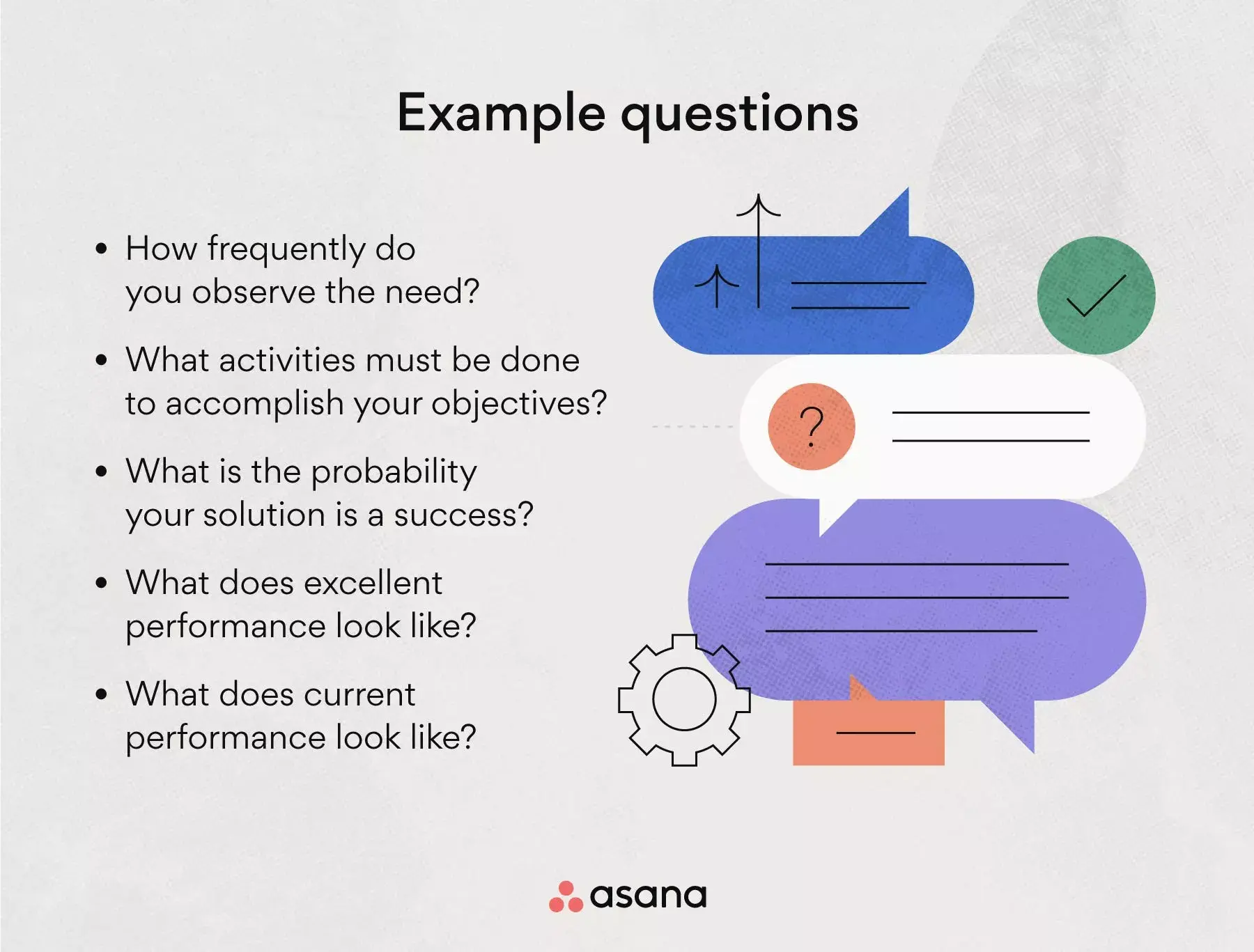
Needs assessment example questions

Success rate questions

  • What activities must be done to accomplish our objectives? 
  • What is the probability our solution is a success? 
  • What tasks are required to successfully solve our needs?

Performance questions

  • Which KPIs are we using to measure performance?
  • What does excellent performance look like?
  • What does current performance look like?

Operational questions

  • Which stakeholders are involved?
  • Where does the need occur within the process?
  • How frequently do we observe the need?

Identifying needs requires team communication, problem solving skills, and out-of-the-box ideas. Use these questions as a jumping off point to get the ball rolling. Once you know which questions to ask, you can begin to gather data. 

How to conduct a needs assessment

A needs assessment is a great way to analyze and interpret relevant data. To do this, you need to understand your team’s baseline needs, as well as the process’s overall desired outcome. 

How to conduct a needs assessment

Success rate questions:

  • What activities must be done to accomplish our objectives? 
  • What is the probability our solution is a success? 
  • What tasks are required to successfully solve our needs?

Performance questions:

  • Which KPIs are we using to measure performance?
  • What does excellent performance look like?
  • What does current performance look like?

Operational questions:

  • Which stakeholders are involved?
  • Where does the need occur within the process?
  • How frequently do we observe the need?

Identifying needs requires team communication, problem-solving skills, and out-of-the-box ideas. Use these questions as a jumping-off point to get the ball rolling. Once you know which questions to ask, you can begin to gather data.

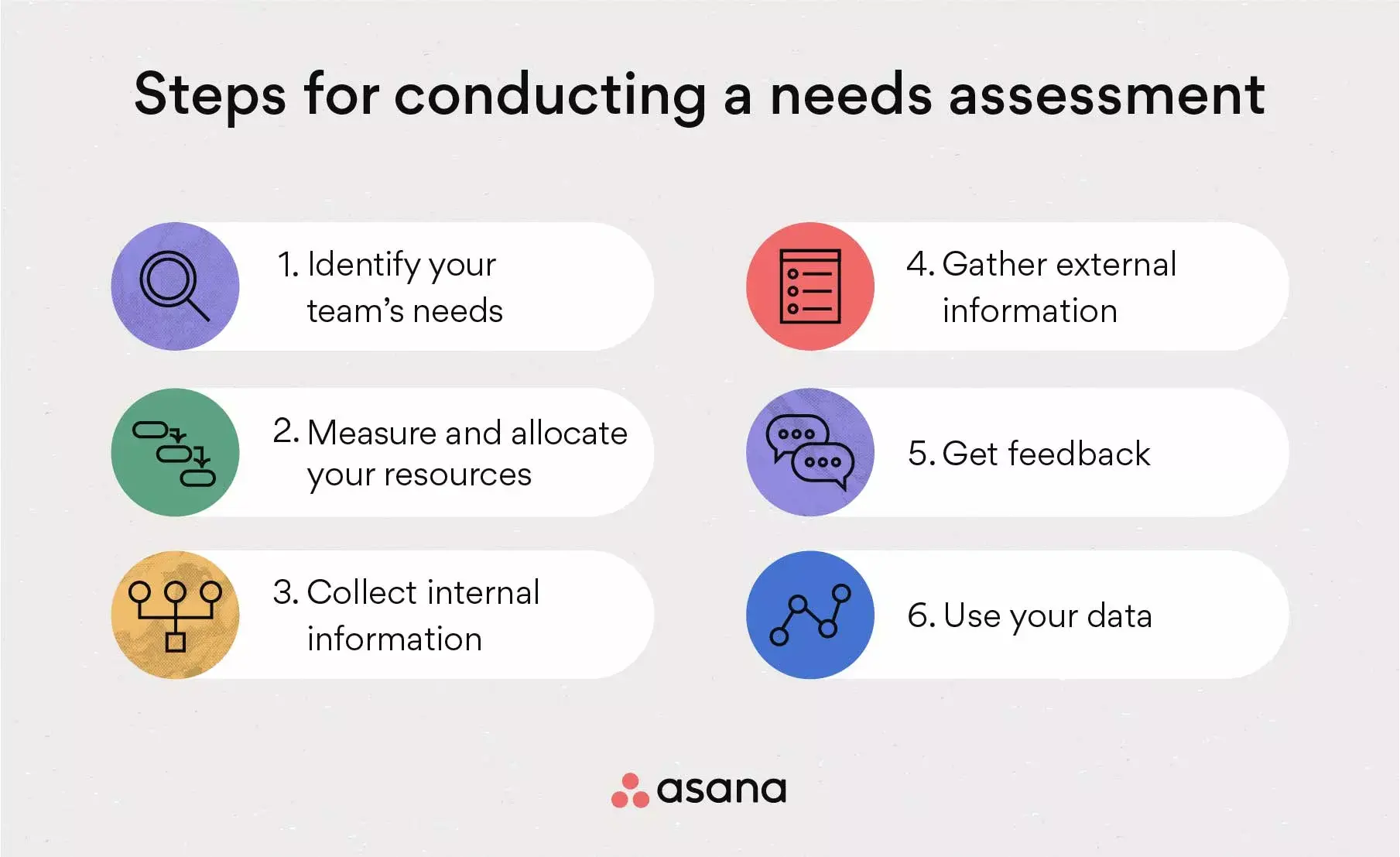
6 steps for conducting a needs assessment

A needs assessment is a great way to analyze and interpret relevant data that will influence your decision-making. To do this, you need to understand your team’s baseline needs, as well as the process’s overall desired outcome. 

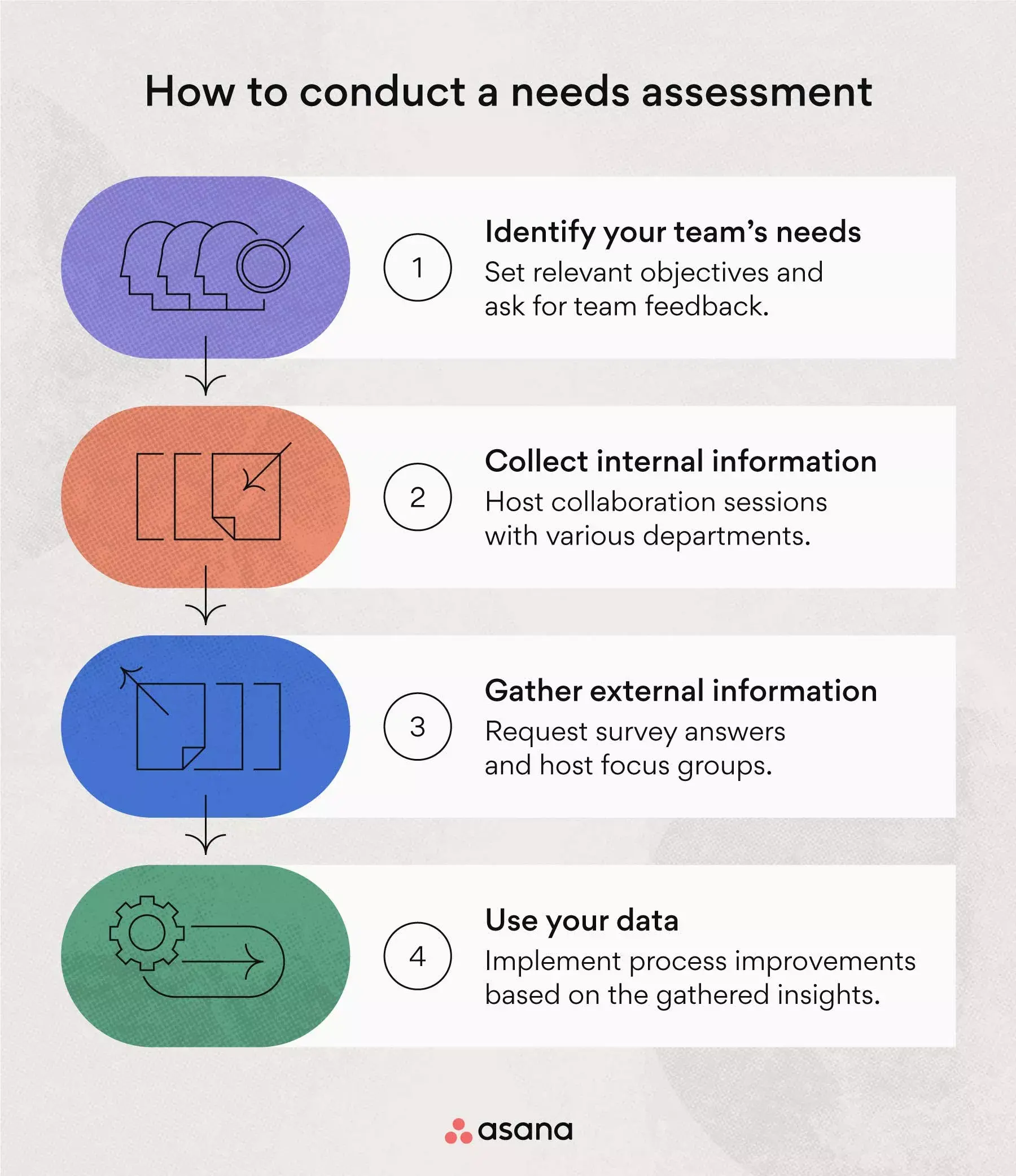
Enlist the help of key stakeholders, funders, and decision makers and collect feedback through meetings or brainstorming sessions. However you choose to start, here are the four steps to follow when conducting a needs assessment. 

[inline illustration] Steps for conducting needs assessment (infographic)

Create a strategic planning template

1. Identify your team’s needs

To determine the gaps between existing and ideal processes, you first need to understand what the ideal process looks like. Clear objectives are the best way to ensure you’re creating a measurable, actionable, and results-oriented needs assessment. 

Before you can start collecting and analyzing information for your needs assessment, take some time to consider your desired outcomes. Set objectives and gather data on areas of opportunity to plan deadlines and understand the intended outcome. 

Your team members are probably closer to the process than you are, and they have valuable insight into potential process improvements. Gather feedback from your project team, or host a general brainstorming session to identify your team’s biggest gaps. 

Work with your team to answer the following questions: 

  • What needs are you trying to solve? 
  • How is this process currently implemented? 
  • Where are the biggest opportunity gaps? 
  • What are your desired outcomes? 
  • Are you looking to solve a specific problem or a more general process? 
  • Do you have clear, measurable data sources? 
  • How will you measure success?

2. Measure and allocate your resources

Before you start your assessment, decide exactly how much bandwidth your team has and how much you’re willing to spend on the project. Also, determine how much time you’re giving yourself to meet your goals. Do you want to fill the gaps in six months? A year? Knowing exactly how much bandwidth you have will allow you to take a systematic approach to your report. 

Your team’s availability and organizational resources will impact the comprehensiveness of your needs assessment. If you allot more time to your needs assessment, you’ll be able to spend more time on data collection. Read: If you like maximizing team impact, you’ll love resource allocation

3. Collect internal information

Next, gather information and collect data on how to best solve the identified gaps. Remember that the goal of a needs assessment is to understand how to get from your current process to the desired outcome. 

Gather data from various departments and stakeholders who are closest to the process. At this point, you’ve already brainstormed with your close project team members, but it’s also critical to understand what your cross-functional partners need from this process improvement as well. 

In order to create a good needs assessment, you need detailed information, so encourage stakeholders to share in depth data about their specific needs. The more information you have, the more likely your needs assessment is to succeed.

Some questions to consider when gathering information include: 

  • Where are improvements needed?
  • Why are current methods underperforming?
  • Do we have enough resources to execute a more successful process?

These questions will help you gather the necessary details to move on to step four.

4. Gather external information

Once you’ve gathered information from your project team and from cross-functional stakeholders, all that’s left is to gather information from external sources. Getting information from external sources, in addition to your internal collaborators, gives you a bird’s-eye view of the process from start to finish. 

There are multiple ways to gather external information on your target group, including:

  • Customer questionnaires: Used to gather quick, high-level customer data from multiple geographical locations
  • Focus groups: Used to gather in-depth information from a specific geographical location

It’s also a good idea to enlist a fresh pair of eyes to follow the process from start to finish to catch additional inefficiencies. While the type of needs assessment technique you use will depend on your situation, you should opt for the one that gives you the best chance of correcting inefficiencies.

5. Get feedback

A needs assessment is all about corporate and community needs. Test your findings with diverse groups of people who might have varying perspectives (and biases) on your data. Share it with stakeholders and community members alike to gauge how both your higher-ups and target audience are going to react to any process changes. 

A few people who may want to see your assessment include: 

  • Project partners
  • Community members
  • Investors
  • Stakeholders
  • Management
  • Colleagues

With the feedback you receive, you can make any necessary adjustments to the report before you start making large-scale changes to your identified needs. 

6. Use your data

At this point, you’ve collected all of the information you can. The only thing left to do is to use your needs assessment results and insights to make a final report and an action plan.

Use the information you gathered in steps one through five to transform your needs assessment data into a cumulative report. In addition to the notes, details, and observations you’ve made during your brainstorming sessions, add a summary documenting the next steps—in particular, the phases, technical assistance, training programs, and other components that will help you implement the process changes. 

Implementing the results of your needs assessment will take time. Make sure your team has an effective process in place to guide the improvement, like:

Needs assessment examples

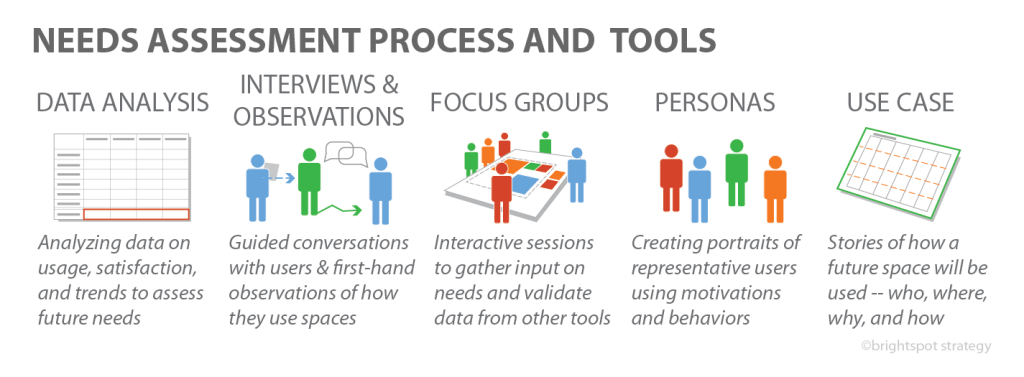
There are many different data collection methods—from quantitative techniques like surveys to qualitative techniques such as focus groups. Your target demographic may influence your methodology, so take into account whose perspective you’re looking for before you decide. 

Needs assessments provide crucial data on existing processes and help teams create more effective systems. 

[inline illustration] 3 types of needs assessment (infographic)

Here are three of the most popular methods of collecting needs assessment data:

Questionnaires

Questionnaires and interviews are the most popular methods for collecting data. A questionnaire is a surface-level form with general yes or no questions. This is a great way to get quick information from respondents.

Use for things like: Evaluating the effectiveness of your brand identity

Surveys

Many teams use surveys to collect external information around customer experience. Surveys often include open-ended questions, so they provide more in-depth information than questionnaires. This is a great way to find accurate but quick information.

Use for things like: Evaluating the success of your post-purchase experience from the customer’s perspective

Focus groups

A focus group is an interview involving a small number of participants who share common traits or experiences. While they require considerably more time than the other two methods, focus groups provide extensive information around needs and customer experience. This is a great way to gather in-depth information.

Use for things like: Evaluating how your customers experience your brand and what they think could be improved

Identify your team’s needs with an analysis

Performing a needs assessment is a great way to understand how current processes are being handled and how you can streamline tasks and communication. Knowing which needs are most important isn’t always obvious. With a needs analysis, you can gather the data you need to make your team more efficient. 

If you’re looking to improve efficiency and productivity as a team, keep information and tasks streamlined with productivity software. From empowering collaboration to creating and sharing templates, Asana can help.Create a strategic planning template

Related resources

ARTICLEHow Asana uses Asana to streamline project intake processes

ARTICLEHow Asana uses work management for smoother creative production

ARTICLE6 steps for writing a persuasive project proposal

ARTICLEHow to create a request for information (RFI) document

Asana Home

© 2024 Asana, Inc.

English

Terms & Privacy

Twitter

Linkedin

Instagram

Facebook

Youtube

app download link Apple

app download link Android

Let all of us become transparent.

For every idle word men may speak.  They will give an account of it in the Day of Judgement.  By your words you will be justified,  and by your words you will be condemned.   Politics requires transparency and truth.  Matthew 12:36-37.

It is time to be transparent and sincere as people who represent our community.  Lies and Deception will be detected by the People.   Therefore   all that I am saying is tell the truth.  God will hold all of us accountable for the things that we have done inside of our body whether it is good or bad.  This is inside of 2nd Corinthians 5:10.

How to Run an Honest Campaign?

You will have to have money and influence in this Country.   I already know that I will have to fill out an application for US President.   I know that I will have to pay $1,000,000 dollars in addition to the application fee.   All it takes to become a successful member in Politics is money, influence,  and support from the Community at large.

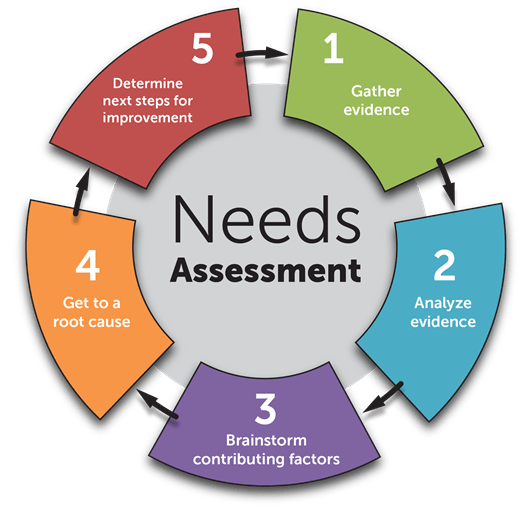
If I want to run for US Senate,  I will have to pay an application fee plus an additional $500,000 dollars.   I will have to hire someone to perform a Needs Assessment of the people inside of the City, State,  and Country.  Running an honest Campaign is based on the needs of the people.

You cannot have a criminal record.   You cannot have anything pending against you in any way to become a successful member of Congress.  Too many pending litigation against you, will hurt your chances of winning and being successful in Politics.  Even the things that we say out of our mouth will get us into trouble.   Matthew 12:36-37 says: For every idle word men may speak will go against you in the Day of Judgement.  By your words you will be justified and by your words,  you may be condemned.

What do you wish you could do more every day?

What do you wish you could do more every day?

I only wish that God could allow me to win the Ohio State Lottery just to pay off my $86,000 dollars in student loan debts.   The very first thing that I would do is give God 20% of my winnings to Fort McKinley United Methodist Church in Dayton,  Ohio.   I also would help my entire family members and friends and spend some time in the South.  I am happy either with the money or without money.  I cannot take it with me if I die unexpectedly and allow my family members to pay for my funeral arrangements.   My total debt is $160,000 dollars in debts.  God is watching all of us individually and collectively.   I am very grateful that I am clean and sober for 33 years now. 🙏   I do have issues with my medication that has.been prescribed to me by 8 doctors in the Dayton,Ohio area.  I am asking God for forgiveness and help with my anger and issues.   Lord God, I Love You forever.   Please take care of me and my family members and friends forever.   I need You in my life right now.

What is Probability?

Whose side are you really on? This is a simple question that we must ask ourselves each living day of our lives. When God created man; God created man in His Image. He created mankind in His image. This means that everything was created equally. Over 2000 years later, I am asking this question again. Whose side are you really on? I would prefer to be on God’s side rather than man. Probability is only a chance.  

Whose side are you really on?  This is a simple question that we must ask ourselves each living day of our lives.   When God created man; God created man in His Image.  He created mankind in His image.  This means that everything was created equally.   Over 2000 years later, I am asking this question again.  Whose side are you really on?  I would prefer to be on God’s side rather than man.  Probability is a chance!

My Personal Introduction About Myself.

Good Morning Everyone!  My name is Anthony Joseph Hopkins and I’m from Dayton, Ohio.   I want to inform everyone that I am suffering from Kidney Disease,  Type 2 Diabetes,  & Glaucoma.   I am a person who suffers from Schizoid Affective Disorder and Alzheimers, and I am an Author of 3 Books right now.   My Books are called Essays & My Grace is Sufficient for Me & The Best of Anthony Hopkins.

Finally,  I want to inform everyone that I am a Graduate from The University of Toledo in Toledo,  Ohio.   I have been voting since June 24, 1983.  I am a person who is very intelligent & highly educated.   I have earned 235 Credit Hours of classes in Social Services Technology and Social Work.  I have completed my Internship at The Jerusalem Outreach Center in Toledo,  Ohio from 1993 through 1996.  Most of my time, I am online writing essays about my personal experiences from getting scammed out of $18,550 dollars in Western Union Funds by Computer Hackers & Scammers from Ghana & Nigeria.