Words in boxes are from the Bible. Words in brackets, ( ), are not in the *Hebrew Bible.
The notes explain some of the words with a *star by them. A word list at the end explains the other words that have a *star by them.
The translated Bible text has yet to go through Advanced Checking.
Jesus said, “Your Father (God) knows how many hairs there are on your head!” (Matthew 10:30)
Psalm 139
(This is) for the music leader. (It is) a psalm of David.
v1 *LORD, when you look at me you know all about me.
v2 You know when I sit down. And you know when I get up. You understand what I am thinking about (even when you are) far away.
v3 You see when I go (somewhere). And you see when I stay (at home). You remember everything that I do!
v4 For example, before I say a word, *LORD, you know all about it.
v5 You are all round me, in front (of me) and behind (me). You have put your *hand upon me.
v6 What you know (about me) is *wonderful. I cannot understand it. It is so high that I cannot climb up to it.
v7 Where can I go from your *Spirit? How can I run away from you?
v8 If I went up to *heaven, you would be there. If I went down to *Sheol, you would be there also.
v9 If I went: · to where the sun rises (in the east) · to the other side of the sea (in the west)
v10 your hand would be there. It would be my guide. Your right hand would give me help.
v11 If I say: · I am sure that *darkness will hide me · or, the light round me will change into night,
v12 *darkness and light are the same to you! *Darkness is not dark to you. The night shines as bright as the day (to you).
v13 But you, you made every part of me. You made me grow in my mother’s *womb.
v14 I *praise you for the *mysterious and *wonderful way that you made me. I know very well that everything that you made is *wonderful.
v15 (Nothing) hid my body from you when I was growing in a secret place. This happened deep in the earth.
v16 Your eyes saw my body growing. Before I had lived one day, you wrote in your book how long I should live for!
v17 You have so many ideas, God. They are so difficult for me to understand.
v18 If I could count them all, there would be more than the *grains of sand (by the side of the sea). I would have to live (as long) as you to count them all!
v19 God, I hope that you will kill the *wicked (people)! And go away from me you *men of blood (murderers).
v20 They are your enemies. They say bad things about you that are not true.
v21 Do I *hate them that hate you, *LORD? Do I really hate them that attack you?
v22 (Yes) I do hate them, I really hate them. I think of them as my enemies.
v23 Look at me, God. And know (what is in) my *heart. Look into my mind and know my thoughts.
v24 See if I am doing anything bad that might hurt me. And lead me in the old ways.
The Story of Psalm 139
We do not know when David wrote this psalm. Some people think that the *prophet Zechariah wrote it; maybe he used David’s words and rewrote (wrote again) them. Zechariah wrote a Book of the Bible. He lived 450 years after David.
What Psalm 139 means
This psalm is in 4 parts:
· Verses 1-6. God knows all about us.
· Verses 7-12. We cannot hide from God.
· Verses 13-18. God created (made) us.
· Verses 19-24. David prays about his enemies and himself.
God knows all about us
“When you look at me” in verse 1 means “when you study me, or give me an exam”. *LORD is a special name for God. It is his *covenant name. A *covenant is when two people (or groups of people) agree. Here, God agrees to love and give help to his people. They agree to love and obey him. The *LORD sees every part of us. He even knows what we are going to say. He knows before we say it, (verse 4)! “Your hand” in verse 5 means “your power”. It means what God does in this world. To understand this is like climbing a very high mountain, (verse 6). It is too high to get to the top!
We cannot hide from God
The Holy Spirit, or Spirit, (verse 7), is another name for God. If you go to *heaven (or the sky) or *Sheol (below the earth) God will find you. If you go to the east or the west, you cannot hide from him, (verses 8-9). His hand (or power) will always be with you, to be a guide and a help, (verse 10). David saw it as a good thing that God was always with him. He had God as a guide and someone to give him help. We cannot see in the *darkness, when there is no light. We cannot see when it is dark … but God can, (verses 11-12)!
God made us
“The secret place” and “deep in the earth” mean his mother’s womb, (verse 15). The womb is where mothers keep babies before they are born. Some Bible students think “difficult” should be “valuable” in verse 17. Both ideas are true! “Grains of sand” in verse 18 are “little bits of sand”.
David prays about things
There is a quick change in the next 4 verses. The *psalmist (David) makes a *prayer of imprecation (asks for bad things to happen) for his enemies. They are God’s enemies too, (verse 20). In verse 19, David says that they are “*wicked people”. “*Wicked” means “very, very bad”. He also says that they are “men of blood”, (or people that murder other people). Verse 21 asks if the *psalmist hates God’s enemies. Verse 22 gives the answer: “Yes!” “Hate” means the opposite of “love”. The psalm finishes where it started. God is looking into the *psalmist’s mind. “The old ways”, (verse 24), are the right ways that God told people to walk in. They will never come to an end.
Something to do
1. Pray the words of verses 23-24 and wait for God’s answer.
2. Read about Psalms of Imprecation in Psalm 69 of this set.
Word List
covenant ~ two people have agreed what each should do (here, God and his people). Look in Psalm 120 about the covenant.
darkness ~ when there is no light.
grains of sand ~ little bits of sand.
hate ~ the opposite of love.
heart ~ part of the body. *Jews believed that you thought in your heart.
heaven ~ the home of God.
Jew ~ a person who is born from Abraham, Isaac and Jacob and their children.
LORD ~ the *covenant name for God (in a *covenant you agree with someone).
men of blood ~ murderers.
mysterious ~ nobody understands it.
praise ~ to say how great someone is; or, words that say how great someone is.
prayer ~ you say a *prayer when you speak to God.
prophesy ~ tell people what God thinks and will do.
prophet ~ someone who *prophesies.
psalmist ~ the person that wrote a psalm (or psalms).
Sheol ~ *Jews believed that you went to Sheol when you died.
sin ~ not to obey God; or what you do when you do not obey God.
Spirit ~ the Holy Spirit.
wicked ~ very, very bad.
womb ~ where mothers keep babies before they are born.
It does not appear, nor is it material to enquire, upon what occasion David penned this psalm; but in it, I. He looks back with thankfulness upon the experiences he had had of God’s goodness to him (v. 1-3). II. He looks forward with comfort, in hopes, 1. That others would go on to praise God like him (v. 4, 5). 2. That God would go on to do good to him (v. 6-8). In singing this psalm we must in like manner devote ourselves to God’s praise and glory and repose ourselves in his power and goodness.
I. How he would praise God, compare Ps. 111:1. 1. He will praise him with sincerity and zeal—“With my heart, with my whole heart, with that which is within me and with all that is within me, with uprightness of intention and fervency of affection, inward impressions agreeing with outward expressions.” 2. With freedom and boldness: Before the gods will I sing praise unto thee, before the princes, and judges, and great men, either those of other nations that visited him or those of his own nation that attended on him, even in their presence. He will not only praise God with his heart, which we may do by pious ejaculations in any company, but will sing praise if there be occasion. Note, Praising God is work which the greatest of men need not be ashamed of; it is the work of angels, the work of heaven. Before the angels (so some understand it), that is, in religious assemblies, where there is a special presence of angels, 1 Co. 11:10. 3. In the way that God had appointed: I will worship towards thy holy temple. The priests alone went into the temple; the people, at the nearest, did but worship towards it, and that they might do at a distance. Christ is our temple, and towards him we must look with an eye of faith, as Mediator between us and God, in all our praises of him. Heaven is God’s holy temple, and thitherward we must lift up our eyes in all our addresses to God. Our Father in heaven.
II. What he would praise God for. 1. For the fountain of his comforts—for thy lovingkindness and for thy truth, for thy goodness and for thy promise, mercy hidden in thee and mercy revealed by thee, that God is a gracious God in himself and has engaged to be so to all those that trust in him. For thou hast magnified thy word (thy promise, which is truth) above all thy name. God has made himself known to us in many ways in creation and providence, but most clearly by his word. The judgments of his mouth are magnified even above those of his hand, and greater things are done by them. The wonders of grace exceed the wonders of nature; and what is discovered of God by revelation is much greater than what is discovered by reason. In what God had done for David his faithfulness to his work appeared more illustriously, and redounded more to his glory, than any other of his attributes. Some good interpreters understand it of Christ, the essential Word, and of his gospel, which are magnified above all the discoveries God had before made of himself to the fathers. He that magnified the law, and made that honourable, magnifies the gospel much more. 2. For the streams flowing from that fountain, in which he himself had tasted that the Lord is gracious, v. 3. He had been in affliction, and he remembers, with thankfulness, (1.) The sweet communion he then had with God. He cried, he prayed, and prayed earnestly, and God answered him, gave him to understand that his prayer was accepted and should have a gracious return in due time. The intercourse between God and his saints is carried on by his promises and their prayers. (2.) The sweet communications he then had from God: Thou strengthenedst me with strength in my soul. This was the answer to his prayer, for God gives more than good words, Ps. 20:6. Observe, [1.] It was a speedy answer: In the day when I cried. Note, Those that trade with heaven by prayer grow rich by quick returns. While we are yet speaking God hears, Isa. 65:24. [2.] It was a spiritual answer. God gave him strength in his soul, and that is a real and valuable answer to the prayer of faith in the day of affliction. If God give us strength in our souls to bear the burdens, resist the temptations, and do the duties of an afflicted state, if he strengthen us to keep hold of himself by faith, to maintain the peace of our own minds and to wait with patience for the issue, we must own that he has answered us, and we are bound to be thankful.
III. What influence he hoped that his praising God would have upon others, v. 4, 5. David was himself a king, and therefore he hoped that kings would be wrought upon by his experiences, and his example, to embrace religion; and, if kings became religious, their kingdoms would be every way better. Now, 1. This may have reference to the kings that were neighbours to David, as Hiram and others. “They shall all praise thee.” When they visited David, and, after his death, when they sought the presence of Solomon (as all the kings of the earth are expressly said to have done, 2 Chr. 9:23), they readily joined in the worship of the God of Israel. 2. It may look further, to the calling of the Gentiles and the discipling of all nations by the gospel of Christ, of whom it is said that all kings shall fall down before him, Ps. 72:11. Now it is here foretold, (1.) That the kings of the earth shall hear the words of God. All that came near David should hear them from him, Ps. 119:46. In the latter days the preachers of the gospel should be sent into all the world. (2.) That then they shall praise God, as all those have reason to do that hear his word, and receive it in the light and love of it, Acts 13:48. (3.) That they shall sing in the ways of the Lord, in the ways of his providence and grace towards them; they shall rejoice in God, and give glory to him, however he is pleased to deal with them in the ways of their duty and obedience to him. Note, Those that walk in the ways of the Lord have reason to sing in those ways, to go on in them with a great deal of cheerfulness, for they are ways of pleasantness, and it becomes us to be pleasant in them; and, if we are so, great is the glory of the Lord. It is very much for the honour of God that kings should walk in his ways, and that all those who walk in them should sing in them, and so proclaim to all the world that he is a good Master and his work its own wages.
I. The favour God bears to his humble people (v. 6): Though the Lord be high, and neither needs any of his creatures nor can be benefited by them, yet has he respect unto the lowly, smiles upon them as well pleased with them, overlooks heaven and earth to cast a gracious look upon them (Isa. 57:15; 66:1), and, sooner or later, he will put honour upon them, while he knows the proud afar off, knows them, but disowns them and rejects them, how proudly soever they pretend to his favour. Dr. Hammond makes this to be the sum of that gospel which the kings of the earth shall hear and welcome—that penitent sinners shall be accepted of God, but the impenitent cast out; witness the instance of the Pharisee and the publican, Lu. 18.
II. The care God takes of his afflicted oppressed people, v. 7. David, though a great and good man, expects to walk in the midst of trouble, but encourages himself with hope, 1. That God would comfort him: “When my spirit is ready to sink and fail, thou shalt revive me, and make me easy and cheerful under my troubles.” Divine consolations have enough in them to revive us even when we walk in the midst of troubles and are ready to die away for fear. 2. That he would protect him, and plead his cause: “Thou shalt stretch forth thy hand, though not against my enemies to destroy them, yet against the wrath of my enemies, to restrain that and set bounds to it.” 3. That he would in due time work deliverance for him: Thy right hand shall save me. As he has one hand to stretch out against his enemies, so he has another to save his own people. Christ is the right hand of the Lord, that shall save all those who serve him.
III. The assurance we have that whatever good work God has begun in and for his people he will perform it (v. 8): The Lord will perfect that which concerns me, 1. That which is most needful for me; and he knows best what is so. We are careful and cumbered about many things that do not concern us, but he knows what are the things that really are of consequence to us (Mt. 6:32) and he will order them for the best. 2. That which we are most concerned about. Every good man is most concerned about his duty to God and his happiness in God, that the former may be faithfully done and the latter effectually secured; and if indeed these are the things that our hearts are most upon, and concerning which we are most solicitous, there is a good work begun in us, and he that has begun it will perfect it, we may be confident he will, Phil. 1:6. Observe, (1.) What ground the psalmist builds this confidence upon: Thy mercy, O Lord! endures for ever. This he had made very much the matter of his praise (Ps. 13:6), and therefore he could here with the more assurance make it the matter of his hope. For, if we give God the glory of his mercy, we may take to ourselves the comfort of it. Our hopes that we shall persevere must be founded, not upon our own strength, for that will fail us, but upon the mercy of God, for that will not fail. It is well pleaded, “Lord, thy mercy endures for ever; let me be for ever a monument of it.” (2.) What use he makes of this confidence; it does not supersede, but quicken prayer; he turns his expectation into a petition: “Forsake not, do not let go, the work of thy own hands. Lord, I am the work of thy own hands, my soul is so, do not forsake me; my concerns are so, do not lay by thy care of them.” Whatever good there is in us it is the work of God’s own hands; he works in us both to will and to do; it will fail if he forsake it; but his glory, as Jehovah, a perfecting God, is so much concerned in the progress of it to the end that we may in faith pray, “Lord, do not forsake it.” Whom he loves he loves to the end; and, as for God, his work is perfect.
This website is AudioEye enabled and is being optimized for accessibility. To open the AudioEye Toolbar, press “shift + =”. Some assistive technologies may require the use of a passthrough function before this keystroke. For more information, activate the button labeled “Explore your accessibility options”.Skip To Main Content
Select a Bible Book Select Book GenesisExodusLeviticusNumbersDeuteronomyJoshuaJudgesRuth1 Samuel2 Samuel1 Kings2 Kings1 Chronicles2 ChroniclesEzraNehemiahEstherJobPsalmsProverbsEcclesiastesSong of SolomonIsaiahJeremiahLamentationsEzekielDanielHoseaJoelAmosObadiahJonahMicahNahumHabakkukZephaniahHaggaiZechariahMalachiMatthewMarkLukeJohnActsRomans1 Corinthians2 CorinthiansGalatiansEphesiansPhilippiansColossians1 Thessalonians2 Thessalonians1 Timothy2 TimothyTitusPhilemonHebrewsJames1 Peter2 Peter1 John2 John3 JohnJudeRevelation Select a ChapterSelect Chapter123456789101112131415161718192021222324252627282930313233343536373839404142
“This whole chapter is occupied with Job’s solemn oath of innocence. It was his final and explicit answer to the line of argument adopted by his three friends.” (G. Campbell Morgan)
A. Job proclaims his innocence
1. (1-4) He was not guilty of lust.
“I have made a covenant with my eyes; Why then should I look upon a young woman? For what is the allotment of God from above, And the inheritance of the Almighty from on high? Is it not destruction for the wicked, And disaster for the workers of iniquity? Does He not see my ways, And count all my steps?”
a. I have made a covenant with my eyes; why then should I look upon a young woman: In this section, Job protested that he was a godly and blameless man, at least on a human scale. His larger context was to explain the sense of injustice he felt at his suffering and humiliation, and to make a final defense before his friends who accused him of special sin deserving of special judgment.
i. This chapter has an interesting similarity to ancient “defense documents.” “The material is similar in form, if not in content, to the negative confession given by the deceased who stands before Osiris in the Egyptian Book of the Dead… Under oath the subject lists the evil things he has not done with the hope he will be vindicated and pass through the portals unscathed.” (Smick)
ii. “It is an oath of clearance in the form of a negative confession. The procedure was well known in ancient jurisprudence. A crime could be disowned by calling down a curse on oneself if one had committed it.” (Andersen)
iii. Yet it also has a clear connection to the Sermon on the Mount. “Chapter 31 is Job’s Sermon on the Mount, for in it he touches on many of the same issues of spiritual ethics that Jesus covers in Matthew 5-7, including the relationship between lust and adultery (Job 31:1, 9-12), loving one’s neighbor as oneself (Job 31:13-15), almsgiving and social justice (Job 31:16-23), and the love of money and other idolatries (Job 31:24-28).” (Mason)
iv. We are clearly told in Job 1 that Job was a blameless and upright man; this is the chapter that most clearly explains what that godly life looked like. “The chapter that we now open breathes, almost or quite throughout, a spirit that belongs rather to the New than to the Old Covenant. It is a practical anticipation of much of the teaching that was to come from Him Who ‘sat down and taught’ His disciples on the mountain. It is the picture of one perfect and upright, who feared God, and eschewed evil.” (Bradley)
b. I have made a covenant with my eyes; why then should I look upon a young woman: In defending his righteous life, Job began with explaining that he was a morally pure man who did not look upon a young woman in impure and inappropriate ways.
i. It is significant that in this long section where Job explained his righteous life, he began with noting that he guarded his eyes from lustful looks upon a young woman. This rightly suggests that a man’s ability to not look upon lustful images is an important indicator of his general righteousness and blamelessness.
ii. This also suggests that the eyes are a gateway for lust, especially for men. This is demonstrated over and over again by both personal experience and empirical study. When a man places enticing, sensual, lust-inducing images before his eyes, it is a form of foreplay, especially considering that it often or frequently causes some level of sexual arousal in the man.
iii. “In Hebrew the same word signifieth both an eye and a fountain; to show, saith one, that from the eye, as a fountain, floweth both sin and misery.” (Trapp)
iv. “Lustfully consider her beauty, till my heart be hot as an oven with lawless lusts, and my body be moiled with that abominable filth… Look upon the woeful chain of David’s lust, and remember how many died of the wound in the eye.” (Trapp)
c. A covenant with my eyes: Job’s ability to control himself was connected with a covenant he made. He made a vow, a promise, a commitment with his own eyes that he would not look upon a young woman in a sinful way.
i. Bullinger says that the Hebrew does not literally say that Job made a covenant with his eyes. “Not ‘made with’… The covenant here was made with God, against his eyes, which are regarded as an enemy likely to lead him astray.”
ii. “When Job says that he has made a covenant with his eyes to abstain from lust, he does not mean that he has stopped experiencing lust altogether. What he means is that he refuses to dwell upon the lustful feelings which, as the normal red-blooded male he is, come to him very naturally.” (Mason)
iii. Job insisted that he would not look upon a young woman – a maiden in this way. This was especially meaningful, because in that culture it would be somewhat accepted for a rich and powerful man like Job to seduce or ravish a maiden, and then add her as either a wife or a concubine. Job restrained himself from women that others in his same circumstances would not restrain themselves from.
iv. “He restrained himself from the very thoughts and desires of filthiness with such persons, wherewith the generality of men allowed themselves to commit gross fornication, as deeming it to be either none, or but a very little sin.” (Poole)
d. For what is the allotment of God from above: In the context of Job’s self-control when it came to lust, he considered what the allotment of God from above was. He understood that the young woman he would be enticed to look upon was not the allotment of God for him; she and her nakedness did not belong to Job in any sense.
i. Leviticus 18:1-18 reinforces this Biblical principle. It relates how the nakedness of an individual “belongs” to that individual and to their spouse, and it does not “belong” to anyone else. Therefore, when a man looks upon the nakedness of a woman who is not his wife, he takes something that does not belong to him.
ii. There certainly existed some type of pornography in Job’s day; some of the earliest artistic images are of women and men in highly sexualized motifs. Nevertheless, Job certainly did not have to contend with the sophisticated, gigantic, and far-reaching modern pornography industry. The availability of modern pornography has made it a significantly greater challenge for men to confine their visual arousal to the allotment of God from above for them.
iii. In this context, it is helpful for a man to ask himself: “Whose nakedness belongs to me, and whose does not?” Only a proud and depraved man would think that every woman’s nakedness belongs to him. A moment of thought reinforces the clear principle: only the nakedness of his own wife is the allotment of God from above for a man; only his own wife is the inheritance of the Almighty from on high for his visual arousal.
iv. “Hereby we plainly see that the command of Christ, Matthew 5:29, was no new command peculiar to the gospel, as some would have it, but the very same which the law of God revealed in his word, and written in men’s hearts by nature.” (Poole)
e. Is it not destruction for the wicked, and disaster for the workers of iniquity: In the context of Job’s self-control when it came to lust, he also considered the destructive nature of allowing one’s self to be aroused by alluring images. He perhaps considered the lives of others that had been destroyed by lust and sexual sin that began with visual arousal.
i. “For in those days, he knew well, he tells us, that God had assigned his heaviest judgments as the sure inheritance of those who infringed that noble law of purity which lifts man above the brute.” (Bradley)
ii. The potential for destruction is all the more real in the modern world, because the challenges to Biblical purity are all the more formidable. Using very rough estimates, we can, compare the world of a man in the year a.d. 1500 to the world a.d. 2000:
· In 1500 the average age of a man’s economic independence was 16; today it is 26.
· In 1500 the average age of marriage for a man was 18; today it is 28 (or more).
· In 1500 the average age of male puberty was 20; today it is 12.
iii. “The ruin of impure souls is infallible, unsupportable, unavoidable; if God hath aversion from all other sinners, he hath hatred and horror for the unchaste; such stinking goats shall be set on the left hand, and sent to hell; where they shall have so much the more of punishment as they had here of sensual and sinful pleasure, as sour sauce to their sweet meats.” (Trapp)
iv. This means that there are many biological, cultural, economic, social, and technological factors that make it much more difficult for a man today to make a covenant with his eyes to not look upon a young woman in the sense meant here by Job. It is much more difficult for a man to choose satisfaction with the allotment of God from above and to avoid the destruction and disaster Job spoke of. Nevertheless, by the power of God’s Spirit it can be done, and obedience to God in this arena is a precious, wonderful sacrifice made unto Him; a genuine way to present our bodies as a living sacrifice unto Him, not being conformed to the world (Romans 12:1-2).
f. Does He not see all my ways, and count all my steps: In the context of Job’s self-control when it came to lust, it was helpful for him to consider that God’s eye was upon him all the time. Most men indulge in ungodly visual arousal with the (at least temporary) delusion that their conduct is unseen by God. It helped Job to know that God did see all his ways.
2. (5-8) He was not guilty of falsehood.
“If I have walked with falsehood, Or if my foot has hastened to deceit, Let me be weighed on honest scales, That God may know my integrity. If my step has turned from the way, Or my heart walked after my eyes, Or if any spot adheres to my hands, Then let me sow, and another eat; Yes, let my harvest be rooted out.”
a. If I have walked with falsehood: Job also proclaimed his blameless life because he lived an essentially truthful life. He was not afraid to beweighed on honest scales, and have his life examined in an honest way.
i. “The self-curse of crop failure (Job 31:8) suggests that verse 5 refers to shady business practices.” (Andersen)
b. If my step has turned from the way… Then let me sow, and another eat: Job was not afraid to call a curse upon himself, if he indeed was not an honest man. He was willing to be deprived of the fruit of his own labor if it was true that he was found lacking on the honest scales of God’s judgment.
i. The confidence Job had in calling curses upon himself if he were not truthful is impressive. It is as if he said to his friends, “Do you think that I am trying to make out before God that I am what I have not been? Would I talk to God with what would be blatant insolence if I had not the facts to back me up?” (Chambers)
3. (9-12) He was not an adulterer.
“If my heart has been enticed by a woman, Or if I have lurked at my neighbor’s door, Then let my wife grind for another, And let others bow down over her. For that would be wickedness; Yes, it would be iniquity deserving of judgment. For that would be a fire that consumes to destruction, And would root out all my increase.”
a. If my heart has been enticed by a woman: The next area of integrity Job proclaimed had to do with faithfulness to his wife within the marriage. He understood that this had more than a sexual aspect (perhaps first mentioned in Job 31:1-4), but also included the heart being enticed.
i. Job touched upon a significant truth; that it is entirely possible to allow one’s heart to be enticed by another. These things happen because of choices one makes, not merely because one has been acted upon by the mystical or magical power of romantic love.
ii. Instead, Job insisted that for him to have his heart enticed by another would be wickedness, and indeed it would be iniquity deserving of judgment. He understood that he had control over whom he would allow his heart to be enticed by.
iii. “The phrase is very emphatical, taking from himself and others the vain excuses wherewith men use to palliate their sins, by pretending that they did not design the wickedness, but were merely drawn in and seduced by the strong enticements and provocations of others; all which Job supposeth, and yet nevertheless owns the great guilt of such practices even in that case, as well knowing that temptation to sin is no justification of it.” (Poole)
b. Then let my wife grind for another: Job insisted that if he had been unfaithful in heart or in action towards his wife, then he would deserve to have his wife taken from him and given to another.
i. “Let her be his slave… or rather, let her be his whore; and may my sin, which hath served her for example, serve her also for excuse.” (Trapp)
ii. “Let others bow down upon her; another modest expression of a filthy action; whereby the Holy Ghost gives us a pattern and a precept to avoid not only unclean actions, but also all immodest expressions.” (Poole)
iii. “Job is so conscious of his own innocence, that he is willing it should be put to the utmost proof; and if found guilty, that he may be exposed to the most distressing and humiliating punishment, even to that of being deprived of his goods, bereaved of his children, his wife made a slave, and subjected to all indignities in that state.” (Clarke)
c. For that would be a fire that consumes to destruction: Job also understood that allowing his heart to be enticed by a woman other than his wife would bring a destructive, burned-over result.
i. And root out all my increase: Many men who feel themselves under oppressive alimony or child support payments because they allowed their hearts to be enticed by another woman have lived this statement by Job and have seen all their increase rooted out.
ii. In this we can see that Job was tempted to adultery but resisted the temptation. “The devil’s fire fell upon wet tinder; and if he knocked at Job’s door, there was nobody at home to look out at the window and let him in; for he considered the punishment both human, Job 31:11, and divine, Job 31:12, due to this great wickedness.” (Trapp)
4. (13-15) He did not treat his servants cruelly.
“If I have despised the cause of my male or female servant When they complained against me, What then shall I do when God rises up? When He punishes, how shall I answer Him? Did not He who made me in the womb make them? Did not the same One fashion us in the womb?”
a. If I have despised the cause of my male or female servant: Job continued the presentation of his own righteousness by noting the good and compassionate treatment of his servants. The goodness of a man or a woman is often best indicated by how they treat those thought to be inferior to them, not how they treat their peers or those thought to be superior to them.
b. What then shall I do when God rises up? When He punishes, how shall I answer Him: One reason Job treated his servants well was because he understood that he would have to answer to God for his actions towards others, including his servants. He understood that God cared about his servants and would avenge ill-treatment of them.
i. “This section embodies a human ethic unmatched in the ancient world.” (Andersen)
ii. Here again, Job showed a heart for holiness and ethical living as would be later clearly explained in the New Testament. Paul gave much the same idea in Ephesians 6:9, where he told masters to treat their servants well: And you, masters, do the same things to them, giving up threatening, knowing that your own Master also is in heaven, and there is no partiality with Him.
c. Did not He who made me in the womb make them: Another reason Job treated his servants well was because he recognized their essential humanity. This was both remarkable and admirable in a time when it was almost universally understood that servants and slaves were subhuman next to those whom they served.
i. “Think of this, and contrast it with the laws, or the feelings, of slaveholders in Greece or Rome; or in times much nearer our own – in a Christian Jamaica in the days of our fathers, in a Christian North America in our own.” (Bradley, writing in 1886)
5. (16-23) He did not victimize the poor or the weak.
“If I have kept the poor from their desire, Or caused the eyes of the widow to fail, Or eaten my morsel by myself, So that the fatherless could not eat of it (But from my youth I reared him as a father, And from my mother’s womb I guided the widow); If I have seen anyone perish for lack of clothing, Or any poor man without covering; If his heart has not blessed me, And if he was not warmed with the fleece of my sheep; If I have raised my hand against the fatherless, When I saw I had help in the gate; Then let my arm fall from my shoulder, Let my arm be torn from the socket. For destruction from God is a terror to me, And because of His magnificence I cannot endure.”
a. If I have kept the poor from their desire, or caused the eyes of the widow to fail: As a further testimony to his righteousness, Job insisted that he had been good and kind to the poor and to the helpless (such as the widow and the fatherless).
b. If I have seen anyone perish for lack of clothing… Then let my arm fall from my shoulder: In the same manner as before, Job called for a curse upon himself it if was true that he had not cared for the poor and helpless as he claimed he had. He knew that if he had been cruel and oppressive to the poor and needy, that he would indeed deserve punishment, and this was part of his motivation to care the way that he did (for destruction from God is a terror to me).
i. “Most of the good deeds that Job presents as evidence of his righteousness are simple, ordinary things… More than any one of these acts alone, it is the accumulation of them that is impressive.” (Mason)
6. (24-28) He was not greedy or a seeker of false gods.
“If I have made gold my hope, Or said to fine gold, ‘You are my confidence’; If I have rejoiced because my wealth was great, And because my hand had gained much; If I have observed the sun when it shines, Or the moon moving in brightness, So that my heart has been secretly enticed, And my mouth has kissed my hand; This also would be an iniquity deserving of judgment, For I would have denied God who is above.”
a. If I have made gold my hope: Job knew that wealthy men often found it easy to trust in riches. Therefore, he again insisted that he had not made riches his hope or his confidence, and also had not rejoiced because his wealth was great.
b. If I have observed the sun when it shines: Job meant that he had not engaged in the common practice of sun worship. His heart was not secretly enticed to idolatry, which was apparently sometimes worshipped with the kissing of the hand.
i. If I have observed the sun: “Not simply, nor only with admiration; (for it is a glorious work of God, which we ought to contemplate and admire;) but for the end here following, or so as to ascribe to it the honour peculiar to God.” (Poole)
ii. “And when the idols were out of the reach of idolaters, that they could not kiss them, they used to kiss their hands, and, as it were, to throw kisses at them; of which we have many examples in heathen writers.” (Poole)
c. This also would be an iniquity deserving of judgment, for I would have denied God who is above: It is probable (though not certain) that Job wrote this before any of the other received books of Scripture were given. Therefore, he knew that idolatry was wrong by both natural revelation and by conscience. He knew that since there was a true, living God enthroned in the heavens, it was an iniquity deserving of judgment to deny the God who is above and to worship any other.
7. (29-34) He was generally without blame.
“If I have rejoiced at the destruction of him who hated me, Or lifted myself up when evil found him (Indeed I have not allowed my mouth to sin By asking for a curse on his soul); If the men of my tent have not said, ‘Who is there that has not been satisfied with his meat?’ (But no sojourner had to lodge in the street, For I have opened my doors to the traveler); If I have covered my transgressions as Adam, By hiding my iniquity in my bosom, Because I feared the great multitude, And dreaded the contempt of families, So that I kept silence And did not go out of the door;
a. If I have rejoiced at the destruction of him who hated me: As further testimony to his personal righteousness, Job claimed that he had not been happy when his enemies had suffered and been destroyed. This is certainly one mark of a man after God’s heart, who also takes no pleasure in the destruction of the wicked (Ezekiel 33:11)
b. By asking for a curse on his soul: Job did not even curse his enemies. He kept himself from this most natural reaction.
c. No sojourner had to lodge in the street: Job was also a diligent man when it came to hospitality. He would not allow a visitor to sleep on the street and instead he opened his doors to the traveler.
d. If I have covered my transgressions as Adam, by hiding iniquity in my bosom: The basic and consistent argument of Job’s friends against him was that though he appeared to be righteous, he really must be covering some serious sin that made sense of the calamity that came against him. Therefore, Job insisted that he was not covering his sins as Adam, who blamed Eve and vainly tried to cover his sin.
i. “Job has never dissembled, attempting to conceal his sin ‘like Adam.’” (Andersen)
e. Because I feared the great multitude: Here, Job answered the accusation that he was motivated to hide his sin because of the fear of how it would appear before the public. Job’s friends had probably known many seemingly righteous people who had hidden their sins and were destroyed when they were eventually exposed, and they assumed Job was like them. Job here rightly protested that he was not like such men who hide their sin out of fear of public humiliation and contempt.
B. Job concludes his plea.
1. (35-37) Job demands an audience with God.
Oh, that I had one to hear me! Here is my mark. Oh, that the Almighty would answer me, That my Prosecutor had written a book! Surely I would carry it on my shoulder, And bind it on me like a crown; I would declare to Him the number of my steps; Like a prince I would approach Him.”
a. Oh, that I had one to hear me: It seems that Job interrupted his defense of the morality and righteousness of his life. He probably had much more he could say to defend himself, but broke off that line of reasoning and made a final, dramatic appeal to be heard before the throne of God.
i. “Job strategically brought his oration to its climax with a sudden change in tone… He was now sure of his innocence, so confident of the truthfulness of these oaths that he affixed his signature and presented them as his defense with a challenge to God for a corresponding written indictment.” (Smick)
ii. The finality of his words are demonstrated by the phrase, “Here is my mark.” “Job’s statement means literally, ‘Here is my taw.’ Some versions translate this, ‘Here is my signature,’ since taw, the last letter of the Hebrew alphabet, could be used like our letter ‘X’ to denote a person’s ‘mark’ or ‘signature.’ Yet even more interesting is the fact that in the ancient Hebrew script used by the author of Job, this letter taw was a cross-shaped mark. In a sense, therefore, what Job was saying is, ‘Here is my cross.’” (Mason)
b. Oh, that the Almighty would answer me: Job was absolutely convinced that what he needed was vindication (or at least an answer) from God. His friends thoroughly analyzed his situation and came to completely wrong conclusions. Job couldn’t make sense of it himself. Here, he called God out to answer for what He had done.
i. This is the demand that Job would later repent of in Job 42:5-6. Job would come to find that he had no right to demand an answer from God, and indeed had to be content when God seemed to refuse an answer.
c. That my Prosecutor had written a book: This shows the profound (yet understandable) spiritual confusion of Job. He felt that God was his accuser (my Prosecutor), when really it was Satan. We sympathize with Job, knowing that he could not see behind that mysterious curtain that separated earth from heaven; yet we learn from what Job should have known.
i. “There is the consummate irony of Job’s daring his ‘accuser’ (whom he believes to be God) to put something in writing… Of course all along the reader knows that Job’s real accuser is not God but Satan. But Job does not know this.” (Mason)
d. Surely I would carry it on my shoulder: Here Job, stepping over bound he would later repent of, longed to have the accusation of God against him written out so he could refute it as he had so effectively refuted his friends. He was so confident in what he knew of himself that he said he would approach God like a prince.
i. Job was indeed confident in what he did know; that he was a blameless and upright man who did not bring the catastrophe upon himself by his own special sin. What he was much too confident about were the things he could not see; the things that happened in the spiritual realm, known to the reader of Job 1-2, but unknown to Job in the story. Somewhat like his friends, Job thought he had it all figured out, but he didn’t.
ii. “Upon my shoulder; as a trophy or badge of honour. I should not fear nor smother it, but glory in it, and make open show of it, as that which gave me the happy and long-desired occasion of vindicating myself.” (Poole)
iii. I would declare to Him the number of my steps: “Far from being abashed, Job is belligerent to the last, eager to have his case settled, confident of the outcome. He is capable of giving a full account of all his steps.” (Andersen)
2. (38-40) The conclusion of Job’s words.
“If my land cries out against me, And its furrows weep together; If I have eaten its fruit without money, Or caused its owners to lose their lives; Then let thistles grow instead of wheat, And weeds instead of barley.” The words of Job are ended.
a. If my land cries out against me: In this chapter Job testified to his own integrity in the most solemn of terms, calling repeated curses upon himself if his friends could indeed demonstrate that he was a conspicuous sinner worthy of conspicuous judgment or discipline from God. Now, he called one more witness on his behalf: his own land and property.
i. This was not unusual in the ancient thinking. “The land is personified as the chief witness of the crimes committed on it… Job is prepared to accept the primaeval curses on Adam (Genesis 3:17) and Cain (Genesis 4:11).” (Andersen)
b. The words of Job are ended: It isn’t that there are no more words from Job in this Book of Job; he will speak again briefly in later chapters. Yet Job is definitely done arguing his case. He is finished; one more man will try in vain to fix the problem; and then God will appear. We might rightly say that God – silent to this point – could not (or would not) appear and speak until all the arguments of man were exhausted.
i. “This is not a mere epigraph of a writer, or editor. They are the concluding words which Job uttered: by which he informed his friends that he did not intend to carry the controversy any further; but that he had now said all he meant to say. So far as he was concerned, the controversy was ended.” (Bullinger)
ii. “At this point, then, we have reached the end of Job’s expressions of pain. The end is silence. That is God’s opportunity for speech. He often waits until we have said everything: and then, in the silence prepared for such speech, He answers.” (Morgan)
I would like to start this essay off by asking a very important question. What is wrong with my neighborhood? The answer to this question is I do not know. In 2025, I only want to inform all of you that things have changed dramatically because there is no sense of openness and honesty.
Next, I want to inform all of you that my family members and I have been arguing every single day for the past 18 months now. My family arguments have occurred more frequently because I have been paying rent at my relatives apartment.
My neighbors are a member of the European Descent. I really cannot tell everyone what to do inside of their own house. However, I want to inform everyone that a lot of people from other descents have moved out of the property because of a rent increase. I really think it is time to leave Dayton, Ohio.
Whoever stated that Dayton, Ohio is a very nice city, they are really telling lies. I want to inform you that my neighbors refused to allow the repairman to fix the property because they stated that they had to wait until a specified person come home from work.
Further, I want to inform you that my hometown of Dayton, Ohio has racial problems. The majority culture are more dominant when it comes to population than minorities. The neighborhood that I currently live at right now is predominantly European Americans. The apartment complex that I am living at consists of people who are really like myself because we are all barely making it.
Moreover, I want to inform everyone that: the cost of living inside of the Dayton, Ohio has increased dramatically since 2010. During the past 15 years, I have been living here inside of different neighborhoods. For the past 14 years, I have lived at Wentworth Hi Rise Apartments which is located inside of Northwest Dayton, Ohio.
The Northwest Side of Dayton, Ohio is predominantly African American and people of Latin Descent. One thing that I have noticed is that there is a lot of people who are of Asian Descent living inside of our neighborhoods right now. There are also people from South African Descent moving to the Dayton, Ohio Area.
There are people who are moving to Dayton, Ohio from other states in the United States. I even noticed that people are moving here from Los Angeles, California and Chicago, Illinois.
There are people who have relocated here from the St. Lois Area due to the tornadoes that have occurred during the past few weeks. There is a small population growth during the past 5 years now. My neighborhood has changed dramatically because people from the majority culture are not as friendly as they once were in years past.
Finally, I want to inform all of you that Huber Heights and Riverside, Ohio is considered as Tornado Alley inside of the Montgomery County Area. To be honest with you, some people remind me of pigs that is inside of the mud. I used to have my head inside of the sand because I was involved inside of failed relationships.
Frankly, we all have our own share of problems. I have been clean and sober for 35 years now. I cannot deal with negativity of all sorts. My nieces and nephews have been dissing me for the past 15 years now. My family members rarely come over to visit me and my brother. I really love everyone no matter what has transpired in the past.
I am the type of person who does not like drama that is coming from anyone including myself. I am staying out of trouble because my life at this time has been filled with chaos. May the Lord Jesus continue to Bless You!! Please keep me and all of my family members in your prayers right now. Therefore; my neighborhood is not integrated like it is in the South and the West Coast right now. Thank you for reading my essay.
Yes, it’s true that dogs and cats are sensitive to human arguments and can become stressed or anxious when they hear people arguing, according to a veterinarian who spoke to Newsweek. Pets are attuned to the emotional tone of their environment and can perceive tension and conflict when humans are arguing, according to Going Mutts Pet Services, LLC. [1, 1, 2, 2, 3, 4]
Here’s why:
They pick up on the vibe: Pets are highly perceptive and can sense changes in mood and energy levels, according to Newsweek. [1, 1, 5, 6]
Stress and anxiety: Arguing can create a stressful environment, which can lead to anxiety in pets. This can manifest in various ways, such as hiding, restlessness, or even changes in eating habits. [1, 1, 2, 2, 7, 8]
Vocal cues: Pets may not understand the specific words being used in an argument, but they can recognize the raised voices and emotional tone, which can be alarming to them. [1, 1, 2, 2, 9]
Safety concerns: Some pets might perceive arguing as a sign of danger or a potential threat to their safety, especially if they have a history of experiencing aggression or conflict in their environment, according to a pet owner on Quora. [1, 1, 10, 10, 11]
Impact on bonding: While some pets may seek comfort from their owners after an argument, others might become withdrawn or avoid interaction, potentially impacting the bond between the pet and the arguing individuals, according to a pet owner on Quora. [2, 2, 10, 10, 12, 13, 14]
According to experts, this makes you a warm person that values intimacy, sees extenuating circumstances and strives for harmony. You’re naturally empathic, compassionate and connect well with others. You listen to your instinct and your gut feelings never lead you astray. You have strong interpersonal skills and you often feel deep compassion for people that you barely know. You always see the big picture and there’s nothing more important to you than balance and harmony. You’re most dominant brain function of intuition makes you a loving friend and lover!
Male menopause is often used in the media as shorthand for the symptoms and health effects suffered by men due to an age-related drop in testosterone levels and activity. However, when used about men, the term menopause can be misleading.
For women, it describes the time when their monthly periods stop as oestrogen levels significantly decline, usually between 45 to 55 years of age.
On the other hand, not all men suffer from a comparable change of life. But men’s hormone levels and balance often go through changes as they age, particularly if they fall into ill health due to problems like obesity, stress and high alcohol intake. This can affect many men with symptoms that are sometimes severe. So in reply to the question, does the male menopause exist?, the answer is yes, it is a real, identifiable health problem.
The good news is that it can be treated successfully and effectively with testosterone replacement therapy.
Is the male menopause just a mid-life crisis?
No, the male menopause is not the same as a mid-life crisis although they may occur at the same age. As clinical psychologist Jean Coleman explains: “You can get a mixture of mid-life crisis and andropause (male menopause) in some men, but mid-life crisis is an existential crisis and an emotional problem.”
However, Coleman says, this is not to do with hormonal levels and activity, as is the case with what is commonly called the male menopause, which has its own distinctive pattern of andropause symptoms.
Are there other names for the male menopause?
Other common terms used to describe the male menopause and the symptoms and signs that usually come with it include andropause, late onset hypogonadism, male climacteric, low T, man-o-pause and Testosterone Deficiency Syndrome. All these refer to the same condition. The Centre for Men’s Health generally uses the more precise medical term Testosterone Deficiency Syndrome (TDS), as we believe this most accurately describes the condition and its cause.
What are male menopause symptoms?
Male menopause symptoms include:
Loss of energy;
Low libido (sex drive);
Erection problems, especially a loss of morning erections;
Depression;
Anxiety;
Irritability and anger;
Night sweating;
Hot flushes;
Joint pains;
Weight gain;
Memory loss;
Reduced beard growth;
Lowered self-confidence;
Poor concentration/’brain fog’;
Gynaecomastia (‘man boobs’)
In addition to these male menopause symptoms, there is mounting evidence indicating that very low testosterone can be linked to a host of serious diseases in later life and older age. These can include diabetes, osteoporosis (reduced bone mass/brittle bones) and Alzheimer’s disease. There is even research suggesting that Low T levels can make men more vulnerable to the effects of Coronavirus/Covid-19.
How long does male menopause last? At what age does it start?
The male menopause has no set duration, and may come on gradually over a period of months or even years, becoming long-lasting if not treated appropriately, damaging a man’s health and well-being.
Most men who experience age related testosterone health problems will see male menopause symptoms and signs during their late forties to early fifties, but they can start any time from the age of 30 onwards. So there is no fixed ‘male menopause age’.
Am I going through the male menopause?
If you think you may be going through the male menopause or andropause, why not take our Testosterone Deficiency Syndrome Symptom Review Test to see if you have the symptoms?
It’s a free, easy questionnaire, developed by international experts, which you can take in the privacy of your own home. Just answer a series of questions and we’ll e-mail you your results.
What is testosterone and what is its role in men’s bodies?
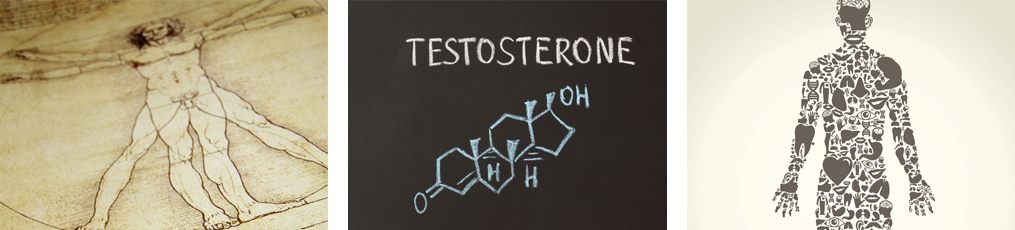
Testosterone is the primary male sex hormone and plays a central role in the development of male reproductive tissues such as the testes and prostate as well as of secondary sexual characteristics including increased muscle and bone mass and growth of body hair. Low testosterone levels, and more importantly activity, are the central cause of the male menopause.
Can I be suffering from the male menopause even if my testosterone level seems to be normal?
Yes. Put simply, this is because it is the availability and activity of testosterone that counts more than just its total level. There are many factors that can prevent the testosterone in your blood from being used effectively by your body.
Of the testosterone circulating in the blood 40-50% is weakly bound to a type of globular protein called albumin and another 50-60% is strongly bound to SHBG (sex hormone-binding globulin). Only 1-3% of the hormone is free testosterone. As men age, SHBG levels rise and free testosterone levels fall. This, combined with other factors, can lead to men suffering from symptoms of the male menopause.Schedule a call with an expert
How do our doctors diagnose the male menopause?
Here at the Centre for Men’s Health, any diagnosis of the male menopause is based on a very thorough review of your health and symptoms by one of our team of experts.
The first step is to ask you to take a blood test before your first visit. The doctor will then undertake a detailed review of your testosterone levels and connected hormone measures. He will also look at wider health measures such as prostate inflammation, liver and kidney function, red and white blood cell count and blood fat.
Then, at your appointment in one of our two UK clinics (London or Manchester), the doctor will review your male menopause symptoms, your medical history and will also conduct a physical examination. We also discuss the results of your blood test with you. We can then talk over the findings and put together a plan with you for treatment options for any health problems we find.Chat now for helpBOOK A CALL WITH AN EXPERT
What treatment options are available for the male menopause?
Testosterone replacement therapy at the Centre’s two UK clinics comes in many forms. TRT is usually given as a gel or injection for the first two to six months. It is often needed long-term and can safely be continued in these forms if good relief of male menopause symptoms is maintained or changed to other types if needed.
Is treatment for the male menopause safe?
Testosterone treatment has been in use for over half a century and has a remarkably good safety record over that time, as confirmed by the detailed studies at this centre. However, every effort is made to exclude pre-existing prostatic cancer, by clinical examination, and a sensitive blood test to measure levels of Prostate-Specific Antigen (PSA).
To ensure the safety and effectiveness of treatment of the male menopause/testosterone deficiency, it is essential that the results are carefully monitored. Both to establish the diagnosis and to monitor the treatment and relief from symptoms carefully, blood tests and laboratory measurements are required at regular intervals. Following the initial consultation and diagnosis, detailed clinical examinations need to be carried out at 3-6 month intervals.
Will my male menopause treatment relieve my symptoms?
While it may take time for the treatment to become fully effective, patients report often dramatic relief from their male menopause symptoms, with benefits including improved energy levels, and restored vitality and sex life. Often the particular physical symptoms that are the hallmark of the male menopause like hot flushes, mood swings, irritability and poor erections are dramatically lessened by TRT treatment. To find out more about how our patients saw their symptoms improve after they started treatment, see Dan’s story and Ian’s story.
Can I get treatment for the male menopause on the NHS?
You can get TRT on the NHS, but only on a restricted basis. Eligibility for male menopause NHS treatment is mainly determined using a relatively low and inflexible blood level cut off for total testosterone. Men whose blood results fall above this, even if they have all the typical andropause symptoms, are unlikely to be given treatment. This means that many men who could benefit from TRT, based on a more detailed review of their testosterone levels and symptoms, are potentially missing out.
Want to find out more about the male menopause and TRT? The Centre for Men’s Health’s founder, Professor Malcolm Carruthers, pioneered TRT in the UK. He published several books explaining TRT and why many men can benefit from it.
References:
‘Male menopause’ is real and treatable, say pharmacy researchers, University of Alberta, Canada, 2022
Diagnosing Low T: it’s not just a simple blood test
Worried about whether you might be suffering from Low Testosterone? You just need to do a simple blood test to measure your testosterone level, don’t you? Well, no, it’s really much more complex. In a series of extracts from his recent book, Testosterone Resistance, Centre for Men’s Health founder, Professor Malcolm Carruthers explains some of […]More
16 signs and symptoms of low testosterone
Low testosterone, low T, male menopause, andropause, late onset hypogonadism and testosterone deficiency syndrome are just some of the names given to the condition that can wreck many men’s health and love lives. There are a range of low testosterone symptoms and signs, some of them serious. So what is low testosterone, what causes it […]More
What are normal male testosterone levels?
If you’re wondering whether you may have low testosterone or not, your first question is almost certainly going to be: what are normal testosterone levels? The answer is not as simple as you might think. What is testosterone? To start with the basics, testosterone is the hormone or ‘chemical messenger’ responsible for normal sexual development […]More
Questions men ask us
Do men go through menopause?Do men’s hormones change with age?What treatment can you take for male menopause?What happens if a man takes menopause pills?At what age does andropause start?How can andropause be prevented?What are the symptoms of andropause?Does the male menopause really exist?How long does the andropause last?How do men treat the menopause?
The information on this site is provided for information only and is not meant to substitute the advice of your own physician or other medical professional.
null
Hi👋 Our real human operators are available to chat, so if you have any questions or need help, just ask!}
Regarding “tap pay” in Dayton, Ohio and Charlotte, North Carolina:
Dayton, Ohio:
Public Transit: The Greater Dayton RTA uses a contactless payment system named Tapp Pay.
How it Works: Tapp Pay can be used through the Transit app on a smartphone or with a physical Tapp Pay smartcard.
Fare Capping: Tapp Pay automatically caps fares to the daily or monthly maximum rate.
Adding Funds: Funds can be added to a Tapp Pay account or smartcard at payment kiosks in RTA transit centers. Debit/credit cards and cash can be used at Wright Stop Plaza. Cash can also be used at retail locations, such as CVS, Walgreens, Dollar General, and Speedway.
Mobile Payment: Tapp Pay mobile requires the Transit app and an internet connection.
Cashless Transition: The RTA planned to exclusively use Tapp Pay for onboard payments, beginning November 1, 2021.
Business Adoption: General contactless payment options are becoming more common in Dayton. Many businesses updated systems to accept EMV chip cards and potentially contactless payments during the 2015 liability shift. Businesses, such as Dorothy Lane Market, have upgraded to accept contactless payments like Apple Pay and Google Wallet.
Charlotte, North Carolina:
Charlotte Area Transit System (CATS): Contact information is available for CATS in Charlotte, but specific tap-to-pay options are not detailed.
General Contactless Payment: Contactless payments are becoming more popular in the U.S..
Mobile Payments: Digital wallets are increasing in Charlotte.
Tap to Pay on iPhone: Some businesses in Charlotte can accept contactless payments directly on their iPhones using platforms like Stripe.
Business Adoption: A 2022 survey showed that 67% of retailers offered contactless payment options, which is a significant increase from 2019.
Challenges: The growth of contactless payments faces challenges such as compatibility issues with older systems and the need for standardized software updates.
Summary:
Dayton, Ohio has a well-established contactless payment system called Tapp Pay for public transportation.
Charlotte, North Carolina is experiencing growth in contactless payment adoption for general retail and potentially for specific businesses.
For the most current and specific tap-to-pay information in Charlotte, including CATS details, the official CATS website or direct contact is recommended.
RTA moves to cashless on-board payment system with Tapp Pay
Aug 13, 2021 — Customers can use Tapp Pay on either a smartphone by downloading Transit app in the Google Play or App store, or via a Tapp Pay card. Tapp Pay cards can be obta…
Dayton RTA
The Way to Pay – Charlotte Area Transit System
Phone: 704.336.7433. Lost and Found: Phone: 704.336.3159.
City of Charlotte (.gov)
Where to Add Funds – Greater Dayton RTA
You can get a Tapp Pay smartcard or add funds onto your Tapp Pay smartcard or smartphone using payment kiosks. Payment kiosks are located at every RTA transit c…
Dayton RTA
How to accept payments on your phone – Stripe
Aug 10, 2023 — To learn more about Tap to Pay on iPhone with Stripe, go here.
Stripe
How the digital payment revolution can drive efficiencies in North Carolina
Dec 1, 2024 — Consumers. Digital wallets are becoming more popular each year. A global payments report found that 30% of all POS transactions in 2023 were made with digital w…
The Business Journals
Dayton RTA Launches Cash Payment Option for Mobile Tickets and Installs Justride Validation Units On Buses with Partner Masabi – Masabi
Dec 16, 2020 — The Dayton RTA has a new contactless payment system called Tapp Pay. Tapp Pay is available through the Transit app, which is available on Google Play and the Ap…
Masabi
Contactless Payments Can Boost Retail Industry – Dayton Chamber
How Do Merchants Start Accepting Contactless Payments? If you accept EMV chip cards, then you can most likely accept contactless payments as well. Millions of t…
Contactless payments have been around for decades, but they’re gaining popularity rapidly. Here are some statistics on contactless payments: * 25% of consumers …
CityCheers Media
Fares – Greater Dayton RTA
Either with your smartphone or a smartcard. Smartcards are available at any RTA Transit Center. To access via smartphone, download the Transit app. With Tapp Pa…
Dayton RTA
Contactless Payments Statistics By 2025: Quick Secure Technology
Jan 14, 2025 — Consumer Behavior and Contactless Payments * Certainly, contactless payments have been on an upward trajectory in terms of popularity among consumers in recent …
Market.us Scoop
Contactless Payment Market is Set to Attain Valuation of US$ 196.18 …
Feb 10, 2025 — * Legacy system incompatibilities complicate modern contactless payment system integrations significantly. * Fragmented software updates and middleware delays h…
FinTech Futures
Tapp Pay Terms & Conditions – Greater Dayton RTA
The Transit App is free (subject to change), but data charges may be incurred to each Participant by the Participant’s cell phone network provider. Tapp Pay req…
Dayton RTA
Cash, credit card use slowing disappearing as digital wallets grow
Nov 8, 2014 — Last year, Dorothy Lane Market upgraded the checkout systems at its three area stores with NFC capability, said Marcus Levin, the local independent grocery chai…
Dayton Daily News
Ultra-reliable mobile payment processing | North
When it comes to accepting payments wherever and whenever, it doesn’t get any easier than this. * Payanywhere 3-in-1 Bluetooth® Credit Card Reader. Transform yo…
north.com
The Rise of Contactless Payments – A Retail Revolution!
Mar 10, 2023 — Continued growth and increased adoption It ( Contactless Payments ) is expected that contactless payments in retail industry will continue to grow in popularity…
You’ll see a bar at the bottom of your screen with the RTA logo. Tap “Buy” and then “Pay with your mobile phone” to add money to your Tapp Pay account.
1. By Mail: Send a check or money order, payable to the City of Charlotte to the Charlotte Transportation Center, Information Center, 310 East Trade Street, …
The cheapest way to get from Charlotte to Dayton costs only $101, and the quickest way takes just 4½ hours. Find the travel option that best suits you.
4:54Learn how to use Tapp Pay– RTA’s new mobile ticketing option available through the Transit app. Download it today and start saving money on your bus fare!
We offer professional medical services in Dayton, OH related to the following: acne, alopecia areata, athletes foot, brown spots, cellulitis, chemical peels, …