The-Stellar-Way-Link-06-Spiritual-Discernment.pdf https://share.google/fcIAAzfgLppZ1qjSP
Bible-Study-Lesson-05_05_21-Spiritual-Discernment.pdf
Bible-Study-Lesson-05_05_21-Spiritual-Discernment.pdf https://share.google/16j3KF5ulNht2obuR
12 Types of Anger


Join our Newsletter
Get helpful tips and the latest information


Find a therapist (enter your state)

Anger TherapyTypes of AngerOnline Anger Management
12 Types of Anger

Author: Renee Skedel, LPC


Medical Reviewer: Rajy Abulhosn, MD
Published: February 8, 2025

Table of Contents
Anger is a natural emotion, but its intensity, triggers, and expressions vary widely. Research shows that anger can be divided into 12 distinct types, each with its own causes, behaviors, and management strategies.1 Identifying which type of anger you’re experiencing is crucial for improving your response to it and managing its impact on your life and relationships.ADVERTISEMENT
A Therapist Can Help You Control Your Anger.
BetterHelp has over 30,000 licensed therapists who provide convenient and affordable online therapy. BetterHelp starts at $65 per week and is FSA/HSA eligible by most providers. Take a free online assessment and get matched with the right therapist for you.Free Assessment
Why Recognizing the Types of Anger Matters
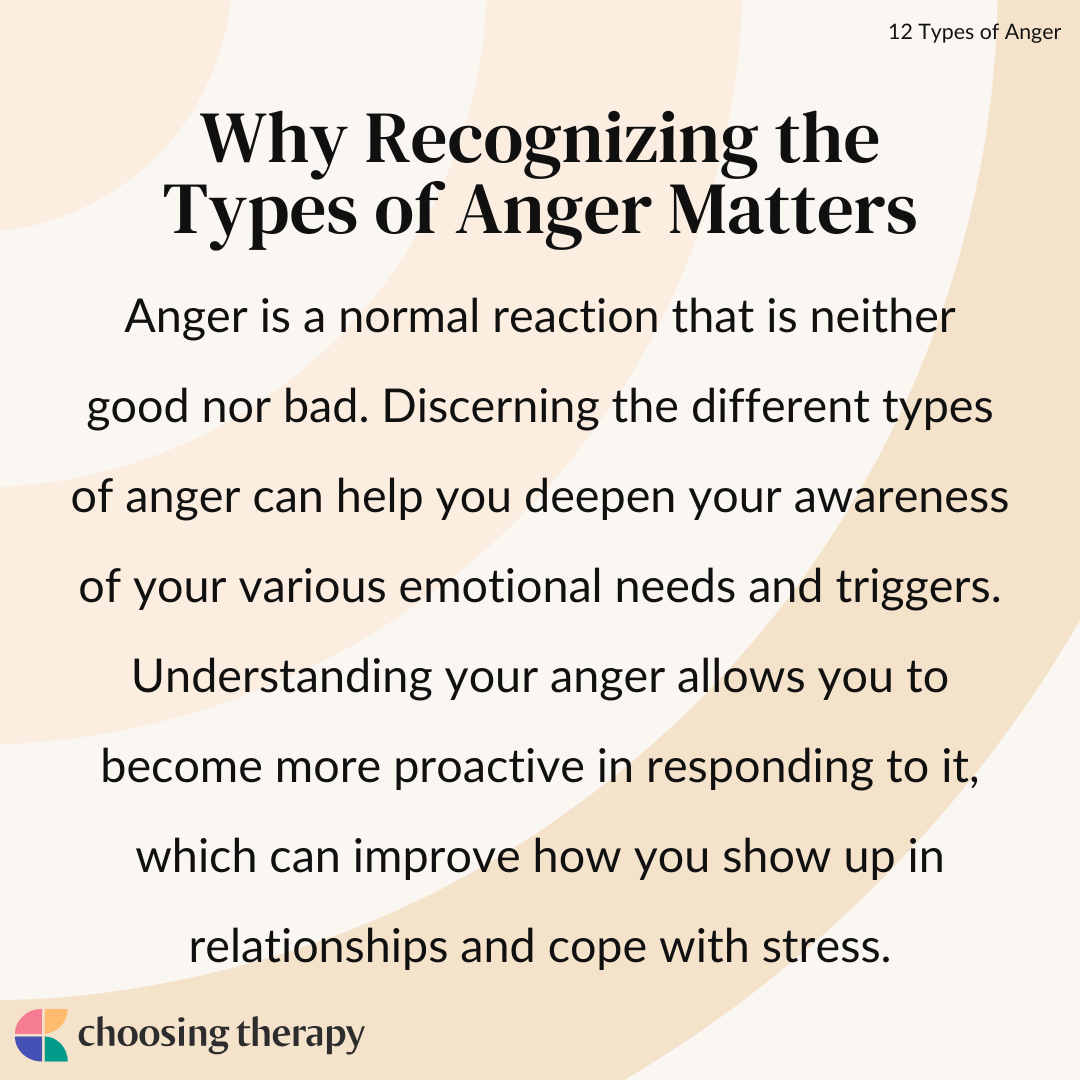
Anger is a normal reaction that is neither good nor bad. Discerning the different types of anger can help you deepen your awareness of your various emotional needs and triggers. Understanding your anger allows you to become more proactive in responding to it, which can improve how you show up in relationships and cope with stress.
12 Types of Anger & How to Manage Them
Because anger can display in different ways depending on the individual and situation, and because anger is a secondary emotion which makes it complex, it is often broken down into specific categories. Common examples include assertive, chronic, and overwhelmed anger, among others. While anger can be challenging to manage, learning how to identify which type you are experiencing can be helpful when working to control your anger.
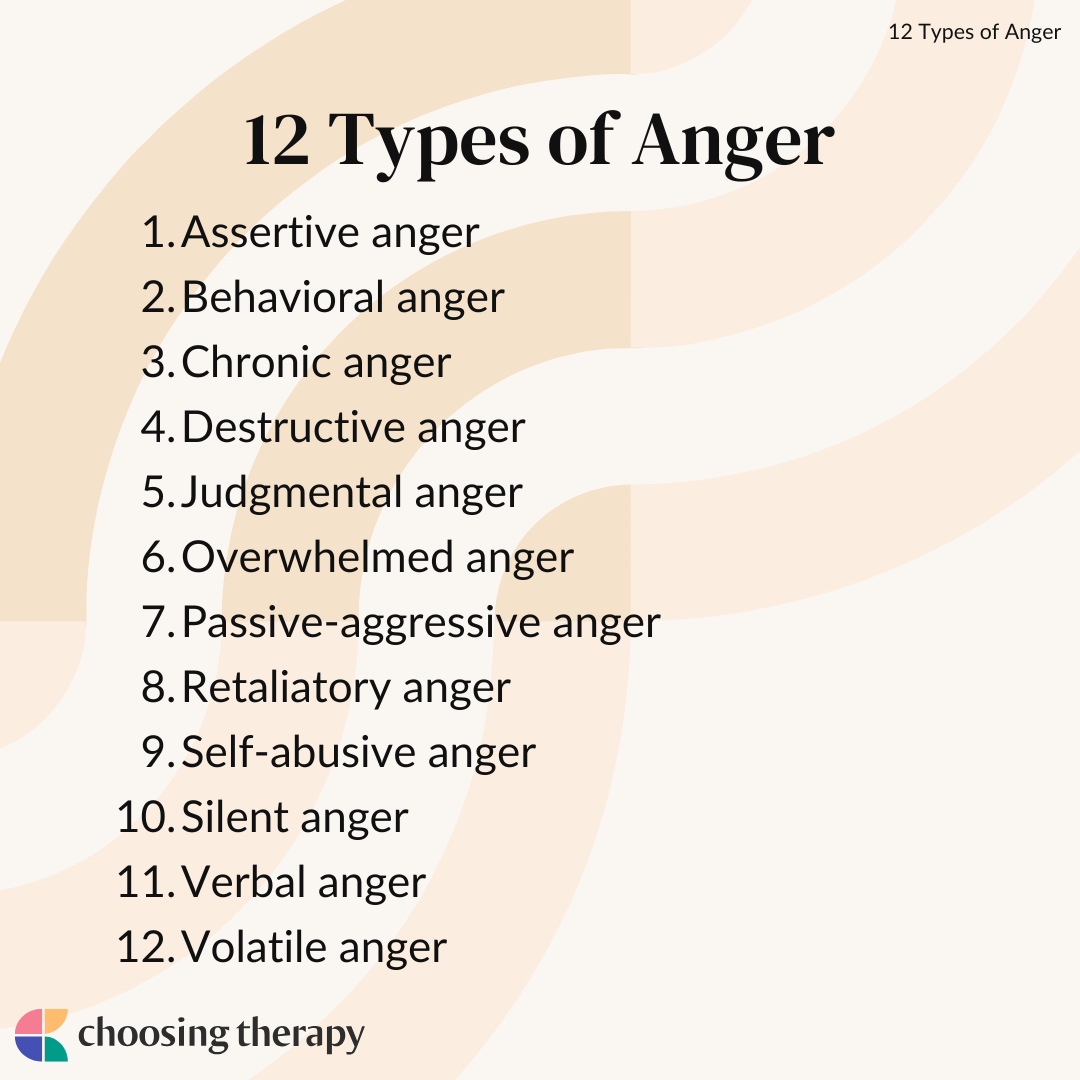
Here are 12 types of anger issues and tips for managing each type:
1. Assertive Anger
Assertive anger is considered a constructive form of anger expression. Rather than avoiding a conversation or being prone to outbursts of screaming or yelling, assertive anger is used as a healthy and productive expression of frustration to make positive change. This can look like expressing how you feel in a positive, safe way.
For example, you might start a statement with, “I feel angry when…” or, “I think…”. Assertive anger is combined with appropriate body language and, sometimes, pre-set expectations about methods to resolve or process the situation. This gives you the chance to express your anger in a way that enables positive change.1, 2, 3, 4, 6
Tips for Managing Assertive Anger
Practice assertiveness in safe situations. If you don’t feel regulated enough to speak in a friendly, collaborative tone, give yourself enough time to calm down. It’s generally better to wait than speak prematurely. Allow yourself to really feel your anger and recognize the unmet needs coexisting beneath it. Triggers aren’t always obvious, so reflecting inward can help you understand what your anger is really about.
2. Behavioral Anger
Behavioral anger is a physical reaction and is common in men with anger issues. This can be dangerous as it may be expressed through violence, potentially slipping into destructive or displaced anger. Behavioral anger is impulsive and unpredictable, sometimes ending with unhealthy legal or interpersonal consequences.
Behavioral anger can present as intimidating behaviors (e.g., cornering someone or raising your voice), throwing or shoving things, breaking things, or attacking someone. It’s important to identify whether your anger is slipping into this area due to potential legal or interpersonal consequences.1, 2, 3, 4, 6
Tips for Managing Behavioral Anger
Be honest with yourself about your behavioral anger tendencies. Spend some time identifying how and when this type of anger shows up for you. Think about other ways you can cope if you feel yourself getting escalated. Grounding yourself is key- you need to practice consistent emotional regulation to tame impulsive desires. The more you can do this, the easier it feels to manage this type of anger.
3. Chronic Anger
Chronic anger is typically directed towards other people, situations, and even yourself, which can impact self-esteem. Sometimes, it can fly under the radar while simultaneously causing a lot of damage. Chronic anger often looks like a continuous, low-level feeling of anger, resentment, irritability, and frustration. Because of how you experience anger, you may have difficulty processing and expressing your needs, which can impact your health, stress levels, and relationships.1, 2, 4, 6
Tips for Managing Chronic Anger
Many people aren’t even aware they’re holding chronic anger. That’s because it can appear like sadness or low self-esteem. However, note the resentments you may have toward yourself or others. What messages do they tell you? What would it be like to let go of those resentments? What benefit do you have in holding onto them? Answering these questions can help you start the initial work of unpacking your anger.
4. Destructive Anger
Destructive anger is a significantly unhealthy experience of anger that can have multiple negative impacts. While there is limited research on this type of anger, it’s often seen in connection with the extreme end of behavioral anger. This may include extreme irritability or hatred of others, even when it isn’t warranted.
Destructive anger can look like verbal or physical actions used to hurt others such as throwing and breaking something that is important to the person you’re angry with. In relationships, this can sometimes present as stonewalling or shutting out your significant other emotionally. Destructive anger can impact many areas of your life in extremely unhealthy ways, potentially destroying important social connections.5
Tips for Managing Destructive Anger
Destructive anger can unquestionably hurt you and your loved ones. Managing this type of anger may require professional support and more concentrated interventions. But if you’re just starting out, pay attention to your earliest warning signs. You need to know your destructive anger triggers, and you must identify other ways to manage stress. Try to focus on mitigating stress in the ways that you can- even small steps can make a big difference.
5. Judgmental Anger
Judgmental anger is often a reaction to some perceived slight, someone else’s flaws (if you feel they impact you), or an injustice against you or someone else. Judgmental anger is identified in people’s core beliefs and basic perspective or understanding of the world. This core belief is generally one of feeling like you’re better or worse than others, leading you to judge them and become angry about their actions or expressions.
Judgmental anger often manifests as “justified fury,” where anger arises from a perceived injustice or personal slight. It may involve criticizing others, making disparaging remarks, or venting frustrations about unfair situations. Over time, this pattern can strain relationships, hinder emotional support systems, and contribute to feelings of isolation and diminished self-worth.1, 2, 4, 6
Tips for Managing Judgmental Anger
Try to consider how judgment is a form of self-protection. Often, we judge what we don’t understand. Sometimes we judge because we dislike something in someone else that represents something we either lack or want. Instead of trying to change your judgment, try to lean into compassion. What good can you find in that other person? What may have led them to act in the ways they do now?
6. Overwhelmed Anger
Overwhelmed anger is unpredictable and can impact your mental health over time. This type of anger builds up, especially when you don’t find ways to express or communicate how you feel. It may show itself when things hit a “boiling point,” or your ability to cope with anger and stress has been overwhelmed due to certain situations, feelings, or interactions.
Overwhelmed anger can look like a sudden snap of irritability and resentment following a long stretch of repression. While the expression of overwhelmed anger appears different for everyone, it will come on suddenly and may be preceded by a stressful event.1, 2, 4, 6
Tips for Managing Overwhelmed Anger
Managing overwhelmed anger often requires earlier intervention. You need to recognize what’s happening inside of you before reaching your threshold. Early warning signs come in many forms, but they may include fatigue, irritability, disconnect, and passive-aggression. Pay attention to these shifts and try to dial in on more self-care. This can help prevent your anger from “spilling over.”
Help for Anger Management
Talk Therapy
A therapist can help you control your anger. BetterHelp has over 30,000 licensed therapists who provide convenient and affordable online therapy. BetterHelp starts at $65 per week and is FSA/HSA eligible by most providers. Take a free online assessment and get matched with the right therapist for you.
Help With Relationship Repair
Affordable Online Relationship Support – OurRelationship has been proven to help couples improve communication, intimacy, and trust. 94% would recommend it to a friend. Get Started
7. Passive-Aggressive Anger
Passive-aggressive anger is an avoidant form of expression. This kind of anger occurs when you suppress how you feel and attempt to avoid all types of conflicts. This can be dangerous, as your self-esteem levels are often impacted by anger. As such, passive-aggressive anger can have a negative influence on your relationships.
Passive-aggressive anger, which can be verbal or physical, includes emotional repression and avoidance of conflict. This may present as passive-aggressive comments (e.g., “I like your outfit, even though it doesn’t fit you”), sarcasm, or an intentional lack of response. Passive aggression is most common in the verbal form, but it can also look like closed-off body language or continuous procrastinating at work.1, 2, 3, 4, 6
Tips for Managing Passive-Aggressive Anger
Recognize the unmet needs existing underneath your passive-aggression. What are you really trying to convey? What fears do you have about actually being honest with your needs? Passive-aggression tends to be rooted in attachment insecurity, so trying to strengthen vulnerability with yourself and others can help you manage this type of anger.
If you do get passive-aggressive, try to stop the cycle as soon as you recognize it and repair it immediately.
8. Retaliatory Anger
Retaliatory anger is a common reaction and an instinctive response to being attacked. It can be influenced by a need for revenge after experiencing perceived hurt. This kind of anger is usually deliberately aimed at someone who hurt you and can be influenced by a need to gain control over an event. You may find yourself targeting your anger at specific people after feeling verbally or physically attacked. Retaliatory anger can potentially increase discomfort and anger levels in relationships.1, 2
Tips for Managing Retaliatory Anger
Identify what you’re hoping to achieve by retaliating against someone else. Really play this desire out in your mind. Note any satisfaction or discomfort that may arise. It’s sometimes helpful to really distinguish why you want to attack, and it can also be valuable to normalize that fantasy. This type of mindfulness also allows you to recognize the risks associated with doing so, and that can lead to behavioral changes.
9. Self-Abusive Anger
Self-abusive anger tends to be connected with shame. This type of anger is seen in people experiencing low self-esteem or feelings of worthlessness and hopelessness. Self-abusive anger is commonly used to help cope with these feelings, even though it only pushes people further away.
Self-abusive anger can affect you internally and externally. It can look like internalizing negative feelings and taking them out on yourself through self-harming behavior, alcohol or drug use, unhealthy and disordered eating, or negative self-talk (e.g., “You are a failure.”). On an external level, this may include lashing out or attacking others verbally.1, 2
Tips for Managing Self-Abusive Anger
The opposite of self-abuse is self-compassion. Self-compassion refers to treating yourself with kindness and love, the way you might treat a friend you really care about. The next time you feel critical toward yourself, pause. Ask yourself, What would I tell a friend experiencing something like this right now? How would I try to help them feel better?
10. Silent Anger
Silent anger is a non-verbal, internal way of experiencing anger. Although you may not verbally express it, it is possible for others to read that you are angry. People who experience silent anger tend to keep these feelings inside and allow them to build up, which can lead to increased stress, tension, and behavior related to overwhelmed anger.
Silent anger can be an internal or external experience. Internally, this type of anger can create a build-up of uncommunicated frustration, anger, and resentment, causing undue stress and low levels of ongoing tension. Externally, it can present as closed-off body language and facial expression and restricted or minimal speech and tone.7
Tips for Managing Silent Anger
Silent anger is not inherently wrong, and it may be necessary for allowing yourself to process certain emotions safely. But there are risks associated with shutting others out. If you resonate with silent anger, it may be helpful to practice simply expressing yourself with one safe person. If that feels too challenging, consider just writing your feelings out. This allows you to process what’s inside you.
11. Verbal Anger
Verbal anger is an aggressive type of anger that can become abusive. Those who experience this type of anger are noted to feel remorseful after lashing out at the target of their anger and may even apologize after an episode. Verbal anger can present as lashing out or “going off” on someone verbally. Specific behaviors can include loud shouting, threatening behaviors, sarcastic comments, continuous and intense criticism, and ridicule. Keep in mind that verbal anger can transition into verbal abuse and also keep you from being able to maintain stable, healthy relationships.1, 2, 3, 4, 6
Tips for Managing Verbal Anger
It’s important to create clear boundaries for how you want to convey your anger. It’s not okay to criticize other people or shout at them. If you struggle with these patterns, identify all the reasons why you want to change. Write them down so they’re easily accessible, especially during heightened moments. Then, get in the habit of pausing when you feel that verbal anger coming on. Take a break, regroup, and then allow yourself to reconvene when you feel more regulated.
12. Volatile Anger
Volatile anger is an explosive type of anger that is sometimes called “sudden anger.” It can happen when someone experiences an annoyance, big or small, and explodes verbally or physically, potentially becoming destructive. This type of anger makes it difficult for the individual to express themselves, process, and communicate.
Volatile anger can look like a rapid progression from status quo to outrage over real or perceived slights. It is frequently destructive and can include shouting, yelling, throwing things, and physical aggression. This type of anger may keep you from being able to maintain stable and trustworthy relationships.1, 2, 4, 6
Tips for Managing Volatile Anger
Volatile anger is tricky because it often feels so sudden and intense. However, if you struggle with this, it just means you need more practice with emotional regulation. Get in the habit of regularly identifying your various emotions. Note what evokes anger within you. Pay attention to how it feels in your body before you react to it. Building this awareness offers you a greater capacity to change your habits.
Free Anger Management Worksheets
This collection of worksheets provides practical tools and strategies for managing your anger. Find the one you need below, or browse our full collection of anger management worksheets.
Complete WorkbookDownload
Nervous System RegulationDownload
Identifying Anger TriggersDownload
Exploring Hidden EmotionsDownload
Challenging Unhelpful ThinkingDownload
Setting Healthy BoundariesDownload
STOP Before RespondingDownload
Practicing GratitudeDownload
How Therapy Can Help Reduce Anger Issues
To process what is fueling or influencing your anger, it can help to engage with a therapist. By seeing a therapist or attending counseling, you can learn ways to process, communicate, and cope. Self-help techniques and coping mechanisms can also help when it comes to anger management. By combining therapy for anger and self-help techniques, you can begin to treat your anger and learn constructive ways to express it. Consider starting your search for the right therapist on an online therapist directory or by using one of the many online therapy platforms available for virtual therapy services.
Is Your Anger Driving Away the People You Care About?
Therapy can help. BetterHelp has over 30,000 licensed therapists who provide convenient and affordable online therapy. BetterHelp starts at $65 per week and is FSA/HSA eligible by most providers. Take a free online assessment and get matched with the right therapist for you.Free Assessment
In My Experience
“If you are struggling with your anger, you’re not alone. It can be difficult to explore and express your emotions, especially if you have experienced abuse or trauma in the past. Help does exist though. Don’t be afraid to reach out to a therapist.”
Types of Anger Infographics
Sources Update History
ChoosingTherapy.com strives to provide our readers with mental health content that is accurate and actionable. We have high standards for what can be cited within our articles. Acceptable sources include government agencies, universities and colleges, scholarly journals, industry and professional associations, and other high-integrity sources of mental health journalism. Learn more by reviewing our full editorial policy.
- Andrews, M. (2020). 10 Types of Anger: What’s Your Anger Style? Retrieved from https://lifesupportscounselling.com.au/blog/types-of-anger-styles-of-anger/
- Modern Therapy. (2021). 10 Types of Anger. Retrieved from https://moderntherapy.online/blog-2/2019/3/31/types-of-anger
- CREducation.org. (n.d.). Anger: A Secondary Emotion. Managing Anger. Retrieved from https://creducation.net/resources/anger_management/anger__a_secondary_emotion.html
- Gagnon, D. (2021). Do You Recognize the 10 Types of Anger? Retrieved from https://www.montrealcbtpsychologist.com/blog/122622-do-you-recognize-the-10-types-of-anger
- Meloy, K. (2014). Constructive vs. Destructive Anger: A Model and Three Pathways for the Expression of Anger (Thesis). Brigham Young University. https://scholarsarchive.byu.edu/cgi/viewcontent.cgi?article=5074&context=etd
- Calm Sage. (2021). 7 Types of Anger We All Experience And Their Impact On Our Wellness. Retrieved from https://www.calmsage.com/types-of-anger-and-their-impact/amp/
- Defoore, W. (n.d.). Silent Rage And What To Do About It. Retrieved from https://www.angermanagementresource.com/silent-rage.html
Show more
Your Voice Matters
Can’t find what you’re looking for?
Request an article! Tell ChoosingTherapy.com’s editorial team what questions you have about mental health, emotional wellness, relationships, and parenting. Our licensed therapists are just waiting to cover new topics you care about!
Leave your feedback for our editors.
Share your feedback on this article with our editors. If there’s something we missed or something we could improve on, we’d love to hear it.
Our writers and editors love compliments, too. 🙂
Additional Resources
To help our readers take the next step in their mental health journey, ChoosingTherapy.com has partnered with leaders in mental health and wellness. ChoosingTherapy.com is compensated for marketing by the companies included below.
Talk Therapy
Online-Therapy.com – Get support and guidance from a licensed therapist. Online-Therapy.com provides 45 minute weekly video sessions and unlimited text messaging with your therapist for only $64/week. Get Started
Learn Self Calming Techniques
Mindfulness.com – Change your life by practicing mindfulness. In a few minutes a day, you can start developing mindfulness and meditation skills. Free Trial
Mental Health Newsletter
A free newsletter from the experts at ChoosingTherapy.com for those interested in mental health issues and fighting the stigma. Get helpful tips and the latest information. Sign Up
ChoosingTherapy.com Directory
Find local therapists that offer online and in-person therapy. Search for therapists by specialty, experience, insurance, and location. Find a therapist near you.SPONSORED
A few questions from Talkiatry can help you understand your symptoms and give you a recommendation for what to do next.
There are a number of factors to consider when trying to determine which online therapy platform is going to be the best fit for you. It’s important to be mindful of what each platform costs, the services they provide you with, their providers’ training and level of expertise, and several other important criteria.
A free newsletter for those impacted by mental health issues. Get helpful tips and the latest information.Submit
Find a therapist in your state
Get the help you need from a therapist near youCity or zipSearch
Alabama
Arizona
California
Colorado
Connecticut
District of Columbia
Florida
Georgia
Illinois
Indiana
Maryland
Massachusetts
New York
North Carolina
Ohio
Pennsylvania
Texas
Virginia
Are you a Therapist?Get Listed Today
FOR IMMEDIATE HELP CALL:
Medical Emergency: 911
Suicide Hotline: 988
© 2025 Choosing Therapy, Inc. All rights reserved.
Anger-Workbook-1.pdf
Anger-Workbook-1.pdf https://share.google/Agm6VeJnZlLFDl5f4
Anger-Management-Workbook.pdf
Anger-Management-Workbook.pdf https://share.google/TLx2GNrbKHMTqfx5a
anger_moodjuice_self-help_guide.pdf
anger_moodjuice_self-help_guide.pdf https://share.google/yFjDOoyGzKCvjf31D
anger_management_workbook_508_compliant.pdf
anger_management_workbook_508_compliant.pdf https://share.google/2hPMT2yH2SBrgm7Qh
anzaldua_from-borderlands.pdf
anzaldua_from-borderlands.pdf https://share.google/ZB9MwU75EwoT8mV6w
truths_about_my_tongue_-_4_lessons[98].pdf
truths_about_my_tongue_-_4_lessons[98].pdf https://share.google/UmWUAZlgk8synNOtt
Taming the tongue with wisdom from above
Free Guide! Open When You Feel Lonely!>>Close Top Banner
Menu
Made for Connection
How to Tame the Tongue with Wisdom from Above


But the wisdom from above is first pure, then peace-loving, gentle, compliant, full of mercy and good fruits, unwavering, without pretense.
James 3:17
I’m not a list person. I know some of you love lists and enjoy marking off items throughout your day, never resting until it’s done. I’m not like that. I love reading lists and making lists, but I rarely mark off everything. I’m not very good at completing a list so whenever I make one, I feel a little dejected before I even begin.
I’ve heard many times that we shouldn’t turn our faith into a checklist kind of faith. For me, that’s great! But if you love a good list, it can be disappointing as you ask yourself, “How do I know if I’m good enough if I can’t check off my list?”
Wisdom from Above in a List
The Godly life isn’t about checking items off a list, but about heart transformation. Yet the Bible has lists in it. One of those lists is in Galatians 5, the fruit of the Spirit. And another list is in James 3, describing characteristics of wisdom from above.
My faith has transformed as I have learned to use the fruit of the Spirit as a guide for my words and behavior, teaching me when to speak and when not to speak. Is it loving, joyful, peaceful? Then speak it out loud. If it’s not one of nine qualities listed, then I should consider if it’s worth saying. I don’t use it as a checklist to do each day, but as a guide for me to discern what is Spirit-like and what is flesh-like.
In James 3:17 we can read another list, the qualities that reveal Godly wisdom. This is also a guide we can use to discern what is wise behavior or words and what is not. It’s very similar to the fruit of the Spirit, with peace and gentleness making both lists.
Heart transformation doesn’t come with making lists and checking items off as we complete them, but change happens when we engage with Scripture—reading, studying, meditating, and praying.
How I Used a List without Making it a Checklist
I became a stay at home mom when my second child was born. That means I went from working a full-time job, conversing with intelligent adult humans all day to taking care of two babies all day everyday—my oldest was not yet two when little sister came along. I was exhausted, lonely, and very cranky.
During that time, the fruit of the Spirit song stuck in my head. During one angry walk up the stairs, those Spirit-like qualities rang through my head and it occurred to me that what I was about to say was not loving, joyful, peaceful, patient, kind or good. And definitely not self-controlled.
After that, those qualities became my gold standard, how I would measure my words either before, during, or after they were spoken. Even when I was angry, I needed self-control and love and gentleness, especially when parenting little ones.
I prayed for those qualities daily. And failed daily. But at least I knew in my heart what a parent guided by the Spirit looked like, and I knew what to ask for in my prayers. And when I failed, I asked for forgiveness and the wisdom and power to do better next time. The fruit of the Spirit is a list I will never complete.
Wisdom from Above List
The list in James 3 teaches us how to act and speak with the wisdom from above, a way that is the opposite of “earthly, unspiritual, demonic” (verse 16). Again, the list isn’t to be used as a checklist, but as a guide of what to pray for. If you’re struggling with attitudes that are not wise, pray daily over this list.
In the first chapter of James, he tells us that if we ask God for wisdom, He gives it to us. Ask God to show you where you fall short and to help you daily. Use this list to convict your heart and bring about change where change is needed.
Wisdom from Above Free Download
If you struggle with taming your tongue, knowing when to speak up or not to speak, and you want to ask God for help, I have created a short Bible study on James 3:16-18. It’s free to download and it is eight pages of Scripture and writing prompts. I hope this study gives you a way to engage with Scripture and a guide to asking for help.
The “Wisdom from Above” download will give you background info on the passage, a place to take notes, and a chart for comparing wisdom from above and earthly wisdom. You will also write down what each word in the list means and doesn’t mean. Then you will write about Jesus and how he was the embodiment of Godly wisdom. Lastly, there is a prayer worksheet to guide your prayers to God in this area.
I pray that this guide will help you speak wise words from above, words that are God-approved and helpful for encouraging others.
To receive your free download, add your name and email address below. Then you’ll be directed to a Dropbox link to download the printable.
[mo-optin-form id=8]
PIN THIS IMAGE TO SAVE AND SHARE

m.Send me the guide!
Share this:
YOU MAY ALSO LIKE…

Consider the Consequences of Your Silence

A Peaceful Playlist for You to Rest & Reflect

Spring Phone Wallpapers and a Playlist
Previous Post:« The World is Desperate for Kindness
Next Post:A Peaceful Playlist for You to Rest & Reflect »
Reader Interactions
Leave a Reply
Your email address will not be published. Required fields are marked *
Comment *
Email *
Website
Comments
Martha Brady saysSeptember 3, 2021 at 9:53 pmNatalie, I’m your next door neighbor at hopewriters. this is an interesting study on wisdom and taming the tongue. thanks a lot.
Natalie Hilton saysSeptember 4, 2021 at 6:38 amThanks for reading!
Primary Sidebar
Hello! I’m Natalie!

I want you to know that loneliness is not the end of your story. My words will encourage you to embrace love over fear, action over inaction, and pleasing God over pleasing people. We are all made for community, even those of us that love solitude! Follow me on Instagram for regular encouragement to make connections.
Get on the List! Be the first to receive new freebies and updates from Natalie Hilton!
Subscribe
Read Recent Posts
- Fresh Florals for Your Phone – 7 Free Downloads
- Avoid Paralysis
- How to Create Connection in Solitude
- Embrace Seasons of Solitude
- A New Year’s Blessing to Inspire Connection
Natalie Hilton | Encouragement for Christian WomenBest Christian EncouragementFollow On
Search this website
FOLLOW ME ON INSTAGRAM!







Copyright © 2025 · Glamour Theme by Restored 316
 Site Title