A House divided cannot stand.

URGENT: Get Through the Storms of Life – Free eBook

Bible Study Tools

PLUSToggle navigation

The Bible Toggle DropdownFind it!null

Jesus’ Powerful Warning: “A House Divided Cannot Stand”

Blair Parke| Editor for Xulon Press20214 Aug

two sets of shoes divided by red line

You might see the phrase adorning houses that have differing sports teams or political views: “A house divided.” Though it is mainly shown to be humorous about the conflicting opinions within the household, the origins of this phrase are very sound and biblical.

The words of Jesus are what sparked the sentiment. It is stated in Matthew 12:25: “Every kingdom divided against itself is brought to desolation, and every city or house divided against itself will not stand.” It is also expressed in Mark 3:25: “And if a house is divided against itself, that house cannot stand.”

While it is said in playful humor for certain situations nowadays, when Jesus stated these words, He was describing the division within the house of the Lord that would eventually lead to His sacrifice on the cross.

But what does it mean that “a house divided cannot stand”? In the eyes of Jesus, it is something we all can contribute to, knowingly or unknowingly, but we can also stop it before it is too late.

Photo credit: ©Getty Images/Vitezslav Vylicilnull

two sets of shoes divided by red line

The Context: Jesus Is Called Satan by the Pharisees

In the context of both verses in Matthew and Mark, the issues began as Jesus was developing His ministry and performing miracles while spreading God’s truth throughout the land. Matthew describes Jesus’s healing of a demon-possessed, blind, and mute man, while Mark depicts the overwhelming crowds clamoring for Jesus to bring healing into their lives, which was not shared among His fellow brethren.

In both situations, the Pharisees witnessed the miraculous changes Jesus was bringing to the people, and believed that He was operating in the spirit of Beelzebub, another name to describe Satan. To them, this would explain how Jesus was able to cast out demons, because they were His own kind (Matt. 12:24, Mk. 3:22).

In response to these accusations, Jesus reflected on this concept by asking the question of how “Satan could cast out Satan?” (Matt. 12:26; Mk. 3:23). He goes on to explain in both passages that any kingdom divided against itself will be destroyed, and any house divided against itself cannot stand.

This notion is to convey that when a house (or a kingdom) is fighting against itself, it can’t prosper or overcome the battle. Any victories only lead to losses and nothing good can come from it.

Jesus goes on to say, going back to the Pharisees calling him Beelzebub/Satan, that “If Satan casts out Satan, he is divided against himself. How then will his kingdom stand?” (Matt. 12:26). Mark 3:26 makes this point as well, stating that if Satan were to rise up to himself, he wouldn’t stand, but would have an end instead.

Just as Jesus makes it a point that Satan wouldn’t prosper if he was against himself, He makes an even bigger point in seeing the house as the body of Christ dealing with the same self-inflicting wounds.

Photo credit: Pexels/Andrea Piacquadionullhttps://buy.tinypass.com/checkout/template/cacheableShow?aid=Zc94Zrydpu&templateId=OTL6FXNXQK9L&gaClientId=1754860177.1618669823&offerId=fakeOfferId&experienceId=EXVSSW54DJO4&iframeId=offer_6ba4738cdd78f6a3a14e-0&displayMode=inline&pianoIdUrl=https%3A%2F%2Fid.tinypass.com%2Fid%2F&widget=template

two sets of shoes divided by red line

What Does “a House Divided” Mean?

Though it would be clear that a house divided would fall apart structurally, Jesus was more specific when it comes to what represents “the house.”

As we read in Matthew and Mark, the Pharisees were against anything that didn’t follow the rules and regulations that they determined were to honor God the most (the same rules and regulations that helped them prosper the most as well).

But as Jesus describes in the verses from Matthew and Mark about a divided house, His perspective is pointed at the divided house within the body of believers of God. The Pharisees were going after their own house, meaning Jesus, because He didn’t follow the rules and regulations they established. He was disproving everything they stood for – the things which brought them fortune and others poverty. Jesus was flipping all of their expectations, and their hearts were hardened towards His message.

By condemning what He was doing (performing miracles, helping those deemed “unholy,” and healing on the Sabbath), the Pharisees hoped others would see the “believed wrong” Jesus was doing and continue following the Pharisee’s unrighteous, greedy plans.

Jesus even boldly proclaimed in Matthew 12:30 that “He who is not with Me is against Me, and he who does not gather with Me scatters abroad.” This is definitely a statement directed towards the Pharisees, that those who don’t believe in Jesus and what God had brought Him to earth to do would find it to their undoing. They will be scattered without Christ’s guidance.

Photo credit: Crosswalk.com/SWNnull

two sets of shoes divided by red line

Christians Must Be United, not Divided

The profound words of Jesus captured in the books of Matthew and Mark are words we should live by now, as we grapple with a tumultuous world and a body of believers that have had their fair share of in-fighting.

As we have seen in recent years, some of the biggest debates have circulated among Christians over various topics; a perfect example of what Jesus means by “a house divided.”

Why should Christians be unified? Well, the biggest reason is to remind a world in need of hope that the truest hope is found in Jesus and knowing He died on the cross so we could be saved from our sins and reunite with God again. This world will do all it can to destroy our hope for a better future, but Jesus reminds us that God has a better future for us on earth and in heaven.

However, if we are divided in our beliefs as the body of Christ, this shows the world and the unbelievers that it is better to be on your own than to believe in a God that allows such turmoil among His own people. God doesn’t allow it; we allow it when we don’t come together, rectify our differences, and unify to spread God’s love and hope to others.

If we feel we are dividing, we need to remember Jesus’s words that we won’t stand against life’s challenges or even unbelievers’ questions because our foundation of knowledge and truth won’t be firmly in the shared belief of God. We will be scattered abroad, as Jesus states in Matthew 12:30, instead of uniting together to speak God’s Word to those who need to hear it.

We need to re-examine what is dividing us and see if the reasons are for our own agendas, or because we are following a leadership different from that of God.

Our house can stand if we stop trying to justify our own rules and regulations pertaining to God and instead stick to the Bible as the only representation of God’s truth.

Photo credit: ©SparrowStock

two sets of shoes divided by red line

Follow God, and Stand Together

While this phrase is normally a comical jab at people living under the same roof who like opposing sports teams or have different viewpoints on matters, it is actually a sound, biblical truth that Jesus shared as a warning to all believers.

He stated that “a house divided against itself will not stand,” making the point to the Pharisees, who were set on disproving everything that Jesus did and actually were causing strife among the body of believers.

The same understanding applies to believers today, as we are divided as a body over several elements of the world today. But if we continue to be divided over issues instead of united in following God’s teachings, our house of faith, truth, and love will not stand against life’s storms.

Now is the time for us to come together to stabilize our house to not let division unsettle it. For if we stand with Jesus, God will always keep our house together and know that life’s promises are nothing compared to the promises of God.

Related articles
5 Biblical Ways to Love Those You Disagree With
5 Steps the Church Must Take for Post-Election Unity
15 Verses to Inspire Us to Pursue Unity

Photo credit: ©Getty Images/Twomeows_IS

Blair Parke is a freelance writer for BibleStudyTools.com and editor for Xulon Press. A graduate of Stetson University with a Bachelor’s in Communications, Blair previously worked as a writer/editor for several local magazines in the Central Florida area, including Celebration Independent and Lake Magazine in Leesburg, Florida and currently freelances for the Southwest Orlando Bulletin.

ShareSavenullnull

Popular Articles

What Type of Bible Should You Buy Next?

What Type of Bible Should You Buy Next?Emma Danzey

What Does the Bible Say about Respecting Our Elders?

What Does the Bible Say about Respecting Our Elders?Jessica Brodie

Jesus’ Powerful Warning: “A House Divided Cannot Stand”

Jesus’ Powerful Warning: “A House Divided Cannot Stand”Blair Parke

Why Must We Do 'Everything in Love'?

Why Must We Do “Everything in Love”?Pamela Palmer

Which of the 12 Disciples Do You Relate To?

Which of the 12 Disciples Do You Relate To?Emma Danzey

10 Easy Tips for Journaling through Scripture

10 Easy Tips for Journaling through ScriptureMicah Maddox


Featured Verse Topics


Thriven
Salem Web Network

Proud member of Salem Media Group.Copyright © 2021, Bible Study Tools. All rights reserved. Article Images Copyright © 2021 Getty Images unless otherwise indicated.California – Do Not Sell My Personal InformationCalifornia – CCPA Notice


Systemic Theology

Get Your Free Devotional From Tim Tebow

Bible Study Tools

PLUSToggle navigation

The Bible Toggle DropdownFind it!https://a0dd4c1b6ce2be730f7e106d6e8ab113.safeframe.googlesyndication.com/safeframe/1-0-38/html/container.html

What Is Systematic Theology and Why Do We Need It?

Lisa Loraine Baker| Contributing Writer202125 Jun

What Is Systematic Theology and Why Do We Need It?

Many Christian “ologies” exist: pneumatology, Christology, soteriology, ecclesiology, missiology, eschatology, hamartiology, bibliology, and others. Most notable is Theology-the study of God. Within Theology exist certain subsets which include but are not limited to: Biblical theology, exegetical theology, historical theology, and the umbrella under which all the others subsist, systematic theology.null

Systematic theology is best defined by Professor John Frame  (retired) and recorded for us by Dr. Wayne Grudem in his 1994 edition of Systematic Theology: “Systematic Theology is any study that answers the question, ’What does the whole Bible teach us today?’ about any given topic’” Systematic theology is comprised of the compilation and comprehension of all the pertinent passages in the Bible and then the encapsulation of them in a clear, teachable form so we have a firm foundation for our beliefs. Systematic theology interacts directly with Scripture and not with extant sources.

Systematic Theology differs from historical theology in that historical theology looks at how Christians of different periods of time have regarded Scripture. In addition, philosophical theology studies biblical topics largely without the use of the Bible. Instead, it uses logical reasoning and the observation of the universe and nature to know God.

What Is the History of Systematic Theology?

Most scholars agree systematic theology has existed since the earliest days of the church, although it did not get titled as such until the term originated with German theologian Bartholomäus Keckermann (1572–1609).

The Bereans practiced systematic theology when they examined the Scriptures daily to see if what Paul and Silas told them was so (Acts 17:10-12).

The early church fathers most probably were systematic theologians as they researched and answered questions about the Way. In Medieval times, John of Damascus (675-749 AD), a Greek Orthodox theologian, sought to develop instruction for the Church. He compiled four theological books, which, although cited as authoritative, did not receive approval by any church council.null

By the 17th century, the Westminster Confession of Faith became the most highly advanced version of systematic theology. To this day, it continues as an essential statement of faith by many Presbyterian churches.

The Enlightenment (late 17th and early 18th century) caused a falling away from the faith for many until the 1800s with the publication of Charles Hodge’s Systematic Theology (1872-1873). It remains in print and, next to Calvin’s Institutes, is the most referenced textbook (Reformed).

The most recent generations of Evangelicals are regarded as the most intellectual Christians, and systematic theologies are highly regarded (and used) by a good percentage. A quick survey of bookstores (brick & mortar and online Christian and secular) reveals numerous books on systematic theology and its subsets.

What Is the Difference between Biblical and Systematic Theology?

Systematic theology, as we have defined, makes use of the entire Bible to discover doctrines about biblical topics (The doctrines of the word of God, God, man, Christ, the Holy Spirit, the church, and each of the subsets within each topic). It looks at all passages that pertain to any given topic, whether in the Old Testament or in the New Testament.

Biblical theology falls under systematic theology in that it is part of it. Biblical theology organizes its topics according to the order they are found in the Bible. It includes both the Old and New Testaments, but it may do a search on the Holy Spirit with the proviso of asking what the Old Testament has to say about the Holy Spirit. The study expanded to the New Testament may ask, what does Paul have to say about the Holy Spirit? Unlike Systematic Theology, biblical theology is not all-encompassing (covering the entire Bible). It spotlights the teachings of individual authors within sections of Scripture and places the instruction within its historical context and the development thereof.null

A more complete list of theologies includes historical theology (how Christians of different eras have understood biblical topics), philosophical theology (theology studied largely without the use of the Bible, but instead looking at God through the lens of His creation), and apologetics (a defensive posture used to convince unbelievers of the biblical truths).

Why Is Systematic Theology Important for Us Today?

Systematic theology is like everyday rationalizations in that we rely on how the Bible speaks to us according to God’s character, His Word, and how He ordered history.

If I want to learn all I can about the doctrine of man (his creation, gender, sinful nature) and his relationship with God, I need to search throughout the whole of the Bible (this is where the Bible tools of a concordance, dictionary, lexicon, and indeed a Systematic Theology reference book are necessary). Another prodigious asset is a website such as the Blue Letter Bible, which includes cross-references, commentaries, topical indexes, and many other useful aids.

Why, though, should we study theology in a systematic way? Why is it important?

Obedience. The preeminent One (Colossians 1:18)—Jesus—gives a commission to all believers in Matthew 28:19-20. How are we to teach all He commanded if we have no knowledge of His commands (1 John 5:2)? His directives begin in the Old Testament (Genesis 2:24Colossians 1:16Deuteronomy 34:28) and continue through Revelation 1:1-3, 19; 22;18-19). As an illustration, the whole Bible is necessary for a complete assessment of a topic, we’ll look at a few things done by Jesus. He quoted the Old Testament both to refute the devil (Matthew 4:1-11) and to substantiate His authority (Luke 4:16-21John 4:25-26; 8:24; 18:6). The Gospels are replete with Jesus’ commands, and they are encapsulated and expanded in the books of Acts through Revelation. As Christians, to know His commands is to follow them in obedience.

To learn about God and love Him more. What better tutorial about our Creator than the one He Himself wrote (2 Peter 1:21). Our love for Him will grow as we read what He has done (John 3:161 John 4:19), is doing (John 14:3; 17:9, 20, 26), and will do for us (John 14:1-3).

To know why we believe. This is huge, and it encompasses an apologetic ministry along with evangelism. If we do not know the whys of our faith, we will falter when faced with the world’s trials and temptations.https://buy.tinypass.com/checkout/template/cacheableShow?aid=Zc94Zrydpu&templateId=OTL6FXNXQK9L&gaClientId=1754860177.1618669823&offerId=fakeOfferId&experienceId=EXVSSW54DJO4&iframeId=offer_6ba4738cdd78f6a3a14e-0&displayMode=inline&pianoIdUrl=https%3A%2F%2Fid.tinypass.com%2Fid%2F&widget=template

To understand our history. In the beginning (Genesis 1:1)…That’s where our history began. The Bible gives us the whole boundary of who we were, are, and will be (in glory).

To learn where we will go. The Bible, while not expansive in its communication about heaven, is definitive in that believers will be there with Jesus (John 14:1-3).

To follow the red thread through the Bible. The red thread is a reference to what the Bible has to say about our Lord and Savior, Jesus Christ, throughout Scripture. From Christophanies in the Old Testament to prophecies of His Second Advent, Jesus is the gist of Scripture.

To facilitate our lessons as we teach others. Since we are students of the Word, it only makes sense that we should know what we teach. Whether it’s a one-on-one discipleship study or a presentation to hundreds, our knowledge of Scripture buttresses our lessons.

To rejoice in our Savior with praise. As we pray and then study the word, the Lord opens our eyes and hearts (and oft-times, our lips) to what He reveals to us. With the guidance of the Holy Spirit, we understand and apply with joy all He is and who we are because of Him. Don’t be surprised if He brings hymns to mind as you study. Do take the time to sing in praise of Him.

When we undertake a systematic study of the Bible, it’s good to remember this wisdom:

Pray and enlist the help of others. None of us has reached the point of total knowledge. God has given us His church for mutual edification and encouragement. Find someone who is more mature in the faith. If something stumps both of you, seek counsel from another who is more seasoned.

With reason. In everything, go forth with wisdom from the Lord (Proverbs 2:6; 3:5-6;9:10, James 1:5-6).

Theological study is not for the faint in diligence. It’s hard work, yet the rewards exceed our human imaginations and take them to the heights of heaven. Those who have gone before us bequeathed us with wisdom regarding the study of God’s Word:

If you are ignorant of God’s Word, you will always be ignorant of God’s will. —Billy Graham

I never saw a useful Christian who was not a student of the Bible. —D. L. Moody

In fact, the devil is delighted when we spend our time and energy defending the Bible, as long as we do not get around to actually reading the Bible. —R. C. Sproul, Jr.

I believe the Bible is the best gift God has ever given to man. All the good from The Savior of the world is communicated to us through this Book. —Abraham Lincoln

And this nugget from C.S. Lewis: We come to Scripture not to learn a subject but to steep ourselves in a Person.

The Bible has been referred to as God’s love letter to us (John 3:16). As we study Him, His Son (John 1:1), and His Holy Spirit in His Word, we acknowledge and welcome His love for us with emotion and intellect. Study the Bible with a combination of both and enter your study with joyful expectancy of what the Lord will teach you. Then apply it in your life. Your love for Him will grow with every deep journey into the Bible.

Photo credit: Unsplash/Sincerely Media

Lisa Baker

Lisa Loraine Baker is a rock & roll girl who loves Jesus. She and her husband, Stephen, inhabit their home as the “Newlyweds of Minerva” with crazy cat, Lewis. Lisa is co-author of the non-fiction narrative, “Someplace to be Somebody” (End Game Press, spring 2022). She has also written for Lighthouse Bible Studies, and CBN.com,

ShareSavenullnull

Popular Articles

14 Encouraging and Empowering Verses for Parents of Special Needs Children

14 Encouraging and Empowering Verses for Parents of Special Needs ChildrenMelanie Campbell

How Soon Is Too Soon to Start Dating Again after the Death of Your Spouse?

How Soon Is Too Soon to Start Dating Again after the Death of Your Spouse?Clarence L. Haynes Jr.

Who Was Zipporah and What Can We Learn from Her Life?

Who Was Zipporah and What Can We Learn from Her Life?Bethany Verrett

How ‘Fear Not for I Am with You’ Can Encourage Despairing Believers

How ‘Fear Not for I Am with You’ Can Encourage Despairing BelieversMelissa Henderson

What Does Ezekiel's Vision of the Wheel Actually Mean?

What Does Ezekiel’s Vision of the Wheel Actually Mean?Dr. Sandra Hamer Smith

7 Powerful Lessons from the Fall of the Walls of Jericho

7 Powerful Lessons from the Fall of the Walls of JerichoPamela Palmer


Featured Verse Topics


Thriven
Salem Web Network

Proud member of Salem Media Group.Copyright © 2021, Bible Study Tools. All rights reserved. Article Images Copyright © 2021 Getty Images unless otherwise indicated.California – Do Not Sell My Personal InformationCalifornia – CCPA Notice
1st Chronicles 16:34, and what it means to all People!!

1st Chronicles 16:34, and what it means to all People!!  By Anthony Joseph Hopkins July 26, 2021

       1st Chronicles 16:34 says O give thanks unto the Lord; for he is good: for his mercy endureth forever.  I give thanks unto the Lord on a daily basis.  What is the definition of the word mercy?  Mercy is compassion or forgiveness shown toward someone whom it is within one’s power to punish or harm.  So, to me, mercy is a “love that responds to human need in an unexpected or unmerited way.” At its core, mercy is forgiveness.

The Bible speaks of God’s love for sinners – that is, for all of us. But the Bible also relates mercy to other qualities beyond love and forgiveness. Mercy is also compassionate or kindly forbearance shown toward an offender, an enemy, or other person in one’s power; compassion, pity, or benevolence: Have mercy on the poor sinner. the disposition to be compassionate or forbearing: an adversary wholly without mercy.  What is the difference between kindness and mercy?  Kindness is a quality of being generous and considerate to someone, and mercy is compassion or forgiveness shown toward someone whom is within someone’s harm.

Next, mercy consist of forgiveness that is shown towards someone who is harmed.  Anyway, back to the subject at hand.  1st Chronicles 16:34 is very true.  His mercy endures forever.  This is the truth because God is always around for all of us.  God is merciful and forgiving.  God is the center of my life at this time.  God continues to love me, and accept me for who I am.  God loves all of us.  He knew us from the time that we were inside of our mother’s womb. 

Further, the Lord has been good to me for the past 56 years.  The Lord God has been by my side; even when I might have forsaken him myself.  You see, God wants me to change the way I talk to myself.  Whenever we get to the point in life that when we feel depressed and sad, God wants all of us to enjoy a life filled with Him.

 For the past 56 years, I have managed to enjoy God’s goodness, even when I was rebellious.  My grandparents and mother sent me to church for a reason.  My parents wanted me to be filled with the Spirit.  My parents wanted me to become a God-Fearing Man.  By becoming a God-Fearing Man, I would become Christlike.  I will admit that I did what other rebellious children were doing.  I also admitted that I have a conscious. 

Finally, I want to inform everyone that I used to associate myself with street gang members for 18 years.  Even though, I attended church on a regular basis.  I still had a problem with my mouth.  The tongue is a consuming fire.  The tongue defiles a man.  What comes out of man when he is defiled is murder, rape, robbery, fornication, and a bitter heart.  God remained close to me.

  I want to inform all of you that grief lives in the past.  Grace looks forward to the past.  Grace liberates, and grief incarcerates.  The Holy Spirit is inside of us.  Goodness and mercy shall follow me all of the days of my life, and I will dwell in the House of the Lord forever.  The Lord is good for all of those who continues to obey him.  God, grant me the serenity to accept the things that I cannot change, please Lord gives me the courage to change the things that I can, and the wisdom to know the difference.  Just for today!!  God loves you, and I love all of you for the rest of my entire life.  God Bless You!!

Matthew 19:26 and what it mean to all People.

Matthew 19:26 and what it mean to all people!!

          Good Day Everyone!! I would like to ask everyone a very important question.  What does this Bible verse Matthew 19:26 mean to all of you?  For me personally, I have to change my expectations and allow God to work things out for me.  Matthew 19:26 in the King James Version states 26.) But Jesus beheld them and said unto them, with men this is impossible; but with God all things are possible.

          Next, this means that I will have to deny myself and follow Him.  I say this because I am guilty of saying something is going to happen.  When it does not happen for me, this means that God did not want me to have anything at man’s convenience and expense.  It is the Lord who will provide.

 Matthew’s Bible verse is very interesting.  In actuality, it is Jesus who is talking to His disciples and letting them know that man cannot tell God what to do.  It is the Lord who will bless you when the time is right.  It does not mean that we have to stop having faith in God and obtain the things that we need on our own accord.  One of our biggest problems is that some of us do not have patience.  We have to exercise patience and self-control when it comes to maintaining good behavior inside of a changing society.

          Mark 9:23 King James Version indicates; 23.) Jesus said unto him, if thou canst believe, all things are possible to him that believeth.  Mark’s gospel is different because Jesus is saying that as long as a person believe in Him; as well as have faith, all things are possible for him who believes.  However, the disciples were trying to cast out a mute spirit from a little boy, and they were not successful at casting the spirit out.  It was also the father of the little boy who had disbelieved.

          Further, he pleaded with Jesus to help him with his unbelief because Jesus had healed the unbelieving man’s son.  Jesus commanded the deaf and dumb spirit to leave the child.  In addition, Jesus stated that this type of spirit can come out by prayer and fasting.  Mark 9:23 goes hand in hand with Matthew 19:26 because it has a whole lot to do with our belief in Him.  Both of these Bible verses would give anyone who does not believe in Jesus Christ to immediately believe.

          Also, I want to say that I believe in Jesus Christ even though I sin from time to time.  According to Romans 3:23; it says: For all have sinned and has fallen short of the glory of God.  I will always believe in God.  I would like for all of you to please pray for me because I suffer from multiple health problems.  Therefore, I am taking a total of 23 prescription medications on a daily basis.  I am a member of Fort McKinley United Methodist Church in Dayton, Ohio.

          Luke 18:27 in the King James Bible says: And he said: The things which are impossible with men are possible with God.  Honestly, Luke’s gospel Bible verse is different, but similar.  It is simply saying that with man, it is impossible, but it is definitely possible with God.  I am placing emphasis on these three Bible verses because I will admit that I am working the 12 Steps of recovery on a daily basis.  Do you know that the 12 Steps are inside of the Bible?

          In Summary, these three Bible verses should give anyone hope.  I will admit that I used to have an anger management problem for 8 years.  When I was living in Charlotte, NC; I used to attend a group called Double Trouble in Recovery.  This class was held on Tuesday and Thursday from 6:30pm to 8:15pm.  It helped me to manage my troubled emotions because I also have a mental illness.

          Furthermore, I am trying to put things in perspective and allow God to work inside of me with the Holy Spirit.  I feel at this time that I am getting better at managing my behavior.  My belief in the Lord right now is very strong. 

          Finally, I can say that I read the Bible and pray every single day because it enables me to stay strong.  The Gospels that are  inside of the Bible helps everyone to read and listen to the verses.  Listen to yourself read out loud.  Please pray before you read the Bible.  Please ask God to talk to you.  My name is Anthony Hopkins and I love all of you.  I believe in God, Jesus Christ, and the Holy Spirit.  God Bless all of you.  Remember to please pray for me.  Remember that the Lord will always make it possible for anyone to believe in Him.

1st Corinthians 3:16, and What it means to all People!!

1st Corinthians 3:16, and What it means to all People!!  By Anthony Joseph Hopkins July 20, 2021

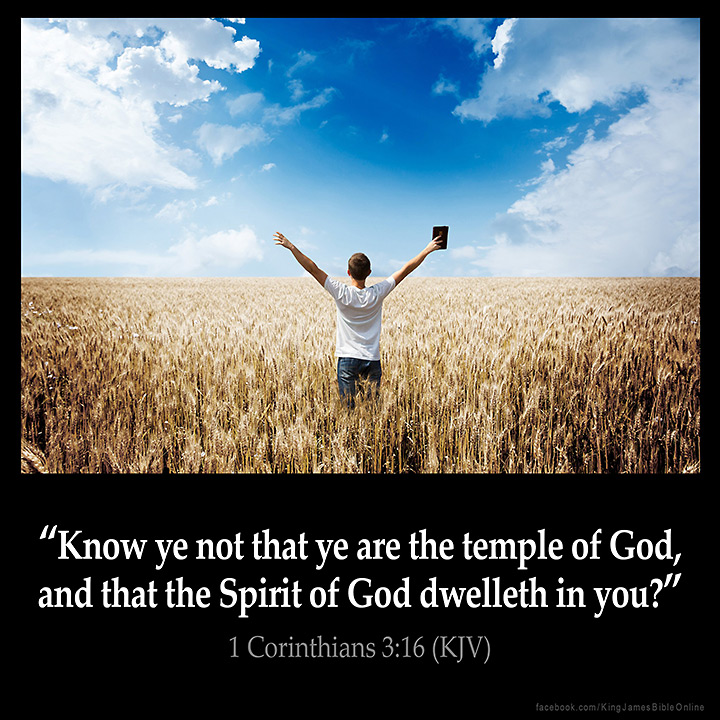
       1st Corinthians 3:16 says Know ye not that ye are the temple of God, and that the Spirit of God dwelleth in you?  I really believe it that our bodies are the temple of the God, and that the Spirit of God dwelleth in you.  This is the reason why I stopped drinking alcohol and smoking marijuana.  I have been clean and sober for 31 years now.  I am so happy that my temple is clean.

Next, my temple is holy and sacred.  I understand that God has saved me from myself.  The Lord has literally cleaned me up.  I know that I belong to God.  I want to say that there was a period of time when I did not care about myself.  I am a follower of Jesus Christ.  I recall a period of time when I used to drink and smoke for 18 years.  I know that I went through a period of time when I was a follower rather than a leader.  The reason why I am writing this essay is because my body belongs to Jesus Christ. 

       Further, I want to say that I do not engage in reckless behavior anymore.  I do not look at pornography anymore.  I choose to obey God, and watch Him work.  God loves all of us.  How do you respond to God?  The answer is obedience.  If I love God, I am going to become obedient.  What drives us to God is need.  I want to inform all of you that our bodies belong to God.  The Spirit of God dwells inside of us.  The Spirit of God helps me in my time of need. 

Moreover, I want the Lord to speak inside of my heart.  Ask the Lord to forgive you of your sins.  The temple itself is not a metaphor.  This is a specific thing that we possess inside of our bodies.  This means that God wants us to do the right things.  Do you know that one of my friends told me in my face that I should not write about God!!  I want to inform all of you that God is faithful to me.  God’s temple is holy and sacred because we are supposed to share His word with everyone.  I am happy that God is reminding me of His faithfulness. 

Finally, I want to inform all of you that I am going to continue to pray without ceasing.  I am going to continue to read the Bible, so that I can communicate with God on a daily basis.  My temple has been through a whole lot of stress for the past few years.  My temple is nice, kind, fantastic, and excellent.  My temple is sharing God’s message with everyone.  My temple always listens to church sermons.

 In order for God to be faithful, God states that His truth endures forever.  I love the Lord because he loved me when I was inside of my mother’s womb.  God’s nature cannot change.  God cannot change.  My temple is pure.  My temple is gracious.  Whatever the case is, we make our needs to God.  Do you know that we are supposed to do God’s Will?  He answers prayers.  God is unchangeable.  God is the Lord and Master in my life.

A Cashless Society

Crosswalk.com


PLUSToggle navigationnull

phone scan pay cashless society digital

Is a Cashless Society Part of the End Times?

Are we moving towards a cashless society? If we are, does a cashless society mean we are moving into the end times? With all the headlines about cryptocurrency—many Christians are questioning whether or not it’s a sign that we are moving deeper into the book of Revelation when Christ will make His return. It is often assumed that in order for the Antichrist or the beast to control all sales, a cashless society is a sign that the tribulation is near. It is assumed that so long as we are still using cash, we are not living in the end of days; but if we move towards a cashless society where all transactions become electric, then every transaction can be controlled and monitored by the beast (Revelation 3:17).

Cash, cryptocurrency, or no cash, we are living in the end of days. Jesus’ resurrection and ascension marked the beginning of the ‘end of days’ over 2,000 years ago. Many interpret the book of Revelation as a way to know when “the end is near” when the Antichrist or the beast control all buying and selling during the tribulation. However, a cashless society is not necessary to fulfill the meaning of Revelation 13:17.

What Is a Cashless Society?

A cashless society might sound like something out of a science fiction movie but it’s already on its way thanks to some governments and financial service companies vying for the new era. However, no society on this planet has gone completely cash-free—despite the rise of cryptocurrency.

A cashless society is an economic concept where all goods, services, and sales are executed in an electronic format rather than cash. Items like electronic cards or devices will be used for all transactions. It can be in the form of what we use today: credit cards, debit cards, or mobile wallets. Other examples are widely used today such as Venmo, PayPal, Apple Wallet, and Amazon Go.null

What Are the End Times or End of Days?

How we understand Eschatology (the study of what the Bible says about what will happen during the end of days) has an impact on our lives here and now and what we are to expect to occur. The End of Days is prophesied by many events that will occur. These events can be categorized as political signs, spiritual signs, natural signs, and sociological signs. The Bible tells if that if many of the signs are present, we can know for sure we are living in the end times.

Jesus’ ascension after His crucifixion and resurrection marked the beginning of the End of Days. Luke 21:11 also lists some of the natural signs as a sign of the times that will occur before Jesus’ second coming: “There will be great earthquakes, famines, and pestilences in various places, and fearful events and great signs from heaven.” Jesus called these things “birth pangs” in Matthew 24:8 but that does not mean we are to interpret every natural disaster as a sign of the end times. Matthew 24:6-7 predicted that “nation will rise against nation, and kingdom against kingdom.” “Wars and rumors of wars” are definitely characteristic of this present age and what we witness in the news.

Along with the signs God will use in the natural and spiritual realms, society will continue to decline in immorality. 2 Timothy 3:13 tells us evildoers and imposters will go from bad to worse. We will be lovers of ourselves and doing right in our eyes (2 Timothy 3:1-4).

This moral decline and a cashless society will supposedly usher in the Antichrist who will control all buying and selling by forcing people to “take the mark of the beast.” Some believe it could be a microchip while others currently believe it means the use of credit cards.

Some believe the church will be raptured as Christ comes in the clouds to snatch away all those who trust in Him (1 Corinthians 15:52). The “dead in Christ” will be resurrected and taken to heaven too. Then the Antichrist will rise as he gains worldwide control with promises of peace and he will be aided by a false prophet (2 Thessalonians 2:7-8, 13:1; Revelation 13:1; 19:20; Daniel 9:27).

Those who are left behind after the Rapture will be faced with an unbearable choice—accept the mark of the beast in order to buy and sell goods to survive, or face starvation and horrific persecution by the Antichrist and his followers.null

Does the Bible Say Anything about a Cashless Society?

There are two references about a cashless society, but the Bible does not specifically contain the phrase, ‘cashless society.’

Revelation 13:16-18 says, “Also it causes all, both small and great, both rich and poor, both free and slave, to be marked on the right hand or the forehead, so that no one can buy or sell unless he has the mark, that is, the name of the beast or the number of its name. This calls for wisdom: let the one who has understanding calculate the number of the beast, for it is the number of a man, and his number is 666.”

Isaiah 55:1-13 says, “Come, everyone who thirsts, come to the waters; and he who has no money, come, buy and eat! Come, buy wine and milk without money and without price. Why do you spend your money for that which is not bread, and your labor for that which does not satisfy? Listen diligently to me, and eat what is good, and delight yourselves in rich food. Incline your ear, and come to me; hear, that your soul may live; and I will make with you an everlasting covenant, my steadfast, sure love for David. Behold, I made him a witness to the peoples, a leader and commander for the peoples. Behold, you shall call a nation that you do not know, and a nation that did not know you shall run to you, because of the Lord your God, and of the Holy One of Israel, for he has glorified you.”

Does a Cashless Society Point to End Times?

We are currently living in the end times, cash or no cash. However, the conditions described in Revelation 13:17 existed without a cashless society. If a tradesman wanted to sell his goods, he needed to be a member of the trade association or guild. Each association had a patron deity and in order to trade, each craftsman had to be willing to worship the deities. If a follower of Christ refused to worship a deity, they were not allowed to buy or sell goods.

In modern communist countries, Christians have been barred and banned altogether from buying or selling goods. Some authorities make it clear no one is to buy or sell to Christ-followers in countries like China or Iran today.

Should Christians Embrace a Cashless Society if It Comes to That?

According to the latest research, 86% of Americans are paperless when it comes to financial transactions. 29% of Americans never purchase with cash and 52% state they only “occasionally” purchase goods and services with cash. These days, there are virtually dozens of ways to pay for goods and services without using cash. From Venmo to debit cards to credit cards and even cryptocurrency, we are slowly moving towards a cashless society.null

Many view a cashless society as an imminent threat because they believe it will usher in the Antichrist and make it easier for the government to track us and therefore control us—eventually giving the Antichrist the ability to implement the mark of the beast. However, when the Antichrist does come, he will have the power to declare cash as worthless. He will have the power to require a new form of cash and require individuals to take the mark of the beast and pledge their allegiance in order to acquire this new way of buying and selling goods. But even in a cashless society, there are ways around the system. Bartering will always exist.

A cashless society will not usher in the Antichrist, nor is it ungodly or antibiblical. Should a cashless society happen, Christians should not fear it. Instead, Christians should have faith in God. Faith and trust that He will provide for all of their needs. Ultimately, we need to remember God is the one who provides our jobs and He is the one who supplies all of our needs. The rapture could occur at any moment.

The good news is that it’s not too late to choose eternal life. It’s not too late to study God’s Word and get to know Him better. It’s not too late to trust He will take care of all your needs. All that is required is faith in God’s free gift of grace through His Son, Jesus Christ. One thing is certain, you will be trading the world’s riches for eternity.

Photo Credit: Unsplash/Jonas Leupe


Heather Riggleman is an award-winning journalist and a regular contributor for Crosswalk. She calls Nebraska home with her three kids and a husband of 22 years. She believes Jazzercise, Jesus, and tacos can fix anything and not necessarily in that order! She is author of I Call Him By Name Bible Study, the Bold Truths Prayer Journal,  Mama Needs a Time Out, and a contributor to several books. You can find her at www.heatherriggleman.com or on Facebook.  https://buy.tinypass.com/checkout/template/cacheableShow?aid=IKC2tj9wpu&templateId=OTAVRQ1OMYV3&offerId=fakeOfferId&experienceId=EXFH6UPE0XIY&iframeId=offer_644a5ba5fd98fb4d21c7-0&displayMode=inline&pianoIdUrl=https%3A%2F%2Fid.tinypass.com%2Fid%2F&widget=template


 Comments


Recently On End Times

Editor’s Picks

Follow Crosswalk.com

Receive FREE Newsletters!

Crosswalk Daily UpdateThe Top 3 new features you need to know about at Crosswalk today.

Love Worth FindingUnchanging truths from Scripture to apply to your changing lifeMore Newsletters ▶SIGN UPIn addition to your newsletter(s), you will receive email updates, timely articles, and special offers from Crosswalk.com.Privacy Policy / Terms of Use

Just For Today!!!

Just for Today

       Good Day Everyone!!  How are you doing today?  Fine, I hope.  I want everyone to know that I am doing good!!  In spite of my depression, I have been hanging in there.  God, grant me the serenity to accept the things that I cannot change, to accept the things that I can, and the wisdom know the difference.

 Just for today, I will have a program.  Just for Today, my thoughts will be on my new associations; people who are not using, as long as I follow that way, I have nothing to fear.  Just for Today.  Just for Today, I will focus on today.  I will focus on my situation.  I am able to deal with the things one moment at a time.  I have to allow God to enter my heart and mind. 

       Lord Jesus, I pray that my day is good.  I also pray that I am able to harness and master my emotions.  I have to learn how to stabilize my emotions.  I have to allow God to give me the faith and the ability to do good things.  God Bless You!!  I love all of you.  Even if you do not love me back, I love you anyway!! 

Just for Today

       Good Day Everyone!!  How are you doing today?  Fine, I hope.  I want everyone to know that I am doing good!!  In spite of my depression, I have been hanging in there.  God, grant me the serenity to accept the things that I cannot change, to accept the things that I can, and the wisdom know the difference.

 Just for today, I will have a program.  Just for Today, my thoughts will be on my new associations; people who are not using, as long as I follow that way, I have nothing to fear.  Just for Today.  Just for Today, I will focus on today.  I will focus on my situation.  I am able to deal with the things one moment at a time.  I have to allow God to enter my heart and mind. 

       Lord Jesus, I pray that my day is good.  I also pray that I am able to harness and master my emotions.  I have to learn how to stabilize my emotions.  I have to allow God to give me the faith and the ability to do good things.  God Bless You!!  I love all of you.  Even if you do not love me back, I love you anyway!! 

Prayer

Dear Jesus, My hero and savior. Why have I ever looked at other sources for Motivation? Forgive me for this transgression. I am weak and did not fully think through my actions, unlike the actions of Christ Precious Jesus, you knew the sufferings and shame that you would endure on the cross, and you were still willing to bear it , so that I could live. With this Prayer I shall Honor your suffering, I shall Honor your life and death. I promise that I will do all in my Power to spread the Love that I have for you with others, so that they may feel the same. I Pray this in you’re Holy Name. Jesus Christ, my love, finisher of Faith ,and Hero! Amen ✝️🙏🏾❤💋💯

What is the truth?

skip to main contentskip to footer

To ensure you receive the best experience on Lifeway.com, we use cookies to process information about your visit. For more information, see our Privacy Policy.OkayFree shipping on books, Bibles, gifts, VBS, and church supplies of $50 or more.View DetailsOur new look is only the beginning.Learn More

Search by keyword, title, author, ISBN, etc.

Sermon: Life Question 2 – What is Truth?

  • Share:

Sermon series: Life Questions

  1. Does God Exist? – Acts 17
  2. What is Truth? – John 8, 18
  3. Who Am I? – Psalm 8, Hebrews 2
  4. Why Am I Here? – Ecclesiastes
  5. What Happens When I Die? – 1 Corinthians 15
  6. Are All Religions Equal? – Acts 17

Scriptures: John 8:3218:37-38

Introduction

During the trial of Jesus, Governor Pilate interrogated Jesus about His kingdom. In His response, Jesus affirmed the spiritual nature of His kingdom and told Pilate, “Everyone who is of the truth listens to my voice.” To which Pilate cynically answered, “What is truth?” [John 18:37-8] And that same ambivalence pervades our culture today. It is even common today for some to flatly deny the truth exists. But the denial of truth never extinguishes truth.

“When England closed its Libyan Embassy, Muammar Qaddafi became so angry that he ordered England to be removed from all maps in Libya. If you buy a map in that country today, that area will be represented by a new arm of the North Sea bordered by Scotland and Wales.” [Stories for preachers and Teachers CD, V.1.01]

Today we will survey current thought about truth and conclude with the Biblical claims of truth. A study of truth presents several unique problems.

1. The problem of defining truth. A survey of common definitions reveals the commonly accepted variables of meaning. Consider the following definitions:

Dictionary.com -The actual state of matter in conformity with reality.

Wikipedia – To be in accord with fact or reality.

Merriam-Webster Dictionary – Fidelity, Constancy, fact, actuality.

For this study we will define truth as, “An understanding of the facts that corresponds to reality.”

2. The problem of inconsistency in the approach to determining truth in the physical realm as opposed to the meta-physical. Why do we demand concrete truth in the physical realm but deny absolute truth in the spiritual realm?

We want truth in the physical realm to be concrete and fixed. There is no room for broad-mindedness in the chemical laboratory. Water is composed of two parts hydrogen and one part oxygen. The slightest deviation from that formula is forbidden. The same holds true in biology, athletics, and mechanics.

But we want truth in the meta-physical realm to be fluid, non-factual, morally neutral, and open to interpretation. We hold this position because spiritual realities make moral judgments about right and wrong.

3. The problem of a lack of consensus on the basis of truth.

Much of this discussion is based on philosophical questions. What makes something true? How do we know what we know [epistemology]? Does this proposition satisfy the theory of correspondence [a statement or proposition is true if it coincides with reality]?

In contrast to those thoughts, we find one of the most quoted saying of Jesus. Our Lord said, “You shall know the truth and the truth shall set you free.” [John 8:32]

Last week we examined the question, “Does God exist?” If we believe that God exists then we should ask, “Has He spoken?” While this message is just a survey of prevailing thought about the source of truth, we affirm that the Bible is God’s message of love to the world. The Bible doesn’t just contain truth, it is truth. Consider these views of truth.

I. The secular approach: Truth is perspective

Some have suggested that perspective is truth. The basis for their approach is personal opinion. We can all be like the men and women in a study about their weight.

“There is a vast difference between truth, and the perception of truth. In a survey of American health, it was learned that 40 percent of overweight men thought they looked fine and “felt they were at about the right weight.” In contrast, 29 percent of women who were not overweight “felt they needed to lose pounds to achieve a healthy body weight.” Both groups were operating under the perception of truth rather than truth itself. Such thinking leads to erroneous behavior. ” [Prevention, Oct. 1993, 54]

This approach is contingent on two variables.

A. Consensus

This is the idea that the majority opinion of a cultural group determines the truthfulness of something. Incidentally, this notion paved the way for Hitler. The majority can trample the minority even if something is not actually true.

B. Relativism and situational ethics

The idea of relativism has been summarized by the popular phrase, “Truth for me.” But what happens when “your truth” is in conflict with “my truth?” Those that embrace relativism lack an objective standard by which to determine the truth. Truth to them is simply an issue of expedience. In short, the secularist believes that truth changes. But I say, try this with your bank and see how broadminded they are!

It is this approach to truth that has led to the notion that every view, concept or idea should be tolerated and respected – even it is patently wrong. Beside that, the secularist attacks those that make exclusive claims like Christianity.

It is not uncommon to read of the attacks by secularists in the media. USA Today [10-19-09] recently published an article by Tom Krattenmaker about the dangers of Christianity invading the sports arena. He wrote:

“Jesus’ representatives in sports aren’t just practicing faith. This exclusiveness sometimes morphs into a form of chauvinism. Tim Tebow…should be seen…as one who promotes a form of belief that makes unwelcome judgments about everyone else’s religion.”

That evaluation is simply an uninformed perspective.

II. The spiritual approach: Truth is tradition

The basis for this approach is religious mysticism. Our world is full of religions. Each of them claims to possess the truth. And our so-called tolerant society tells us that they are all right. In short, the argument goes like this, “All religions are basically teaching the same thing.” But we need to ask if that statement is true.

Can we or should we challenge religious beliefs? Yes! For that matter, we, as Christians, welcome those challenges. When comparing the truthfulness of all religious claims, there are only two options:

  1. Both claims are false.
  2. One is truth and one is false.

Just consider the comparisons between any monotheistic system of belief [Judaism, Christianity, and Islam] and any polytheistic system of belief [Hinduism, Shintoism, Animalism]. They may both be false, but they can’t both be true.

III. The scientific approach: Truth is facts

The basis for this approach is verifiable empirical data. Many view science as an infallible god. Christians, in fact, fear questioning the findings of science less we be viewed as uninformed. But we must be careful here because science has some inherent weaknesses when it comes to declaring truth.

A. We must guard against assuming that the scientist is unbiased and neutral in dealing with the data. Scientists, despite their claim to the contrary, are equally influenced by professional biases, political correctness, atheistic and evolutionary worldviews, and blind spots in their thinking. This doesn’t make the scientist evil; it makes him/her human.

B. While the scientific approach can discover certain facts about our world, it cannot make any moral judgments in regard to those facts. Further, scientific “truth” does not necessarily affect human behavior. Have you ever heard a drug addict say, “I was reading a math book gave up my drugs?” Or, “I was reading a biology book and decided to stop lying.”

C. There are limits to the collection of data. Thus, science cannot know everything, especially regarding the meta-physical or spiritual arena.

For example consider today’s discussion of global warming. This is a theory that is accepted by the larger scientific community as fact. But what if the data moves away from the theory? What is a scientist to do with his/her truth/facts? The hottest year recorded was 1998. But the last eleven years in a row have been cooler than that year. So what should happen next for the scientist? He should re-evaluate this theory and adjust for any variance in the data.

IV. The Scriptural approach: Truth is a person

Ultimately, we are asking, “Has God spoken?” And, if so, what has He said?” As Christians, we believe that God has spoken and that He has revealed Himself through His word – the Bible.

Consider these biblical truth claims. Although this is not an exhaustive list of truth claims, it is foundational to our understanding the source of truth.

A. Objective truth exists – John 8:32

This is also called propositional truth. We believe that just as we can boldly assert mathematical truth, we can affirm spiritual truth. Further, this truth exists independent of one’s acceptance of it.

B. The absence of truth creates bondage – John 8:32

We might call this spiritual bondage.

C. The application of truth liberates – John 8:32

Truth only liberates if you believe it and apply it to your life.

D. God’s Word is truth – John 17:17

  1. God has spoken.
  2. God desires to communicate with us.
  3. God’s communication is consistent with His nature.
  4. God breathed is Word into existence – 2 Timothy 3:16

E. Jesus embodies truth – John 14:6

Jesus said, “I am the Way, the Truth, and the Life” – John 14:6 [See Hebrews 1:1-3]

Conclusion

“Lew Wallace, governor of New Mexico, was writing a book against Jesus Christ and in the process was converted to Christianity. He told a friend how it happened.”

“I had always been an agnostic and denied Christianity,” Wallace said. “Robert C. Ingersoll, a famous agnostic, was one of my most intimate friends. He once said, ‘See here, Wallace, you are a learned man and a thinker. Why don’t you gather material and write a book to prove the falsity concerning Jesus Christ, that no such man has ever lived, much less the author of the teachings found in the New Testament? Such a book would make you famous. It would be a masterpiece, and a way of putting an end to the foolishness about the so-called Christ.'”

“Wallace went home and told his wife about the project. She was a member of the Methodist Church and did not like the idea. But Wallace began to collect material from libraries all over the world that covered the period in which Jesus Christ should have lived. He did that for several years and then began writing. He was four chapters into the book, he says, when it became clear to him that Jesus Christ was just as real a personality as Socrates, Plato, or Caesar. “The conviction became a certainty. I knew that Jesus Christ had lived because of the facts connected with the period in which he lived.”

So he asked himself candidly, “If he was a real person, was he not then also the Son of God and the Savior of the world?” Gradually Wallace realized that since Jesus Christ was a real person, he probably was the one he claimed to be.”

“I fell on my knees to pray for the first time in my life, and I asked God to reveal himself to me, forgive my sins, and help me to become a follower of Christ. Toward morning the light broke into my soul. I went into my bedroom, woke my wife, and told her that I had received Jesus Christ as my Lord and Savior.”

“‘O Lew,’ she said, ‘I have prayed for this ever since you told me of your purpose to write this book, that you would find him while you wrote it!’ “

“Wallace went on to write a famous book. Every time I watch the epic film Ben Hur, based on that book, I wonder at how it was written by a man who wanted to disprove that Jesus ever existed and instead became convinced that he was the greatest man who ever lived.” [David Holdaway, The Life of Jesus, Sovereign World Publishers, 1997]Jerry Gifford is senior pastor at First Baptist Church of Franklin, Kentucky. Jerry holds degrees from Western Kentucky University and Liberty Baptist Seminary. He and his wife, Tammie, have two sons, Daniel and David. He is passionate about his family, spiritual renewal, discipleship, preaching, basketball, and water sports.

Related Content

Loading…

About Lifeway

My Account

Digital Resources

Don’t Miss a Thing!

First Name *Last Name *Email Address *Sign Up

Lifeway Faithfully serving the church since 1891
Lifeway Christian Resources, Religious Goods, Nashville, TN

© 2001–2021 Lifeway Christian Resourceshttps://www.google.com/recaptcha/api2/bframe?hl=en&v=TbD3vPFlUWKZD-9L4ZxB0HJI&k=6LebYyATAAAAAI_X0R6oF1WIPfd4rrh93kOCLOzn&cb=2h4cxz998qw1null

Ephesians 2:8-9, and what it means to all People!!

Ephesians 2:8-9, and what it means to all people!!  By Anthony Joseph Hopkins July 13, 2021.

  1.        Praise the Lord Saints!!  Praise the Lord!!  How are you doing today?  Fine, I hope.  Ephesians 2:8-9 says it is by grace you have been saved, through faith-and this not from yourselves, it is the gift of God- not by works, so that no one can boast.  To be honest with all of you, God is giving us something that we do not deserve.  What is the definition of the Word grace?  Grace is when do honor or credit to someone or something by one’s presence.

Next, when it comes to the spiritual definition of the word grace.  Grace is a spiritual gift that involves love and mercy given to others even when we feel that they don’t deserve it.  The Biblical definition of the word grace is; In Western Christian theology, grace is the help given to us by God because God desires us to have it, not necessarily because of anything we have done to earn it.  What is the definition of the word mercy?

 Mercy is compassion or forgiveness shown toward someone whom it is within one’s power to punish or harm.

  What is the Biblical definition of the word mercy? So, to me, mercy is a “love that responds to human need in an unexpected or unmerited way.” At its core, mercy is forgiveness. The Bible speaks of God’s love for sinners – that is, for all of us. But the Bible also relates mercy to other qualities beyond love and forgiveness.

 Other definitions of the word mercy consist of 1a: compassion or forbearance (see forbearance sense 1) shown especially to an offender or to one subject to one’s power also: lenient or compassionate treatment begged for mercy. b: imprisonment rather than death imposed as penalty for first-degree murder.  Let us fall into the hand of the Lord, for his mercy is great; but let me not fall into the hand of man.” Put on then, as God’s chosen ones, holy and beloved, compassionate hearts, kindness, humility, meekness, and patience. To the Lord our God belong mercy and forgiveness, for we have rebelled against him. 

Finally, I know that I have done some things that were not pleasing to both God and man alike.  I have grace because I have been saved.  I know when it comes to my life personally, I have completely changed behaviorally since February 15, 2015.  For six years right now, I am only a Work in Progress.  I am saying this because I am not perfect.

 God has a hold onto me right now.  When it comes to my thoughts, we are supposed to bring every thought into obedience.  We have a God who loves all of us.  God is in control!!  God gave authority to man over all of the earth.  Do you know who this man is Adam.  God gave the dominion over to man.  We have the authority to make a choice.  We have a choice to follow God or follow the world.  We must give our attention to Jesus Christ concerning obedience to the doctrine.  We must yield to the attention to the righteousness through Jesus Christ.  If Jesus is righteous then I am righteous because through Jesus Christ.  We are saved by grace because of what Jesus did for me.  Under grace we are working for God.