Take a look! 📌 https://pin.it/4nMLO8BZI
What is Fentanyl
What is Fentanyl?
Fentanyl is a synthetic opioid that is made in a lab from precursor chemicals instead of from poppies. It is 50 times more potent than heroin and 100 times more potent than morphine. According to the DEA, 2 milligrams of fentanyl is generally considered a lethal dose for most people. This is equivalent to a few grains of salt.
Fentanyl was developed as a powerful pain relief drug for people with end-of-life cancers. In a medical setting, it can be administered via injection, patch, or lozenge. Clandestinely produced fentanyl is usually a powder added into other drugs (cocaine, heroin, methamphetamine even marijuana) or pressed into counterfeit pills that can look like OxyContin, Percocet, Vicodin, Xanax, Alprazolam, Adderall, Ecstasy, Molly, or other pills/tablets.
Why is Fentanyl being added to street drugs?
Fentanyl is much cheaper to make than other opioids. It is also easier to smuggle because small amounts are very powerful. It is a lot easier to smuggle in a baggie of Fentanyl powder than kilogram bricks of other drugs for the same profit margin.
In addition, it is highly addictive making individuals wanting/needing to buy more as they chase their first high.
Why would drug dealers add Fentanyl to drugs if it can kill people?
Because Fentanyl is cheap and so highly addictive, it creates a much greater profit margin. The occasional loss of one or two users are not detrimental to their bottom line because they know that another addict can be easily created.
People can also develop a tolerance for Opioids like Fentanyl requiring them to use more and more to get high. This causes drug dealers and cartels to make stronger pills with more Fentanyl. However, these stronger pills may kill newer users who have not developed such a tolerance.
In addition, some dealers intentionally add deadly amounts to some pills because the death of a user is like an advertisement that that dealer has really strong drugs.
Finally, these drugs are being mixed and cooked in open air “labs” in rural parts of China and Mexico. These labs are not being run by individuals with an interest in quality control and scientific measures. They use large vats over inconsistent heating elements.
What can parents do about Fentanyl?
Address any underlying concerns that may lead to your child to take Fentanyl intentionally or unintentionally. Parents of Fentanyl victims often report that their children took a pill or other drug to try deal with issues related to sleep, anxiety, loneliness, or other emotional challenges.
Talk with your kids about Fentanyl. They likely know someone who has died from Fentanyl poisoning or overdose. Share concerns Fentanyl raises for you both. Don’t threaten but talk about risks and that even one pill from someone they trust can kill. Inhaling it by mistake can be deadly.
Keep an eye on your kid’s backpack, room, car, or phone. Fentanyl is most often smoked using a pill crusher, small piece of tinfoil, lighter, and straw to inhale the smoke. Other items indicating use may be needles, small mirrors, scales, blotter paper, unlabeled candies, blue M-30 pills, Xanax “bars”, or other pills/tablets/capsules.
Be aware of what your child is doing on their phone. Pills and other drugs are now often purchased through Snap Chat, Gaming Platform “chat” functions, and other dark web sites. Today, there are about 9,300 websites selling drugs illegally on the Dark web. According to the Center for Addiction and Substance Abuse, ONE in FIVE teens have already tried prescription drugs illegally.
The majority, 76 percent of these teenagers, buy these prescription pills illegally.
Check your kid’s phones for unusual words like Blues, Blueberries, Apache, China Girl, China Town, Dance Fever, Friend, Goodfellas, Great Bear, He-Man, Jackpot, King Ivory, Murder 8, Tango & Cash, f3nt, TNT, fluff, tabs, vikes, hydros, vitamins, ercs, or 30s. However, these “code” words change frequently so pay attention to any odd abbreviations or words.
I want to inform all of you that this type of drug can kill an average person from inhaling it. I know that inside of my apartment building, people are smoking Fentanyl with Marijuana and Crack Cocaine.
I know that this is a very difficult medication to cure; if anyone comes in contact with this drug, it can kill you.
I know that last night on 1/26/24, someone threw some of this powder contents inside of the apartment building where I live at in Dayton, Ohio. I know that I was taking my asthma medication, when suddenly, I came in contact with this powdered substance.
I went to the hospital several times because someone was smoking this drug at Wentworth Hi Rise Apartments located at 2765 Wentworth Avenue Dayton, Ohio 45406. I had to leave my apartment building this afternoon because someone was smoking this drug inside of the hallway at my apartment complex.
This is an image of my apartment building in Dayton, Ohio. I know that this is a residential building.
In Conclusion, I want to inform all of you that there are residents, who are living inside of this building who are called bad apples.
This is another example of what this drug looks like in Dayton, Ohio and worldwide. I have to be very careful because this is called Rainbow Fentanyl. This stuff looks like candy, but it is highly addictive and it deadly!!
There are people who have been prescribed Fentanyl as a substance to prevent pain inside of the body. This drug is prescribed in lower dosages by physicians worldwide. Please be very careful because the marijuana that people are smoking today contains fentanyl.
This drug is very dangerous. If you know of anyone who is in contact with this drug, please contact your nearest Law Enforcement or the paramedics inside of your hometown. Thank you very much for reading my essay.
jesus-through-the-eyes-of-women.pdf
What does it mean to be called by God?
What Does It Mean To Be Called By God?
CALL, v.t. Heb. To hold or restrain. In a general sense, to drive; to strain or force out sound. Hence,
1. To name; to denominate or give a name. And God called the light day, and the darkness he called night. Gen. 1.
2. To convoke; to summon; to direct or order to meet; to assemble by order or public notice; often with together; as, the king called his council together; the president called together the congress.
3. To request to meet or come.
He sent his servants to call them that were bidden. Math. 22.
4. To invite.
Because I have called and ye refused. Prov. 1.
5. To invite or summon to come or be present; to invite, or collect.
Call all your senses to you.
6. To give notice to come by authority; to command to come; as, call a servant.
7. To proclaim; to name, or publish the name.
Nor parish clerk, who calls the psalm so clear.
8. To appoint or designate, as for an office, duty or employment.
See, I have called by name Bezaleel. Ex. 31.
Paul called to be an apostle. Rom. 1.
9. To invite; to warn; to exhort. Is. 22:12.
10. To invite or draw into union with Christ; to bring to know, believe and obey the gospel. Rev. 8:28
11. To own and acknowledge. Heb. 2:11.
12. To invoke or appeal to.
I call God for a record. 2 Cor. 1.
13. To esteem or account. Is. 47:5. Mat. 3:15.
To call down, to invite, or to bring down.
To call back, to revoke, or retract; to recall; to summon or bring back.
To call for, to demand, require or claim, as a crime calls for punishment; or to cause to grow. Ezek. 36. Also, to speak for; to ask; to request; as, to call for a dinner.
To call in, to collect, as to call in debts or money; or to draw from circulation, as to call in clipped coin; or to summon together; to invite to come together; as, to call in neighbors or friends.
To call forth, to bring or summon to action; as, to call forth all the faculties of the mind.
To call off, to summon away; to divert; as, to call off the attention; to call off workmen from their employment.
To call up, to bring into view or recollection; as, to call u the image of a deceased friend; also, to bring into action, or discussion; as, to call up a bill before a legislative body.
To call over, to read a list, name by name; to recite separate particulars in order, as a roll of names.
To call out, to summon to fight; to challenge; also, to summon into service; as, to call out the militia.
To call to mind, to recollect; to revive in memory.
CALL, v.i.
1. To utter a loud sound, or to address by name; to utter the name; sometimes with to.
The angel of God called to Hagar. Gen. 21.
2. To stop, without intention of staying; to make a short stop; as, to call at the inn. This use Johnson supposes to have originated in the custom of denoting ones presence at the door by a call. It is common, in this phrase, to use at, as to call at the inn; or on, as to call on a friend. This application seems to be equivalent to speak, D. Kallen. Let us speak at this place.
To call on, to make a short visit to; also, to solicit payment, or make a demand of a debt. In a theological sense, to pray to or worship; as, to call on the name of the Lord. Gen. 4. To repeat solemnly.
To call out, to utter a loud voice; to bawl; a popular use of the phrase.
CALL, n.
1. A vocal address, of summons or invitation; as, he will not come at a call.
2. Demand; requisition; public claim; as, listen to the calls of justice or humanity.
3. Divine vocation, or summons; as the call of Abraham.
4. Invitation; request of a public body or society; as, a clergyman has a call to settle in the ministry.
5. A summons from heaven; impulse.
St. Paul believed he had a call, when he persecuted the Christians.
6. Authority; command.
7. A short visit; as, to make a call; to give one a call that is, a speaking to; D. Kallen. To give one a call, is to stop a moment and speak or say a word; or to have a short conversation with.
8. Vocation; employment. In this sense calling is generally used.
9. A naming; a nomination.
10. Among hunters, a lesson blown on the horn, to comfort the hounds.
11. Among seamen, a whistle or pipe, used by the boatswain and his mate, to summon the sailors to their duty.
12. The English name of the mineral called by the Germans tungsten or wolfram.
13. Among fowlers, the noise or cry of a fowl, or a pipe to call birds by imitating their voice.
14. In legislative bodies, the call of the house, is a calling over the names of the members, to discover who is absent or for other purpose; a calling of names with a view to obtain answers from the person named.
called
CALLED, pp. Invited; summoned; addressed; named; appointed; invoked; assembled by order; recited.
calling
CALLING, n.
1. A naming, or inviting; a reading over or reciting in order, or a call of names with a view to obtain an answer, as in legislative bodies.
2. Vocation; profession; trade; usual occupation, or employment.
Pope. Swift. 1 Cor. 7:20
3. Class of persons engaged in any profession or employment.
4. Divine summons, vocation, or invitation.
Give all diligence to make your calling and election sure. 2 Pet. 1.
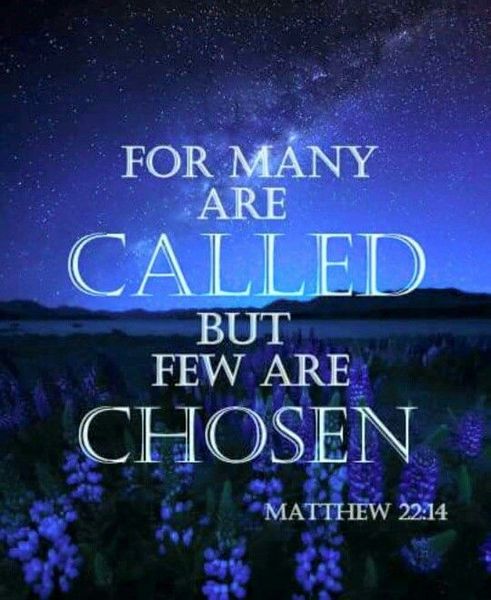
When it comes to the New Testament, it specifically states that we are Temples of the Living God. Our Bodies are the Temple of God. I would like to express myself for a few moments. I would like to say that I am a Born Again Christian. I have totally submitted myself completely to His Will. I also will admit that I am sinful flesh, but I am still a Child of God. I want to ask another question. Matthew 22:14 states that for many are called, but a few are chosen. What does this Bible verse mean? I would like to receive both positive and negative feedback on this question.

Next, I would like to continue pondering on this question about Matthew 22:14. Do anyone know what does this Bible verse mean? The answer to this question is that God has called all of us to do according to His Will. I begin to realize that God still loves us for who we are as people. He only want us to repent of all of our sins. He want all of us to live for Him. The Lord is slow to anger, and is abounding with grace. I understand that the First 144,000 are going to be considered.
Moreover, I want to inform everyone that we all still have a chance to be His chosen people. When it comes to being called by God, it gives me an opportunity to live for him and serve Him. This means that I must become Christ-like in my manner of living and completely change. I have dedicated my life for Him by writing and sharing my personal testimony with others. I am at the realization that I still have more to do for Him. For Instance, I have to make amends with everyone that I have wronged in my personal life.
In Addition, I have to be willing to forgive every one of all of their trespasses. I have to be willing to share His word with others. I have to commune with the assembly of the Saints. I have to dedicate myself to reading His word to everyone. I have to have an intimate personal relationship with God and Jesus Christ. Therefore, I want to say that my relationship with Jesus Christ is very important to me right now. I want to inform everyone that I am willing and ready to work out my salvation with fear and trembling.
Further, I want to say that my favorite Bible verse is Jeremiah 32:27 which states; behold I am the Lord, the God of all flesh, is there anything too hard for me? God asked Jeremiah the Prophet this question in the Old Testament. I want to say that my life has done a complete 180 degree turn because I do not have a desire for the things of the world. I am ready to go back to work and earn a decent wage. If the Lords Will, I will seek employment somewhere within the next 6 months.
Finally, I want to say that I have given up the street life. I have been clean and sober for 35 years right now. My sobriety date is May 2, 1990. I have given up the high cost of low living. As it relates to the question at hand, I feel that I am ready to step up to the plate and become a real man. I am ready to share the Gospel with everyone that I meet personally. I also want to inform everyone that on February 15, 2015, I have rededicated my life to Jesus Christ. I have been baptized on that day, and a total of 8 other times. I am in the Lambs Book of Life right now, and I have a record of baptism in several churches.
In conclusion, I want to say that I am a Born Again Christian, and I really feel that I am chosen by God to serve Him and share my personal testimony with everyone. I am guilty of robbing God of my tithes and offerings. I have to submit my income to God. I am very sorry for placing emphasis on my household rather than giving to God. Please pray for me because I have too many bills to pay in my household. I have a student loan from the University of North Carolina at Charlotte that is in collections right now.
people-of-prayer-devotional_2.pdf
Conversion to Christianity
Converting an agnostic to Christianity involves
building a trusting relationship, fostering open dialogue, and presenting the Christian faith through personal example rather than forced arguments. Focus on addressing their specific questions through Christian apologetics, encouraging them to read the Bible (particularly the Gospels), and praying for them, as conversion is seen as a personal journey often requiring intellectual and spiritual exploration.
Key Approaches for Engaging Agnostics:
- Build Authentic Relationships: Approach conversations with love and respect, rather than attempting to “proselytize” or prove superiority. Listen genuinely to understand why they are agnostic.
- Use Apologetics and Logic: Provide logical reasons for faith. Recommend resources like GotQuestions.org or books by apologists, which address questions about the existence of God and the reliability of the Bible.
- Focus on Jesus: Shift focus from abstract theology to the life, claims, and resurrection of Jesus Christ.
- Encourage Scriptural Reading: Encourage reading the Bible, such as the Gospel of John, to let them engage with the text directly.
- Live a Christlike Life: Demonstrate the impact of faith through actions, as a consistent life can spark curiosity.
- Pray for Them: Consistently pray for the person, asking for God to open their heart and mind to the message.
Common Pitfalls to Avoid:
- Applying double standards in arguments.
- Using fear or guilt as a primary tool for conversion.
- Assuming the agnostic’s position is based on ignorance.
Note: The ultimate decision to convert is personal, and the process often takes time and patience.
Billy Graham: Why Does God Allow Suffering?
Billy Graham: Why Does God Allow Suffering? https://share.google/JGTMo6J84jvIUxWY3
5+Spiritual+Keys+to+Find+Fulfillment+in+God.pdf
5+Spiritual+Keys+to+Find+Fulfillment+in+God.pdf https://share.google/pmEsG8ulSEsdrP621
Why Does God Allows Suffering?

Why Does God Allow Suffering?
By:
Bob Russell and Rob Suggs
Topic:
Perspective:


Let’s be honest: This is no easy question, the relationship of God to human suffering.
Why Does God Allow Suffering?
The wise and the devout have grappled with it throughout history, and not always to a victorious conclusion. St. Teresa of Avila said, “Lord, if this is the way you treat your friends, it’s no wonder you don’t have many!” At least hers was less an expression of doubt than of frustration.
Others have taken hold of the Question as a kind of checkmate in the game of rationalizing God out of existence—or at least diminishing our view of him. Their line goes like this:
- God is purportedly good. Yet there is great human suffering.
- Since God doesn’t intervene, he lacks either the will or the power.
- If he lacks the will, he isn’t good after all. (If he’s God, he isn’t good.)
- If he lacks the power, he isn’t God after all. (If he’s good, he isn’t God.)
It’s a striking line of reasoning. But it’s also a little too cut and dried, right? God, the world, and suffering: These are not simple issues. We all sense that there could be other reasons God would hold back from stopping anything and everything unpleasant in this world.
So we look for other reasons that evil and suffering may exist; we round up the usual suspects.
Six Suspects for Our Suffering
1. Discipline
Maybe it’s simple cause and effect. This is the “you had it coming” argument. Once Jesus came across a blind man, and his disciples immediately asked, “Who sinned, this man or his parents, that he was born blind?” (John 9:2).
They are hoping, of course, for a lively philosophical debate with Jesus the teacher. They have been taught that disease or disability is mark of someone’s sin. So whose?
“Let’s be honest: This is no easy question, the relationship of God to human suffering.”
Jesus tells his disciples they’re asking the wrong question. It’s not about who sinned, but how the goodness of God can shine through the situation. And he proceeds to make that happen. As always, Jesus gets to the root of the subject in a startling way. He shows us an old question from a brand-new angle. As we’ll see, he has hit upon a key element of the problem of suffering.
We’d like to scoff at the disciples’ thinking and say that our God doesn’t work that way, punishing sin with suffering. The problem is, the Bible says that he does—sometimes. Moses wasn’t allowed to enter the Promised Land because of a certain incident in which he lost his temper and usurped God’s glory, a serious offense. Miriam, his sister, was temporarily struck with leprosy for undermining Moses’ leadership.
And those are not isolated incidents. There’s an important passage in Hebrews 12. It tells us that God disciplines us as a father disciplines his children—for our good. Discipline is simply a part of loving training. We do need to distinguish punishment from discipline. The former is simply a penalty dealt out for a misdeed; the latter is a loving form of training. We impose discipline on ourselves not as punishment but to be better people.
So God disciplines. But there are other angles, too.
2. Poor Decisions
Sometimes we suffer due to our own willful error. Maybe the warning was on the label all along, and we simply ignored it. The sign said the road was slippery, and we pushed the accelerator down.
Let’s say Uncle Bob’s bad report from the doctor concerned lung cancer. He smoked for years, everyone nagged him about it, and he really did mean to stop. But the fact is, he didn’t. He foolishly ignored the warning signs. So it’s not as if God is suddenly, arbitrarily inflicting this bad medical report like a lightning bolt of sheer wrath. Uncle Bob quite sadly brought this upon himself.
Sometimes we choose the wrong friends, eat the wrong foods, make the wrong decisions in business or in family. The old TV detective Baretta used to say, “Don’t do the crime if you can’t do the time.”
But the Bible puts it better: “Be sure that your sin will find you out” (Numbers 32:23). Life comes with any number of hazard labels. We can’t rail against God when we’re given fair warning. Actions have consequences.
3. Satanic Attack
Could it be the devil?
It’s the simplest and most logical of arguments, in a way: All good things come from heaven, all bad things are the work of Satan. The Bible describes how he attacked a good man named Job, who suffered deeply and thoroughly.
Paul spoke of a “thorn in the flesh,” some unpleasant infirmity that God allowed Satan to use as a weapon against the apostle. From the devil’s perspective, it was an attack; from God’s, it was a tool to protect Paul’s humility.
“God must be God, and can’t be reduced to the easy and rational and comfortable.”
Again, here’s a compelling clue to how God relates to our pain. An attack could originate from hell, while shaping us for heaven. The devil himself—as much as he hates it—finds his own place in the vast plan of God, who is all-powerful, capable of using any element as part of the great tapestry he is knitting together.
4. The Sins of Others
The disciples suggested that the blind man may have been blind because of his parents’ sins. This was logical, from their perspective, because the man had been born with his infirmity; it couldn’t be his fault if he was born that way.
Sometimes relatively innocent people suffer out of all proportion to any argument of sin being the cause. A little child dies. A drunk driver steals the life of a promising young lady. An emotionally disturbed man opens fire in a theater or a school. A child is born with a drug addiction stemming from the mother’s use of cocaine.
Surely God is not dispensing “discipline” through such horrendous events; it would be mere punishment, serving no purpose for the victim. No, in these cases, people are clearly suffering for the sin of others. It’s an unavoidable conclusion, but not a very pleasing one: We may suffer as the consequence of others’ sins.
It brings us right back to the question of God’s place in this: Why would he allow the innocent to be victimized for someone else’s wrongs?
And yet we read in the Old Testament the idea that the sins of the fathers are visited on the third and fourth generations. It may not seem fair, but it’s the way the world turns. We must take into account that our sins put out ripples, in the world around us and the future ahead of us.
5. Persecution
Here is another striking idea from the Bible: “Everyone who wants to live a godly life in Christ Jesus will be persecuted” (2 Timothy 3:12). So maybe, bad things happen to good people because they’re good people.
Again, this checks out logically. We know that if we take a stand for biblical values in an anti-biblical world, we will face certain consequences: ridicule, rejection, possibly loss of work or even freedom, in some circumstances. People are still punished or even executed for their faith in some parts of the world. We’ve seen businesses lose income when their prominently Christian leaders stood firm for biblical values. Jesus said this would happen, and there’s never been a time when he wasn’t proven correct.
6. A Fallen World
There’s also the distinctly Christian idea that we live not just among fallen people, but in an entire fallen world. In other words, the rebellious sin of Adam and Eve caused all of creation to be corrupted. Paul teaches, in Romans 8, that all of this world “groans” as in childbirth pains, awaiting the birth of a new creation.
This helps us to account for natural calamities: tsunamis, earthquakes, diseases, floods, and even the attacks of vicious animals. We can suffer through non-human agency, and the Bible teaches us that even in these cases, we are feeling the consequences of a world that has rebelled.
As a matter of fact, we find this subject arising much more frequently in recent days. Monster storms have devastated New Orleans and New York; and even near my home, an F4 tornado twisted its way through the community at 170 miles per hour, killing eleven people and doing untold damage. These are the times when people come to me with haunted eyes and ask, “Why?”
The answer is that our planet and our people suffer from the fall of humanity. For this life, we will see the result of rebellion against God again and again, and we call the natural disasters “Acts of God.”
Even so, I suspect Jesus would point out that we’re still asking the wrong questions. We’re quick to brand horrendous things as acts of God, but what about all things bright and beautiful? What about a gentle spring rain, a day of glorious weather, a field of ripe corn? Are these not also acts of God?
In the same way, we look to the heavens in the midst of a bad day and say, “Why me, Lord?” Bad moments are quickly dubbed “God moments.” But when something good happens, we tend not to see it in that way. Fathers don’t tend to hold a first newborn child, look to heaven, and cry out, “Why me, Lord? Why do I deserve such a beautiful blessing?”
When was the last time you rose in the morning and asked God why he gave you another precious day of life? Three square meals? Family, church, health?
Maybe that’s one of the right questions.
The Question Remains
We can name all these sources of suffering and more, but none of them get to the root of the why question. Wherever the bad things came from—why didn’t God do something about them?
After all, we’re told that God has loved us with an everlasting love. The Bible goes into incredible detail to show us the depth of that love; the fact that he has loved us as his very children, that we are God’s handiwork, created by him to do good works. Meanwhile, we’re also told that God is infinitely powerful, that nothing is impossible with him. He is sovereign, which means that the buck stops here; he created everything, he knows when the smallest bird falls from a tree, and his hand utterly controls human destiny.
So how do we put these two realities together? How can God be both wonderfully good and ultimately powerful, while allowing all the evil that we see and experience?
Like everyone else, I wish God would phone me and clue me in. I know all the big theological issues, but I get frustrated; I long for him to just give me the short answer. I almost wish he wouldn’t trust me so much to handle the hard questions of faith—but that’s exactly what he does.
When I was in school, my mathematics text sometimes had the answers in the back of the book. I knew that no matter how difficult any problem seemed, no matter how inside out it twisted my mind, there was a wonderfully logical, perfectly neat answer on the final pages of that book. I do believe the Bible has the answers. The “back” of the book, known as the New Testament, has the solution to every problem. But these are not encapsulated in simple numbers or a few words. They must be worked out within the human heart, and held together by the glue of faith.
Each one of us, if we intend to be serious about pursuing God, must wrestle through the night with the mysteries of good and evil. Jacob did that in Genesis 32. At a crossroad moment of his life, a dark night of his soul, he was visited by a messenger of God. The two of them literally wrestled until sunset. Jacob fought for all he was worth, and wouldn’t let go until he had his blessing. Neither should we. I believe we are blessed by the courage we show when we squarely face our doubts. Conversely, we are diminished by looking the other way, closing our minds, and “protecting” our faith as if it were some weak and fragile thing.
The way to strengthen faith is to walk forward in it, facing all the hard questions and trusting in the goodness of God for resolution. I’ve tried to do that as long as I’ve known Christ, and here is what I’ve found: The mysteries, to some extent, endure. God must be God, and can’t be reduced to the easy and rational and comfortable.
“God wants me to know him; he even wants me to have intimacy with him.”
We can’t make him smaller and easier to carry around in our minds; instead, our own minds and spirits must expand. They must grow stronger and wider, so that they can allow for the things that must be taken on faith. As we walk forward in that way, we do find out just how good, and how powerful, God really is.
As a matter of fact, I find that this is even true of people. They too are mysterious in many ways. Every ordinary person you know is a unique creation, filled with surprises and impossible to pigeonhole— the living sum total of a life no one else has lived, a uniqueness no one but God could have designed. Should we expect to understand every little thing about the Creator himself, when his people are so wonderfully unpredictable?
So God wants me to know him; he even wants me to have intimacy with him. But he doesn’t want me to live under the illusion that I can get him all figured out—he would then be less than God. What he wants is for us to accept his mystery and trust his character. As I’ve sought to do that, I’ve discovered that the other questions often reveal their answers in startling and wonderful ways.
Published on December 10, 2021. Modified on January 6, 2022.

For Further Reading:
Acts of God
by Bob Russell and Rob Suggs
Bob Russell has seen it all—tragedy in his childhood church, broken families in his pastoral ministry, a world torn by war and injustice—the…
Free ebook: Habits for Spiritual Growth
Sign up for our weekly email and get a free download
Bible Insights by Email
Sign up for learning delivered to your inbox weekly
Free ebook: Habits for Spiritual Growth
Sign up for our weekly email and get a free download

Bible to Life is a ministry of Moody Publishers. © 2026.
All Rights Reserved. Site by Mere.
God Bless All of You Worldwide






 Site Title