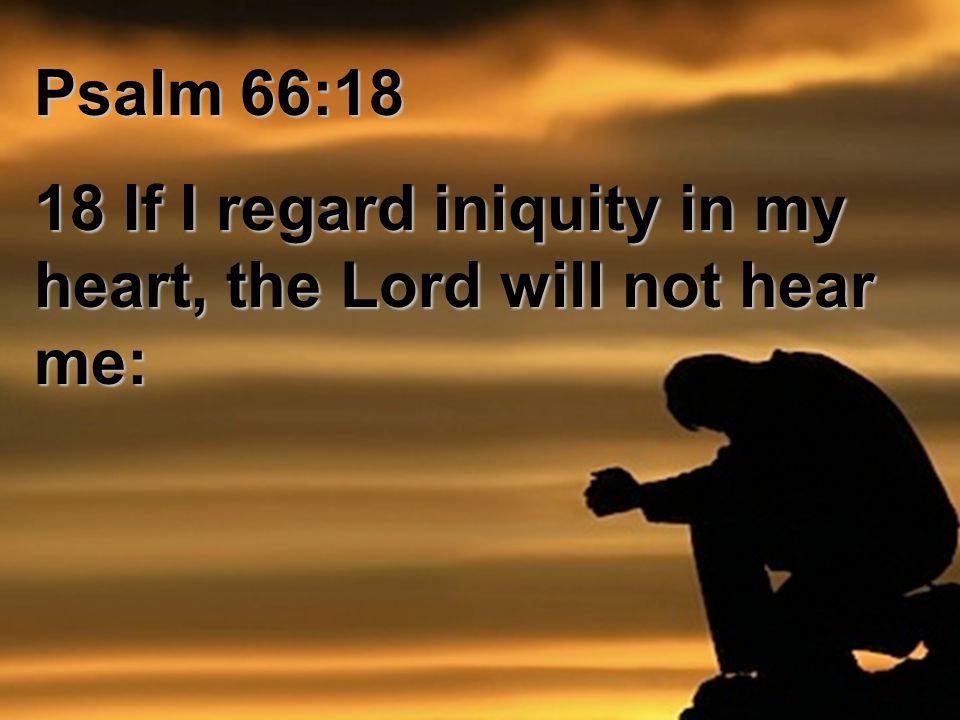
Psalm 66:18 says: If I regard iniquity in my heart, the Lord will not hear me. This means that if I have anger and sin in my heart, God will not hear me. I will admit that I am bearing a resentment towards my sister. I remember the last time we argued, she called the police on me. That really hurt me personally. I love all of my family members and friends. I really don’t like Law Enforcement. My family members are quick to call the police on me. Lord Jesus, please give me to say to my family.
This is the truth because God does not want us to be angry with Him. God wants all of us to be very honest with Him. God wants us to say whatever is on our mind. God knows the things that we are going to say in advance. God wants us to have peace with each other. God wants all of us to be in one accord with each other. There is no such thing as majority rules with God. He believes in a consensus. This means that we all have to agree with each other. This is a one decision process. God will hear from all parties involved in the situation. God already knows what we are going to say in advance. God is exameing our hearts and minds simultaneously.
Finally, I feel a lot better now. I am able to listen to my family members. I know that there are going to be cliques and groups who will agree to disagree in advance. For 53 years now, there has been those opposing parties. There has been division among family members. I know that as long as you have God on your side, you cannot lose anyway. God, Grant me the serenity to accept the things that I cannot change. Please give me the courage to change the things that I can, and give me the wisdom to know the difference. Feeling tend to get in the way from opposition and opposing parties. God, please give me the words to express to my family members. Please allow me to become an active listener and a change agent. Negotiation with my family members are very important.
In Conclusion, I am very thankful for your assistance in this situation with my family members. You have negotiated terms between Moses and Pharoah, when it pertains to releasing the Israelites from Egyptian Rule. Thank You For negotiating things with my family members and beyond. Thank You For Your Precious Breath of Life. Thank you for allowing me to sleep a few hours. Thank you for everything. In Jesus name I pray. Amen and Amen!!
Is It True That We Have To Forgive Each Person 490 Times?
By: Anthony Joseph Hopkins
Praise The Lord Everyone!! Praise The Lord!! How are all of you doing today? Fine, I hope. I have a very important question to ask all of you. Is it true that we have to forgive each person 490 times? The answer to this question is yes. We have to forgive everyone for what each person have done to you.
I used to have a problem with forgiveness a long time ago. This is because I used to get abused and neglected as a child as well as an adult. I want to let everyone know that it is not very easy apologizing and accepting apologies from other people. I feel good right now because I have learned how to forgive others while attending church as a child. At first, I used to get upset when others have hurt me. I used to run away from God. It is very serious when it comes to forgiveness. This means that I have to forgive each person living on this earth 490 times. I literally understand right now what it takes to accept other people. I meditated on this topic before I decided to type it.
Next, I am very happy that I am the person that I am right now because I have learned a brand new behavior. It is called forgiving other people. The first thing that I had to do is ask God for forgiveness in all of my sins. I have to ask God to accept me as I am as a human being. God really loves me. He literally loves all of us.
Further, I had to confess with my mouth to the Lord Jesus and believe it inside of my heart. I really believe that God had raised Jesus Christ from the dead: You will be saved. I am just happy that I have learned a new behavior, and it makes the Lord very happy that I am forgiving others, and accepting each other in love.
I have to realize that I really have to be very careful when it comes to dealing with my own emotions. I have come to the realization that I am a brand new creation in Christ Jesus. He will never leave you, nor forsake you. I am very happy that I have Jesus Christ as my Personal Savior. The very thing that I am doing is imitating the behavior of Jesus Christ. I know that it is not going to be an easy journey: However, God is with me! I also have to give other people credit for molding and shaping my overall behavior. God works through people. There have been people that were involved in my life; just to see me do something positive in my life.
Moreover, I want to inform all of you that I know that I have to give an account of myself to God. The reason why I said 490 times is simply because 70X7=490. I have been doing the math. It is that God is watching all of us from heaven. I will admit that I had to take Anger Management classes for a total of 8 years. I had to learn how to get my emotions in check. I understand that God is doing for us more than we are doing for ourselves. This is a fact of life that God is doing for all of us.
In Addition, I really love all of you very much. Do you know that God gives us instructions even while we are sleeping inside of our bed at night? God speaks to us in many, many ways. I am so excited to share this information because I want others to change for the better. I am not a self-righteous person. I am a person who accepts everyone as Children of God. Is it true that we have to forgive other people 490 times? The answer is a definite yes.
I want to inform everyone that we all have the Holy Spirit inside of us. I want to say that 1st Corinthians 3:16 says: Do you not know that you are the Temple of The Living God, and the Holy Spirit dwells inside of us? This is the truth. I am so thrilled to help others like I was helped before by other people. I am so happy that I am blessed each day when I get up, and each day when I lay down on top of my bed.
Also, I want to say that God is with me every single day of the week. I just want everyone to please keep me in your prayers because I want to live according to the Word of God. What is the definition of the word forgive? The answer to this question is stop feeling angry or resentful toward (someone) for an offense, flaw, or mistake. “I don’t think I’ll ever forgive David for the way he treated her” stop feeling angry or resentful toward someone for (an offense, flaw, or mistake).”He was not a man who found it easy to forgive and forget” cancel (a debt).”He proposed that their debts should be forgiven“. What is the biblical meaning of forgiveness?
The Bible has plenty to say about forgiveness. … The Greek word translated as “forgive” in the New Testament, aphiēmi, carried a wide range of meanings, including to remit (a debt), to leave (something or someone) alone, to allow (an action), to leave, to send away, to desert or abandon, and even to divorce. I had to let go of self and live for Jesus Christ.
Finally, I had to learn to allow God to help me to let go of the things from my past. I am just happy and ready to serve Jesus Christ. Forgiveness when it comes to the 490 times thing is endless. All that I am really saying that we have to forgive others on a regular basis. This is a life- long process. It takes a lot of progress and effort on our part when it comes to making a difference in the lives of others. I am a very nice person, who have come a very long way in my personal life. I had to forgive people for taking advantage of me. In some cases, I put myself in that situation for others to oppress me. I have to examine my role in all of my doings.
In Conclusion, please remember to always think before your act. I have to consider all of my ways by thinking before I decide to do anything. It only takes a thought that would cause all of us to react in a positive or negative manner. Is it true that we have to forgive each person 490 times? Absolutely!! This is a life-long process that lasts forever. We are being watched by God and His Son Jesus Christ on a daily basis. Thank you for reading my essay.
Empathy is the ability to emotionally understand what other people feel, see things from their point of view, and imagine yourself in their place. Essentially, it is putting yourself in someone else’s position and feeling what they are feeling.
Empathy means that when you see another person suffering, such as after they’ve lost a loved one, you are able to instantly envision yourself going through that same experience and feel what they are going through.
While people can be well-attuned to their own feelings and emotions, getting into someone else’s head can be a bit more difficult. The ability to feel empathy allows people to “walk a mile in another’s shoes,” so to speak. It permits people to understand the emotions that others are feeling.
Press Play for Advice on Empathy
Hosted by therapist Amy Morin, LCSW, this episode of The Verywell Mind Podcast, featuring empathy expert Dr. Kelsey Crowe, shares how you can show empathy to someone who is going through a hard time. Click below to listen now.
For many, seeing another person in pain and responding with indifference or even outright hostility seems utterly incomprehensible. But the fact that some people do respond in such a way clearly demonstrates that empathy is not necessarily a universal response to the suffering of others.
If you are wondering whether you are an empathetic person, here are some signs that show that you have this tendency:
There are several types of empathy that a person may experience. The three types of empathy are:
Affective empathy involves the ability to understand another person’s emotions and respond appropriately. Such emotional understanding may lead to someone feeling concerned for another person’s well-being, or it may lead to feelings of personal distress.
Somatic empathy involves having a physical reaction in response to what someone else is experiencing. People sometimes physically experience what another person is feeling. When you see someone else feeling embarrassed, for example, you might start to blush or have an upset stomach.
Cognitive empathy involves being able to understand another person’s mental state and what they might be thinking in response to the situation. This is related to what psychologists refer to as the theory of mind or thinking about what other people are thinking.
Empathy vs. Sympathy vs. Compassion
While sympathy and compassion are related to empathy, there are important differences. Compassion and sympathy are often thought to be more of a passive connection, while empathy generally involves a much more active attempt to understand another person.
Being able to experience empathy has many beneficial uses.
Empathy allows you to build social connections with others. By understanding what people are thinking and feeling, you are able to respond appropriately in social situations. Research has shown that having social connections is important for both physical and psychological well-being.1
Empathizing with others helps you learn to regulate your own emotions. Emotional regulation is important in that it allows you to manage what you are feeling, even in times of great stress, without becoming overwhelmed.
Empathy promotes helping behaviors. Not only are you more likely to engage in helpful behaviors when you feel empathy for other people, but other people are also more likely to help you when they experience empathy.
Potential Pitfalls of Empathy
Having a great deal of empathy makes you concerned for the well-being and happiness of others. It also means, however, that you can sometimes get overwhelmed, burned out, or even overstimulated from always thinking about other people’s emotions. This can lead to empathy fatigue.
Empathy fatigue refers to the exhaustion you might feel both emotionally and physically after repeatedly being exposed to stressful or traumatic events. You might also feel numb or powerless, isolate yourself, and have a lack of energy.2
Empathy fatigue is a concern in certain situations, such as when acting as a caregiver. Studies also show that if healthcare workers can’t balance their feelings of empathy (affective empathy, in particular), it can result in compassion fatigue as well.3
Other research has linked higher levels of empathy with a tendency toward emotional negativity, potentially increasing your risk of empathic distress.4 It can even affect your judgment, causing you to go against your morals based on the empathy you feel for someone else.
Your ability to experience empathy can impact your relationships. Studies involving siblings have found that when empathy is high, siblings have less conflict and more warmth toward each other.5 In romantic relationships, having empathy increases your ability to extend forgiveness.6
Not everyone experiences empathy in every situation. Some people may be more naturally empathetic in general, but people also tend to feel more empathetic toward some people and less so toward others. Some of the factors that play a role in this tendency include:
How you perceive the other person
How you attribute the other individual’s behaviors
What you blame for the other person’s predicament
Your past experiences and expectations
Research has found that there are gender differences in the experience and expression of empathy, although these findings are somewhat mixed. Women score higher on empathy tests, and studies suggest that women tend to feel more cognitive empathy than men.7
At the most basic level, there appear to be two main factors that contribute to the ability to experience empathy: genetics and socialization. Essentially, it boils down to the age-old relative contributions of nature and nurture.
Parents pass down genes that contribute to overall personality, including the propensity toward sympathy, empathy, and compassion. On the other hand, people are also socialized by their parents, peers, communities, and society. How people treat others, as well as how they feel about others, is often a reflection of the beliefs and values that were instilled at a very young age.
Barriers to Empathy
Some people lack empathy and, therefore, aren’t able to understand what another person may be experiencing or feeling. This can result in behaviors that seem uncaring or sometimes even hurtful. For instance, people with low affective empathy have higher rates of cyberbullying.8
A lack of empathy is also one of the defining characteristics of narcissistic personality disorder. Though, it is unclear whether this is due to a person with this disorder having no empathy at all or having more of a dysfunctional response to others.9
A few reasons why people sometimes lack empathy include cognitive biases, dehumanization, and victim-blaming.
Sometimes the way people perceive the world around them is influenced by cognitive biases. For example, people often attribute other people’s failures to internal characteristics, while blaming their own shortcomings on external factors.
These biases can make it difficult to see all the factors that contribute to a situation. They also make it less likely that people will be able to see a situation from the perspective of another.
Dehumanization
Many also fall victim to the trap of thinking that people who are different from them don’t feel and behave the same as they do. This is particularly common in cases when other people are physically distant.
For example, when they watch reports of a disaster or conflict in a foreign land, people might be less likely to feel empathy if they think that those who are suffering are fundamentally different from themselves.
Victim Blaming
Sometimes, when another person has suffered a terrible experience, people make the mistake of blaming the victim for their circumstances. This is the reason that victims of crimes are often asked what they might have done differently to prevent the crime.
This tendency stems from the need to believe that the world is a fair and just place. It is the desire to believe that people get what they deserve and deserve what they get—and it can fool you into thinking that such terrible things could never happen to you.
Human beings are certainly capable of selfish, even cruel, behavior. A quick scan of the news quickly reveals numerous unkind, selfish, and heinous actions. The question, then, is why don’t we all engage in such self-serving behavior all the time? What is it that causes us to feel another’s pain and respond with kindness?
The term empathy was first introduced in 1909 by psychologist Edward B. Titchener as a translation of the German term einfühlung (meaning “feeling into”). Several different theories have been proposed to explain empathy.
Neuroscientific Explanations
Studies have shown that specific areas of the brain play a role in how empathy is experienced. More recent approaches focus on the cognitive and neurological processes that lie behind empathy. Researchers have found that different regions of the brain play an important role in empathy, including the anterior cingulate cortex and the anterior insula.
Leviticus 6:2 Says: If anyone sins and commit a trespass against God, and deals falsely with his neighbor in a matter of deposit, or of bargain or of robbery, or has oppressed his neighbor.
This means that God will hold me accountable for all of my sins, especially when it pertains to this nature of things.
I know that there are things that I can do to protect myself from any form of fraud. I have to be very careful about dealing with other people.
This is because I am a victim of wire fraud from 2010 in Charlotte, NC and Dayton, Ohio from March 13, 2008 through February 28, 2010.
This is simply because I was online on Blackplanet.com and Yahoo.Com conversing with; what I thought was someone from the United States, and at that time, I was looking for a single woman to marry me.
Next, I did not think about looking at the physical profiles of the women who I was talking to at the time. I got scammed out of a total of $16,977 dollars in Wire Funds.
Also, I got scammed by an African Woman, who appeared as a Caucasian woman in the Accra Ghana Area. I was online with her on September 1, 2017 through June 30, 2017. This young lady and a total of 17 other men and women who scammed me out of money.
In Addition, these women were using other women’s profiles and phone numbers from Accra, Ghana just to completely deceived me as well as other men worldwide out of money.
I examine the voice of the individual who I am talking to each day. These profiles were illegally used by men and women who are scammers and computer hackers from the University of Ghana as well as Computer Cafes that are overseas. I was also a victim of a romance scam. This means that I was having an online relationship with the intentions of getting married someday.
These romance scams are on Dating Websites Online and other Websites that exist worldwide. If a person takes advantage of me they are also taking advantaged of God. This is God’s money that is being used because I am supposed to pay tithes and offerings to Fort McKinley United Methodist Church located on 3721 West Siebenthaler Avenue Dayton, Ohio 45406. I am supposed to pay a total of $150.00 dollars per month in tithes and offerings.
This is the truth because we are supposed to pay 10% of our income to the church. I am also supposed to pay another 30% of my income on my apartment for rent. This is the truth because I am paying rent at the Greater Dayton Premier Management located at 400 Wayne Avenue Dayton, Ohio 45423. I know that I have made mistakes myself because all of the money that I am supposed to pay for tithes and offerings went towards other bills.
Finally, I want to inform all of you that I do not have any business paying other bills with God’s money. It is my fault because I really need an accountant to handle all of my finances.
In Conclusion, I am supposed to do the right thing when it comes to paying all of my bills. I will admit that I have come a very long way financially. If someone oppresses their own neighbors, they are hurting God as well as His Creation.
God is a very Just God!! He really means business all of the time. I have to take a trip out of state within the next few months just to see about my Uncle and visit my close friend. My life has been filled with ups and downs for the past 53 years. Therefore, I have had bad luck inside of my family due to a generational curse.
My life has changed for the better because I do not have any children. I do not have any children because I cannot afford the expenses of taking care of a child. I am a single man.
Leviticus 6:2 Says: If anyone sins and commit a trespass against God, and deals falsely with his neighbor in a matter of deposit, or of bargain or of robbery, or has oppressed his neighbor.
This means that God will hold me accountable for all of my sins, especially when it pertains to this nature of things.
I know that there are things that I can do to protect myself from any form of fraud. I have to be very careful about dealing with other people.
This is because I am a victim of wire fraud from 2010 in Charlotte, NC and Dayton, Ohio from March 13, 2008 through February 28, 2010.
This is simply because I was online on Blackplanet.com and Yahoo. Com conversing with; what I thought was someone from the United States, and at that time, I was looking for a single woman to marry me.
Next, I did not think about looking at the physical profiles of the women who I was talking to at the time. I got scammed out of a total of $16,977 dollars in Wire Funds.
Also, I got scammed by an African Woman, who appeared as a Caucasian woman in the Accra Ghana Area. I was online with her on September 1, 2017 through June 30, 2017. This young lady and a total of 17 other men and women who scammed me out of money.
In Addition, these women were using other women’s profiles and phone numbers from Accra, Ghana just to completely deceived me as well as other men worldwide out of money.
I examine the voice of the individual who I am talking to each day. These profiles were illegally used by men and women who are scammers and computer hackers from the University of Ghana as well as Computer Cafes that are overseas. I was also a victim of a romance scam. This means that I was having an online relationship with the intentions of getting married someday.
These romance scams are on Dating Websites Online and other Websites that exist worldwide. If a person takes advantage of me they are also taking advantaged of God. This is God’s money that is being used because I am supposed to pay tithes and offerings to Fort McKinley United Methodist Church located on 3721 West Siebenthaler Avenue Dayton, Ohio 45406. I am supposed to pay a total of $150.00 dollars per month in tithes and offerings.
This is the truth because we are supposed to pay 10% of our income to the church. I am also supposed to pay another 30% of my income on my apartment for rent. This is the truth because I am paying rent at the Greater Dayton Premier Management located at 400 Wayne Avenue Dayton, Ohio 45423. I know that I have made mistakes myself because all of the money that I am supposed to pay for tithes and offerings went towards other bills.
Finally, I want to inform all of you that I do not have any business paying other bills with God’s money. It is my fault because I really need an accountant to handle all of my finances.
In Conclusion, I am supposed to do the right thing when it comes to paying all of my bills. I will admit that I have come a very long way financially. If someone oppresses their own neighbors, they are hurting God as well as His Creation.
God is a very Just God!! He really means business all of the time. I have to take a trip out of state within the next few months just to see about my Uncle and visit my close friend. My life has been filled with ups and downs for the past 53 years. Therefore, I have had bad luck inside of my family due to a generational curse.
My life has changed for the better because I do not have any children. I do not have any children because I cannot afford the expenses of taking care of a child. I am a single man.
Unbelievable!! You absolutely nailed this ultimate memory test! If you were in school you would be receiving a gold star!! Keep eating that fish because your brain is on fire!
Lord Jesus, I am on need of a healing today. As long as I meditate on Your Words told I am thinking about my health and wellness today. I am reflecting on my whole family members and friends. I’m in need of prayers for my sick family members. Lord Jesus I am thinking about my uncle right now. My uncle right now is in the mending process. The Lord God is always watching to see who is able to join Him inside of His Kingdom.
Next, I know that Uncle is healing after surgery. This prayer is a mending process for everyone who is in need right now. Lord Jesus, I am very sorry for mentioning some personal details out loud yesterday. Today is a brand new day. It is like celebrating a brand new year. Everyday is New Year’s Day. This is because we only have today to reflect on. Yesterday has passed and the healing process begins. Lord Jesus, when I read Your prayer, I really know that you heard my voice and cry for help. Thank you for hearing and listening to my prayer.
Right Now, I am leaving this burden on the altar. Uncle is inside of Your Hands. My family members are there also because this battle does not belong to me. This battle is best suited for You. I am putting all of my heart and soul into You. Lord Jesus, Thank you for your friendship and service. Lord Jesus, I love you very much. My heart is on my sleeve. Lord Jesus, You are here with me both physically and spiritually. You are everywhere and I am very happy to bear Your Holy Spirit. My spirit is in communication with Your spirit. I have a lot of affairs to tend to right now. I have to make amends with my family members and friends. Please be there by my side.
In Conclusion, I want to thank you for granting me a few hours of sleep. I even thank you for the residents who have supported me throughout the years. Thank You Lord Jesus for keeping it real with me. You are always available whenever someone needs you. Thank you Lord, for Your Elders and support. Do those who are in need of prayers, you are everywhere and you love you for being You. Thanks for listening to me. You have been there whenever I need you. Thank you for being my God and Friend. In Jesus Wonderful Name I Pray Amen and Amen.
People with difficult personalities often display these 11 behaviors (without realizing it)
Posted 28 Nov 2023, byLachlan Brown
Navigating the maze of human personalities can be tricky. Often, people with challenging personalities aren’t even aware of their own behaviors.
We’ve all come across them: those people who can turn even the simplest interaction into a challenge. The thing is, these individuals often don’t even realize they’re doing it.
The behaviors they display are often subtle, but with a keen eye, you can spot them.
Let’s dive into nine such behaviors that people with difficult personalities often exhibit, without even knowing it.
1) They love control
We’ve all encountered them. The individuals who have to dictate every situation, every conversation, every meeting.
Interestingly, control-freaks often don’t realize they’re doing it. For them, it’s a way of keeping things in order, of ensuring that everything goes according to plan. It’s not necessarily about power, but more about stability and predictability.
But in reality, this constant need for control can be suffocating for those around them. It discourages input from others and can lead to a very one-sided interaction.
So if you find someone always taking the reins and insisting on their way without considering alternatives, you might just be dealing with a difficult personality. And the irony is that they may not even be aware of it.
2) They struggle with empathy
I recall an encounter I had with a colleague a while back. We were working on a group project and a team member was going through a rough patch personally.
This colleague, let’s call him Jack, didn’t seem to understand why this team member couldn’t “just get on with it”. Jack couldn’t put himself in the other person’s shoes and it was as if he lacked the ability to comprehend someone else’s emotional state.
Struggling with empathy is another behavior often displayed by people with difficult personalities. They may not understand or share the feelings of others, making social interactions challenging and sometimes hurtful.
Ironically, most times, they don’t even realize they’re lacking in this area.
They’re not necessarily cold-hearted, they just struggle with understanding emotions that they’re not personally experiencing.
3) They’re frequently negative
Did you know the human brain is more likely to remember negative experiences than positive ones? This is because our ancestors needed to remember dangerous situations in order to survive.
People with difficult personalities often take this to another level. They see the glass as half empty rather than half full and are quick to point out problems or obstacles. They may focus on negatives, even when positives outweigh them.
This constant negativity can be draining for those around them and create a challenging environment.
And the kicker? They might not even realize they’re doing it. It’s just their default way of viewing the world.
4) They avoid responsibility
Another common behavior displayed by individuals with difficult personalities is the tendency to shirk responsibility. They are often the first to point fingers and blame others when things go wrong, rather than owning up to their mistakes.
This avoidance of responsibility can be frustrating for those around them, as it creates an environment where accountability is lacking. It can also hinder growth and progress, as learning from our mistakes is a vital part of improvement.
Interestingly, these individuals may not even realize they’re doing this.
They may genuinely believe that they’re never at fault, which can make handling such situations even more challenging.
5) They’re resistant to change
Change can be scary. It’s a leap into the unknown and requires us to step out of our comfort zones. However, while most people can adapt to change with time, those with difficult personalities often display a heightened resistance.
Whether it’s a new work process, a shift in social dynamics, or adopting a different routine, they’ll often dig their heels in and resist. This rigidity can cause tension in relationships and stunt personal and professional growth.
Bizarrely, they may not even be aware of their resistance.
They might just view it as a preference for tradition or routine, unaware of how their reluctance to adapt can affect those around them.
6) They struggle with listening
Communication is a two-way street. It’s about speaking and listening. But for some, the listening part can be a struggle.
I’ve seen it firsthand in relationships and friendships. Those with difficult personalities often dominate conversations without realizing it. They’re eager to share their thoughts, their stories, their opinions. But when it’s time to listen, they seem to tune out.
This isn’t because they don’t care. Often, they’re simply caught up in their world or they’re eager to connect by sharing their own experiences.
However, this behavior can leave others feeling unheard and undervalued.
It’s a tough pill to swallow when you realize that someone you care about struggles with genuinely listening to you.
But remember, it’s likely they don’t even realize they’re doing it.
7) They’re frequently defensive
I remember a time when I tried to give constructive feedback to a friend about an issue that was affecting our friendship. Instead of taking the feedback in stride, they immediately went on the defensive, turning the conversation into an argument.
This defensive behavior is common in people with difficult personalities. They often perceive criticism, even if it’s constructive, as an attack and react defensively. This can make it challenging to address issues or conflicts with them.
The sad part is, they may not even see their defensiveness as a problem. They might believe they’re just standing up for themselves, not realizing the strain it puts on their relationships.
8) They struggle with boundaries
Setting and respecting boundaries is fundamental to healthy relationships, be it personal or professional. However, people with difficult personalities often struggle with this concept.
They might frequently cross personal boundaries or fail to understand when they’re being intrusive. This could range from sharing unsolicited advice to overstepping in someone’s personal space.
The baffling part? They may not even realize that they’re crossing a line. They may think they’re being helpful or friendly, not understanding the discomfort or resentment they’re unintentionally causing.
9) They’re often unaware
Perhaps the most significant thing to remember about people with difficult personalities is this: they’re often utterly unaware of their behaviors. They may not realize the impact they’re having on those around them, and in many cases, they might believe they’re acting perfectly normally.
This lack of self-awareness can make dealing with these individuals challenging, but understanding this can also be the first step towards better handling interactions with them.
10) They have a hard time apologizing
Apologizing can be hard for anyone, but for those with difficult personalities, it seems almost impossible.
It’s not that they don’t regret their actions or words; it’s more that they struggle to admit they were wrong.
This behavior often comes from a place of pride or a fear of showing vulnerability. They might think that apologizing is a sign of weakness, so they avoid it at all costs.
What’s intriguing is that they may not even realize their reluctance to apologize. They might justify their actions in their mind, convincing themselves that they were right all along.
This can make resolving conflicts tough, as apologies are often the first step towards reconciliation.
11) They’re often judgmental
Lastly, being judgmental is a trait commonly seen in people with difficult personalities. They tend to form opinions about others quickly and often harshly. They might label people, make assumptions, or dismiss others’ viewpoints without really trying to understand them.
What’s ironic is that while they’re quick to judge others, they often don’t see their own faults. They may believe they’re just being honest or realistic, not realizing how their judgmental attitude can alienate others and create a negative atmosphere.
These judgments may not come from a place of malice; sometimes, it’s just a habitual way of thinking. But the lack of awareness about how this behavior affects their relationships can be a major hindrance to forming meaningful connections.
By understanding these additional behaviors, we can navigate our interactions with people with difficult personalities more effectively.
It’s about recognizing these traits, not to judge or label, but to manage our expectations and responses in a way that fosters healthier interactions.
Final thoughts: Understanding is key
The complexities of human behavior often stem from a myriad of factors. One’s upbringing, life experiences, and even their genetic makeup can play a role in shaping their personality.
For those with difficult personalities, their behaviors are often not a conscious choice. They might not even realize that they’re challenging to deal with, or that their actions are affecting those around them negatively.
Understanding this is crucial. It allows us to approach these individuals with empathy and patience, rather than frustration. It encourages open conversations about behaviors, leading to self-awareness and growth.
So, the next time you encounter someone with a difficult personality, remember: they may not even be aware of it. And your understanding might just be the first step in bridging that gap.
Direction and Purpose: Navigate life’s journey with conviction and clear intent.
Renewed Passion: Each day becomes more meaningful when aligned with your core values.
Self-Improvement: Overcome obstacles and evolve personally by staying true to yourself.
Deeper Relationships: Connect with others on a more authentic and profound level.
Seize this chance to participate in the free exercise offered by The Vessel. You will not only discover a transformative approach to value alignment, but you will also benefit from the expertise of a team dedicated to self-improvement and meaningful digital engagement.
People with difficult personalities often display these 11 behaviors (without realizing it)
Posted 28 Nov 2023, byLachlan Brown
Navigating the maze of human personalities can be tricky. Often, people with challenging personalities aren’t even aware of their own behaviors.
We’ve all come across them: those people who can turn even the simplest interaction into a challenge. The thing is, these individuals often don’t even realize they’re doing it.
The behaviors they display are often subtle, but with a keen eye, you can spot them.
Let’s dive into nine such behaviors that people with difficult personalities often exhibit, without even knowing it.
1) They love control
We’ve all encountered them. The individuals who have to dictate every situation, every conversation, every meeting.
Interestingly, control-freaks often don’t realize they’re doing it. For them, it’s a way of keeping things in order, of ensuring that everything goes according to plan. It’s not necessarily about power, but more about stability and predictability.
But in reality, this constant need for control can be suffocating for those around them. It discourages input from others and can lead to a very one-sided interaction.
So if you find someone always taking the reins and insisting on their way without considering alternatives, you might just be dealing with a difficult personality. And the irony is that they may not even be aware of it.
2) They struggle with empathy
I recall an encounter I had with a colleague a while back. We were working on a group project and a team member was going through a rough patch personally.
This colleague, let’s call him Jack, didn’t seem to understand why this team member couldn’t “just get on with it”. Jack couldn’t put himself in the other person’s shoes and it was as if he lacked the ability to comprehend someone else’s emotional state.
Struggling with empathy is another behavior often displayed by people with difficult personalities. They may not understand or share the feelings of others, making social interactions challenging and sometimes hurtful.
Ironically, most times, they don’t even realize they’re lacking in this area.
They’re not necessarily cold-hearted, they just struggle with understanding emotions that they’re not personally experiencing.
3) They’re frequently negative
Did you know the human brain is more likely to remember negative experiences than positive ones? This is because our ancestors needed to remember dangerous situations in order to survive.
People with difficult personalities often take this to another level. They see the glass as half empty rather than half full and are quick to point out problems or obstacles. They may focus on negatives, even when positives outweigh them.
This constant negativity can be draining for those around them and create a challenging environment.
And the kicker? They might not even realize they’re doing it. It’s just their default way of viewing the world.
4) They avoid responsibility
Another common behavior displayed by individuals with difficult personalities is the tendency to shirk responsibility. They are often the first to point fingers and blame others when things go wrong, rather than owning up to their mistakes.
This avoidance of responsibility can be frustrating for those around them, as it creates an environment where accountability is lacking. It can also hinder growth and progress, as learning from our mistakes is a vital part of improvement.
Interestingly, these individuals may not even realize they’re doing this.
They may genuinely believe that they’re never at fault, which can make handling such situations even more challenging.
5) They’re resistant to change
Change can be scary. It’s a leap into the unknown and requires us to step out of our comfort zones. However, while most people can adapt to change with time, those with difficult personalities often display a heightened resistance.
Whether it’s a new work process, a shift in social dynamics, or adopting a different routine, they’ll often dig their heels in and resist. This rigidity can cause tension in relationships and stunt personal and professional growth.
Bizarrely, they may not even be aware of their resistance.
They might just view it as a preference for tradition or routine, unaware of how their reluctance to adapt can affect those around them.
6) They struggle with listening
Communication is a two-way street. It’s about speaking and listening. But for some, the listening part can be a struggle.
I’ve seen it firsthand in relationships and friendships. Those with difficult personalities often dominate conversations without realizing it. They’re eager to share their thoughts, their stories, their opinions. But when it’s time to listen, they seem to tune out.
This isn’t because they don’t care. Often, they’re simply caught up in their world or they’re eager to connect by sharing their own experiences.
However, this behavior can leave others feeling unheard and undervalued.
It’s a tough pill to swallow when you realize that someone you care about struggles with genuinely listening to you.
But remember, it’s likely they don’t even realize they’re doing it.
7) They’re frequently defensive
I remember a time when I tried to give constructive feedback to a friend about an issue that was affecting our friendship. Instead of taking the feedback in stride, they immediately went on the defensive, turning the conversation into an argument.
This defensive behavior is common in people with difficult personalities. They often perceive criticism, even if it’s constructive, as an attack and react defensively. This can make it challenging to address issues or conflicts with them.
The sad part is, they may not even see their defensiveness as a problem. They might believe they’re just standing up for themselves, not realizing the strain it puts on their relationships.
8) They struggle with boundaries
Setting and respecting boundaries is fundamental to healthy relationships, be it personal or professional. However, people with difficult personalities often struggle with this concept.
They might frequently cross personal boundaries or fail to understand when they’re being intrusive. This could range from sharing unsolicited advice to overstepping in someone’s personal space.
The baffling part? They may not even realize that they’re crossing a line. They may think they’re being helpful or friendly, not understanding the discomfort or resentment they’re unintentionally causing.
9) They’re often unaware
Perhaps the most significant thing to remember about people with difficult personalities is this: they’re often utterly unaware of their behaviors. They may not realize the impact they’re having on those around them, and in many cases, they might believe they’re acting perfectly normally.
This lack of self-awareness can make dealing with these individuals challenging, but understanding this can also be the first step towards better handling interactions with them.
10) They have a hard time apologizing
Apologizing can be hard for anyone, but for those with difficult personalities, it seems almost impossible.
It’s not that they don’t regret their actions or words; it’s more that they struggle to admit they were wrong.
This behavior often comes from a place of pride or a fear of showing vulnerability. They might think that apologizing is a sign of weakness, so they avoid it at all costs.
What’s intriguing is that they may not even realize their reluctance to apologize. They might justify their actions in their mind, convincing themselves that they were right all along.
This can make resolving conflicts tough, as apologies are often the first step towards reconciliation.
11) They’re often judgmental
Lastly, being judgmental is a trait commonly seen in people with difficult personalities. They tend to form opinions about others quickly and often harshly. They might label people, make assumptions, or dismiss others’ viewpoints without really trying to understand them.
What’s ironic is that while they’re quick to judge others, they often don’t see their own faults. They may believe they’re just being honest or realistic, not realizing how their judgmental attitude can alienate others and create a negative atmosphere.
These judgments may not come from a place of malice; sometimes, it’s just a habitual way of thinking. But the lack of awareness about how this behavior affects their relationships can be a major hindrance to forming meaningful connections.
By understanding these additional behaviors, we can navigate our interactions with people with difficult personalities more effectively.
It’s about recognizing these traits, not to judge or label, but to manage our expectations and responses in a way that fosters healthier interactions.
Final thoughts: Understanding is key
The complexities of human behavior often stem from a myriad of factors. One’s upbringing, life experiences, and even their genetic makeup can play a role in shaping their personality.
For those with difficult personalities, their behaviors are often not a conscious choice. They might not even realize that they’re challenging to deal with, or that their actions are affecting those around them negatively.
Understanding this is crucial. It allows us to approach these individuals with empathy and patience, rather than frustration. It encourages open conversations about behaviors, leading to self-awareness and growth.
So, the next time you encounter someone with a difficult personality, remember: they may not even be aware of it. And your understanding might just be the first step in bridging that gap.
Direction and Purpose: Navigate life’s journey with conviction and clear intent.
Renewed Passion: Each day becomes more meaningful when aligned with your core values.
Self-Improvement: Overcome obstacles and evolve personally by staying true to yourself.
Deeper Relationships: Connect with others on a more authentic and profound level.
Seize this chance to participate in the free exercise offered by The Vessel. You will not only discover a transformative approach to value alignment, but you will also benefit from the expertise of a team dedicated to self-improvement and meaningful digital engagement.
Psalm 38:18 says: I will confess my iniquity; I am very sorry for my sin. This means that I am supposed to confess all that I have done wrong in Your eyes. First, I want to inform all of you that I urinated on myself when I was six years old. The reason why is because I was too afraid to go to the bathroom at my mother’s house. She whipped me with a belt for urinating on the bed. Second, I had learned how to use Vulgarity at the age of five years old. This is because my aunt cursed her mother for getting pregnant at the age of 14. My grandparents knew that she was having sex with a grown man. Third, I asked my aunt what was wrong because her only son died from Sid’s at the age of mine months. Fourth, I remember when I caught TB at the age of 11 years old. My grandparents took me to the hospital and I had to stay away from school for a month and a half. My mother became very angry because her husband caught the disease from drinking alcohol after his friends. Fifth, I do remember giving my sister’s a haircut with a pair of scissors. My family members whipped me for nine years. I got into a fistfight over cutting my sister’s hair.
I still have a state of uneasiness for all of my iniquities. I remember stealing from my own mother. I took thirty dollars from my mother’s purse and I went downtown and I bought a gym bag. I do remember when I tried to steal a candy bar at the store. I still feel bad for stealing candy at the store and I had to go over my grandparents house and stay for four years. I do remember getting into a fistfight with a girl at school. She smacked me in my face because I had accidentally bumped into her at school. Later that day, I shot her with my rifle. Sixth, I remember when I shot 36 birds in one day. The police chased me and my cousin home. I do remember when I slapped my grandma because she punished me for fighting my sister. My sister got pregnant at the age of 14 by a grown man. She also got pregnant two years later at the age of 16. My sister and I do not speak to each other anymore.
Finally, these are an example of some of my sins that I had committed in my life. I am still dealing with the repercussions of my sins. It is all my fault for injuring my family members and other people for the things that they have done to me personally. I forgave my mother’s husband for stabbing me in my left arm with a hookknife. I told the police that he was too old to go to jail. I also forgiven my mother for changing my last name. Life had dealt me a bad hand for the sins that I have committed even as an adult because I am a mentally ill man, who has a very high IQ. At least I graduated from college twice. I have worked with some troubled kids for three years. I have worked 12 years inside of college libraries in Toledo, Ohio and Charlotte, NC. I had a good life right now. I have been clean and sober for 33 years now. I love all of my family members very much. All 38 nieces and nephews do not respect me as a person. Lord Jesus, please intervene between my family vs myself. This is not my fault.






































 Site Title