4 GRACE JOURNAL
the 5th century A. D., and our manuscripts of it come from a still later
period. The tradition may have some value however. It may not be
that the data on authorship was correctly remembered by the Jews
but that they came to the conclusion of early authorship from various
factors that we too can observe.
That there was an ancient worthy by the name of Job is sure a
from Ezekiel 14:14, 20, which mentions him along with Noah and Daniel.
The reference is similar to that in Jeremiah 15:1, which uses Moses and
Samuel as ancient types of righteousness. It used to be remarked that
the verses in Ezekiel mean little because Daniel is one of the trio, and
the book of Daniel is now regularly placed in the second century B. C.
We are, of course, not willing to concede the late date of Daniel. A
newly discovered Targum, a Targum of Job, interestingly, argues that
the Aramaic of Daniel does not reflect the language of the second cen-
tury B. C. in Palestine as has been so widely believed. It is claimed
that this Targum of Job was translated about 100 B. C. and shows a later
stage of Aramaic than Ezra or Daniel. In any case, this passage in
Ezekiel is no longer held to be against the early date of Job, for the
reference to Daniel is now differently understood. It is now said that
the Daniel of Ezekiel refers not to the canonical Daniel, but to the Daniel
mentioned in the Ugaritic Texts as an ancient wise man, the father of
the hero, Aqhat. Here again, we may enter a disclaimer. The Daniel
of Ugarit is quite different from the righteous man of Ezekiel 14. Ac-
tually Ezekiel does not appeal to these men because they were ancient,
but because they were righteous. But in any case, the verses do assure
us that Ezekiel, about 600 B. C., did know the story of Job.
The only other external evidence for the antiquity of the book
would come from cross references and allusions in other Biblical books.
Proverb 3:11 is one such passage, with the wording quite similar to
Job 5:27. Job says, “Despise not the chastening of the Almighty.”
Proverbs says, “My son, despise not the chastening of the Lord.” The
wording of the two passages is identical in Hebrew, except that Job has
the divine name, Shaddai, which it very frequently uses, and Proverbs
uses the more common name, the Tetragram. It also adds a charac-
teristic proverbial touch, “my son.” The force of such a parallel is
debatable, because it is hard to know which book quoted the other,
granted that there was some verbal dependence. The whole chapter is
an encomium of wisdom in terms of a search for wisdom in places which
only God knows. The conclusion is that “the fear of the Lord that is
wisdom; and to depart from evil is understanding.” This conclusion is
quite like Proverbs 1:7; 9:10; 15:33 and Psalm 111:10. Again the question
is, did Job build a beautiful poem on the subject of wisdom as defined in
Proverbs and use it in his context? Or did Proverbs and the Psalms take
a theme already developed in Job and allude to it In various verses? We
4 GRACE JOURNAL the 5th century A. D., and our manuscripts of it come from a still later period. The tradition may have some value however. It may not be that the data on authorship was correctly remembered by the Jews but that they came to the conclusion of early authorship from various factors that we too can observe. That there was an ancient worthy by the name of Job is sure a from Ezekiel 14:14, 20, which mentions him along with Noah and Daniel. The reference is similar to that in Jeremiah 15:1, which uses Moses and Samuel as ancient types of righteousness. It used to be remarked that the verses in Ezekiel mean little because Daniel is one of the trio, and the book of Daniel is now regularly placed in the second century B. C. We are, of course, not willing to concede the late date of Daniel. A newly discovered Targum, a Targum of Job, interestingly, argues that the Aramaic of Daniel does not reflect the language of the second cen- tury B. C. in Palestine as has been so widely believed. It is claimed that this Targum of Job was translated about 100 B. C. and shows a later stage of Aramaic than Ezra or Daniel. In any case, this passage in Ezekiel is no longer held to be against the early date of Job, for the reference to Daniel is now differently understood. It is now said that the Daniel of Ezekiel refers not to the canonical Daniel, but to the Daniel mentioned in the Ugaritic Texts as an ancient wise man, the father of the hero, Aqhat. Here again, we may enter a disclaimer. The Daniel of Ugarit is quite different from the righteous man of Ezekiel 14. Ac- tually Ezekiel does not appeal to these men because they were ancient, but because they were righteous. But in any case, the verses do assure us that Ezekiel, about 600 B. C., did know the story of Job. The only other external evidence for the antiquity of the book would come from cross references and allusions in other Biblical books. Proverb 3:11 is one such passage, with the wording quite similar to Job 5:27. Job says, “Despise not the chastening of the Almighty.” Proverbs says, “My son, despise not the chastening of the Lord.” The wording of the two passages is identical in Hebrew, except that Job has the divine name, Shaddai, which it very frequently uses, and Proverbs uses the more common name, the Tetragram. It also adds a charac- teristic proverbial touch, “my son.” The force of such a parallel is debatable, because it is hard to know which book quoted the other, granted that there was some verbal dependence. The whole chapter is an encomium of wisdom in terms of a search for wisdom in places which only God knows. The conclusion is that “the fear of the Lord that is wisdom; and to depart from evil is understanding.” This conclusion is quite like Proverbs 1:7; 9:10; 15:33 and Psalm 111:10. Again the question is, did Job build a beautiful poem on the subject of wisdom as defined in Proverbs and use it in his context? Or did Proverbs and the Psalms take a theme already developed in Job and allude to it In various verses? We
Psalm in Life

Psalm 144
Of David.
1 Blessed be the LORD, my rock, who trains my hands for war, and my fingers for battle;
2 he is my steadfast love and my fortress, my stronghold and my deliverer, my shield and he in whom I take refuge, who subdues peoples [Many Hebrew manuscripts, Dead Sea Scroll, Jerome, Syriac, Aquila; most Hebrew manuscripts subdues my people] under me.
This second to last psalm of David recapitulates many themes and phrases in David’s earlier psalms. These opening verses recall Psalm 18, David’s prayer of thanksgiving for God’s dramatic deliverance of him in times of battle. The first verse focuses on the victories that David had experienced in military conflict. YHWH is the one who trained his hands and fingers in handling the bow, sling and sword. This is a good example of synonymous parallelism where the second line adds specificity to the first, “my hands…my fingers”. Furthermore, David lists a number of metaphors revealing the nature of YHWH in his life, again reminiscent of the first two verses of Psalm 18. YHWH is “my rock, my steadfast love, my fortress, my stronghold, my deliverer, my shield.” Several of these terms are battlefield related as this was an identifying feature of David’s life. He first came onto the biblical stage as a soldier while just a boy with a sling, and he is remembered as a victorious king, in the civil war with the house of Saul and for extending the kingdom and the peace of Israel through conflicts with other nations. The final phrase, “who subdues peoples under me” makes sense in that context. However, most manuscripts have “my people”. The difference between the two is a single letter in Hebrew, the apostrophe-like “yohd” at the end of the word. This reading would suggest that David is thinking of how God has blessed his reign as king, how the people of Israel have submitted to his rule, allowing an ordered society to flourish. Of course there was the affair with Absalom that split the nation for a time, but that was resolved and David passed on his kingdom to Solomon, whose name means “peace.” While my life is nothing like David’s, I can make the same claims about YHWH’s character as it relates to the struggles of this life. God has trained me to withstand and to win the battles of this life, and his steadfast love has been the refuge that I run to in times of need.
3 O LORD, what is man that you regard him, or the son of man that you think of him?
4 Man is like a breath; His days are like a passing shadow.
As David considers how the LORD has blessed his life as a leader and king, he again marvels at why one so great would have any regard for one so small? He wondered this in Psalm 8:4 after considering who God’s hand had placed the moon and stars, saying “What is man (enosh) that you are mindful of him, the son of adam that you visit him?” Here he wonders the same when he thinks about the hand of God in his life. The sentiment is the same, although the language is a little different, saying “what is adam that you take knowledge of him, the son of man (enosh) that you esteem him?” There is a question there, but it is more of a statement. God does care for each and every human being, even though He shouldn’t. There’s no reason why one so great should give a single thought to a mere mortal man, a body composed of the most basic stuff of the earth, unless we are more than mere mortals. From a human perspective we are exactly as David describes, “a breath” and “a passing shadow.” That is certainly true of a human life in the scope of history. An entire life is merely a dash between our birthday and our deathday. And yet in that lifespan, David has experienced the goodness of God, his blessings in life and his victories in the struggles of this life. Yes, we must be made for more than just this life. Why else would God care about us? According to Psalm 8, YHWH has given us cosmic responsibilities (ruling over the works of his hands, stewarding the bounty of the earth, calling us to make something of the world in the times in which we are born). In the context of Psalm 144, David is looking back on his life and remembering how God gave him responsibility to rule the nation, and how that calling was fulfilled with God’s hand. David revels in the fact that God has taken knowledge of him and has esteemed him, even when there is no earthly reason for him to do so. If God thinks we are worthy of this, then this has profound implications on what we think of ourselves and every other human being. This is the foundation of the modern idea of “self-esteem”. We should think highly of ourselves because God does. We should think highly of everyone else because God does.
5 Bow your heavens, O LORD, and come down! Touch the mountains so that they smoke!
6 Flash forth the lightning and scatter them; send out your arrows and rout them!
In language similar to Psalm 18, David asks for YHWH to show up on his behalf in dramatic fashion. “Bow, stretch out, and bend the heavens” and “come down” he asks. In metaphorical terms, he’s asking YHWH to leave his heavenly throne room and come down through the sky to act upon the earth. God in his awesome vastness will require the bending and stretching of the sky in order to make an opening sizable for him. The first place he lands will be the mountains, the highest places on earth, and he will cause them to bellow with smoke and volcanic fury. Then he will stir up a mighty thunderstorm ripe with static electricity. The phrase in verse six is a verb followed by a noun, “lightning (verb) the lightning (noun)”. God doesn’t shoot mere wooden arrows. He shoots lightning bolts of 300 million volts of electricity, scattering everyone in the area to see shelter in caves and homes. David is calling for a theophany, a God-appearance, a spectacular show of force that will remove any doubt among his enemies that they are on the losing side. David’s prayer was ultimately answered by Jesus, who came to us through the heavens in a dramatic show of force. Not volcanic or meteorological, but earthshaking nonetheless. When he was crucified, the sky darkened, the earth shook and the dead rose from their tombs. Jesus routed the ultimate enemies of mankind, scattering them before the power of the resurrection. Don’t ever underestimate the power of God to quickly change your circumstances. He’ll show up when you least expect it and shake things up. Pray today for a God-appearance. He who split the heavens, made the mountains smoke, and scattered his enemies with lighting is the same God who accompanies you today.
7 Stretch out your hand from on high; rescue me and deliver me from the many waters, from the hand of foreigners,
8 whose mouths speak lies and whose right hand is a right hand of falsehood.
Having invited God to move into the neighborhood so to speak, to bend the heavens, command the volcanoes and stir up a mighty storm, David asks God to stretch out his hand from on high and pull him out of the deep waters. The phrase “deep waters” is a metaphor for death (or near-death). David is drowning without hope of rescue from men, so he appeals to YHWH to stretch out his hand from heaven and pull him out. The threat to David is coming from language, from foreigners who are using the power of words to destroy him. The “right hand” represented power, as it was the favored and stronger arm of most people. Here the word is used twice for emphasis, “in whose right hand is a right hand of falsehood.” Controlling the narrative is a powerful thing. Entire populations have been swayed by lies. Repeated often enough and convincingly enough, falsehood can become accepted truth until we reach an Orwellian moment where we are saying things like “2 + 2 = 5”, and we’ll receive a beating if we say otherwise. David lays the blame for these lies upon foreigners, outsiders who have no stake in the kingdom of Israel, and only desire to see it destroyed. They are not builders, they are wreckers, for it’s much easier to destroy a civilization than to build one. The antidote to falsehood is truth, so David is effectively asking God to make truth known, thereby rescuing David and his kingdom from death. God uses his people today to make the truth known; not just His truth, but THE truth, reality, the way things really are. The arena for this battle for the truth is the public square, but it must be lived out consistently in private as well if we are to have any credibility in the public square. Help me to speak the truth publicly while maintaining a private world that is in line with reality as well.
9 I will sing a new song to you, O God; upon a ten-stringed harp I will play to you,
10 who gives victory to kings, who rescues David his servant from the cruel sword.
11 Rescue me and deliver me from the hand of foreigners, whose mouths speak lies and whose right hand is a right hand of falsehood.
Verse 9 is literally, “a God-song new I will sing to you; on a harp of ten I will psalm to you.” The rescue has not yet come for David, and yet he has already begun to write a new song recounting God’s victorious rescue mission. This is a feature of the psalms where often the psalmist’s lament will turn to worship before the prayer is finished. David can already visualize the victory. It’s as certain as the rising of the sun after a long dark night, the coming of spring after a long cold winter. History has informed David that God gives victory to kings and he will certainly rescue him from the cruel sword, a sword that is empowered by the lies of outsiders. Verse 11 is a repetition of verses 7-8. The word “foreigners” is actually a phrase, “sons of foreignness”, denoting that which is alien and strange. Their words which are meant to destroy will meet the reality of God and truth will win. Reality always wins. David believes this and so he begins writing a God-song to celebrate it. He picks up his ten-stringed harp and crafts a melody in which to place the lyric. In the writing and singing, his fears of drowning in lies are dispelled. This remains one of the most powerful effects of worship today, whether that worship is public or private. Singing and writing new God-songs is an act of faith that also strengthens our faith. So sing a new God-song today in the face of the strange lies that our alien enemies throw at us.
12 May our sons in their youth be like plants full grown, our daughters like corner pillars cut for the structure of a palace;
David’s future-orientation continues in these last four verses that are a vision of shalom, peace and wholeness. This is stated in the form of a blessing or prayer for others. It starts with the family then moves to work and then to society as a whole. First, may our sons be mature, even in their youth may they be full-grown and strong. “Mature beyond their years” is the phrase that comes to mind when your son does something really wise without your prompting. When they arrive at adulthood before you expect it. They are compared to plants at the fruit-bearing stage, contributing to life and health. Second, may our daughters be the corner pillars, beautifully carved and fit for a palace. The corner pillar was the primary support structure for the building, and the building represents the home (Psalm 127:1). Because of her ability to bring new life into the world, a woman has a unique role in the formation of a family. This is a prayer not only for the fruitfulness of daughters but for their strength to support the family and nurture the children in it so that they might grow up and do the same. Boys and girls growing into adulthood well is key to the health of a culture. This is where we have real problems today in the West. We’ve extended adolescence into the mid-twenties. At the same time we expose them to aspects of adult life while they are children (pornography, drag shows, sexual orientation and gender ideology, sexualized music and art, etc.). As a result, young men do not grow up strong and fruitful and women do not grow up prepared to create and nurture a family. Most young men aren’t expected to grow up until they graduate from college, and few are ready in their teenage years to take on the responsibilities of marriage and parenting. The average age of marriage continues its steady climb and compounding the problem is the sexual confusion resulting in men choosing to act like women (either transgender or homosexual) and choosing sterile relationships or singleness. Likewise, women are encouraged to go to college, have a career and then consider child-bearing after everything else has been accomplished, as if children were an accessory to everything else, not the focus of it all. Access to birth control and abortion have given women the illusion that they can be just like men, even though their bodies were designed for something better, more miraculous. They are daughters of Eve, the “mother of the living” and yet they’ve been convinced that they should act more like Adam. It is a recipe for the collapse of society, and we are already seeing it play out in the form of declining birth rates in the West. A major shift in worldview is required to avoid population collapse. What is more likely is that the population of the West will be replaced by cultures that do value children and family through immigration.
13 may our granaries be full, providing all kinds of produce; may our sheep bring forth thousands and ten thousands in our fields;
14 may our cattle be heavy with young, suffering no mishap or failure in bearing;[Hebrew with no breaking in or going out] may there be no cry of distress in our streets!
15 Blessed are the people to whom such blessings fall! Blessed are the people whose God is the LORD!
When everything is right with our children and families, all of society will prosper. Having offered a blessing for our sons and daughters, the psalmist prays a blessing for our work. This portion of the psalm should be connected with Psalm 127 which also speaks of home and work as the foundations of society. The prayer for work is that it would be rewarded with abundance. As an agricultural economy, this was expressed in the form of full granaries after the harvest, sheep reproducing successfully and filling the fields, and cattle as well, all capable of reproducing themselves. In this way it relates to the previous verse about sons and daughters, maturing and supporting the family for the purpose of reproduction. Doing work and family God’s way results in prosperity and a good life for all. There will be “no cry of distress in our streets”, suggesting peace and stability. Verse 15 is a blanket blessing to the people whose God is YHWH, those who have aligned their lives with God’s design and purpose for them will enjoy the riches of family life and work. The blessings don’t come accidentally or randomly. They are linked to Torah observance. Doing life God’s way is the way to access these blessings. Doing life in opposition to what God has designed and desired will bring about the opposite of these blessings — immaturity, barrenness, poverty, and civil unrest.
Devotional
Cookie PolicySkip to content

Psalm 144: Battle
Devotionals > Old Testament > Psalms > Psalm 144: Battle
Psalm 144: Battle
July 19, 2022
TODAY’S BIBLE READING:
2 Chronicles 17-19, Psalm 144, Luke 11:29-36, 2 Thessalonians 1
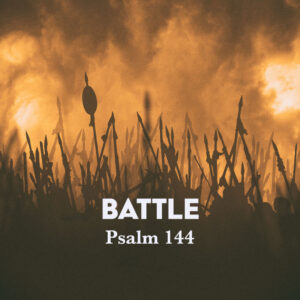
Life can sometimes feel like a battle. Endless demands. You get up early and work hard. Then there are the children. The bills. The taxes. On and on it goes: you fight for health, you fight to be heard, you fight to get good grades, you fight to do what is right. David was a real warrior in the most literal sense. And yet David knew it was God “who trains my hands for war, my fingers for battle” (144:1). What has David learned about battling with the Lord on his side, and with God training and equipping him?
First, that despite our inadequacy as humans, God still loves his people (144:2-4). We are but a “breath…a fleeting shadow” (144:4). But still, “He is my loving God and my fortress, my stronghold and my deliverer.” So the first lesson is to lean upon the character of God, not upon our own worthiness to receive his love and strength.
Second, that God is all-powerful (144:3-11). Certainly the battle is real. There is a “deadly sword” (144:10). There are lies and deceit (144:8). But, in wonderful imagery of God’s power, David draws upon the thunderstorm to evoke the kind of majestic might that God alone wields. “Send forth lightning and scatter the enemy” (144:6). The second lesson then is to lean upon the power of God, not be fearful of the power of people.
Third, David refuses to be brow-beaten by circumstances but looks to the future blessing of God in hope (144:12-15). “Then,” verse 12, David envisions, there will be all kinds of blessings. Sons and daughters thriving, barns full, sheep, oxen, no defeat by the enemy. All the signs of blessing in a material sense: family, economy and defense. But there is a much higher blessing still: “blessed is the people whose God is the Lord” (144:15). The greatest blessing of all is to know God and to be known by God. The third lesson then is to lean on hope, and not give in to despair when you are in the midst of the battle.
These are David’s lessons for fighting the good fight of faith, lessons from a real warrior who knew that God trained him for battle. Lean upon the character of God who loves you. Lean upon the power of God which protects you. Lean upon the hope of God that will not let you down.

ABOUT THE AUTHOR
Josh Moody (Ph.D., University of Cambridge) is the senior pastor of College Church in Wheaton, IL., president and founder of God Centered Life Ministries, and author of several books including How the Bible Can Change Your Life and John 1-12 For You.
WANT MORE?
To receive God Centered Life devotionals directly in your inbox, as well as other resources, enter your email address in the form at the bottom of this page and click “subscribe.”

Posts navigation
Psalm 145: The Greatness, the Love, and the Faithfulness of God! →
Devotionals
Get Pastor Josh’s Daily Devotional in your inbox.
Subscribe
BROADCAST
RESOURCES
ABOUT
DONATE
CONTACT GOD CENTERED LIFE
P.O. Box 1025, Wheaton, IL 60187

© 2025 God Centered Life. All Rights Reserved.
Website Designed By In the Light Studios

nullhttps://i.liadm.com/sync-container?duid=6da5b3141503–01k0wp6725gd8mr2a2zvhc1m7x&ds=did-003x&euns=1&s=&version=v3.13.0&cd=.godcenteredlife.org&pv=45c78ec4-8f91-4e94-bae6-f1b9f02e4ddb
Commentary and Lecture Notes
Search tools
AI Overview
+9
Psalm 144: Summary of themes and key insights
Psalm 144, attributed to King David, reflects themes of divine strength, human fragility, and God’s intervention in the lives of His people. This psalm, likely penned during a period of conflict or trouble, showcases David’s reliance on God for both victory in battle and prosperity for his nation.
Here’s a breakdown of the key elements and themes often highlighted in seminary lectures and commentaries on Psalm 144:
1. God as David’s strength and fortress (verses 1-11)
- Praise for God’s power and training: David begins by blessing God, describing Him as his Rock who trains his hands for war and his fingers for battle. This acknowledges God’s role in equipping him for leadership and warfare.
- A multitude of names for God: David uses various titles to express God’s multifaceted protection: “my lovingkindness,” “my fortress,” “my high tower,” “my deliverer,” “my shield,” and “my refuge”. This emphasizes the comprehensive nature of God’s care and provision.
- Human frailty and God’s amazing grace: David reflects on the insignificance and brevity of human life, contrasting it with God’s eternal existence and greatness. He marvels that God would be mindful of mankind, showcasing God’s unexpected care for the unworthy.
2. Prayer for divine intervention against enemies (verses 5-8, 11)
- Plea for God’s dramatic appearance: David appeals for God to “bow the heavens and come down” and to “touch the mountains so they smoke”. This imagery draws on powerful displays of God’s might and past interventions, such as those at Mount Sinai and against Pharaoh.
- Request for rescue from oppressive forces: He asks for deliverance from “deep waters” (likely symbolizing overwhelming danger) and from the grasp of deceitful foreigners.
- The nature of the enemies: These adversaries are portrayed as those who speak falsehood and act treacherously, highlighting the need for God’s protection from both physical and moral threats.
3. Anticipation of victory and commitment to praise (verses 9-10)
- Promise of a new song: David expresses his confidence in God’s deliverance by promising to sing a “new song” of praise, perhaps with musical accompaniment, according to Blue Letter Bible.
- God as the source of salvation: He proclaims that God “gives salvation to kings” and rescues His servant David, emphasizing God’s role in delivering his people from harm. This may even foreshadow the ultimate salvation found in the Son of David, Jesus Christ.
4. Prayer for national prosperity and peace (verses 12-15)
- Vision of flourishing generations: David desires for sons to be like strong plants and daughters like beautiful corner pillars of a palace, representing a healthy and thriving populace.
- Desire for abundance and security: He prays for full granaries, abundant livestock, and freedom from war and distress in the streets.
- Blessedness of God’s people: The psalm concludes by declaring the happiness of the people whose God is the Lord, emphasizing that true prosperity and peace are found in a right relationship with Him.
Theological implications
- God’s active involvement: The psalm underscores God’s active involvement in the lives of His people, providing strength, protection, and intervention in times of need.
- Balancing piety and warfare: Psalm 144 demonstrates that true piety is not detached from the struggles of life, but rather empowers individuals for spiritual warfare, while simultaneously fostering devotion to God.
- Holistic well-being: The psalm connects spiritual devotion to God with tangible blessings of family, prosperity, and peace, reminding us that God cares about every aspect of our lives.
- Reliance on God, not self-reliance: David’s humble acknowledgment of his frailty and dependence on God contrasts with worldly self-reliance, highlighting the importance of seeking God’s power and guidance in all endeavors.
- God’s unchanging nature: Despite the uncertainties of life, Psalm 144 reminds us that God remains committed to rescuing His people from deceit and delivering them into His truth.
This psalm serves as a powerful reminder for believers to trust in God’s strength, seek His blessings in all areas of life, and live as a testament to His transforming love.
Psalm 144 Study Bible
Jan 2, 2025 — Psalm 144 Study Bible. … Blessed Be the LORD, My Rock. Psalm 144 is a testament to the infinite power and grace of God, our rock and deliverer in times of tri…
Bible Hub
Psalm 144: Our Refuge and Deliverer – Logos Sermons
Aug 6, 2023 — You know that game where you interlock fingers with your opponent and squeeze and bend, trying to inflict enough pain to get your opponent to cry, “Mercy! Mercy…
Logos Sermons
Commentary on Psalms 144 by Matthew Henry – Blue Letter Bible
Psalm 144. The four preceding psalms seem to have been penned by David before his accession to the crown, when he was persecuted by Saul; this seems to have bee…
Blue Letter Bible
Psalm 144 Pulpit Commentary Homiletics – Bible Hub
He praises and blesses God: * For what God is to him. (Ver. 1.) “My Strength.” Perpetual demand arose for strength. Fierce foes were all around, and as formidab…
Bible Hub
Psalm 144 Summary – 5 Minute Bible Study – 2BeLikeChrist
Jan 20, 2025 — Psalm 144 Short Summary: In Psalm 144, David, the warrior king of Israel, asked the Lord to fight for their nation and send power from Heaven to defeat their cr…
2BeLikeChrist
Synopsis | TheBibleSays.com
Psalms 144:1 meaning. In this opening verse of Psalm 144, the psalmist, David, expresses profound gratitude for the divine strength that equips him for the chal…
TheBibleSays.com
Doxological Cohesion & Comprehensiveness Psalm 144 for …
Nov 18, 2023 — Doxological Cohesion & Comprehensiveness Psalm 144 for Worship * Piety & Polemics. The themes of warfare and worship, piety and polemics dance together harmonio…
Gospel Reformation Network
Study Guide for Psalm 144 by David Guzik – Blue Letter Bible
Aug 15, 2022 — A. Prayer and worship regarding seasons of war. * (Psalm 144:1-2) Praising God who blessed and helped David in battle. Blessed be the LORD my Rock, Who trains m…
Blue Letter Bible
Psalms 144 – The Pulpit Commentaries – StudyLight.org
That our daughters may be as cornerstones, polished (or, “carved”) after the similitude of a palace. The daughters are like carved pillars, lighting up the angu…
StudyLight.org
Dive deeper in AI Mode
AI responses may include mistakes. Learn more
Enduring Wordhttps://enduringword.comEnduring Word Bible Commentary Psalm 144
David Guzik commentary on Psalm 144, which was written by David in seasons of war, praising God for the blessing of peace.
Missing: seminary | Show results with: seminary
Blue Letter Biblehttps://www.blueletterbible.orgPsalm 144 by C. H. Spurgeon
Happy was the nation which he ruled; happy in its king, in its families, in its prosperity, and in the possession of peace; but yet more in enjoying true religion and worshipping Jehovah, the only living and true God. EXPLANATORY NOTES AND QUAINT SAYINGS. Whole Psalm.—The psalm, in its mingled tones of prayer and …
Missing: seminary | Show results with: seminary
God is, who we are, and what we can trust God to do for us. Psalm 144 helps us gain clarity in each of these areas, while pointing us to the final, climactic and eschatological victory of the Davidic Messiah, King Jesus. Our Lord is a Warrior and a blessing, as a warrior, to his people. 2) Psalm 144 is something of …
Missing: seminary | Show results with: seminary
biblestudydaily.orghttps://biblestudydaily.orgPsalms 144-150 – Bible Study Daily
Psalm 144 is a psalm of David in which he prays for God to give him victory in combat. In verses 1-2, David praises God as his rock who had trained him for battle. God is his love, fortress, stronghold, deliverer, and shield. In verses 3-11, David marvels that since life is short (like a vapor), God reaches out to …
Missing: seminary | Show results with: seminary
Bible.orghttps://bible.orgPsalm 144
Jan 2, 2014 — NASB, NKJV, NRSV, TEV, NJB. Prayer for Rescue and Prosperity MT Intro A Psalm of David. A Song To the Lord Who Preserves and Prospers His People, A King Prays for Deliverance, A King Thanks God for Victory, Hymn for War and Victory. 144:1-4, 144:1-2, 144:1-2, 144:1-2, 144:1-2. 144:3-4, 144:3-4 …
10:26
This content isn’t available. A chapter-by-chapter and verse-by-verse study of the Psalms taught by Pastor Paul LeBoutillier of Life Bible Ministry. Full study through Psalms plus study notes: http://www.lifebibleministry.com/psalms Studies through the entire Bible: http://www.lifebibleministry.com/through-the-bible …
3 key moments in this video
Missing: seminary | Show results with: seminary
People also search for
Logos Sermonshttps://sermons.logos.comPsalm 144
In fact, Psalm 2, which we looked at some time ago, sets the scene for the whole book of Psalms with an anointed warrior king who is the Son of God. With the power of God he subdues the nations and defeat’s God’s enemies. He reigns over God’s people with God’s anointing and God’s blessing.
StudyLight.orghttps://www.studylight.orgPsalms 144 – Clarke’s Commentary
Verse 1. PSALM CXLIV. The psalmist praises God for his goodness, 1, 2. Exclamations relative to the vanity of human life, 3, 4. He prays against his enemies, 5-8;. and extols God’s mercy for the temporal blessings enjoyed by. his people, 9-15. NOTES ON PSALM CXLIV. The Hebrew, and all the Versions, attribute this …
The Westminster Standardhttps://thewestminsterstandard.orgPsalm 144
This psalm was probably composed by David upon the occasion of his advancement to the throne, 1 Chron. 12, 2 Sam. 5, as Psalm 138, 75, etc. In it we have, (1.) Thankful acknowledgements of God’s relation to him, and condescending kindness towards him, ver. 1-4. (2.) Supplication for divine deliverance from his …
Missing: seminary | Show results with: seminary
Feb 16, 2022 — Psalm 144 (‘Of David‘) opens with the bold praises and declarations of a man- a king, indeed- who sounds supremely confident in who he is, and Whose he is. Moses talked back to God at the Burning Bush, protesting that he wasn’t half as competent at public speaking as the job description seemed to …
Get the answer you’re looking for added to the web
Your question will be shared with online publishers who may be able to answer it. When shared, it won’t be associated with your Google Account.
Make sure you don’t include any private info
Learn moreSubmit
People also search for
Results are not personalized
45404, Dayton, OH – From your device
Update location
AI overview is ready
Psalm Commentary
This website is AudioEye enabled and is being optimized for accessibility. To open the AudioEye Toolbar, press “shift + =”. Some assistive technologies may require the use of a passthrough function before this keystroke. For more information, activate the button labeled “Explore your accessibility options”.Skip To Main Content

Select a Bible Book Select Book GenesisExodusLeviticusNumbersDeuteronomyJoshuaJudgesRuth1 Samuel2 Samuel1 Kings2 Kings1 Chronicles2 ChroniclesEzraNehemiahEstherJobPsalmsProverbsEcclesiastesSong of SolomonIsaiahJeremiahLamentationsEzekielDanielHoseaJoelAmosObadiahJonahMicahNahumHabakkukZephaniahHaggaiZechariahMalachiMatthewMarkLukeJohnActsRomans1 Corinthians2 CorinthiansGalatiansEphesiansPhilippiansColossians1 Thessalonians2 Thessalonians1 Timothy2 TimothyTitusPhilemonHebrewsJames1 Peter2 Peter1 John2 John3 JohnJudeRevelation Select a ChapterSelect Chapter123456789101112131415161718192021222324252627282930313233343536373839404142434445464748495051525354555657585960616263646566676869707172737475767778798081828384858687888990919293949596979899100101102103104105106107108109110111112113114115116117118119120121122123124125126127128129130131132133134135136137138139140141142143144145146147148149150
Psalm 144 – War and Peace
Video for Psalm 144:
This psalm has the title A Psalm of David. It is believed to have been written near the time David came to be recognized as the king over all the tribes of Israel, and the psalm expresses David’s heart for the nation in both war and peace.
“It appears from verse 2 and verse 10 of this psalm, that it was composed after David’s accession to the throne. And it is evident, from verse 5, etc. that he had more enemies still to conquer, such as the Philistines, etc.” (George Horne)
A. Prayer and worship regarding seasons of war.
1. (1-2) Praising God who blessed and helped David in battle.
Blessed be the LORD my Rock,
Who trains my hands for war,
And my fingers for battle—
My lovingkindness and my fortress,
My high tower and my deliverer,
My shield and the One in whom I take refuge,
Who subdues my people under me.
a. Blessed be the LORD my Rock, who trains my hands for war: David was a remarkable warrior, who in today’s terms would be an elite special forces soldier. David killed many men in hand-to-hand combat, as described in 1 Samuel 17:48-50 and 18:26-27. Training is an essential part of success as a soldier, and David understood that it was the LORD who had trained his hands for war and his fingers for battle.
i. In his youth, David’s hands and fingers were familiar with “…the [shepherd’s] hook and [musician’s] harp, and not to the sword and spear; but God hath apted and abled them to feats of arms, and warlike exploits.” (Trapp)
ii. Adam Clarke listed the weapons he thought David intended: “…to use the sword, battle-axe, or spear…to use the bow and arrows, and the sling.”
iii. Who trains my hands for war: If a man or woman feels that God is training him or her to use spiritual weapons – such as the sword of the Spirit, the word of God – then training must always continue. It is never “who trained my hands for war,” but always in the present: who trains my hands for war.
iv. Spurgeon wrote of the danger of using some weapons without adequate training – a danger in both the natural and spiritual realms: “Untrained force is often an injury to the man who possesses it, and it even becomes a danger to those who are round about him; and therefore the psalmist blesses the Lord as much for teaching as for strength.”
b. My lovingkindness and my fortress, my high tower and my deliverer: David poured out names and titles for God, each representing some aspect of God’s character or help that had been of use in battle. David knew God’s help and presence in many ways, not just one or two.
i. Of all the names and titles, we note that David began with my lovingkindness (hesed, the great word for God’s loyal and covenant love). He loved and valued God for being his fortress, his high tower, his deliverer, his shield, his refuge, and his conquering victory. Yet first among all those was the gift from God of love, mercy, and faithfulness.
ii. “In Psalm 144 David is extremely personal as he confesses who he had found God to be. He says ‘my Rock,’ ‘my loving God,’ ‘my fortress,’ ‘my stronghold,’ ‘my deliverer,’ and ‘my shield’.” (Boice)
c. Who subdues my people under me: David likely wrote this after he was received as king over all the tribes of Israel (2 Samuel 5:1-5). If this psalm comes from an earlier period, he may have meant the subduing of the mighty men under his authority (as in 1 Samuel 22:1-2).
i. “Men who rule others should thank God if they succeed in the task. Such strange creatures are human beings, that if a number of them are kept in peaceful association under the leadership of any one of the Lord’s servants, he is bound to bless God every day for the wonderful fact.” (Spurgeon)
2. (3-4) The unexpected love and care of God for humanity.
LORD, what is man, that You take knowledge of him?
Or the son of man, that You are mindful of him?
Man is like a breath;
His days are like a passing shadow.
a. LORD, what is man, that You take knowledge of him? In the previous lines David exalted God’s great strength and victory. In light of that, it amazed David that God would have an interest in him, or in humanity in general.
i. Psalm 8:4 asks the same questions from a slightly different perspective. Here the emphasis is on the LORD as a warrior that none can oppose. In Psalm 8:4 the emphasis is on the power of God as Creator and sustainer of the universe.
ii. “The Lord thinks much of man, and in connection with redeeming love makes a great figure of him: this can be believed, but it cannot be explained.” (Spurgeon)
b. Or the son of man, that You are mindful of him? David used the common method of repetition to bring emphasis to the concept of God’s unusual and even unexpected care for humanity.
i. “Though I am king over my people, yet, alas, I am but a man. a base, sinful, mortal, and miserable creature; if compared with thee, less than nothing and vanity.” (Poole)
c. Man is like a breath: Having been responsible for the death of so many men, and having been so near to death himself, David knew how temporary human life was. It was as fleeting as a breath or a passing shadow.
i. “The psalmist does not present his petition before the Lord timidly but with boldness. He knows his God; and despite human shortcomings, he is convinced that the Lord does ‘care for him’ and ‘think of him.’” (VanGemeren)
3. (5-8) A plea for rescue from the great God.
Bow down Your heavens, O LORD, and come down;
Touch the mountains, and they shall smoke.
Flash forth lightning and scatter them;
Shoot out Your arrows and destroy them.
Stretch out Your hand from above;
Rescue me and deliver me out of great waters,
From the hand of foreigners,
Whose mouth speaks lying words,
And whose right hand is a right hand of falsehood.
a. Bow down Your heavens, O LORD, and come down: David used phrases and images from God’s appearance on Mount Sinai (Exodus 19:16-20) to give the sense of awe and even terror connected with God’s presence.
i. “He wants God to be as present in his day as he was when he revealed himself at Sinai.” (Boice)
ii. “In like manner, the church, or mystical body of Christ, is instant in prayer for the final completion of all her hope. She wisheth for the glorious day, when her God and Saviour shall bow the heavens, and come down to judgment, causing the mountains to smoke, and flame, and dissolve, and flow down before him; when his lightnings, those arrows of his indignation, and ministers of his vengeance, shall scatter the host of darkness, and destroy the anti-christian powers; when we shall be delivered from every enemy, and from all that hate us.” (Horne)
b. Rescue me and deliver me out of great waters: David asked that the same God of majestic awe would fight for him, sending forth lightning like arrows against the foreigners who fought against David with lies and falsehood.
i. During David’s days as a fugitive from Saul, he had many men who informed against him so they might gain favor with King Saul (1 Samuel 22:6-10, 23:19-20). David also likely faced whisperers and liars against his character when he was king. Like the greater Son of David, he was often lied about and slandered.
ii. When David spoke against these foreigners, it was not because of their nationality. By their actions they proved that they were truly foreigners from the people of God and rejected Yahweh, the God of Israel.
iii. “Those against whom he pleaded were out of covenant with God; they were Philistines and Edomites; or else they were men of his own nation of black heart and traitorous spirit, who were real strangers, though they bore the name of Israel!” (Spurgeon)
B. Praise and prayer to God for the blessing of peace.
1. (9-10) Praise to the God who rescues.
I will sing a new song to You, O God;
On a harp of ten strings I will sing praises to You,
The One who gives salvation to kings,
Who delivers David His servant
From the deadly sword.
a. I will sing a new song to You, O God: New victories and new deliverance required a new song. God’s love and help for David were always fresh and new, so his praise would also be.
i. I will sing a new song: “Upon the receipt of any new mercy, like as in a lottery, at every new prize drawn the trumpet soundeth.” (Trapp)
b. On a harp of ten strings I will sing praises to You: David was a skilled musician (1 Samuel 16:18), and he played his harp of ten strings as he sang praises to God.
c. The One who gives salvation to kings: David had felt God’s help many times as a humble shepherd boy (1 Samuel 17:34-36) and as a despised fugitive (1 Samuel 23:24-29). We sense that David was almost surprised that God would also help him as king, rescuing him from the deadly sword.
2. (11-15) Praying that the enemy be defeated so that God’s people would prosper.
Rescue me and deliver me from the hand of foreigners,
Whose mouth speaks lying words,
And whose right hand is a right hand of falsehood—
That our sons may be as plants grown up in their youth;
That our daughters may be as pillars,
Sculptured in palace style;
That our barns may be full,
Supplying all kinds of produce;
That our sheep may bring forth thousands
And ten thousands in our fields;
That our oxen may be well laden;
That there be no breaking in or going out;
That there be no outcry in our streets.
Happy are the people who are in such a state;
Happy are the people whose God is the LORD!
a. Rescue me and deliver me from the hand of foreigners: David here repeated the idea from earlier in the psalm (Psalm 144:7-8). The presence and destructive work of these foreign liars and false speakers were of great concern to him, and he pleaded with God to rescue him.
b. That our sons may be as plants grown up in their youth: David prayed for a series of blessings that would come among God’s people when God dealt with the evil speakers in their midst. The list of blessings focuses on the concerns of everyday people in farming societies:
· Blessed with children in the home; well-rooted and flourishing sons, and stable and stately daughters.
· Blessed in the work of their hands, with barns full, ten thousands of sheep, and oxen burdened with heavy harvests.
· Blessed with safety and peace in the community, with no violence (breaking in or going out) or riot over injustice (outcry in our streets).
i. “The Lord had promised to bless his people with stalwart youth, productivity, and prosperity, and to protect them from enemy attacks and humiliation (cf. Leviticus 26:1-13; Deuteronomy 28:1-14; Psalm 132:13-18).” (VanGemeren)
ii. Daughters may be as pillars: “…the daughters as the very picture of statuesque elegance and strength, ‘like sculptured pillars at the corners of a palace’ (New English Bible). There has been nothing slipshod in their upbringing.” (Kidner)
iii. “We desire a blessing for our whole family, daughters as well as sons. For the girls to be left out of the circle of blessing would be unhappy indeed.” (Spurgeon)
iv. No breaking in or going out: “So well ordered is the police of the kingdom, that there are no depredations, no robbers, house-breakers, or marauding parties, in the land; no sudden incursions of neighbouring tribes or banditti breaking into fields or houses, carrying away property, and taking with them the people to sell them into captivity: there is no such breaking in, and no such going out, in the nation.” (Clarke)
c. Happy are the people who are in such a state: David prayed as a wise and caring king, asking God for blessing upon his people in their common, everyday lives.
i. “This mercy I beg, not only for my own sake, but for the sake of thy people, that thine and our enemies being subdued, and peace established in the land, thy people may enjoy those blessings which thou hast promised to them.” (Poole)
ii. “These verses may with a little accommodation be applied to a prosperous church, where the converts are growing and beautiful, the gospel stores abundant, and the spiritual increase most cheering. There ministers and workers are in full vigour, and the people are happy and united. The Lord make it so in all our churches evermore.” (Spurgeon)
d. Happy are the people whose God is the LORD: Yet such blessings could only come to God’s covenant people when they were loyal to God as they had promised to be loyal (Exodus 24:3-8). When they looked to Yahweh as their only God and Master, rejecting all the idols of the nations, the promised blessings were granted – and God’s people were happy.
i. What was true for David and Israel under the Old Covenant is even truer for the believer in Jesus under the New Covenant. It should be said of believers, Happy are the people whose God is the LORD. This is our promise and heritage as believers, followers of Jesus Christ.
ii. “Those who worship the happy God become a happy people.” (Spurgeon)
iii. “The prayer ends at the source of the harmony it has visualized. For while it treasures the gifts, it reserves its final beatitude for the relationship behind them: that of being the people who know the Lord as their own.” (Kidner)
3Shares
© 1996-2025 Copyright – The Enduring Word Bible Commentary by David Guzik | Site Hosted & Maintained by Local View Digital Marketing | Privacy Policy
Psalm 144 Lecture Notes



Menu
Search (e.g. John 3:16, Jesus faith love)KJV

← Back to David Guzik’s Bio & Resources
David Guzik :: Study Guide for Psalm 144
War and Peace
This psalm has the title A Psalm of David. It is believed to have been written near the time David came to be recognized as the king over all the tribes of Israel, and the psalm expresses David’s heart for the nation in both war and peace.
“It appears from verse 2 and verse 10 of this psalm, that it was composed after David’s accession to the throne. And it is evident, from verse 5, etc. that he had more enemies still to conquer, such as the Philistines, etc.” (George Horne)
A. Prayer and worship regarding seasons of war.
1. (Psalm 144:1-2) Praising God who blessed and helped David in battle.
Blessed be the LORD my Rock,
Who trains my hands for war,
And my fingers for battle—
My lovingkindness and my fortress,
My high tower and my deliverer,
My shield and the One in whom I take refuge,
Who subdues my people under me.
a. Blessed be the LORD my Rock, who trains my hands for war: David was a remarkable warrior, who in today’s terms would be an elite special forces soldier. David killed many men in hand-to-hand combat, as described in 1 Samuel 17:48-50 and 18:26-27. Training is an essential part of success as a soldier, and David understood that it was the LORD who had trained his hands for war and his fingers for battle.
i. In his youth, David’s hands and fingers were familiar with “…the [shepherd’s] hook and [musician’s] harp, and not to the sword and spear; but God hath apted and abled them to feats of arms, and warlike exploits.” (Trapp)
ii. Adam Clarke listed the weapons he thought David intended: “…to use the sword, battle-axe, or spear…to use the bow and arrows, and the sling.”
iii. Who trains my hands for war: If a man or woman feels that God is training him or her to use spiritual weapons — such as the sword of the Spirit, the word of God — then training must always continue. It is never “who trained my hands for war,” but always in the present: who trains my hands for war.
iv. Spurgeon wrote of the danger of using some weapons without adequate training — a danger in both the natural and spiritual realms: “Untrained force is often an injury to the man who possesses it, and it even becomes a danger to those who are round about him; and therefore the psalmist blesses the Lord as much for teaching as for strength.”
b. My lovingkindness and my fortress, my high tower and my deliverer: David poured out names and titles for God, each representing some aspect of God’s character or help that had been of use in battle. David knew God’s help and presence in many ways, not just one or two.
i. Of all the names and titles, we note that David began with my lovingkindness (hesed, the great word for God’s loyal and covenant love). He loved and valued God for being his fortress, his high tower, his deliverer, his shield, his refuge, and his conquering victory. Yet first among all those was the gift from God of love, mercy, and faithfulness.
ii. “In Psalm 144 David is extremely personal as he confesses who he had found God to be. He says ‘my Rock,’ ‘my loving God,’ ‘my fortress,’ ‘my stronghold,’ ‘my deliverer,’ and ‘my shield’.” (Boice)
c. Who subdues my people under me: David likely wrote this after he was received as king over all the tribes of Israel (2 Samuel 5:1-5). If this psalm comes from an earlier period, he may have meant the subduing of the mighty men under his authority (as in 1 Samuel 22:1-2).
i. “Men who rule others should thank God if they succeed in the task. Such strange creatures are human beings, that if a number of them are kept in peaceful association under the leadership of any one of the Lord’s servants, he is bound to bless God every day for the wonderful fact.” (Spurgeon)
2. (Psalm 144:3-4) The unexpected love and care of God for humanity.
LORD, what is man, that You take knowledge of him?
Or the son of man, that You are mindful of him?
Man is like a breath;
His days are like a passing shadow.
a. LORD, what is man, that You take knowledge of him? In the previous lines David exalted God’s great strength and victory. In light of that, it amazed David that God would have an interest in him, or in humanity in general.
i. Psalm 8:4 asks the same questions from a slightly different perspective. Here the emphasis is on the LORD as a warrior that none can oppose. In Psalm 8:4 the emphasis is on the power of God as Creator and sustainer of the universe.
ii. “The Lord thinks much of man, and in connection with redeeming love makes a great figure of him: this can be believed, but it cannot be explained.” (Spurgeon)
b. Or the son of man, that You are mindful of him? David used the common method of repetition to bring emphasis to the concept of God’s unusual and even unexpected care for humanity.
i. “Though I am king over my people, yet, alas, I am but a man. a base, sinful, mortal, and miserable creature; if compared with thee, less than nothing and vanity.” (Poole)
c. Man is like a breath: Having been responsible for the death of so many men, and having been so near to death himself, David knew how temporary human life was. It was as fleeting as a breath or a passing shadow.
i. “The psalmist does not present his petition before the Lord timidly but with boldness. He knows his God; and despite human shortcomings, he is convinced that the Lord does ‘care for him’ and ‘think of him.’” (VanGemeren)
3. (Psalm 144:5-8) A plea for rescue from the great God.
Bow down Your heavens, O LORD, and come down;
Touch the mountains, and they shall smoke.
Flash forth lightning and scatter them;
Shoot out Your arrows and destroy them.
Stretch out Your hand from above;
Rescue me and deliver me out of great waters,
From the hand of foreigners,
Whose mouth speaks lying words,
And whose right hand is a right hand of falsehood.
a. Bow down Your heavens, O LORD, and come down: David used phrases and images from God’s appearance on Mount Sinai (Exodus 19:16-20) to give the sense of awe and even terror connected with God’s presence.
i. “He wants God to be as present in his day as he was when he revealed himself at Sinai.” (Boice)
ii. “In like manner, the church, or mystical body of Christ, is instant in prayer for the final completion of all her hope. She wisheth for the glorious day, when her God and Saviour shall bow the heavens, and come down to judgment, causing the mountains to smoke, and flame, and dissolve, and flow down before him; when his lightnings, those arrows of his indignation, and ministers of his vengeance, shall scatter the host of darkness, and destroy the anti-christian powers; when we shall be delivered from every enemy, and from all that hate us.” (Horne)
b. Rescue me and deliver me out of great waters: David asked that the same God of majestic awe would fight for him, sending forth lightning like arrows against the foreigners who fought against David with lies and falsehood.
i. During David’s days as a fugitive from Saul, he had many men who informed against him so they might gain favor with King Saul (1 Samuel 22:6-10, 23:19-20). David also likely faced whisperers and liars against his character when he was king. Like the greater Son of David, he was often lied about and slandered.
ii. When David spoke against these foreigners, it was not because of their nationality. By their actions they proved that they were truly foreigners from the people of God and rejected Yahweh, the God of Israel.
iii. “Those against whom he pleaded were out of covenant with God; they were Philistines and Edomites; or else they were men of his own nation of black heart and traitorous spirit, who were real strangers, though they bore the name of Israel!” (Spurgeon)
B. Praise and prayer to God for the blessing of peace.
1. (Psalm 144:9-10) Praise to the God who rescues.
I will sing a new song to You, O God;
On a harp of ten strings I will sing praises to You,
The One who gives salvation to kings,
Who delivers David His servant
From the deadly sword.
a. I will sing a new song to You, O God: New victories and new deliverance required a new song. God’s love and help for David were always fresh and new, so his praise would also be.
i. I will sing a new song: “Upon the receipt of any new mercy, like as in a lottery, at every new prize drawn the trumpet soundeth.” (Trapp)
b. On a harp of ten strings I will sing praises to You: David was a skilled musician (1 Samuel 16:18), and he played his harp of ten strings as he sang praises to God.
c. The One who gives salvation to kings: David had felt God’s help many times as a humble shepherd boy (1 Samuel 17:34-36) and as a despised fugitive (1 Samuel 23:24-29). We sense that David was almost surprised that God would also help him as king, rescuing him from the deadly sword.
2. (Psalm 144:11-15) Praying that the enemy be defeated so that God’s people would prosper.
Rescue me and deliver me from the hand of foreigners,
Whose mouth speaks lying words,
And whose right hand is a right hand of falsehood—
That our sons may be as plants grown up in their youth;
That our daughters may be as pillars,
Sculptured in palace style;
That our barns may be full,
Supplying all kinds of produce;
That our sheep may bring forth thousands
And ten thousands in our fields;
That our oxen may be well laden;
That there be no breaking in or going out;
That there be no outcry in our streets.
Happy are the people who are in such a state;
Happy are the people whose God is the LORD!
a. Rescue me and deliver me from the hand of foreigners: David here repeated the idea from earlier in the psalm (verses 7-8). The presence and destructive work of these foreign liars and false speakers were of great concern to him, and he pleaded with God to rescue him.
b. That our sons may be as plants grown up in their youth: David prayed for a series of blessings that would come among God’s people when God dealt with the evil speakers in their midst. The list of blessings focuses on the concerns of everyday people in farming societies:
- Blessed with children in the home; well-rooted and flourishing sons, and stable and stately daughters.
- Blessed in the work of their hands, with barns full, ten thousands of sheep, and oxen burdened with heavy harvests.
- Blessed with safety and peace in the community, with no violence (breaking in or going out) or riot over injustice (outcry in our streets).
i. “The Lord had promised to bless his people with stalwart youth, productivity, and prosperity, and to protect them from enemy attacks and humiliation (cf. Leviticus 26:1-13; Deuteronomy 28:1-14; Psalm 132:13-18).” (VanGemeren)
ii. Daughters may be as pillars: “…the daughters as the very picture of statuesque elegance and strength, ‘like sculptured pillars at the corners of a palace’ (New English Bible). There has been nothing slipshod in their upbringing.” (Kidner)
iii. “We desire a blessing for our whole family, daughters as well as sons. For the girls to be left out of the circle of blessing would be unhappy indeed.” (Spurgeon)
iv. No breaking in or going out: “So well ordered is the police of the kingdom, that there are no depredations, no robbers, house-breakers, or marauding parties, in the land; no sudden incursions of neighbouring tribes or banditti breaking into fields or houses, carrying away property, and taking with them the people to sell them into captivity: there is no such breaking in, and no such going out, in the nation.” (Clarke)
c. Happy are the people who are in such a state: David prayed as a wise and caring king, asking God for blessing upon his people in their common, everyday lives.
i. “This mercy I beg, not only for my own sake, but for the sake of thy people, that thine and our enemies being subdued, and peace established in the land, thy people may enjoy those blessings which thou hast promised to them.” (Poole)
ii. “These verses may with a little accommodation be applied to a prosperous church, where the converts are growing and beautiful, the gospel stores abundant, and the spiritual increase most cheering. There ministers and workers are in full vigour, and the people are happy and united. The Lord make it so in all our churches evermore.” (Spurgeon)
d. Happy are the people whose God is the LORD: Yet such blessings could only come to God’s covenant people when they were loyal to God as they had promised to be loyal (Exodus 24:3-8). When they looked to Yahweh as their only God and Master, rejecting all the idols of the nations, the promised blessings were granted — and God’s people were happy.
i. What was true for David and Israel under the Old Covenant is even truer for the believer in Jesus under the New Covenant. It should be said of believers, Happy are the people whose God is the LORD. This is our promise and heritage as believers, followers of Jesus Christ.
ii. “Those who worship the happy God become a happy people.” (Spurgeon)
iii. “The prayer ends at the source of the harmony it has visualized. For while it treasures the gifts, it reserves its final beatitude for the relationship behind them: that of being the people who know the Lord as their own.” (Kidner)
© 2020 The Enduring Word Bible Commentary by David Guzik — ewm@enduringword.com
References:
- Boice, James Montgomery “Psalms: An Expostional Commentary” Volume 3 (Psalms 107-150) (Grand Rapids, Michigan: Baker Books, 1998)
- Clarke, Adam “Clarke’s Commentary: The Holy Bible Containing the Old and New Testaments with a Commentary and Critical Notes” Volume 3 (Job-Song of Solomon) (New York: Eaton and Mains, 1827)
- Horne, George “Commentary on the Psalms” (Audubon, New Jersey: Old Paths Publications, 1997 of a 1771 edition)
- Kidner, Derek “Psalms 73-150: A Commentary” (Kidner Classic Commentaries) (Leicester, England: Inter-Varsity Press, 1975)
- Poole, Matthew “A Commentary on the Holy Bible” Volume 2 (Psalms-Malachi) (London: Banner of Truth Trust, 1968)
- Spurgeon, Charles Haddon “The Treasury of David: Volume 3” (Psalms 111-150) (Peabody, Massachusetts: Hendrickson, 1988)
- Trapp, John “A Commentary on the Old and New Testaments” Volume 2 (Ezra to Psalms) (Eureka, California: Tanski Publications, 1997)
- VanGemeren, Willem A. “Psalms: The Expositor’s Bible Commentary” Volume 5 (Psalms-Song of Songs) (Grand Rapids, Michigan: Zondervan, 1991)
Updated: August 2022
Study Guide for Job 1← Prior Book
Study Guide for Proverbs 1Next Book →
Study Guide for Psalm 143← Prior Chapter
Study Guide for Psalm 145Next Chapter →Return to Top
← Back to David Guzik’s Bio & Resources
CONTENT DISCLAIMER:
The Blue Letter Bible ministry and the BLB Institute hold to the historical, conservative Christian faith, which includes a firm belief in the inerrancy of Scripture. Since the text and audio content provided by BLB represent a range of evangelical traditions, all of the ideas and principles conveyed in the resource materials are not necessarily affirmed, in total, by this ministry.
View Desktop Site
BLB Institute BLB Blog Newsletters
Blue Letter Bible study tools make reading, searching and studying the Bible easy and rewarding.
Blue Letter Bible is a 501(c)(3) nonprofit organization
©2025 Blue Letter Bible | Privacy Policy
Psalm 144:4
https://biblehub.com/commentaries/vmenus/psalms/144-4.htmhttps://biblehub.com/bmcom/psalms/144-4.htm
Bible > Commentaries > Psalm 144:4
Man is like to vanity: his days are as a shadow that passeth away.
Jump to: Barnes • Benson • BI • Calvin • Cambridge • Clarke • Darby • Ellicott • Expositor’s • Exp Dct • Gaebelein • GSB • Gill • Gray • Guzik • Haydock • Hastings • Homiletics • JFB • KD • Kelly • King • Lange • MacLaren • MHC • MHCW • Parker • Poole • Pulpit • Sermon • SCO • TTB • TOD • WES • TSK
EXPOSITORY (ENGLISH BIBLE)
Ellicott’s Commentary for English Readers
(4) Vanity . . . shadow.—See Psalm 39:5-6; Psalm 102:11. The occasion of the introduction of these sentiments here is not quite clear. It may be the humility of the warrior who ascribes all success to God instead of to human prowess, or it may be a reflection uttered over the corpses of comrades, or, perhaps, a blending of the two.
Matthew Henry’s Concise Commentary
144:1-8 When men become eminent for things as to which they have had few advantages, they should be more deeply sensible that God has been their Teacher. Happy those to whom the Lord gives that noblest victory, conquest and dominion over their own spirits. A prayer for further mercy is fitly begun with a thanksgiving for former mercy. There was a special power of God, inclining the people of Israel to be subject to David; it was typical of the bringing souls into subjection to the Lord Jesus. Man’s days have little substance, considering how many thoughts and cares of a never-dying soul are employed about a poor dying body. Man’s life is as a shadow that passes away. In their highest earthly exaltation, believers will recollect how mean, sinful, and vile they are in themselves; thus they will be preserved from self-importance and presumption. God’s time to help his people is, when they are sinking, and all other helps fail.
The idea of Job is, that there is no substance, nothing that is permanent. A shadow moves on gently and silently, and is soon gone. It leaves no trace of its being, and returns no more. They who have watched the beautiful shadow of a cloud on a landscape, and have seen how rapidly it passes ever meadows and fields of grain, and rolls up the mountain side and disappears, will have a vivid conception of this figure. How gently yet how rapidly it moves. How soon it is gone. How void of impression is its course. Who can track its way; who can reach it? So man moves on. Soon he is gone; he leaves no trace of his being, and returns no more.
Psalm 144:4Man is like to vanity – See the notes at Psalm 39:5-6; Psalm 62:9. The idea here is, that man can be compared only with that which is utterly vain – which is emptiness – which is nothing.
His days are as a shadow that passeth away – See the notes at Psalm 102:11 : “My days are like a shadow that declineth.” The idea is essentially the same. It is, that as a shadow has no substance, and that as it moves along constantly as the sun declines, until it vanishes altogether, so man has nothing substantial or permanent, and so he is constantly moving off and will soon wholly disappear.
Jamieson-Fausset-Brown Bible Commentary
PSALM 144
Ps 144:1-15. David’s praise of God as his all-sufficient help is enhanced by a recognition of the intrinsic worthlessness of man. Confidently imploring God’s interposition against his enemies, he breaks forth into praise and joyful anticipations of the prosperity of his kingdom, when freed from vain and wicked men.
Man is like, in his nature and continuance in the world,
to vanity, or to a vapour or a breath, as Isaiah 57:13, which is gone in an instant.
That passeth away; or, that declineth, as Psalm 102:11 109:23; that groweth less and less, till it be quite out of sight, and lost.
Gill’s Exposition of the Entire Bible
Man is like to vanity,…. Is vanity itself, in every age, state, and condition; yea, in his best estate, Psalm 39:5; or, “to the breath” (h) of the mouth, as Kimchi; which is gone as soon as seen almost: or, to a vapour (i); to which the life of man is compared, James 4:14;
his days are as a shadow that passeth away; as the former denotes the frailty and mortality of man, this the shortness of his duration; his days fleeing away, and of no more continuance than the shadow cast by the sun, which presently declines and is gone.
(h) “halitui”, Muis; so Kimchi. (i) “Vapori”, Cocceius; so the Syriac and Arabic versions.
Man is like to vanity: his days are as a shadow that passeth away.
EXEGETICAL (ORIGINAL LANGUAGES)
Cambridge Bible for Schools and Colleges
4. vanity] Or, a breath, unsubstantial and evanescent (a different word from that in Psalm 144:8; Psalm 144:11). Cp. Psalm 39:5; Psalm 39:11; Psalm 62:9.
his days &c.] Cp. Psalm 102:11; Psalm 109:23; Job 8:9; Ecclesiastes 6:12.
Verse 4. – Man is like to vanity; or, “to a breath” (comp. Psalm 39:5; Psalm 62:9). His days are as a shadow that passeth away (see Psalm 102:11; Psalm 119:23). And yet God has regard to this weak creature of an hour. Psalm 144:4
Keil and Delitzsch Biblical Commentary on the Old Testament
It is evident that Psalm 144:3 is a variation of Psalm 8:5 with the use of other verbs. ידע in the sense of loving intimacy; חשּׁב, properly to count, compute, here rationem habere. Instead of כּי followed by the future there are consecutive futures here, and בּן־אדם is aramaizingly (בּר אנשׁ) metamorphosed into בּן־אנושׁ. Psalm 144:4 is just such another imitation, like a miniature of Psalm 39:6., Psalm 39:11, cf. Psalm 62:10. The figure of the shadow is the same as in Psalm 102:12, cf. Psalm 109:23. The connection of the third stanza with the second is still more disrupt than that of the second with the first.
Links
Psalm 144:4 Interlinear
Psalm 144:4 Parallel Texts
Psalm 144:4 NIV
Psalm 144:4 NLT
Psalm 144:4 ESV
Psalm 144:4 NASB
Psalm 144:4 KJV
Psalm 144:4 Bible Apps
Psalm 144:4 Parallel
Psalm 144:4 Biblia Paralela
Psalm 144:4 Chinese Bible
Psalm 144:4 French Bible
Psalm 144:4 German Bible
Bible Hub
null
null
null
null


null
Surrender is for Everyone


21 July
Surrender is for everyone
Page 211
“If, after a period of time, we find ourselves in trouble with our recovery, we have probably stopped doing one or more of the things that helped us in the earlier stages of our recovery.“
Basic Text, p. 95
❖
Surrender is just for newcomers, right? Wrong!
After we’ve been around awhile, some of us succumb to a condition particular to oldtimers. We think we know something about recovery, about God, about NA, about ourselves–and we do. The problem is, we think we know enough, and we think that merely knowing is enough. But it’s what we learn and what we do after we think we know it all that really makes the difference.
Conceit and complacency can land us in deep trouble. When we find that “applying the principles” on our own power just isn’t working, we can practice what worked for us in the beginning: surrender. When we find we are still powerless, our lives again unmanageable, we need to seek the care of a Power greater than ourselves. And when we discover that self-therapy isn’t so therapeutic after all, we need to take advantage of “the therapeutic value of one addict helping another.”
❖
Just for Today: I need guidance, support, and a Power beyond my own. I will go to a meeting, reach out to a newcomer, call my sponsor, pray to my Higher Power–I will do something that says, “I surrender.”All NAWS subscriptions are free. We are able to provide this service due, in part, to the generous contributions of our members. If you are a member, you can make a contribution here: www.na.org/contribute
UNSUBSCRIBE to stop receiving all NAWS emails.
UPDATE SUBSCRIPTION PREFERENCES to update which emails you receive.
NA World Services, Inc.
19737 Nordhoff Place
Chatsworth, CA 91311
Copyright © 2025 by Narcotics Anonymous World Services, Inc. All Rights Reserved.
More Questions than Answers
null
Trump sharpens the axe for the Education Department. Swing away, Mr. President. | Opinion
Despite the Department of Education’s massive budget, students in the U.S. far too often lag behind peers in other industrialized countries.

USA TODAY
null
null
- The federal government is the largest employer in the U.S., and the Trump administration is reducing its size.
- Layoffs have occurred at the State and Education Departments, the latter of which has a $268 billion budget despite declining student test scores.
- USA TODAY columnist Nicole Russell argues that reducing the federal bureaucracy in education will give more control to states and local districts, leading to better choices for parents.
- The author notes that federal job cuts are happening amidst a larger trend of companies restructuring and adapting to technological changes.
The largest employer in the United States isn’t a Fortune 100 company like Alphabet, Amazon or Apple. It’s the federal government − and that’s a problem.
Thankfully, President Donald Trump continues to slash bureaucratic bloat. On July 11, the administration sent layoff notices to more than 1,300 State Department workers, and three days later, the Supreme Court allowed Trump to move forward with plans to gut the Department of Education.
That’s bad news for government employees, but great for taxpayers, especially given the Education Department’s expense − $268 billion in the last fiscal year − and its lack of effectiveness.
Despite the department’s massive budget, students in the U.S. far too often lag behind peers in other industrialized countries. In 2022, for example, American high school students scored behind teens from 25 other countries on an international math test.
And we’re losing ground. Math and reading scores on the National Assessment of Educational Progress continue to decline. Part of the drop can be attributed to pandemic-related learning loss, but reading scores in the U.S. began to decline in 2019 − before Americans had even heard of COVID-19.Need a break? Play the USA TODAY Daily Crossword Puzzle.
But how will pulling the federal government out of K-12 education help? It’s important to note that more than 90% of public school funding comes from state and local governments along with foundations and other private sources.
Much of the federal education budget is used to feed the bureaucracy, which generates rules and regulations that local administrators and teachers must obey. If all of that bureaucratic oversight consistently produced better results, there might be a case for keeping it. But the data clearly shows it doesn’t.
Stories worth knowing.
Unlock all the stories for as low as $4.99 per month.
Removing federal bureaucrats from our schools should give states and local school districts more flexibility to set education policy, and that should improve choices for parents like me. Returning more control to the states also should improve efficiency and enable schools to better meet students’ needs.Opinion: Our schools are struggling because teachers unions don’t put kids first
Government efficiency is vital for the American people
Trump isn’t cutting jobs only at the Education Department, of course. The State Department layoffs follow reductions at other federal agencies this spring.
The cuts are driven by necessity: our national debt is now more than $37 trillion and the annual budget deficit will top $1 trillion again this year.https://www.usatodaynetworkservice.com/tangstatic/html/usat/sf-q1a2z3584c02f3.min.html
So, I was surprised to see news reports paint the laid off State Department workers as heroic. Cameras caught teary goodbyes and applause for well-liked employees. I don’t recall the same concern when President Joe Biden halted construction of the Keystone Pipeline, which cost 1,500 workers their jobs and eliminated plans to create thousands more.Opinion: PBS, NPR push liberal propaganda. Trump is right to cut their funding.
Companies often restructure. So should the federal government.
While job loss is certainly scary, and I don’t wish it on anyone, federal job cuts should be put in the context of the overall jobs market.
Microsoft announced this month it would eliminate 9,000 jobs, not because the company is failing but because it’s retooling as the market changes. Other companies, including Intel and Meta, have announced plans to restructure this year as the emergence of artificial intelligence and other technology changes how Americans work.
The federal government should be as flexible as our top companies in adapting to a changing world.
Yet, progressives have criticized the Trump administration’s efforts to restructure the federal bureaucracy as cruel.
The president’s job, however, isn’t to employ as many bureaucrats as possible. It’s to deliver effective services as efficiently as possible to taxpayers. Dismantling ineffective and inefficient bureaucracies like the Education Department is a long overdue step toward achieving that goal.
Nicole Russell is a columnist at USA TODAY and a mother of four who lives in Texas. Contact her at nrussell@gannett.com and follow her on X, formerly Twitter: @russell_nm. Sign up for her weekly newsletter, The Right Track, here.https://www.usatodaynetworkservice.com/tangstatic/html/usat/sf-q1a2z3584c02f3.min.htmlCatastrophe for a Kansas TV stationMore for Subscribers
 Site Title