Good Morning Everyone ! I want to inform all of you that I am feeling better now. The antibiotics are doing it’s job by removing the excess mucus and phlegm that is inside of my lungs. I know that I am in need of a breathing treatment, but my doctor ordered me a nebulizer with the medicine that I need in order to stay alive. God has been good to me on a daily basis. Thank you for your prayers and support . God Bless All of You! May The Lord God Continue to Bless You
I do have a question. How come people enjoy talking about your past rather than edifying you altogether?
1 Timothy 5:24-25
Search tools
Search Results
Featured snippet from the web
1 Timothy 5:24 In-Context24 Some men’s sins are clearly evident, preceding them to judgment, but those of some men follow later. 25 Likewise, the good works of some are clearly evident, and those that are otherwise cannot be hidden.
1 Timothy 5:24 NKJV – “Some men’s sins are clearly evident, preceding …
First Epistle to Timothy
Web results
Bible Gatewayhttps://www.biblegateway.com1 Timothy 5:24 NKJV – New King James Version
Some men’s sins are clearly evident, preceding them to judgment, but those of some men follow later.
People also ask
Is NKJV more accurate than KJV?
What is the meaning of 1 Timothy 5/24?
Is God near to the brokenhearted NKJV?
Can not serve two masters in NKJv?
Feedback
Web results
Some men’s sins are clearly evident, preceding them to judgment, but those of some men follow later. Likewise, the good works of some are clearly.
biblia.comhttps://biblia.com1 Timothy 5:24 NKJV – Some men’s sins are… – Biblia
1 Timothy 5:24 — King James Version (KJV 1900) … 24 Some men’s sins are open beforehand, going before to judgment; and some men they follow after.
Web results
Bible.comhttps://www.bible.comI Timothy 5:24-25 NKJV
Do not lay hands on anyone hastily, nor share in other people’s sins; keep yourself pure. NKJV: New King James Version. Read I Timothy 5.
BibleRef.comhttps://www.bibleref.comWhat does 1 Timothy 5:24 mean?
KJV Some men’s sins are open beforehand, going before to judgment; and some men they follow after. NKJV Some men’s sins are clearly evident, preceding them to …
Blue Letter Biblehttps://www.blueletterbible.org1 Timothy 5:24 :: New King James Version (NKJV)
1 Timothy 5:24 NKJV – Some men’s sins are clearly evident, preceding [them] to judgment, but those of some [men] follow later.
Bible.comhttps://www.bible.com1 Timothy 5:24 Share
1 Timothy 5:24 New King James Version (NKJV) · Some men’s sins are clearly evident, preceding them to judgment, but those of some men follow later. Share. Read …
People also search for
Web results
NASB 1995. The sins of some men are quite evident, going before them to judgment; for others, their sins follow after. American Standard Version
Read 1 Timothy 5 NKJV in the New King James Bible: “Do not rebuke an older man, but exhort him as a father, younger men as brothers,”
Page Navigation
Footer Links
Results are personalized-Try without personalization
45404, Dayton, OH – From your device
Update location
Psalm 73:19 Commentary & Meaning!
Search ESV NIV NASB CSB NLT KJV NKJV Psalms73
Verse
1 2 3 4 5 6 7 8 9 10 11 12 13 14 15 16 17 18 19 20 21 22 23 24 25 26 27 28
Psalm 73:19
ESVHow they are destroyed in a moment,swept away utterly by terrors!
NIVHow suddenly are they destroyed,completely swept away by terrors!
NASBHow they are destroyed in a moment! They are utterly swept away by sudden terrors!
CSBHow suddenly they become a desolation!They come to an end, swept away by terrors.
NLTIn an instant they are destroyed,completely swept away by terrors.
KJVHow are they brought into desolation, as in a moment! they are utterly consumed with terrors.
NKJVOh, how they are brought to desolation, as in a moment!They are utterly consumed with terrors.
What does Psalm 73:19 mean?
Asaph’s revelation about the wicked (Psalm 73:17–18) included the fact that God’s judgment of them will be sudden (Acts 12:23). They will be destroyed in a moment. Terror will hold them in a death grip. This is at least a partial answer to the bitterness (Psalm 73:21) and angst of his initial complaint (Psalm 73:2–3). It is frustrating to suffer while honoring God, only to see some who defy Him living what appear to be comfortable lives. And yet, not only does their sin put them at risk of disaster (Proverbs 9:13–18), it guarantees them an eternity of judgment (Hebrews 9:27).
Just as the wicked people of Asaph’s day seemed stable and happy, so too did the later king of Babylon, Belshazzar. Just as his judgment came with sudden catastrophe, so will be the end of those who reject God and celebrate their own sin (Psalm 73:8–9).
Belshazzar arrogantly hosted an elaborate banquet for a thousand of his lords and drank wine in front of them (Daniel 5:1). He and all his guests committed blasphemy by drinking wine from the temple’s vessels and by praising idols (Daniel 5:2–4). But suddenly God announced Belshazzar’s judgment by a finger that wrote on the plaster of a wall. Belshazzar was so terrified by the mysterious writing that he was notably shaken (Daniel 5:6). He learned from the prophet Daniel that God found him lacking and his kingdom would fall to the Medes and Persians (Daniel 5:26–28). That night those enemies seized the kingdom and Belshazzar was killed (Daniel 5:30–31).
CollapseContext Summary
Psalm 73:15–28 gives a fitting resolution to Asaph’s complaint (Psalm 73:2–3). He was disturbed by the contrast between the seemingly prosperous wicked and the difficulties of the righteous. Many today feel the same conflict. An eternal perspective gave the answer he needed to those hard examples. In short, wickedness does come with risks, and earthly life is not all there is to our existence. Even in the context of the natural world, evil invites negative consequences and disaster. In eternity, judgment on godlessness is absolutely guaranteed.
ExpandChapter Summary
Seeing godless people thrive, even as they hatefully mock God, while believers suffer, leads many people to a crisis of faith. This was the case for Asaph. Using exaggerated imagery, he complains to the Lord that it seems as if evil people have easy lives, while godly people suffer. Further reflection reminds Asaph that sin does lead to consequences, both in this life and the next. He confesses his sins of bitterness and resolves to trust God more deeply.
ExpandWhat is the Gospel?


Download the app:


BibleRef.com is part of Got Questions Ministries
For answers to your Bible questions, please visit


Follow Us:
© Copyright 2002-2025 Got Questions Ministries. All rights reserved.
www.BibleRef.com| Sitemap| Books of the Bible| Passages
THE HOLY BIBLE, NEW INTERNATIONAL VERSION®, NIV® Copyright© 1973, 1978, 1984, 2011 by Biblica®.
The Holy Bible, New Living Translation, Copyright© 1996, 2004, 2007. Used by permission of Tyndale House Publishers, Inc. Carol Stream, Illinois 60188.
The Holy Bible, English Standard Version® Copyright© 2001 by Crossway Bibles, a publishing ministry of Good News Publishers.
New American Standard Bible Copyright© 1960 – 2020 by The Lockman Foundation.
Christian Standard Bible®, Copyright© 2017 by Holman Bible Publishers. Used by Permission.
This is something that I have been suffering from for 20 years now.
Locations:


Abu Dhabi|Canada|Florida|London|Nevada|Ohio

Nasal Polyps
Nasal polyps are soft, painless, noncancerous growths that can form in the lining of your nose or sinuses. They happen most often in people with asthma, allergies, repeat infections or nasal inflammation. Medication and outpatient surgery can shrink nasal polyps and relieve symptoms.ContentsOverviewSymptoms and CausesDiagnosis and TestsManagement and TreatmentPreventionOutlook / PrognosisLiving WithAdditional Common Questions
Overview
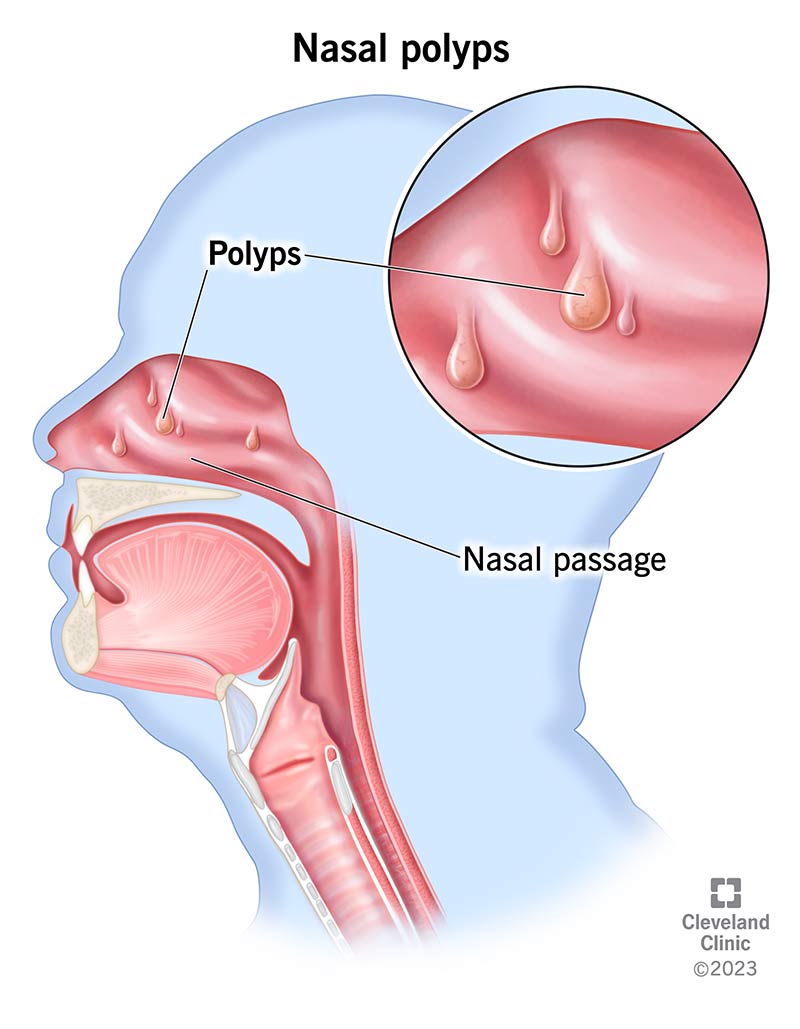
Nasal polyps range in size from small teardrops to large grapes.
What are nasal polyps?
Nasal polyps are painless and benign (noncancerous) growths. They form in the mucosa (thin, soft tissue) that lines your nasal and sinus passages. They usually appear on both sides of your nose. Nasal polyps can get irritated and swollen, making it hard for you to breathe through your nose.
Advertisement
null
Cleveland Clinic is a non-profit academic medical center. Advertising on our site helps support our mission. We do not endorse non-Cleveland Clinic products or services. Policy
Small polyps are teardrop-shaped. But as they grow larger, they often resemble peeled grapes that are pink, yellow or gray.
Nasal polyps affect up to 40% of the general population. Anyone can get them. But they’re twice as common in men. Many people get them in their 30s or 40s. But the overall risk increases with age.
Nasal polyposis is another name for nasal polyps.
Symptoms and Causes
Nasal polyp symptoms
Small polyps in your nose might not cause symptoms at all. But if they start to grow, you could develop:
- Nasal congestion (stuffy nose).
- Rhinorrhea (runny nose).
- Headaches.
- Loss of taste and smell.
- Nosebleeds.
- Postnasal drip.
- Sinus pressure.
- Snoring.
When polyps grow large enough, they can block your nasal passages and sinuses, leading to:
- Frequent asthma attacks (in people with asthma).
- Repeated sinus infections (sinusitis).
- Sleep apnea or other sleep disorders.
- Difficulty breathing, even in people who don’t have asthma.
https://imasdk.googleapis.com/js/core/bridge3.685.0_en.html#fid=goog_1387742610Nasal polyps are soft, painless, noncancerous growths that can form in the lining of your nose or sinuses.
Nasal polyp causes
Healthcare providers know that inflammation causes nasal polyps. But they don’t know why some people go on to develop polyps because of inflammation while others don’t.
Chronic sinusitis — from allergies, infection or asthma — seems to be the most common reason polyps appear. Chronic sinusitis refers to nasal and sinus inflammation that’s lasted three months or longer. But several risk factors could contribute to the development of nasal polyps.
Advertisement
null
Risk factors
A risk factor is something that increases your chance of getting a certain condition. Nasal polyp risk factors include existing health conditions like:
- Asthma.
- Allergic rhinitis (hay fever).
- Chronic sinus infections.
- Cystic fibrosis.
- Hypersensitivity to certain NSAIDs (nonsteroidal anti-inflammatory drugs).
Genetics may also play a role in the development of nasal polyps. For instance, certain gene mutations (changes) may impact how your nasal tissues react to inflammation.
Complications of nasal polyps
Ongoing sinus infections associated with nasal polyps can result in rare but serious complications like:
- Bone infection (osteomyelitis) and bone loss.
- Abscesses (pockets of infection) that can spread to your eye sockets and brain.
- Meningitis (infection of the tissues around your brain and spinal cord).
Diagnosis and Tests
How doctors diagnose nasal polyps
To diagnose nasal polyps, a healthcare provider will start with a physical examination. During this appointment, they may:
- Look inside your nose with a scope (a thin, tubelike instrument with a camera and light).
- Review your medical history (with a focus on allergies, asthma or sinus infections).
- Ask about your symptoms and how long you’ve had them.
Tests used to diagnose nasal polyps
If your healthcare provider needs more information, they may order one of these imaging tests to help them determine the size and location of each polyp:
Your provider may also recommend allergy testing. This can help them identify allergens that lead to nasal inflammation and polyps.
Management and Treatment
How are nasal polyps treated?
Nasal polyp treatment depends on the severity of your condition. Medication and surgery are the two main approaches.
Even with surgical removal, nasal polyps may grow back over time. Your healthcare provider will talk to you about the likelihood of recurrence (return) and how you can manage it.
Medication
Medication usually doesn’t get rid of nasal polyps, but it can ease symptoms. Common treatments include:
- Steroid nasal sprays to shrink polyps and improve symptoms.
- Oral steroids (pills you swallow) like prednisone.
- Biologic medications, such as dupilumab injections. (Dupilumab contains monoclonal antibodies that stimulate your immune system and may shrink nasal polyps.)
Your healthcare provider also may prescribe antibiotics if you have an infection.
Surgery for nasal polyps
If medication doesn’t work — or if you have large polyps — you may need sinus surgery to remove them. Your provider may use nasal endoscopy to do one of these minimally invasive procedures:
- Polypectomy. A healthcare provider uses tiny instruments — like surgical scissors or snares — to grab onto and remove the polyps inside your nose. (A surgical snare is like a lasso that wraps around a polyp.)
- Balloon sinuplasty. A surgeon threads a small balloon through your nostril and into your sinus cavity. They slowly inflate the balloon to unblock your nasal passages. In some cases, they’ll remove nasal polyps at the same time.
- Functional endoscopic sinus surgery (FESS). A surgeon uses small instruments to remove polyps, diseased tissue, damaged bone and anything else that obstructs your nasal passages.
Advertisement
All these procedures are minimally invasive. That means your surgeon does everything through your nostrils. So, you won’t have visible incisions or sutures.
Care at Cleveland Clinic
Prevention
Can nasal polyps be prevented?
It’s not always possible to prevent nasal polyps. But here are a few things you can do to reduce your risk:
- Take all medications exactly as directed.
- Avoid breathing airborne allergens or irritants that can lead to nose and sinus inflammation.
- Use a humidifier in your home to help moisten your breathing passages.
- Use a saline nasal rinse or spray to flush out allergens or other irritants.
- Practice good hygiene.
Outlook / Prognosis
What can I expect if I have nasal polyps?
Treatment can help you get rid of nasal polyps and make it easier for you to breathe through your nose. But unfortunately, polyps can come back after treatment. Some people need to stay on steroid medications or have repeat surgery to manage them.
People with loss of taste (ageusia) and loss of smell (anosmia) may not see a total improvement of symptoms after treatment. Ask your healthcare provider what you should expect in your case.
Living With
When should I see my healthcare provider?
Schedule an appointment with your healthcare provider if you have nasal polyp symptoms that last longer than 10 days.
Additionally, let your provider know if you notice a single growth on one side of your nose. This could be a nasal or paranasal tumor rather than a polyp.
Advertisement
What questions should I ask my doctor?
Consider asking your healthcare provider:
- How can I lessen the symptoms?
- Do I need medications, surgery or both?
- Should I restrict my activities?
- Do I need to see a specialist?
- Should I go to the emergency room for any symptoms?
Additional Common Questions
Will nasal polyps go away on their own?
In some cases, nasal polyps can shrink on their own over time. But they rarely go away. People who have severe symptoms will likely need treatment.
Can you see nasal polyps by looking up your nose?
You usually can’t see nasal polyps by looking up your own nose. But if they grow large enough, a provider might be able to see them if they look up your nose with a nasoscope (lighted tool).
Can nasal polyps get dislodged?
Trauma or blowing your nose really hard can cause nasal polyps to swell or become dislodged. Nasal steroid sprays may help reduce inflammation and help the polyps return to their original position.
How can I remove nasal polyps at home?
You should never — under any circumstances — try to remove nasal polyps yourself. Doing so can lead to injury, excessive bleeding and infection.
A note from Cleveland Clinic
Nasal polyps can make your nose feel stuffy all the time. Left untreated, they can interfere with your breathing and ultimately lead to bone and tissue damage. If you develop nasal polyp symptoms, tell your healthcare provider right away. They can find a treatment option that works for your situation.
Advertisement
Medically Reviewed
Last reviewed on 01/16/2024.
Learn more about the Health Library and our editorial process.
References
Ad
null
Appointments 216.444.8500
Actions
Appointments & AccessAccepted InsuranceEvents CalendarFinancial AssistanceGive to Cleveland ClinicPay Your Bill OnlineRefer a PatientPhone DirectoryVirtual Second OpinionsVirtual Visits
Blog, News & Apps
Consult QDHealth EssentialsNewsroomMyClevelandClinicMyChart
About Cleveland Clinic
100 Years of Cleveland ClinicAbout UsLocationsQuality & Patient SafetyOffice of Diversity & InclusionPatient ExperienceResearch & InnovationsCommunity CommitmentCareersFor EmployeesResources for Medical Professionals
Site Information & Policies
Send Us FeedbackSite MapAbout this WebsiteCopyright, Reprint & LicensingWebsite Terms of UsePrivacy PolicyNotice of Privacy PracticesNon-Discrimination Notice
9500 Euclid Avenue, Cleveland, Ohio 44195 | 800.223.2273 | © 2025 Cleveland Clinic. All Rights Reserved.
Nasal or Paranasal Tumor

Nasal and paranasal tumors
Overview
Nasal and paranasal tumors are growths that begin in and around the passageway within the nose. Nasal tumors begin in the main passageway within the nose, called the nasal cavity. Paranasal tumors begin in air-filled chambers around the nose, called the paranasal sinuses.
Advertisement
null
Mayo Clinic does not endorse companies or products. Advertising revenue supports our not-for-profit mission.Advertising & Sponsorship
Some nasal and paranasal tumors aren’t cancerous. These noncancerous tumors also are called benign tumors. They can grow to block the flow of air through the nose.
Other nasal and paranasal tumors are cancers. Cancerous tumors also are called malignant tumors. They can grow to invade and destroy healthy body tissue. In time, the cells can break away and spread to other parts of the body.
Several types of nasal and paranasal tumors exist. The type of tumor you have helps determine the best treatment for you.
Products & Services
Show more products from Mayo Clinic
Symptoms
Signs and symptoms of nasal and paranasal tumors can include:
- Difficulty breathing through the nose.
- Frequent headaches.
- Loss of the sense of smell.
- Nosebleeds.
- Discharge from the nose.
- Facial swelling or pain.
- Watery eyes.
- A sore on the roof of the mouth.
- Vision problems.
- A lump in the neck.
- Difficulty opening the mouth.
When to see a doctor
Make an appointment with a doctor or other healthcare professional if you have any symptoms that worry you.
Causes
Nasal and paranasal tumors happen when cells in the nasal cavity or chambers around the nose develop changes in their DNA. A cell’s DNA holds the instructions that tell a cell what to do. In healthy cells, the DNA gives instructions to grow and multiply at a set rate. The instructions also tell the cells to die at a set time. In tumor cells, the changes give different instructions. The changes tell the tumor cells to make many more cells quickly. Tumor cells can keep living when healthy cells would die. This causes too many cells.
Sometimes the changes in the DNA turn the cells into cancer cells. Cancer cells can invade and destroy healthy body tissue. In time, cancer cells can break away and spread to other parts of the body. When cancer spreads, it’s called metastatic cancer.
Risk factors
Factors that may increase the risk of nasal and paranasal tumors include:
- Smoking tobacco increases the risk. This includes cigarettes, cigars and pipes.
- Being exposed to air pollution. Breathing in polluted air increases the risk of nasal and paranasal tumors.
- Being exposed to chemicals and irritants in the air at work. These may include wood dust, fumes from glue, rubbing alcohol and formaldehyde, and dust from flour, chromium and nickel.
- Being exposed to human papillomavirus, also called HPV. HPV is a common virus that’s passed through sexual contact. For most people, it causes no problems and goes away on its own. For others, it causes changes in cells that can lead to many types of cancer.
Prevention
To reduce your risk of nasal and paranasal tumors, you can:
- Stop smoking. If you don’t use tobacco, don’t start. If you currently use tobacco of any kind, talk with a healthcare professional about strategies to help you quit.
- Protect yourself at work. Follow your workplace safety rules for protecting yourself from harmful fumes and irritants in the air, such as wearing a face mask.
- Ask about the HPV vaccine. Receiving a vaccination to prevent HPV infection may reduce your risk of HPV-related cancers. Ask your doctor or other healthcare professional whether an HPV vaccine is right for you.
Nasal and paranasal tumors care at Mayo Clinic
Oct. 24, 2023
Advertisement
Mayo Clinic does not endorse companies or products. Advertising revenue supports our not-for-profit mission.Advertising & Sponsorship
Living with nasal and paranasal tumors?
Connect with others like you for support and answers to your questions in the Head & Neck Cancer support group on Mayo Clinic Connect, a patient community.
Head & Neck Cancer Discussions
Scheduled for a Vermilionectomy for premalignant lip tissue
34 RepliesSun, Feb 09, 2025
How do I go through 6 weeks radiation and chemotherapy, alone?
41 RepliesSat, Feb 01, 2025
Newly diagnosed and scared: How did you cope?
42 RepliesMon, Feb 10, 2025
See more discussionsShow references
Related
Products & Services
Show more products and services from Mayo Clinic
Advertisement
Mayo Clinic Press
Check out these best-sellers and special offers on books and newsletters from Mayo Clinic Press.
- NEW: Mayo Clinic Guide to Better Sleep – Mayo Clinic PressNEW: Mayo Clinic Guide to Better Sleep
- Listen to Health Matters Podcast – Mayo Clinic PressListen to Health Matters Podcast
- Mayo Clinic on Incontinence – Mayo Clinic PressMayo Clinic on Incontinence
- The Essential Diabetes Book – Mayo Clinic PressThe Essential Diabetes Book
- FREE Mayo Clinic Diet Assessment – Mayo Clinic PressFREE Mayo Clinic Diet Assessment
- Mayo Clinic Health Letter – FREE book – Mayo Clinic PressMayo Clinic Health Letter – FREE book
CON-20198269
Fuel groundbreaking medical research!
Your donation powers the future of medicine and helps save lives.
About Mayo Clinic
Medical Professionals
Businesses
Students
Researchers
International Patients
Charitable Care & Financial Assistance
Community Health Needs Assessment
Follow Mayo Clinic
Get the Mayo Clinic app
- Terms and Conditions
- Privacy Policy
- Notice of Privacy Practices
- Notice of Nondiscrimination
- Accessibility Statement
- Advertising and Sponsorship Policy
- Site Map
Language:English
© 1998-2025 Mayo Foundation for Medical Education and Research (MFMER). All rights reserved.
Feedback
Daily Quiz Results

gettyimages
WOW!! You’re in the top 6%.
You are phenomenal!! Only 6% of Americans completed these American idioms and phrases. You are an exceptional thinker. You automatically read letter combinations and scan through texts without losing your focus. You have a purpose for reading, and you subconsciously monitor that purpose while reading a text. You catch satire and puns, and you can usually predict what is about happen in movies and books. Let us know below if we are spot on.
IQ Test

17 / 20
YOUR IQ IS 149!
Genius!! Your IQ is 149 and your general knowledge is exceptional. You must be curious, well-read, and a life-long learner, but can you get a PERFECT score in a basic geography test? Try the next quiz to find out. It’s worth it:)
Barbershop Equality Causes Staph Infection
Search tools
Search Results
AI Overview
AI Overview
Yes, barbershop equipment, like combs, scissors, and razors, can be a source of staph infection if not properly cleaned and disinfected between clients, as Staphylococcus aureus (staph bacteria) can easily transfer from one person to another through contaminated tools, potentially causing skin infections like folliculitis or “barber’s rash” when a small cut or abrasion is present on the scalp or face.
Key points about staph infections in barbershops:
- Transmission:Staph bacteria can be readily transferred through contact with unhygienic tools, towels, or even the barber’s hands if proper hand hygiene is not practiced.
- Symptoms:A staph infection from a barbershop might manifest as red, pus-filled bumps, irritation, or inflammation at the site of a cut or nick.
- Prevention:
- Proper disinfection: Thoroughly cleaning and disinfecting all equipment between clients using a hospital-grade disinfectant.
- Single-use items: Using disposable razors or blades when necessary.
- Hand hygiene: Barbers should frequently wash their hands with soap and water.
7 Gross Infections You Can Get From the Barber – Men’s Health
May 3, 2018 — Rossi, MD, dermatologist at Dermatologic, Mohs, Cosmetic & Laser Surgery. “It looks like tiny white pustules (filled with pus).” It’s usually caused …
Men’s Health
Bumps from Haircut: Causes, Treatment, and Prevention
Dec 14, 2020 — Folliculitis (barber’s rash) If you develop red, itchy, or pus-filled, pimple-like bumps after your haircut, you may have an inflammation of the hai…
Healthline
Infections acquired in barbershops – A review in – AKJournals
Nov 22, 2024 — Since barbers work with non-sterile and reusable sharp objects, a simple nick might facilitate blood-borne infections. In our review article we summ…
AKJournals
Potential risk of HIV transmission in barbering practice among …
Though barbers do not carry out procedures that deliberately penetrate the skin, the procedures can inadvertently damage the skin through abrasion or minor acci…
National Institutes of Health (NIH) (.gov)
Barbers’ compliance with biological hazard preventive measures …
Oct 29, 2023 — Globally, 2 billion people have HBV infection, with more than 350 million being chronically infected. … On the other hand, ringworm, infestation o…
National Institutes of Health (NIH) (.gov)
Hair Woe Fixes Treating Barbers Rash – BEVEL
Sep 13, 2024 — Dr. Kari: Yes, it is definitely possible to contract Barber’s rash from a barber. If they are not properly cleaning and disinfecting their tools in …
BEVEL
This is for informational purposes only. For medical advice or diagnosis, consult a professional. Generative AI is experimental.
Export
Save
Featured snippet from the web
Bacterial pathogensThe results showed that even in one of the examined barbershops methicillin-resistant Staphylococcus aureus (MRSA) bacteria were found. In addition, higher bacterial burdens were detected if the hairdryers were used for 20 if compared to 10 seconds [28].Nov 22, 2024
Infections acquired in barbershops – A review in – AKJournals
Feedback
People also ask
Can you get a staph infection from a barber?
Can you get a staph infection from gym equipment?
Can barbers spread diseases?
Can you get an infection from barber clippers?
Feedback
Web results
Men’s Healthhttps://www.menshealth.com7 Gross Infections You Can Get From the Barber
May 3, 2018 — It’s usually caused by staph bacteria, which can be transmitted through improperly sanitized combs, scissors, or razors. Advertisement – …
Discussions and forums
Can I sue a hair salon for giving me a staph infection? – Legal AnswersAvvo · 5y
After all it was their unsanitized equipment that gave me a staph infection. … caused your infection. You will also have to prove that …More
hair cuts and infections – BarberReddit · r/Barber · 5 comments · 2y
Web results
by SA Al Yousef · 2021 · Cited by 4 — Barbershops are ideal places for the interactive spread of infections, including community-associated methicillin-resistant Staphylococcus aureus (CA-MRSA).
Missing: Equipment Causes
It’s possible but unlikely, assuming they sterilize their equipment appropriately. The scalp has a rich blood supply and it is relatively …
People also search for
Staph infection
Impetigo
Boil
Skin infections
Folliculitis
Fungal infection
Urinary tract infection
Abscess
For informational purposes only. Consult your local medical authority for advice.Learn more
Infection from barber clippers treatment
Can you get HIV from barber clippers
Hairdresser dermatitis treatment
Feedback
Web results
DermNethttps://dermnetnz.orgSkin problems in hairdressers and barbers
Bacterial infection (impetigo, boils and folliculitis) is usually caused by Staphylococcus aureus and or Streptococcus pyogenes. … Personal protective equipment …
Punch Newspapershttps://punchng.comTreating seven infections you can get from barbershop
Nov 16, 2019 — One of the infections one can from barbershop is the barber’s itch. It is a form of folliculitis that develops in the beard area or scalp.
Missing: Equipment | Show results with: Equipment
Learn how to safeguard against staph infections from haircuts and barber equipment. Avoid the risks associated with barber clippers and hair …
Missing: Causes | Show results with: Causes
GQOTD-What are common signs of a Staphylococcus infection that, you as a barber may see on a client?
Missing: Causes | Show results with: Causes
Punch Newspapershttps://punchng.comSeven infections you can contract from a barber’s
Jun 5, 2021 — The only disease some people thought they could contract from a barber’s is the Human Immunodeficiency Virus through an infected clipper.
Get the answer you’re looking for added to the web
Your question will be shared with online publishers who may be able to answer it. When shared, it won’t be associated with your Google Account.
Make sure you don’t include any private info
Learn moreSubmit
People also search for
Page Navigation
Footer Links
Results are personalized-Try without personalization
45404, Dayton, OH – From your device
Update location
AI overview is ready
Infection in the skin

Filters and Topics
Search tools
Search Results
Staph infection
Also called: staphylococcus infection
Main Results
Requires a medical diagnosis
Common symptoms include boils and oozing blisters. Staph can also cause food poisoning resulting in nausea, vomiting, and stomach ache. In rare cases, staph infections can turn deadly if the bacteria invade deeper into the body or enters the bloodstream resulting in fever, joint, and muscle pain.
People may experience:
Pain areas: in the abdomen or skin
Skin: blister, boil, impetigo, rashes, or redness
Gastrointestinal: diarrhea, nausea, or vomiting
Whole body: chills or fever
Also common: abscess, pus, or swelling
For informational purposes only. Consult your local medical authority for advice.
Sources: Mayo Clinic and others. Learn more
Web results
Mayo Clinichttps://www.mayoclinic.orgStaph infections – Symptoms & causes
A staph infection in food usually doesn’t cause a fever. Signs and symptoms you can expect with this type of staph infection include: Nausea and vomiting. …
OverviewSymptomsWhen to see a doctorCauses
People also ask
Is staph contagious?
AI Overview
+3
Yes, staph is contagious and can spread from person to person through skin-to-skin contact, shared items, or contaminated surfaces.
How staph is spread
- Skin-to-skin contact: Staph can spread through direct contact with an infected person.
- Shared items: Staph can spread through sharing towels, soap, toothbrushes, or sports equipment.
- Contaminated surfaces: Staph can spread through touching surfaces that are often touched, like phones or doorknobs.
- Food preparation: Staph can spread if food handlers don’t wash their hands properly.
- Coughing and sneezing: Staph can spread through droplets in coughs and sneezes, but this is less common.
How to prevent staph
- Wash your hands
- Keep wounds clean and covered
- Finish the entire course of antibiotics, even if you feel better
- Avoid sharing personal items
Who is at risk for staph infections?
- People with lowered immune systems
- People who frequently use communal environments
- Athletes who participate in sports with skin-to-skin contact
- Healthcare workers or patients
This is for informational purposes only. For medical advice or diagnosis, consult a professional. Generative AI is experimental. Learn more
Fact Sheet: Staph Skin Infections – Georgia Department of Public Health
Touching skin-to-skin can spread staph from one person to another. Staph can be picked up from surfaces that are often touched, like phones or doorknobs. Someti…
Georgia Department of Public Health
Staph infections – Symptoms & causes – Mayo Clinic
Staph bacteria can spread easily through cuts, scrapes and skin-to-skin contact. Staph infections may also spread in the locker room through shared razors, towe…
Mayo Clinic
Is staph infection contagious? Duration, signs, transmission
Jul 6, 2021 — When antibiotics are involved, finishing the entire course is vital, even if a person begins to feel better before they complete the final dose. Once…
MedicalNewsToday
Staph infection – NHS
The bacteria that cause staph infections live harmlessly on many people’s skin, often in the nose and armpits and on the buttocks. They usually only cause an in…
NHS
Staph Infection | Primary Care – Mercy Health
Children in daycare — children can transfer infections between each other, children in daycare are exposed to more germs and have lower immunity built up to fig…
Mercy Health
STAPH INFECTION – CDC
Staphylococcus aureus, called “staph” for short, is one of the most common germs found on people’s skin and in their noses. Most of the time it doesn’t do any h…
CDC
What are 5 ways a person can catch MRSA?
Does staph infection stay with you for life?
How do you know if you have a staph infection?
Will staph go away on its own?
What ointment kills staph?
Feedback
Web results
Jun 7, 2022 — A staph infection on the skin can present as small pus-filled lumps with folliculitis, larger lumps with abscesses and boils and irregular scabs with impetigo.
MedlinePlus (.gov)https://medlineplus.govStaphylococcal Infections
Nov 8, 2023 — Skin infections can look like pimples or boils. · Bone infections can cause pain, swelling, warmth, and redness in the infected area.
Bone InfectionStaph infections – self-care at…ImpetigoSkin InfectionsCellulitisMRSA
Images
Images
Staph Infection: Symptoms, Diagnosis, Treatment, and More
Verywell Health
Symptoms of Staph Infection
Everyday Health
Staph Skin Infections and MRSA Treatments
Verywell Health
3 Ways to Recognize Staph Infection Symptoms – wikiHow
wikiHow
Web results
Depending upon the site of infection (skin, heart, lungs or joints), symptoms may range from skin lesions, fever, extreme tiredness, pneumonia, arthritis and …
Discussions and forums
Well, now, you can see a doctor who can do the lab work and diagnose it for you (we can’t …More
Top answer · 3 votes
MRSA infections start out as small red bumps that can quickly turn into deep, painful abscesses. …More
What are the symptoms of Staphylococcus aureus and its effects on humans?Quora · 3 answers · 3y
Web results
nhs.ukhttps://www.nhs.ukStaph infection
Check if you have a staph skin infection. Symptoms of a staph skin infection can include: A painful red lump or bump on the skin. Picture of a boil on the …
Apr 15, 2024 — Signs and symptoms Staph infections can look like pimples, boils or other skin conditions. In healthcare settings, staph infections can be …
Mayo Clinichttps://www.mayoclinic.orgMRSA infection – Symptoms & causes
Staph skin infections, including MRSA , generally start as swollen, painful red bumps that might look like pimples or spider bites. The affected area might be:.
Videos
7:09What Is a Staph Infection? – Causes, Symptoms & Treatments – VideoStudy.com · The Study.com Video TeamFeb 16, 2024
1:11Staph infections can kill, March 2019, Vital SignsYouTube · Centers for Disease Control and Prevention (CDC)Mar 5, 2019
1:24Diagnosing and treating staph infectionYouTube · WellMed Medical ManagementNov 21, 2019
staph infections are relatively easy to diagnose and sometimes no test is necessary to diagnose that clinicians doctors nurse practitioners.
More videos
Feedback
People also search for
Staph infection Stages pictures
Fastest way to cure staph infection
Is Staphylococcus a toilet infection
How long does it take for a staph infection to kill you
Page Navigation
Footer Links
Results are not personalized
45404, Dayton, OH – Based on your past activity
Update location
Staph Infection


0Best Post-Holiday DealsPlanners to Buy Right NowBrooks January SalesTested Nike Walking ShoesHoka Vs. Asics
What Is a Staph Infection? Here’s 6 Symptoms to Look For and When to See a Doctor
When left untreated, staph infection symptoms can become life-threatening.by Markham Heid, Korin Miller and Madeleine HaaseUpdated: Mar 1, 2023

Save Article
How To Wash Your Hands
Good Housekeeping US
Current Time 0:35
Total Duration 0:48

We may earn commission from links on this page, but we only recommend products we back. Why Trust Us?


Jump to:
- What is a staph infection?
- Types of staph infections
- Who is at risk for staph infections?
- Signs and symptoms of a staph infection
- How is a staph infection diagnosed?
- How is a staph infection treated?
- How to prevent a staph infection
- When to see a doctor about staph infection symptoms
Any kind of infection can sound scary at first, but it’s important to understand what’s going on with you and your body so that you can get the help you need. Staph infections, given how common they are, can particularly trigger panic if you aren’t sure what to attribute your symptoms to. Here, we’ve consulted both dermatologists and infectious disease experts to explain exactly what staph infection symptoms you should look for if you suspect something’s wrong.
Advertisement – Continue Reading Below
What is a staph infection?
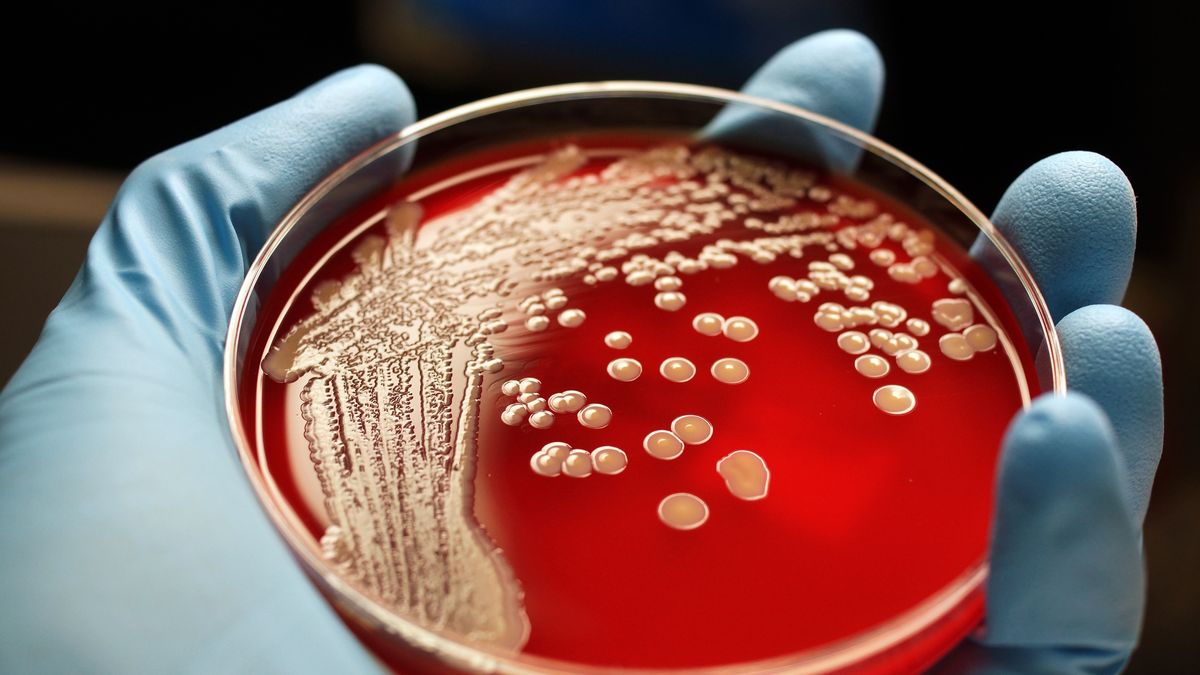
Put simply, a staph infection is caused by a specific type of bacteria, typically Staphylococcus aureus, though other strains can also cause infection, says William B. Miller, Jr. M.D., infectious disease expert, evolutionary biologist, and author of Bioverse: How the Cellular World Contains the Secrets to Life’s Biggest Questions. “Staphylococcus bacteria are very widely distributed on nearly all surfaces and some staph normally live on our skin.” Staph infections are extremely common, estimated at over one million cases annually in the United States, he adds. “Most are mild and do not need treatment.”
Staphylococcus is a group of bacteria and there are more than 30 different types, per the U.S. National Library of Medicine. They are known as “commensal” microorganisms because they’re friendly enough to live on our bodies without causing any problems, says Paul Fey, Ph.D., medical director of the University of Nebraska Medical Center’s department of pathology and microbiology. “You can find staph in your nose, on your skin, and sometimes in other mucous membranes like your anus,” he explains.
Advertisement – Continue Reading Below
null
null
Types of staph infections
While staph bacteria are courteous houseguests when confined to their normal quarters, they can cause infections and illness (most commonly caused by Staphylococcus aureus) if they gain access to areas of your body where they don’t belong. There are different types of staph infections, Dr. Fey says, and they show up in different ways.
“Staph infections most commonly develop when there is a break in the skin, giving the staph an entry point for infection,” explains Joshua Zeichner, M.D., director of cosmetic and clinical research in dermatology at Mount Sinai Hospital in New York City. “This may occur after regular cuts and scrapes, nicks from shaving, or even open skin because of athlete’s foot.”
Advertisement – Continue Reading Below
null
In addition to minor local infections, staph can also cause a serious immune system reaction to an infection known as sepsis, says Gary Goldenberg, M.D., assistant clinical professor of dermatology at the Icahn School of Medicine at Mount Sinai Hospital. “People can die from a staph infection if it gets into the bloodstream or infects internal organs,” he says.
Who is at risk for staph infections?
Anyone can get a staph infection, says Dr. Miller. “Some people carry staph bacteria that are harmless to them but can cause symptomatic infection in others which can be spread by person-to-person contact.” In other cases, there are identifiable underlying risk factors.
Advertisement – Continue Reading Below
In particular, individuals who are immunosuppressed because of chronic diseases (e.g. types of diabetes, HIV), cancer treatment, or recently post-operative, are more susceptible. Anyone with a heart valve, indwelling catheter, or artificial joint is at higher risk. Drug use is specifically associated with a higher risk for staph infections. Staphylococcus infections can also be spread through improper food handling, leading to food poisoning.
Most staph infections, especially those that involve the skin, are transmitted by skin-to-skin contact, adds Richard Watkins, M.D., infectious diseases physician and a professor of medicine at the Northeast Ohio Medical University. Because staph infections are typically transmitted through close contact, incarcerated people and athletes also have higher risk, he says.
Advertisement – Continue Reading Below
Signs and symptoms of a staph infection
Not sure what to watch for? Here are the telltale signs of a staph infection you should know how to recognize.
1. Skin boils or pustules
Wendy Townrow//Getty Images
Advertisement – Continue Reading Below
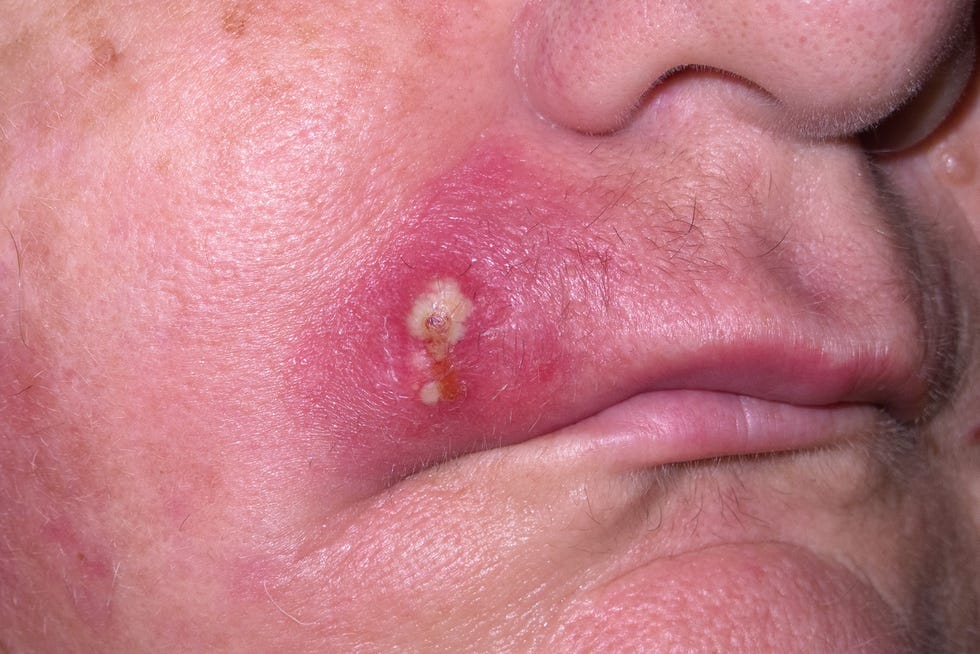
Pus-filled or inflamed skin blemishes are by far the most common type of staph infection, Dr. Fey says.
“Let’s say you have a mosquito bite on your arm, and you have staph on your finger because you’ve been scratching or touching your nose,” he says. If you scratch your bug bite or some other place where your skin is broken, the staph bacteria on your finger can infect that wound and cause a big, red, painful, pus-filled blemish to form. You could also develop a rash-like cluster of raised blisters called impetigo, he says.
Advertisement – Continue Reading Below
“It’s fairly common in the ER for people to come in thinking they have a large spider bite, when really they have a staph infection,” Dr. Fey says.
2. Skin infections
Staph is actually the most common cause of cellulitis, a common and potentially serious bacterial skin infection, Dr. Goldenberg says. “It can occur in completely healthy people or in those with weak immune systems,” he says.
Advertisement – Continue Reading Below
Staph usually enters the skin through a cut or eczema patch and causes a local infection, leading to skin inflammation, Dr. Goldenberg explains. This can present as a warm, red, swollen area of skin that is tender or painful to the touch, most commonly on the lower legs, face, or arms.
While it may seem like no big deal, any skin condition that feels unusually painful or irritated should be evaluated by your doctor ASAP, as cellulitis can progress rapidly. “Deep infections like boils or infections of the legs should get immediate attention,” says Dr. Zeichner.
Advertisement – Continue Reading Below
3. Food poisoning
When a food is exposed to staph, the bacteria multiply and produce toxins. It’s those toxins that can make you sick, and they can lead to symptoms like vomiting, diarrhea, and stomach pain, typically within 30 minutes to 8 hours after ingesting the contaminated food, according to the Centers for Disease Control and Prevention (CDC). However, it’s important to note that a fever is not typically something you’d experience from staph-related food poisoning, Dr. Fey says.
The best ways to avoid staph-related food poisoning is to make sure your food is handled at the right temperature, the CDC says. Hot foods should be kept at 140°F or hotter and cold foods at 40°F or colder. And, of course, it doesn’t hurt to wash your hands thoroughly for at least 20 seconds with soap before cooking or eating.
Advertisement – Continue Reading Below
4. Fever and low blood pressure
In some cases—usually when someone’s exposed to staph in a hospital setting, like during surgery—staph bacteria can get into your bloodstream, Dr. Fey says.
This can cause a blood infection known as bacteremia, which can initially lead to a fever and low blood pressure. Once in your blood, this kind of staph infection can spread to your heart, bones, and other organs—and result in a number of serious or even deadly infections. Those include pneumonia, and also a type of bone infection called osteomyelitis, which could lead to swelling or warmth in the infected area, according to resources from the Mayo Clinic.
Advertisement – Continue Reading Below
Bacteremia could also lead to an infection of the lining of your heart known as endocarditis. Symptoms—like fever, chills, night sweats, joint pain, pale skin, and weakness—can develop very slowly, suddenly, or even come and go, per the U.S. National Library of Medicine.
5. Toxic shock syndrome
When the toxins staph produces accumulate, they can cause a particular type of blood poisoning known as toxic shock syndrome (TSS). This could lead to a sudden fever, vomiting or diarrhea, muscles aches, headaches, and a rash resembling sunburn on your palms and the soles of your feet, research shows.
Advertisement – Continue Reading Below
TSS is rare, though. The condition affects fewer than one in 100,000 people in the U.S., according to data from the CDC.
6. Sepsis
If a staph skin infection is left untreated, it can eventually enter the bloodstream and lead to sepsis, Dr. Goldenberg says, which is an intense immune system reaction to an infection that sends harmful inflammatory chemicals into the blood and other internal organs. This can block proper blood flow and potentially cause your organs to shut down, which can be fatal. Someone with sepsis might have one or more of the following symptoms, according to the CDC:
Advertisement – Continue Reading Below
- A high heart rate
- Fever, shivering, or feeling very cold
- Confusion or disorientation
- Shortness of breath
- Extreme pain or discomfort
- Clammy or sweaty skin
How is a staph infection diagnosed?
Simple infections can be diagnosed clinically, says David Cennimo, M.D., assistant professor of medicine-pediatrics infectious disease at Rutgers New Jersey Medical School. “Often, you want to drain a collection, meaning drain the pus of any boils and send it to the lab, and see what bacteria is there.” He adds that if the staph infection has traveled to the bloodstream, your doctor will likely take blood samples to grow a blood culture to determine if the infection is indeed caused by staph bacteria.
Advertisement – Continue Reading Below
How is a staph infection treated?
There are several antibiotics that treat staph infections, both oral and intravenous ones, says Dr. Watkins. “Usually, the person is no longer contagious once the symptoms are resolved.” However, some people become carriers of staph and can pass it on even when they don’t have symptoms of active infection.
Depending on the resistance, some staph infections are pretty sensitive to most antibiotics and some have more resistance, says Dr. Cennimo. He says that the usual course for treatment can “anywhere between a week and 6 weeks of antibiotics.”
Advertisement – Continue Reading Below
What is MRSA?
You’ve probably heard of MRSA—pronounced “mer-sa”—which stands for “methicillin-resistant Staphylococcus aureus,” Dr. Fey explains. As the name states, this is a type of staph that has developed resistance to certain antibiotic drugs, including a commonly used type called methicillin.
In most cases, MRSA infections manifest just the same as other types of staph infections—meaning they show up as skin boils or pustules, he says. But MRSA can also lead to some of the more serious skin and blood infections mentioned above. In those cases, MRSA’s drug resistance may make it tougher to treat.
Advertisement – Continue Reading Below
“Staph infections need to be treated immediately.”
That’s why “staph infections need to be treated immediately,” Dr. Goldenberg says, which could range anywhere from topical or oral antibiotics for superficial skin infections to IV antibiotics for more serious infections.
Advertisement – Continue Reading Below
While anyone can develop a staph infection, those with weakened immune systems and diabetes are at a higher risk, Dr. Goldenberg says. People with eczema also tend to get more superficial staph infections, he says.
How to prevent a staph infection
Washing your hands thoroughly and often—especially when you’ll be handling food or touching a wound or broken skin—is the best way to prevent a staph infection, Dr. Fey says.
Neosporin Original Antibiotic Ointment
Now 28% Off
You should also try to keep broken skin (such as itchy rashes, cuts, and sores) away from gym equipment and other surfaces that may be harboring bacteria. “Make sure you tend to any open skin by cleaning the area, applying over-the-counter antibiotic ointment and then cover with a bandage to protect the area,” Dr. Zeichner says. “Do not share personal care products like razors, as they can spread bacteria, and avoid direct contact of the skin with someone who has crusts, scabs, or signs of an active infection themselves.”
Advertisement – Continue Reading Below
If you have eczema, make sure it’s treated and see a doctor if you have any uncontrolled or infected-looking flare-ups, Dr. Goldenberg adds.
While you may be tempted to give yourself an intense scrubbing in the shower to optimize your hygiene, Dr. Cennimo advises against it. “Don’t dry out your skin (or scrub too hard in the shower) because if you have dry cracked skin, bacteria can hide in those cracks.” So after your shower or following any kind of exfoliation, be sure to moisturize!
Advertisement – Continue Reading Below
And lastly, whenever you’re engaging in healthcare, make sure that everybody that is seeing you is washing their hands, says Dr. Cennimo. “It’s ok to ask ‘did you wash your hands?’ and alcohol hand sanitizers can do just as well.”
When to see a doctor about staph infection symptoms
Anybody that is having high fever or signs of systemic infection (fever, chills, change in activity level) should seek urgent medical care, says Dr. Cennimo. “Things that look like a skin infection that are lasting more than a day that are expanding rapidly, that are making you have a fever, that are particularly painful, you really need to be evaluated.”
Advertisement – Continue Reading Below
Also, if someone you have had contact with has a staph infection and you have new symptoms on your skin, seeing a doctor would be a good idea, adds Dr. Watkins.
Unless you have an angry skin boil or blemish, spotting a staph infection is going to be difficult, since the symptoms can overlap with all sorts of health conditions, Dr. Fey says. When in doubt, see your doctor, who can give you a proper diagnosis and treatment plan.
Advertisement – Continue Reading Below
Related Stories
..
Advertisement – Continue Reading Below
Health
Which State Is the Best for Women’s Health?An Editor’s Review of the Gravity Weighted BlanketSausage Links Recalled in 3 StatesWhy It Matters If You Have Flu A or B
Advertisement – Continue Reading Below
Odell Beckham Jr. Reveals Health DiagnosisChocolate Recall Updated to ‘Deadly’ by FDAStudy Links Processed Red Meat With DementiaThe Most Dangerous Ozempic Side Effects
What Causes White Bumps on Lips?How to Stop Post-Nasal Drip QuicklyLay’s Potato Chips Recall Elevated to Class ITesters and Dietitians Rec These Women’s Vitamins
Advertisement – Continue Reading Below


About Prevention.comNewsletterPress RoomGive A GiftCommunity GuidelinesSubscribeMedia KitAdvertise OnlineOther Hearst SubscriptionsCustomer Service
A Part of Hearst Digital Media
We may earn commission from links on this page, but we only recommend products we back.
©2025 Hearst Magazines, Inc. All Rights Reserved.
Privacy NoticeCA Notice at CollectionYour CA Privacy Rights/Shine the LightDAA Industry Opt OutTerms of UseSite Map

Your Privacy Choices: Opt Out of Sale/Targeted Ads
null
 Site Title